Managing killed game is a fundamental part of hunting. After the animal is recovered, a variety of operations begin: evisceration, skinning, separation of the main muscle groups, deboning, and trimming . Using the appropriate tool for each phase allows for greater precision, safety, and efficiency.
The EKA Butcher set was born with this very philosophy. The Swedish manufacturer has brought together in a hard case a series of tools for meat processing, developed for both professional use and for hunters who want to handle their own game.
It is therefore not simply a set of knives, but a working system in which the blade shape, rigidity, size and handle are adapted to the different operations.
EKA: Swedish tradition since 1882
The story of EKA begins in Sweden in 1882Over the course of over a century, the company has developed knives for professional, outdoor, hunting, and everyday use, building a strong specialization in the design of functional cutting tools.
The Butcher Set arrived much more recently. EKA indicates the 2014 as the year of introduction of its own complete set of butcher's knives, developed specifically for professionals and huntersOver time, the system has been further refined, with particular attention to ease of use.
One of the distinctive elements of the project was the integration of a specific tool for opening the abdominal cavity, particularly useful when working on freshly killed game.
Why one knife is not enough
A good hunting knife can handle many operations, but the complete processing of a spoil often requires contrasting characteristics.
During skinning, a relatively wide, controllable blade capable of following the animal's surface is useful. For deboning , a narrower, sharper blade is needed, one that can work close to the bones and penetrate precisely between muscles and joints. During evisceration, the primary requirement is to open the abdominal wall while avoiding accidental damage to the internal organs.
The philosophy of the Butcher Set is therefore not to force a single knife to perform all these functions.
Alleima 12C27: the steel chosen by EKA
The blades of the Butcher Set are made of Alleima 12C27 , a Swedish stainless steel well known in the world of cutlery.
It is also important to clarify the name. The material has long been known as Sandvik 12C27; in the specifications EKA It is currently correctly referred to as Alleima 12C27. For this reason, the previous name can still be found in older catalogs, packages, and technical data sheets.
For the Butcher Set knives EKA declares a hardness between 57 and 59 HRCIt is a particularly interesting range for a work tool, because it seeks a balance between cutting capacity, edge retention, robustness and the ability to quickly restore the cutting edge's efficiency.
Why 12C27 is suitable for meat processing
A knife used on game doesn't work under the same conditions as a knife used occasionally in the kitchen. It can come into contact with skin, tendons, connective tissue, fat, and joints, and is frequently used in the presence of blood and moisture.
For this reason, both corrosion resistance and the ability to maintain an effective edge during a prolonged working session are important .
At the same time, extreme hardness isn't necessarily an advantage. In a utility knife, it's useful to be able to quickly sharpen the edge without having to resort to complex sharpening each time. 12C27 treated to a hardness of 57-59 HRC is a good choice for this purpose.
Santoprene™ handles
The second common element among the tools is the Santoprene™ polymer handles.
When processing game, grip is particularly important. Blood, grease, and moisture can make it much more difficult to maintain a secure grip than when using a knife under normal conditions.
Santoprene provides a resilient, grippy surface, while the ergonomic shape of the handle aids blade control during repeated movements.

The choice of high-visibility orange color also has a practical function: it makes it easier to locate tools on the workbench, in the grass or among the equipment.
Skinning Knife: the knife for skinning
The Skinning Knife from the Butcher Set uses a 155mm blade , with an overall knife length of 298mm . The blade thickness is approximately 2mm and the stated weight is 120 grams.
EKA defines the blade geometry as concave with Drop Point tipThe surface is polished and the sharpening uses a secondary bevel, with a stated indicative angle of approximately 20° per side.

The geometry is particularly suited to the progressive separation of the skin from the underlying tissue. The curved part of the cutting edge allows for controlled movements while maintaining a good working surface, while the Drop Point allows for precise control of the tip without making it excessively aggressive.
Skinning without wasting meat
Proper skinning isn't simply a matter of removing the hide. The process should proceed by trying to leave as much muscle tissue as possible on the carcass , while avoiding unnecessary cuts to the hide when it needs to be recovered.
A blade specifically designed for skinning allows you to work with more of the cutting edge and less of the tip. This makes it more natural to follow the animal's curved surfaces and control the depth of the cut.
Boning Knife: Precision Around the Bones
The Boning Knife serves a completely different purpose. The blade is 146 mm long , while the overall length reaches approximately 290 mm . The stated thickness is 2,7 mm and the weight is approximately 115 grams.
The blade features a narrow profile with a pronounced tip . This shape allows you to work close to bone structures, enter the most difficult spaces and precisely separate flesh, tendons and connective tissue.
When deboning, the goal isn't to exert great force, but to use the blade according to the animal's anatomy. A relatively narrow blade allows for more precise movements than a wide skinning knife.
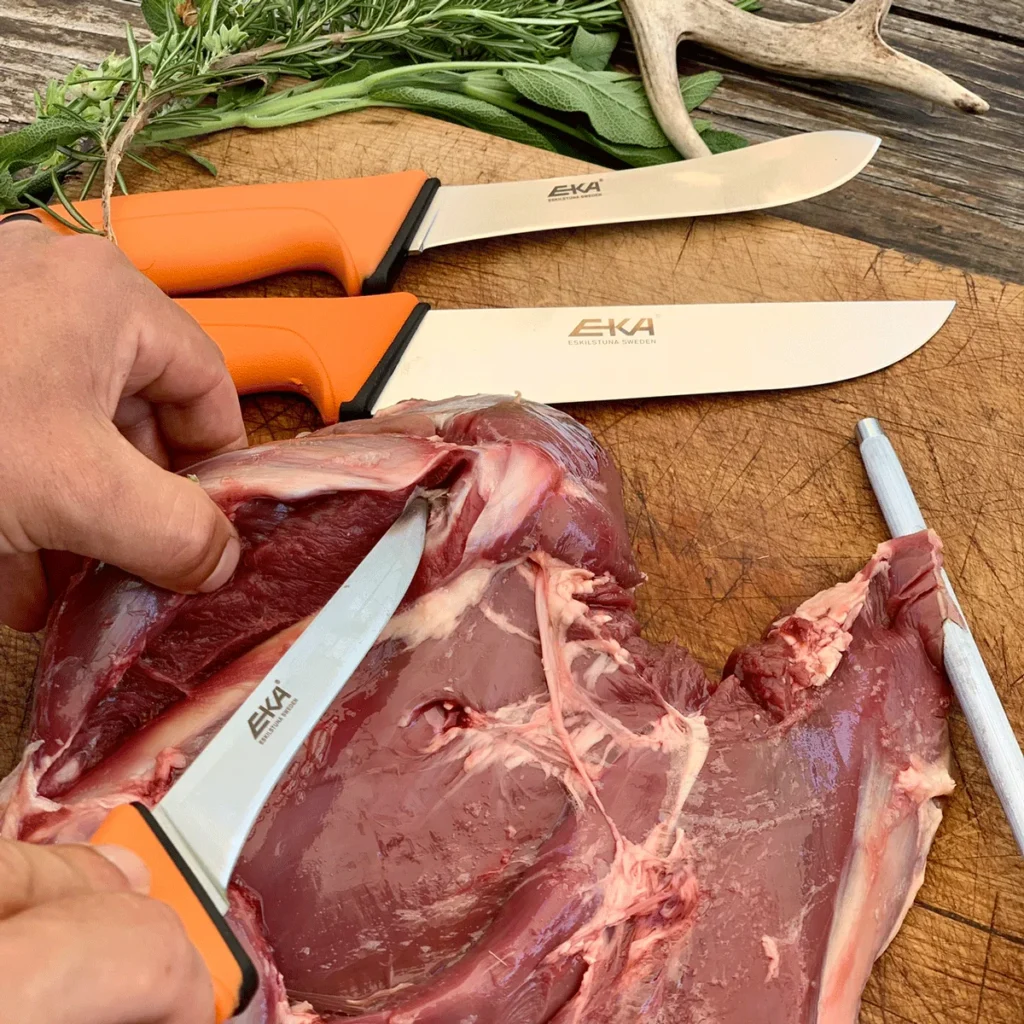
Boning the game
Boning is one of the stages where the quality of the equipment becomes most evident. Leg, shoulder, and other anatomical areas require following irregular bone surfaces, trying to recover as much meat as possible.
The knife is used with controlled movements along the bone, using mainly the front part of the blade and the tip to reach joints and muscle insertions.
A good boning knife therefore allows you to reduce waste and obtain cleaner cuts , also making subsequent trimming operations easier.
Gut Hook/Knife: the opening of the abdominal cavity
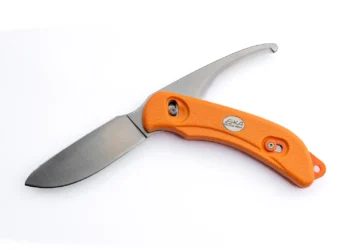
One of the elements that most characterise the system EKA is the Gut Hook/Knife, developed to intervene in the initial phase of processing.

Opening the abdomen is a delicate operation. A traditional blade used with the tip facing inward can accidentally injure the stomach or intestines. The specific geometry of the tool EKA instead it allows for a more controlled cut.
This does not eliminate the need for proper evisceration technique, but it does provide the hunter with a tool designed specifically for this function.
Evisceration and meat quality
The speed and accuracy of evisceration are important beyond operational convenience. The management of the carcass must be carried out with great attention to cleanliness and contamination prevention.

Accidentally damaging the gastrointestinal contents can contaminate the carcass surfaces. Therefore, the opening phase requires supervision, clean tools, and proper technique.
The Gut Hook/Knife should therefore be considered a mechanical aid to correct processing, not a substitute for necessary hygienic procedures.
Sharpening Steel: Maintaining the edge while working
The Butcher Set also includes a Sharpening Steel, the traditional steel . Its function is particularly important during prolonged work sessions.
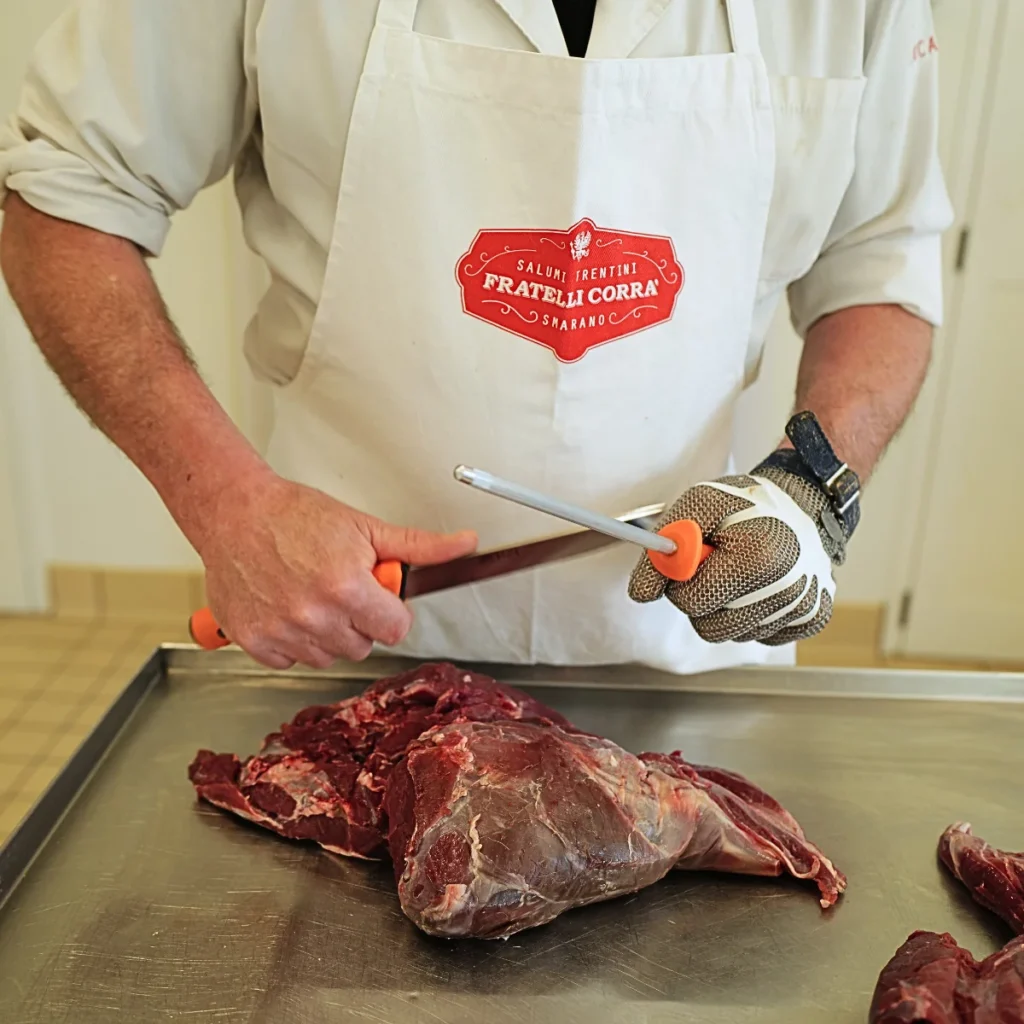
Maintaining the edge must be distinguished from actual sharpening. The steel is primarily used to realign and sharpen a still-effective cutting edge ; when the blade is truly dull or damaged, it becomes necessary to resort to an abrasive sharpening system.
Frequent, light passes over the steel allow you to keep the knife effective without waiting for the loss of cutting ability to become evident.
Because a sharp knife is also more controllable
An efficient cutting edge doesn't just help you work faster. When the knife cuts properly, less pressure is needed and its movement becomes easier to control.
Conversely, trying to compensate for a weak cutting edge by increasing force can make the action less precise. In meat processing, where the hands often work close to the blade, maintaining the cutting edge must therefore be considered an integral part of proper tool management.
The hard case
The entire system comes in a hard plastic caseThe dimensions declared by EKA are 175 × 60 × 360 mm.
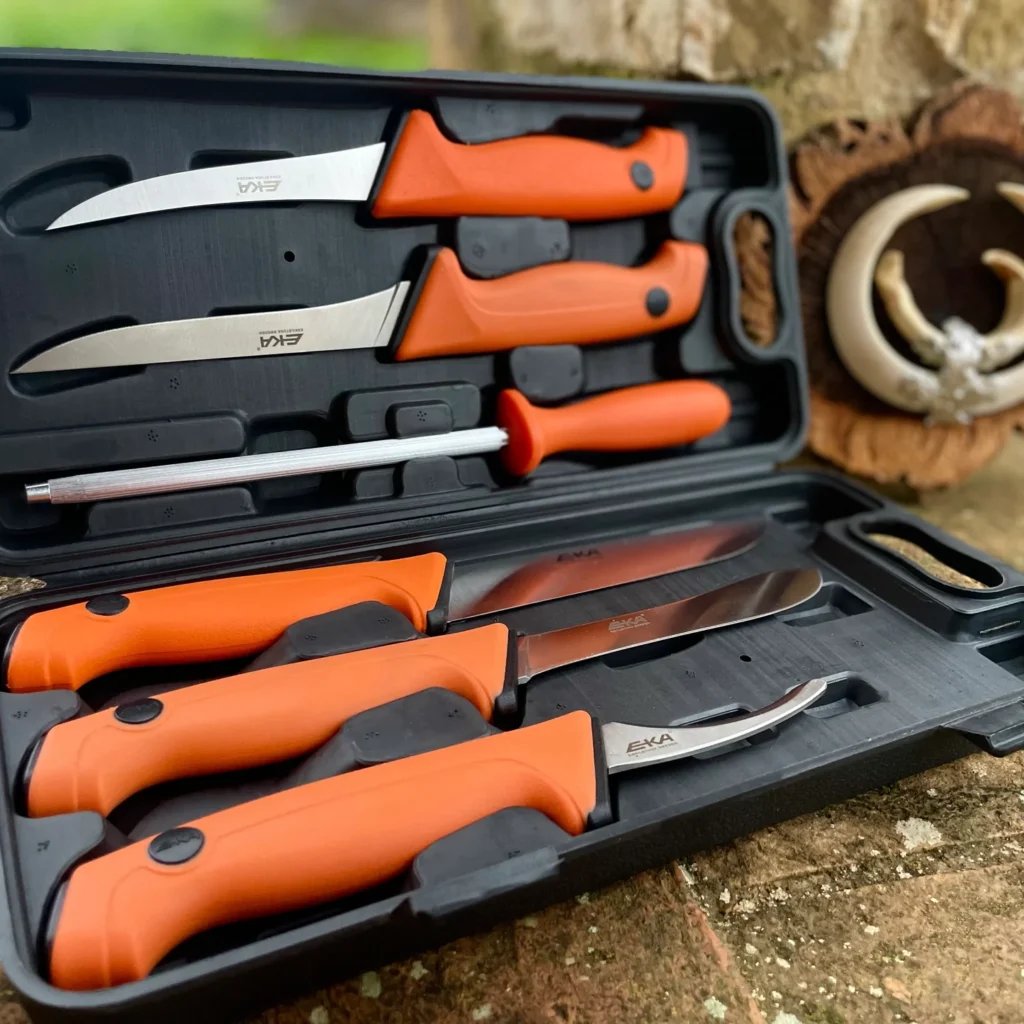
The case protects the tools during transport and keeps them separate and organized when not in use. The total declared weight of the set is 1.014 grams.
EKA has also provided for in the custody space for two additional knives from the Butcher Pro seriesThe system can therefore be expanded according to the user's needs.
From the ground to the processing room
The Butcher Set is particularly interesting because it accompanies several phases following the hunt.
The first can take place directly on the ground, where the primary requirement is to correctly perform the initial operations on the carcass. Next, in a suitable environment, skinning and cutting begin. Finally, the process of deboning and preparing the cuts for preservation or cooking begins.
In this process, each tool takes on a specific function, avoiding the need to continuously use the same knife for very different operations.
Suitable for working ungulates
For the Italian hunter, the most obvious field of application is the processing of wild ungulates . Roe deer, fallow deer, red deer, and wild boar all have different sizes, skins, fat distribution, and anatomical characteristics, but the main processing phases follow common requirements.
Having a skinning knife, a boning knife, and a specific opening tool allows you to organize your work more rationally than using a single universal knife.
Of course, tools are no substitute for the skills needed for proper hygienic and sanitary management of game intended for consumption.
Ergonomics during prolonged work
When working a large animal, or multiple animals at once, the number of movements required with the knife becomes considerable. Under these conditions, weight, balance, and handle shape directly affect fatigue.
EKA He kept the individual tools relatively light: the Skinning Knife weighs about 120 grams and the Boning Knife about 115 grams. These values encourage precise handling without making the knife an unnecessarily heavy tool.
Santoprene also helps maintain a stable grip without forcing the user to continuously squeeze the handle with excessive force.
Cleaning and maintenance after use
Processing game requires special attention to cleanliness. After use, it's necessary to carefully remove blood, grease, and organic residue from the blades and handles.
Tools should be cleaned with systems compatible with the materials, rinsed, and, above all, dried completely before being stored in the case . Even stainless steel knives benefit from proper maintenance, especially when used in humid environments.
The case itself must be kept clean: placing a perfectly cleaned knife in a contaminated case would nullify part of the work done on the tool.
EKA Butcher Set: main technical features
| Feature | Data declared by EKA |
|---|---|
| Product | EKA Butcher Set Orange |
| Producer | EKA 1882 |
| Year of introduction of the Butcher Set family | 2014 |
| Steel blades | Allied 12C27 |
| Hardness | 57-59 HRC |
| Grip material | Santoprene™ Polymer |
| Colour | Orange |
| Custody | Hard plastic case |
| Case dimensions | 175 × 60 × 360 mm |
| Total weight | 1.014 gr |
| Custody preparation | Space for 2 additional knives EKA Butcher Pro |
Skinning Knife: technical data
| Total length | 298 mm |
| Blade length | 155 mm |
| Blade thickness | 2,0 mm |
| Weight | 120 gr |
| Steel | Alleima 12C27, 57-59 HRC |
| Trim | Polished |
| Profile | Concave with Drop Point tip |
| Sharpening | Secondary Bevel |
| Wire angle | About 20° per side |
| Grip | Santoprene™ |
Boning Knife: technical data
| Total length | 290 mm |
| Blade length | 146 mm |
| Blade thickness | 2,7 mm |
| Weight | 115 gr |
| Steel | Alleima 12C27, 57-59 HRC |
| Profile | Narrow with a pronounced tip |
| Grip | Santoprene™ |
A tool to enhance game meat
The value of such a set shouldn't be measured solely by the knives' cutting ability. The real advantage lies in the ability to perform each operation with a tool designed for that function.
Careful skinning limits waste; precise boning allows for better meat recovery; a controlled opening of the abdominal cavity helps properly manage one of the most delicate phases after slaughter.
From this point of view, the Butcher Set interprets well a modern concept of hunting in which the harvest does not represent the conclusion of the activity, but the beginning of a second phase: the correct management and valorization of the food resource obtained.
Who is it suitable for?EKA Butcher set
The kit is aimed primarily at hunters who personally process game and don't want to rely on a single knife for all operations. It's particularly useful for those who hunt ungulates and have a suitable space for completing skinning, sectioning, and boning.
It can be equally interesting for those who wish to build up a more complete set over time: the case's provision for two additional knives from the Butcher Pro series allows the system to be expanded without sacrificing the order and portability of the original configuration.
Conclusions
The EKA Butcher set It is a device built around a rational principle: Game processing is made up of different operations and each operation benefits from using the appropriate tool.
The choice of Swedish Alleima 12C27 steel with a hardness of 57-59 HRC , the Santoprene™ handles, the specialized geometry of the blades and the presence of the tool dedicated to opening the abdominal cavity show a design oriented towards practical use rather than simple aesthetics.
More than ten years after the Butcher Set was introduced in 2014, the project retains its precise identity: to provide hunters with an organized kit with which to methodically tackle the various phases between recovering the animal and preparing the meat.
Remember that knowledge of game does not end with the shot; it also includes respect for the carcass, proper processing, and the ability to transform the resulting harvest into a food product, managed with care, expertise, and with minimal waste.