BÖHLER steel does not refer to a single alloy, but rather to a broad family of specialty steels produced by the Austrian brand BÖHLER, part of the voestalpine High Performance Metals group. Each steel is identified by a specific acronym and has different compositions, performance characteristics, and intended uses.
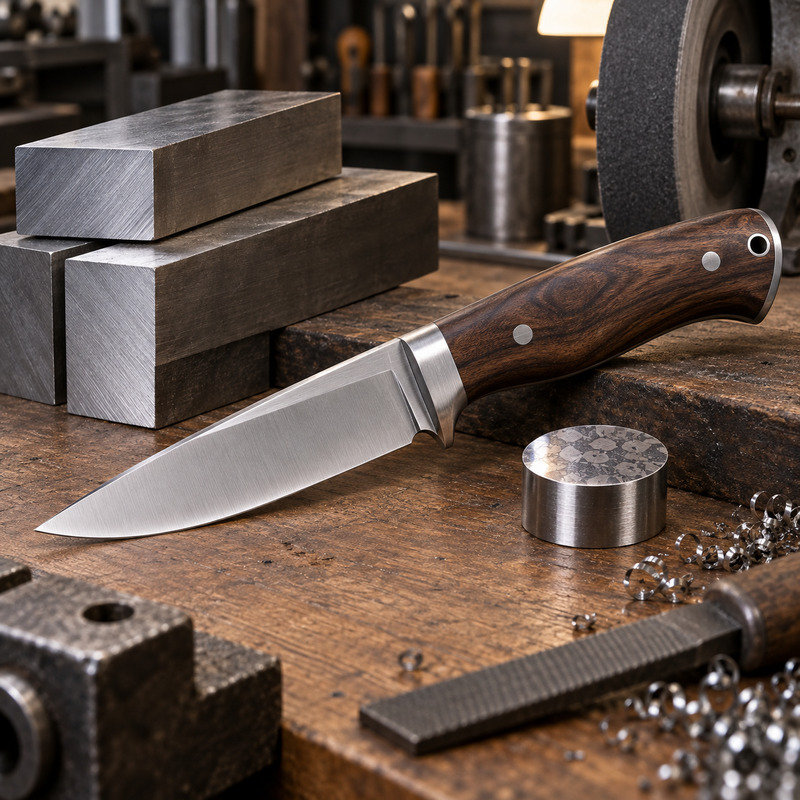
In the hunting industry, the BÖHLER name is best known for its steels used in knifemaking . These materials are used in the production of hunting knives, skinning blades, outdoor tools, and medium- to high-end artisanal cutlery.
BÖHLER is not a type of steel
Simply calling a blade "BÖHLER steel" doesn't reveal its true characteristics. It's important to check the alloy code , such as N690, N695, M390, K110, or K390.
The different acronyms can indicate steels:
- martensitic stainless steels;
- from cold working tools;
- products by powder metallurgy;
- characterized by high wear resistance;
- designed to prioritize toughness, hardness, or corrosion resistance.
Therefore, there is no single best BÖHLER steel. The choice depends on the type of knife, the blade size, the environment in which it will be used, and the desired balance between sharpness, edge durability, robustness, and ease of sharpening.
The most popular BÖHLER steels for knives
BÖHLER N690
BÖHLER N690 is one of the most popular steels in European cutlery. It is a corrosion-resistant martensitic chromium steel with a relatively high carbon content and additions of molybdenum, vanadium, and cobalt.
Its average nominal composition includes approximately:
- 1,08% carbon;
- 17,30% chromium;
- 1,10% molybdenum;
- 1,50% cobalt;
- 0,10% vanadium.
When properly heat treated, it offers a good balance between corrosion resistance, edge retention, stability, and resharpenability . For these reasons, it is widely used in hunting knives, folding blades, and fixed-blade knives intended for outdoor use.
The final hardness is chosen by the manufacturer based on the geometry and use, often being around 58–61 HRC . However, the actual value should not be deduced from the name of the steel alone.
BÖHLER N695
BÖHLER N695 is a martensitic stainless steel with a high carbon and chromium content. It is generally considered a reliable and relatively easy-to-use solution, suitable for the production of utility and hunting knives.
It offers good corrosion resistance and can achieve high hardness, while requiring less resharpening than some modern steels produced using powder metallurgy. Performance, however, depends on the quality of the heat treatment and the geometry of the cutting edge.
BÖHLER M390 MICROCLEAN
BÖHLER M390 MICROCLEAN is a martensitic chromium steel produced by powder metallurgy . It is appreciated in high-end cutlery for its combination of:
- high wear resistance;
- excellent thread life;
- remarkable resistance to corrosion;
- fine and homogeneous structure;
- good polishability.
The high presence of alloying elements favors the formation of very hard carbides. This allows the cutting edge to last a long time, but makes resharpening more difficult than with conventional steels. For good results, diamond stones or specific abrasives are recommended.
The M390 is particularly suitable for folding knives, compact hunting blades, and tools requiring long cutting power and low maintenance. It's not necessarily the ideal solution for very large blades subject to impact, twisting, or lateral stress.
BÖHLER K110
BÖHLER K110 is a cold-work tool steel, generally associated with the D2 family. It has a high carbon and chromium content and offers remarkable wear resistance.
It is also used in cutlery for its long-lasting edge and generally lower cost than powder metallurgy steels. Despite its high chromium content, it generally does not achieve the corrosion resistance of true stainless steels for cutlery. It therefore requires cleaning, drying, and minimal surface protection.
BÖHLER K390 MICROCLEAN
BÖHLER K390 MICROCLEAN is a powder metallurgical tool steel developed to offer extremely high wear resistance combined with good toughness for its class.
It produces blades with extremely long edge retention, but it is not stainless steel. In the presence of moisture, organic residues, or salty substances, it must be carefully cleaned and protected. Resharpening also requires efficient abrasives and a certain amount of experience.
MICROCLEAN Powder Metallurgy
Some of BÖHLER's most advanced steels carry the MICROCLEAN designation . In these materials, the metal is transformed into small particles, which are then consolidated under controlled conditions to obtain a compact, homogeneous product.
Compared to a properly comparable conventional steel, this process allows for a more uniform distribution of carbides and reduces segregation of alloying elements. Advantages may include:
- finer and more homogeneous microstructure;
- high wear resistance;
- greater consistency of performance;
- possibility of using high quantities of alloying elements;
- good combination of hardness, toughness and material stability.
Powder metallurgy doesn't automatically make a blade superior. The result always depends on the knife's design, workmanship, and heat treatment.
Hardness and heat treatment
The steel code describes the material, but it doesn't guarantee the quality of the knife. Two blades made from the same alloy can perform very differently due to heat treatment.
Quenching, possible cryogenic treatment and tempering determine the final hardness and influence:
- thread holding;
- resistance to chipping and breaking;
- dimensional stability;
- ease of sharpening;
- ability of the blade to withstand impacts and bending.
A very high hardness can improve the durability of the edge, but it's not always an advantage. If the treatment is inadequate or the cutting edge is too thin, the risk of micro-chipping increases. For a hunting knife, a balance between hardness and toughness is often preferable.
BÖHLER steel and corrosion resistance
Corrosion resistance varies significantly from alloy to alloy. N690, N695, and M390 contain a high percentage of chromium and are designed to effectively resist oxidation, but no cutlery steel should be considered completely immune.
The K110 and K390 require extra care, especially when hunting. Blood, moisture, sweat, and salt residue can promote oxidation and surface stains if the blade is stored dirty or wet.
After use it is advisable to:
- wash the blade avoiding aggressive detergents;
- carefully remove all organic residue;
- dry the knife, tang and mechanisms;
- apply a thin protective film compatible with the intended use;
- Do not store the knife in a damp sheath for a long time.
Use in hunting knives
For a normal hunting knife, the BÖHLER N690 represents a balanced solution: it resists corrosion well, holds its edge well and can be resharpened without particularly complex equipment.
The M390 is suitable when very long cutting edge life and reduced maintenance are desired, accepting a higher cost and more laborious resharpening.
The K390 can offer exceptional edge retention, but requires greater attention to prevent rusting. The K110, on the other hand, is a solid choice for robust knives and work tools where wear resistance is more important than complete rustproofing.
Blade geometry and cutting quality
Steel is just one element that determines performance. Blade thickness, bevel type, sharpening angle, and edge finish can all affect cutting performance just as much as the metallurgical composition.
A thin blade with the right geometry can cut better than a blade made of more expensive but excessively thick steel. Likewise, a highly wear-resistant steel doesn't compensate for poor sharpening or inadequate heat treatment.
How to choose a BÖHLER steel knife
Before purchasing, it is advisable to check:
- the full acronym for steel;
- the hardness declared by the manufacturer;
- the type of heat treatment;
- the geometry and thickness of the blade;
- the required corrosion resistance;
- the availability of the tools needed to sharpen it;
- the reliability of the knife manufacturer.
Generic terms such as "surgical steel," "special steel," or simply "BÖHLER steel" do not provide sufficient information. The precise name of the alloy is essential for assessing its characteristics and maintenance.
Advantages of BÖHLER steels
- wide choice of specialized alloys;
- high quality uniformity;
- availability of conventional and powder metallurgy steels;
- excellent cutting performance in the most advanced alloys;
- solutions suitable for both industrial and artisan cutlery;
- possibility of choosing different balances between hardness, toughness and corrosion resistance.
Limitations and aspects to consider
- performance varies greatly from one acronym to another;
- more wear-resistant steels are generally more difficult to sharpen;
- some BÖHLER alloys are not stainless;
- powder metallurgy steels are typically more expensive;
- Improper heat treatment can compromise even a high-quality alloy.
Final houghts
BÖHLER steels are an important benchmark in technical and hunting knives, but the manufacturer's name shouldn't replace the alloy identification. N690, M390, K110, and K390 are profoundly different materials, designed to meet different needs.
For the hunter, the most rational choice doesn't necessarily mean the hardest or most expensive steel. The best material is the one that offers the right balance of cutting power, strength, corrosion resistance, maintenance, and ease of sharpening , depending on the knife's actual use.