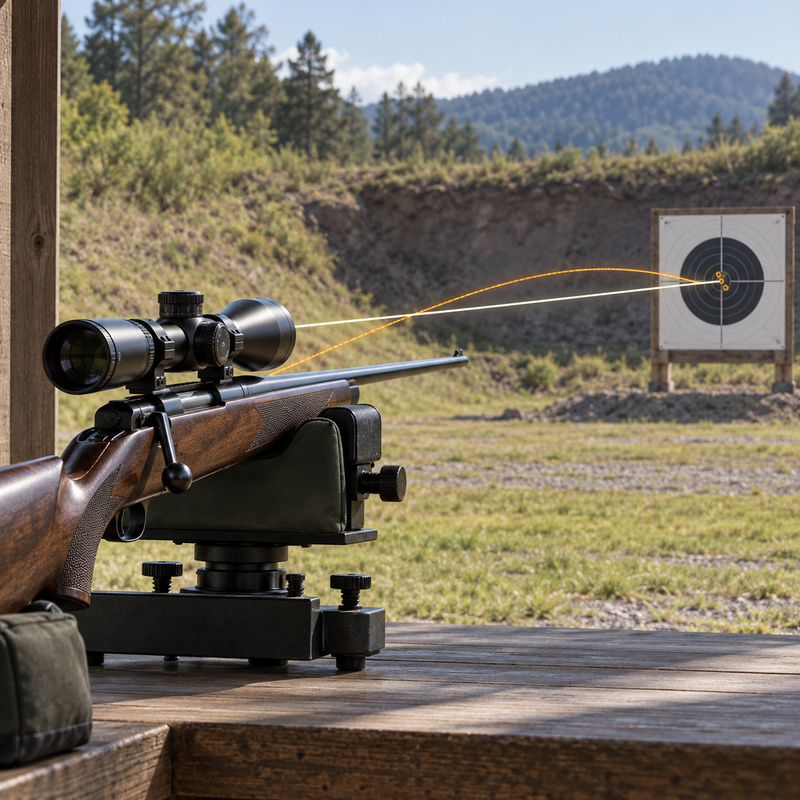
Zeroing is the adjustment of the sighting system so that the average point of impact of the projectiles coincides, or maintains a predetermined relationship, with the aimed point at a given distance.
It can be done with scopes, red dots, iron sights, and other adjustable aiming devices. Zeroing does not alter the bullet's trajectory, but aligns the line of sight with the barrel axis so that the trajectory and line of sight meet at the chosen distance.
A properly zeroed weapon is a system consisting of the gun, optics, mounts, and ammunition . Changing any of these elements can change the point of impact and must be re-verified.
Sight line and barrel axis
The sight line is the ideal line connecting the shooter's eye, the aiming device, and the target. In a telescope, it coincides, in simplified form, with the optical axis of the instrument.
The bore axis represents the geometric direction of the bore. When the gun is zeroed, the barrel is normally oriented with a slight upward inclination compared to the aiming line.
The two lines are not parallel because the bullet, after leaving the muzzle, is gradually pulled downward by gravity. The initial inclination allows the trajectory to reach the aiming line at the set distance.
The trajectory relative to the line of sight
The bullet doesn't travel in a straight line. Once it exits the barrel, it is subjected to gravity and aerodynamic drag, following a curved trajectory.
Relative to the line of sight, the bullet can:
- start from a lower position, because the barrel is below the scope;
- gradually approach the line of sight;
- intersect it at a first distance;
- to temporarily find oneself above it;
- go down and intersect it again at the main reset distance;
- continue below the line of sight.
This representation relates to the line of sight. From a physical standpoint, the bullet begins to be subject to gravity from the moment it leaves the barrel.
First and second intersection
In many configurations, the trajectory intersects the sight line at two points. The first is commonly referred to as the near zero , while the second represents the far zero or main zeroing distance.
The presence and position of the two intersections depend on:
- height of the optic in relation to the barrel;
- initial velocity;
- ballistic coefficient of the projectile;
- distance chosen for zeroing;
- weather conditions;
- angle of the shot.
It should not be assumed that a provisional zeroing obtained at a short distance will automatically match the expected zeroing at a longer distance. The result must be confirmed directly at the chosen distance.
Zeroing distance
Zeroing distance is the distance at which you want the average point of impact to coincide with the aiming point. There is no ideal distance that applies to all weapons and all applications.
The choice depends on:
- caliber and type of ammunition;
- projectile velocity;
- trajectory characteristics;
- usual shooting distances;
- target size;
- type of hunting or sporting discipline;
- aiming system used;
- shooter's ability to evaluate distance and corrections.
A relatively close zero limits the distance at which the trajectory deviates significantly from the aiming line. A more distant zero can extend the range over which the aiming point can be maintained without significant corrections, but may cause the bullet to pass further above the aiming line at intermediate distances.
Maximum direct shot distance
The concept of maximum direct shot distance indicates the range in which the trajectory remains within a pre-established vertical zone with respect to the aiming line.
The size of this zone must be chosen based on the target and the actual accuracy of the system. A zeroing designed according to this criterion seeks to exploit the trajectory without requiring constant adjustments within the considered distances.
This method does not eliminate the need to know the distance and behavior of the ammunition, but it allows you to set a zero consistent with the intended use.
Zeroing with a scope
In a riflescope, the reticle is moved using adjustment turrets. One turret generally controls the vertical correction, while the other controls the horizontal adjustment.
Adjustments can be expressed as:
- MOA, angle minutes;
- MRAD or MIL, milliradians;
- proprietary divisions indicated by the manufacturer.
Each turret click corresponds to a specific angular change. The linear movement on the target increases proportionally to the distance.
Before zeroing, it is necessary to check that the optics and mounts are correctly installed, tightened according to the manufacturer's instructions and without play.
Zeroing with red dot
The red dot is zeroed by adjusting the position of the illuminated dot for elevation and windage. The general procedure is similar to that of a riflescope, but the lack of magnification can make it more difficult to distinguish small shifts at longer distances.
Observable accuracy also depends on the apparent size of the dot, usually expressed in MOA. A larger dot is quicker to acquire, but covers a larger portion of the target.
The position of the dot on the glass should not be used as a geometric reference: what matters is its alignment with the target through the correct position of the eye.
Zeroing with iron sights
Iron sights generally use a front sight and a rear notch or diopter. Adjustment can be done by moving one or both elements, depending on the construction of the weapon.
The correction must be carried out following the manufacturer's specific instructions, because the direction of the movement varies depending on whether the intervention is on the front or rear element.
With iron sights the following are particularly important:
- constant alignment of the sights;
- uniform height of the crosshair in the notch;
- correct side light;
- visual focus on the viewfinder;
- repeatability of head position.
Preliminary reset
Before shooting, a preliminary alignment between the barrel and the optics can be performed. This only serves to bring the first shots onto the target and to reduce initial corrections.
This can be done by looking through the bore of the barrel, when the gun's configuration allows it, or using a suitable collimator. Neither of these systems replaces actual zeroing with the selected ammunition.
Confirmation must always take place by shooting at a range or in a legally authorized area, adopting all necessary safety measures.
The group of shots
Zeroing shouldn't be based on the location of a single shot. Each shot can be affected by small shooter errors, ammunition variations, and environmental conditions.
It's best to evaluate a group of shots and determine their average center. Adjustment should move this center toward the desired point.
A widely dispersed group makes it difficult to establish a reliable correction. Before repeatedly adjusting the turrets, it is therefore necessary to verify that the weapon, support, optics, and shooting technique allow for a sufficiently low dispersion.
General reset procedure
The procedure must be performed under controlled conditions, with a suitable target and a secure backstop.
- Check that the gun is in good condition and that the barrel is clear.
- Check that the sight system is mounted correctly.
- Use only one type and lot of ammunition, when possible.
- Adopt a stable support without altering the natural behavior of the weapon.
- Carry out a first group at a controlled distance.
- Locate the middle center of the group.
- Calculate the necessary vertical and horizontal correction.
- Adjust the aiming system according to the value of each shot.
- Shoot a new group to check the result.
- Definitively confirm zero at the chosen distance.
Between one group and the next it is a good idea to check the temperature of the barrel and maintain conditions as uniform as possible.
Move the point of impact
The indications on the turrets normally show the direction in which the point of impact is moved . Before making any adjustments, however, it is necessary to consult the device's manual.
The correction must be based on the distance between the center of the group and the desired point. The displacement expressed in centimeters must then be converted to the angular unit used by the optics.
Making random corrections after every single shot can make the process longer and less reliable.
MOA and milliradians in zeroing
The MOA and milliradian are angular units. They are not a fixed linear measurement, because the displacement on the target increases with distance.
In practical terms:
- 1 MOA corresponds to approximately 2,9 centimeters at 100 meters;
- 0,1 MRAD corresponds to 1 centimeter at 100 meters;
- the same angle produces double the displacement at 200 meters and triple the displacement at 300 meters.
It is important to know the value of each click of your optic, which can be, for example, a fraction of an MOA or 0,1 MRAD.
Height of the optic on the barrel
The vertical distance between the optics axis and the barrel axis influences the relationship between the sight line and the trajectory. This value is referred to as sight height.
A higher-mounted optic requires greater convergence between the barrel axis and the line of sight. The difference is particularly noticeable at very close ranges, where the bullet is still below the line of sight.
To obtain reliable ballistic calculations, the height must be measured correctly and entered into the program used.
Influence of ammunition
Zeroing is valid for the ammunition it was performed with. Changing the brand, lot, weight, shape, or type of bullet may shift the point of impact.
The variation depends on:
- initial velocity;
- residence time in the barrel;
- ballistic coefficient;
- pressure and charge behavior;
- reed harmonics;
- distribution of projectile masses;
- regularity of ammunition.
Even two apparently similar loads can produce different impact points. Each change of ammunition must therefore be followed by a verification test.
Cold, hot, clean or contaminated pipe
The first shot fired from a cold, clean barrel may have a slightly different point of impact than subsequent shots. Even a cold barrel already slightly contaminated with residue may behave differently.
For hunting use, it is particularly important to check the first shot under the real conditions in which the weapon is normally used.
During zeroing, it is also necessary to prevent the progressive heating from modifying the harmonics of the barrel and causing a displacement of the group.
Condizioni atmosferiche
Temperature, atmospheric pressure, humidity, and altitude affect the density of the air and thus the resistance encountered by the projectile. The effect becomes more pronounced as the distance increases.
Wind can also move the assembly during zeroing. Whenever possible, the initial adjustment should be done in limited, steady wind conditions.
A zero obtained in environmental conditions very different from those of use may require verification or correction.
Zeroing and inclined shooting
When the target is higher or lower than the shooter, the site angle comes into play . Drop compensation depends primarily on the horizontal component of the distance and not just on the measured slope distance.
A gun zeroed in the horizontal plane can therefore produce a seemingly high point of impact on shots at steep canting, both up and down, if the intended correction is applied for the entire canting distance.
Short-distance reset
An initial short-range adjustment can be helpful to ensure shots hit the target and to roughly center the scope.
This step does not replace confirmation of the final distance. Small angular errors detected at close range become much more noticeable as the distance increases.
The correspondence between a given short-range impact point and a farther zero must be calculated for the specific combination of firearm, ammunition and scope height.
Zeroing and Accuracy of the Weapon
Zeroing and accuracy are two different concepts. A gun may produce a very tight group far from the aiming point: it's accurate, but not properly zeroed. Conversely, some shots may spread around the center of the target, but form an excessively wide group.
Zeroing shifts the average position of the group; it doesn't reduce its dispersion. If the shots aren't grouped together, you must first identify the cause of the problem.
Common errors during reset
Some of the most common errors include:
- adjust the optics after every single shot;
- use unstable support;
- change ammunition during the procedure;
- overheat the barrel;
- confusing the MOA value with the MRAD value;
- not knowing the value of the turret trigger;
- correct in the wrong direction;
- neglecting to tighten the optics and mounts;
- confirm zero only at close range;
- ignore wind and environmental conditions;
- rely on generic ballistics data rather than your own weapon.
When to recheck the reset
The impact point should be checked periodically and whenever a potentially significant change occurs.
It is advisable to carry out a check:
- before the start of the hunting season;
- after a shock or fall of the weapon;
- after disassembling the optics;
- after interventions on the mounts, stock or barrel;
- after changing ammunition or batch;
- after a particularly demanding transport;
- when abnormal variations in the point of impact appear;
- after installing or removing a muzzle device.
Return to zero of the turrets
Some scopes allow you to adjust the turret scale so that, after zeroing, the index is set to zero. This feature makes it easier to apply temporary corrections and then return to the original setting.
However, the mechanical return of the turret to the indicated zero does not guarantee that the point of impact has remained unchanged. If in doubt, confirmation on the target is always necessary.
Zeroing and ballistic calculators
Ballistic calculators use zeroing distance as the key input for trajectory estimation. To obtain reliable results, correct values must be entered for:
- real initial velocity;
- ballistic coefficient;
- height of the optics;
- zeroing distance;
- weather conditions;
- corner of the site;
- wind direction and speed.
The calculation represents a prediction and must be verified through real tests at the distances of interest.
Safety during reset
Zeroing must be carried out exclusively at a shooting range or in an authorized area, with a suitable backstop and in compliance with safety rules.
Before starting you need to:
- know how the weapon and optics work;
- check that the ammunition is compatible with the caliber;
- use eye and hearing protection;
- always keep the muzzle in a safe direction;
- check the weapon before making any adjustments;
- comply with the instructions of the director or shooting instructor.
A setting to check, not a permanent value
Zeroing establishes the relationship between the line of sight and the point of impact for a given weapon, a specific ammunition, and specific shooting conditions. It is not an immutable characteristic of the scope or rifle.
Proper zeroing requires consistent shot groups, calculated adjustments, and confirmation at the chosen distance. Periodic testing helps maintain the system's reliability and provides a more precise understanding of the actual trajectory behavior.