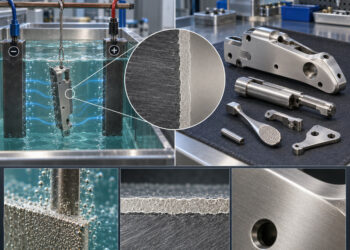
Case hardening is a thermochemical treatment used to increase the surface hardness of components made from low-carbon steels. The process enriches the outer layer of the metal with carbon, which is then hardened by quenching.
The treated component thus retains a tough, impact-resistant internal core , while the surface acquires greater hardness and wear resistance. In the firearms industry, case hardening has been used primarily for action frames, locking elements, firing pins, levers, gears, and other mechanical parts subjected to pressure and friction.
How it works
During carburizing, the component is heated to a high temperature in a carbon-rich environment. Carbon atoms gradually penetrate the steel surface through diffusion.
Once the surface enrichment is completed, the piece is subjected to a thermal cycle which generally includes:
- heating to the expected temperature;
- permanence in the cementing environment;
- diffusion of carbon into the surface;
- tempra to obtain hardening;
- possible discovery to reduce tension and fragility.
Surface layer and core
The main characteristic of case hardening is the presence of two zones with different properties. The case hardened layer contains a higher percentage of carbon and, after quenching, achieves high hardness.
The core, however, retains its original low carbon content and remains tougher. This combination allows the component to resist both surface wear and dynamic stresses.
Cementation depth
The depth of the enriched layer is not the same for all components. It depends on the temperature, the duration of the treatment, the composition of the steel, and the process used.
Extended exposure to the carburizing environment allows the carbon to penetrate more deeply. However, the thickness must be appropriate for the size of the part and the expected stresses: an excessively thin layer could wear away rapidly, while too deep a treatment could alter the component's behavior.
Solid cementation
In solid carburization, the pieces are placed inside heat-resistant containers and surrounded by carbon-rich materials, traditionally charcoal and bone charcoal.
The container is closed and heated for several hours. The carbon released during the process penetrates the surface of the steel. It is a historic technique, closely linked to the traditional processing of the action frames of fine weapons.
Gas cementation
Gas carburizing is performed in furnaces with a controlled atmosphere containing gases capable of transferring carbon to the surface. The process allows for more precise control of temperature, carbon concentration, and layer depth.
It is particularly suitable for the industrial production of components that must have uniform and repeatable characteristics.
Low pressure cementation
In low-pressure carburizing , also known as vacuum carburizing, the treatment takes place in a controlled chamber using fuel gases at reduced pressure.
This technology achieves good uniformity, limits oxidation, and allows for the treatment of components with complex geometries. It can also be combined with tempering systems capable of reducing deformations and dimensional variations.
The tempering phase
Carbon enrichment alone does not produce the maximum required hardness. After case hardening, tempering is required , which transforms the structure of the surface layer.
Rapid cooling can be performed using oil, gas, water, or specific solutions, depending on the steel and the desired result. This phase must be carefully controlled because it can generate internal stresses, deformations, or cracks.
The discovery
After quenching, tempering can be performed at a controlled temperature . Its purpose is to reduce residual stresses and limit excessive surface brittleness, while preserving much of the achieved hardness.
The correct balance between carburizing, quenching and tempering determines the final properties of the component.
Use in weapons
Case hardening is suitable for parts that must withstand contact, friction, compression, and repeated impacts. Traditional and modern weaponry applications include:
- bascules and action bodies;
- crampons and closure surfaces;
- pins, levers and hinges;
- firing pins and trigger components;
- gears and internal mechanisms;
- parts subject to sliding and rubbing.
Case hardening of the bascule
In traditional side-by-side and over-and-under shotguns, casehardening of the action served primarily a mechanical function. It allowed the use of workable and tough steel, subsequently giving the surface the hardness necessary to resist the wear of the locking mechanisms.
In some artisanal processes, the process also produces the characteristic irregular colors known as tortoiseshell . The blue, purple, brown, and straw-yellow hues are a superficial effect of tempering and oxidation, not the cause of hardening.
Cementation and tortoiseshelling
The two terms are not exactly equivalent. Case hardening refers to the treatment designed to enrich the carbon content and harden the surface. Case hardening primarily describes the color appearance that can result from some traditional case hardening and tempering techniques.
There are also decorative finishes that imitate those colors without producing a true case hardening layer. Therefore, aesthetic appearance is not sufficient to identify the metallurgical characteristics of the piece.
Carburizing and nitriding
Carburizing introduces predominantly carbon into the surface and typically requires subsequent hardening. Nitriding, on the other hand, introduces nitrogen and is generally performed at lower temperatures, often without the need for drastic cooling.
Carburizing can produce relatively deep hardened layers and is suitable for components subjected to heavy loads. Nitriding offers high surface hardness, good wear resistance, and reduced dimensional deformation.
Main benefits
- high surface hardness;
- good resistance to wear and tear;
- tough inner core;
- increased resistance to contact loads;
- ability to handle complex mechanical components;
- long life of properly worked surfaces.
Limits of treatment
Case hardening is a complex process and must be tailored to the steel grade. Improper temperatures, times, or cooling can cause deformation, brittleness, oxidation, grain growth, or uneven carbon distribution.
Since hardening primarily affects the outer layer, subsequent, excessively deep processing can remove it. Grinding and polishing must therefore be planned and monitored throughout the entire production cycle.
Final checks
After treatment, surface hardness, case depth, microstructure, and any deformations can be checked. Precision components are also checked for tolerances, flatness, and proper surface fit.
A well-executed cementation is not only judged by its external appearance, but by the regularity of the layer and the correct balance between surface hardness and internal toughness.
A mechanical balance
Case hardening allows for components to resist wear without becoming completely brittle. The hard surface protects the contact areas, while the tough core absorbs impacts and stresses.
This combination explains the long use of case hardening in precision mechanics and gun construction, from traditional action machining to modern industrial components.