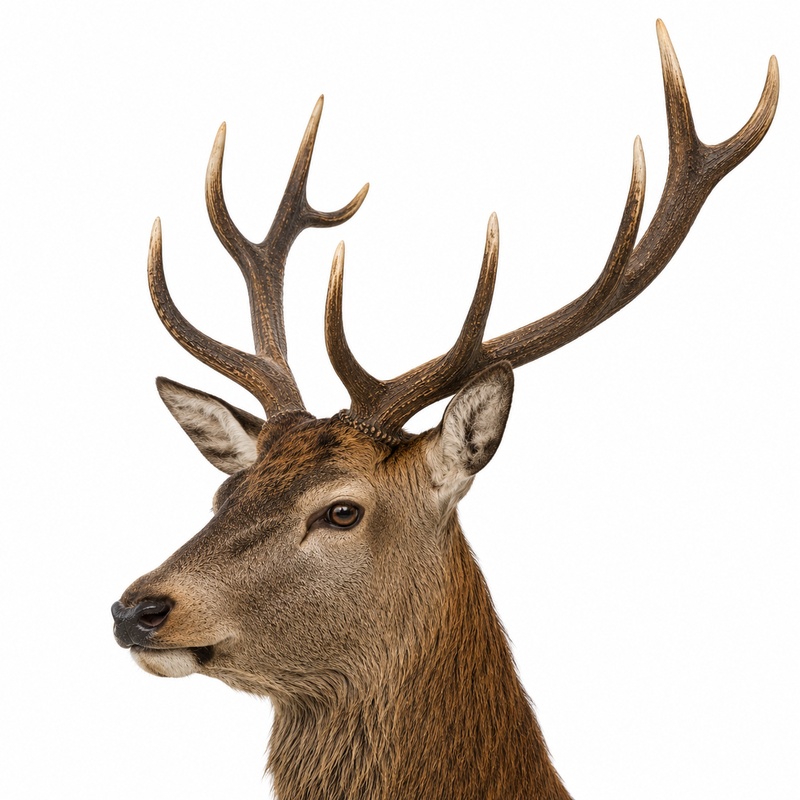
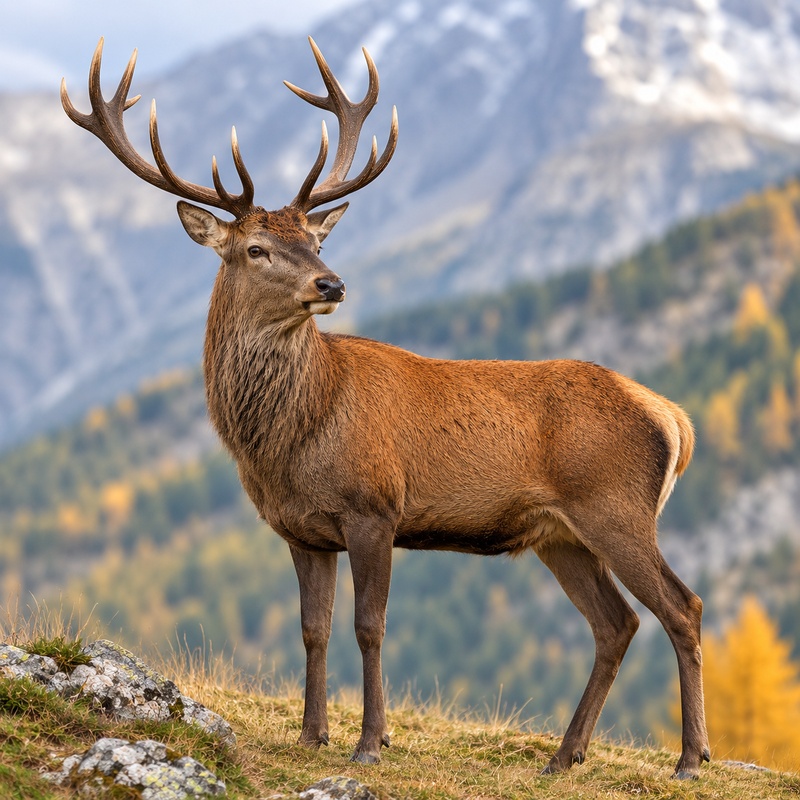
The red deer , scientifically classified as Cervus elaphus , is the largest wild deer present in continental Italy and one of the most imposing and fascinating ungulates of the European fauna.
The large male with its fully developed antler represents one of the most powerful images in wildlife, but to limit the deer to the spectacular nature of the trophy would mean understanding only a small part of it.
The deer is, above all, an animal characterized by profound biological seasonality . Over the course of twelve months, its behavior, social structure, territory use, body condition, and, in males, even a significant part of its anatomy, change.
The stage falls.
It grows back.
It mineralizes.
It gets cleaned.
The roar arrives.
Males fight.
Once the breeding season is over, everything changes again.
For this reason, truly knowing the red deer – Cervus elaphus means following it throughout its entire annual cycle and understanding how environment, feeding, reproduction, social hierarchy and management are closely linked.
Deer: identity card
| Common name | Porto Cervo |
| Scientific name | Cervus elaphus |
| English name | Red deer |
| Order | Artiodactyla |
| Family | cervidae |
| Gender | cervus |
| Distribution | Europe, parts of Western and Central Asia and North Africa, considering the taxonomic complex of the species |
| Presence in Italy | Significant populations especially in the Alpine arc and in various Apennine sectors; nuclei and populations also present in other areas |
| Habitat | Woods alternating with meadows, pastures, clearings, mountain environments and agro-forestry mosaics |
| Diet | Vegetable, composed of herbs, leaves, shoots, fruits, seeds, bark and other seasonal resources |
| Social structure | Females and young generally gregarious; males organized separately for most of the year |
| Reproductive period | Mainly September-October, with geographical and climatic variations |
| Gestation | Approximately 230-240 days |
| Left | Mainly between May and June |
| Number of little ones | Usually one; twin births possible but uncommon |
| Trofeo | Male stage |
| Hunting status | Managed through harvest plans and regional regulations in the territories where hunting activity is planned |
The giant of the Italian deer
The adult male deer has an imposing structure.
The chest is deep, the neck robust and the front part of the body particularly developed, especially during the breeding season.
Females are noticeably lighter and more slender.
Sexual dimorphism is therefore much more evident than that observed in the roe deer.
How much does a deer weigh?
Dimensions can vary considerably depending on:
sex;
age;
population;
geographical origin;
habitat quality;
food availability;
season.
Adult males of continental populations can weigh well over 150 kg and, in larger populations and exceptional individuals, reach significantly higher masses.
Females are generally much smaller in size.
As with wild boar, when high weights are quoted it is essential to distinguish between live weight, eviscerated weight and carcass weight.
Male and female: obvious differences
The adult male presents:
larger size;
more powerful neck;
very developed forequarters;
stage;
overall more massive appearance.
The female is lighter, has a relatively thin neck and does not normally have a antler.
The male deer
The adult male is often simply referred to as a stag.
During the rutting season, it takes on a particularly impressive conformation: the neck visually increases in volume, the coat of the cervical region appears more developed and the entire posture communicates strength and dominance.
The doe
The adult female is called a doe.
Females form the core of the most stable social structures of the species and can live in groups lasting multiple generations.
The small
At birth, the young of the year has a coat characterised by numerous white spots.
The coloring interrupts the silhouette and ensures effective camouflage among grass, vegetation and the play of light in the undergrowth.
The summer coat
During the summer the coat takes on predominantly reddish or reddish-brown tones.
It is precisely from this coloration that the English name Red Deer derives.
The winter coat
During the winter the coat becomes thicker and takes on predominantly grey-brown tones.
The transformation improves thermal insulation and significantly changes the overall appearance of the animal.
The male's mane
In adult males, the hair on the cervical region becomes particularly developed during the autumn period.
This kind of mane contributes to the imposing appearance of the deer during the roar.
The anal mirror
The posterior region has a lighter area, generally yellowish or cream, which constitutes the anal mirror.
In the European red deer the speculum extends over the rump and is associated with a relatively short tail.
This trait is also useful for distinguishing the European red deer from similar species such as the sika deer and the fallow deer. ISPRA specifically lists speculum shape and tail length among the useful diagnostic traits in the field.
Red Deer, Fallow Deer, and Sika Deer: Beware of Confusion
Correct recognition becomes particularly important in areas where there are many deer present.
| Feature | European red deer | Daino | Sika deer |
|---|---|---|---|
| Scientific name | Cervus elaphus | Dama dama | Cervus nippon |
| Dimensions: | Big | Intermediate | Generally inferior to the European red deer |
| Adult stage | Branched, not palmate | Typically palmate in mature males | Branched and generally less complex |
| Anal mirror | Light yellowish extending to the rump | White with characteristic dark edge | White and more circumscribed |
| Tail | Short | Relatively long | Intermedia |
The Deer Stage
The antler is the most spectacular feature of the male.
It is a bone structure , deciduous and completely renewed periodically.
It should not be called a horn.
Stage and horns: what's the difference?
Deer antlers are made of bone and are periodically shed and regrown.
The horns of Bovids, such as the chamois, ibex and mouflon, have a permanent structure consisting of a bony core covered by a horny sheath.
The distinction is not merely terminological: it represents two completely different biological strategies.
One of the fastest growing bones in the animal world
During the development phase, the stag's antler grows with extraordinary rapidity.
To build a structure that can reach impressive dimensions in large males every year requires enormous investments in energy, proteins and minerals.
The antler therefore also constitutes an indicator of the general condition of the animal, although it cannot be interpreted in a simplistic way.
The stems
The antler grows on permanent structures of the skull called stalks or peduncles.
The stems remain for life, while the stage is periodically shed.
Roses
The basal part of the stage has an irregular annular structure indicated as rose.
The development and characteristics of the roses also enter into the morphological evaluation of the trophy.
The poles
The two main structures that develop from the stems are the poles.
The different branches originate from them.
The main points of the stage
Traditional terminology distinguishes different branches in relation to their position.
Among the most important ones we find:
eye;
needle or winter when present;
median;
terminal tips that can form the crown.
Morphology is extremely variable and not all individuals have the same configuration.
The crown
In well-developed adult males the terminal part of the shaft can branch out to form the so-called crown.
The crown is one of the most spectacular elements of the mature stage.
A crowned deer
In hunting language, a male in which the upper part of the antler has a well-developed crown is often defined as crowned .
The presence of the crown is associated with the morphological maturity of the antler, but again, it alone does not allow for a precise determination of age.
The number of spikes does not indicate age
This is one of the most important concepts of the entire card.
A twelve-pointed stag is not twelve years old.
The number and development of the tips depend on:
age;
genetics;
diet;
body condition;
environmental quality;
any traumas;
individual variability.
The spindle
In the young male, the first antler may consist of two simple shafts without significant ramifications.
This subject is traditionally referred to as fusion.
It is one of the most easily recognizable classes when the first stage has the typical shape.
However, the fusone does not represent every young male
Individual variability must always be considered.
Particularly favourable nutritional conditions can produce more developed structures already in the first cycle, while unfavourable conditions can reduce development.
The annual cycle of the stage
The stage goes through a regular sequence:
fall;
regrowth;
velvet development;
mineralization;
cleaning;
use during the roar;
new fall.
When does the Stag lose the stage?
In mature males, shedding generally occurs between late winter and early spring.
Older, more mature individuals may lose their antlers earlier than younger individuals.
However, there are individual and geographical variations.
Why is the stage falling down?
The cycle is mainly controlled by hormonal changes linked to reproductive seasonality and variations in photoperiod.
After the reproductive period, hormone levels change and the process that leads to the detachment of the antler from the stems is gradually activated.
The fall does not necessarily occur at the same time
The two poles can be lost hours or days apart.
For a short time it is therefore possible to observe a male with only one pole.
The regrowth
After the fall, the formation of the new stage begins quickly.
Growth continues throughout spring and summer.
The velvet
During development the stage is covered with a soft, highly vascularized tissue known as velvet.
Velvet transports blood and nutrients needed for bone formation.
At this stage the stage is extremely sensitive and vulnerable to trauma.
The velvet stage is not yet the definitive trophy
Beneath the velvet the structure continues to grow and mineralize.
The final shape and size will depend on the entire development process.
The cleaning
Once mineralization is complete, the velvet progressively loses vitality.
The male then begins to rub his antler against trees and shrubs to remove it.
This phase is called stage cleaning.
The Deer's fregoni
Rubbing can leave very visible marks on the logs.
Compared to the spawning of a roe deer, those produced by a large deer can affect trees of significantly larger dimensions.
Peeled bark, broken branches, and trampled ground can make the mark extremely obvious.
The color of the stage
The freshly cleaned stage initially appears relatively clear.
Subsequent rubbing against vegetation, soil, resins and organic material contribute to the colouring of the poles.
The color therefore does not simply represent the natural color of the bone.
Is the stage really for fighting?
Yes, but not only that.
The antler plays an important role in competition between males and simultaneously constitutes a visual signal of the quality and status of the subject.
Many confrontations can be resolved before physical confrontation through mutual assessments, posture, and vocalizations.
Why avoid combat?
A fight between two large males is extremely costly.
Holds:
energy consumption;
risk of injury;
possible loss of control of females;
in extreme cases risk of death.
The ability to assess a rival before a fight is therefore an important evolutionary advantage.
The Roar of the Deer
The bellowing is probably one of the most spectacular phenomena of European fauna.
During the breeding season the male emits deep vocalizations that can be heard from great distances.
A valley in which several deer roar simultaneously produces one of the most impressive acoustic scenarios in the Italian natural world.
Why does the deer roar?
The roar serves several functions.
Communicate information:
to females;
to other males;
on the presence of the individual;
on his competitive motivation;
on the control of a breeding group or area.
The roar is not simply a call
It is part of a complex communication system that also includes:
posture;
odor;
markings;
movements;
stage performance;
direct comparisons.
When does the roar occur?
In Italy the main period generally falls between September and October , with differences linked to altitude, latitude, population and climatic conditions.
The peak can be concentrated within a few weeks.
The photoperiod
The progressive reduction in daylight hours helps regulate the hormonal changes that precede the reproductive period.
The seasonality of the deer is therefore closely linked to the annual biological calendar.
The male before the roar
During spring and summer, males must accumulate reserves.
Building the stage and preparing for the breeding season requires a tremendous amount of energy.
During the roar the male eats less
During peak reproductive activity, dominant males may significantly reduce the time spent feeding.
Most of the energy is invested in:
search for females;
group control;
roar;
movements;
distancing of rivals;
fighting.
Weight loss during roaring
A large male can lose a significant portion of his body mass during the breeding season.
This loss demonstrates how high the energy cost of competition is.
The Deer's Insolation
During the breeding season, males often frequent muddy pools in which they wallow.
These sites are called insogli.
Why does the male become undressed?
The insole performs functions related to thermoregulation, coat care and olfactory communication.
During the roar the male can become covered in mud, urine and secretions, producing a very intense odor.
The smell of the deer in rut
A large male can be perceived by smell even by humans.
The particularly intense odor is part of the complex reproductive communication system.
The roaring square
Some areas are used repeatedly during the breeding season.
Meadows, clearings, and open areas near forest canopy can become true hotspots for male activity.
The dominant male
A large male may try to control a group of receptive females.
Must simultaneously:
follow the females;
prevent them from getting lost;
identify females in heat;
to long;
drive away competitors.
The harem
In common parlance, the group of females temporarily controlled by a male during the reproductive period is often called a harem.
It is important, however, not to imagine it as a fixed and immutable structure.
Females may move and males may lose or gain control of the group.
The satellite male
Younger or subordinate males may remain nearby attempting to take advantage of any reproductive opportunities that arise.
The dominant male must therefore maintain constant vigilance.
The comparison between two males
The meeting can develop through different phases.
Vocalization is perceived first.
Then the two animals can come closer.
They observe each other.
They walk in parallel.
They evaluate the size and behavior of the rival.
Only when neither side gives up can the real fight begin.
The fight
The two males lower their heads and intertwine their antlers.
Force is exerted through the neck, shoulders and limbs.
The goal is to force the opponent to give ground and recognize the rival's superiority.
Can the antlers get stuck?
It is possible, although it is not the norm.
When the branches become irreversibly blocked, the consequences can be very serious for both animals.
The winner is not necessarily the one with the most points
Competitive ability depends on a set of elements:
body mass;
Force;
physical condition;
experience;
motivation;
stage.
The number of tips represents only part of the whole picture.
The social structure outside the roar
Once the breeding season is over, males and females gradually return to a different social structure.
For much of the year there is marked sexual segregation.
Women's groups
Females, pups and young can form relatively stable groups.
The structure can be based on kinship ties and knowledge of the territory.
The male groups
Outside the breeding season, males can also form groups.
Individuals that become rivals during the roar may then tolerate each other during other periods of the year.
Why do males and females live separately?
Males and females have different body sizes and energy needs.
They can therefore select habitats, food resources and space use strategies that do not perfectly coincide.
Deer Habitat
The ideal habitat is not necessarily a continuous forest.
The deer often benefits from landscapes characterised by the alternation between:
woods;
clearings;
meadows;
pastures;
shrubby areas;
refuge areas.
The forest offers protection, the meadow offers nourishment
This simple relationship explains why forest mosaics can be particularly favorable.
Deer can use cover during resting periods and reach open areas when feeding.
The Deer in the Alps
The Alps are home to some of Italy's most important populations.
Here the species can use very different habitats throughout the year, moving from summer alpine meadows to forest and valley areas used during the winter.
Altitudinal migration
In mountain environments, some deer make real seasonal movements between different altitudes.
During the summer they can reach high areas rich in vegetation, while the accumulation of snow subsequently pushes them towards lower and more favorable winter quarters.
Not all deer migrate the same way
Different strategies may exist within the same population.
Some individuals may make large seasonal movements, while others remain relatively resident.
A deer can travel tens of kilometers
Telemetry data shows that some individuals may use seasonal areas that are very distant from each other.
This is one of the reasons why the management of the species cannot be artificially confined within administrative territories that are too small.
The winter quarters
During the winter, the choice of territory depends heavily on:
snow cover;
exposure;
food availability;
calm;
slope;
microclimate.
The snow
Deep snow greatly increases the energy cost of travel.
During difficult winters, deer tend to concentrate their activity in areas that allow them to limit energy consumption.
Disturbing a deer in winter has a cost
An animal repeatedly forced to flee must expend energy precisely at the time of year when food is scarcest.
For this reason, the tranquility of the winter quarters represents an important management element.
The Deer in the Apennines
Numerous Apennine populations derive from reintroduction projects and subsequent natural expansion.
In some areas of the central-northern Apennines the species has reached significant densities and continues to expand its range.
ISPRA highlights how, in some Apennine areas, environmental conditions can be particularly favorable to population growth. :contentReference[oaicite:1]{index=1}
The Deer in Italy: A Story of Disappearance and Return
The deer historically occupied a very large part of the Italian territory.
Centuries of human pressure, habitat transformation and exploitation, however, led to a sharp reduction in the range.
The recent recolonization of the central-eastern Alps has also been favored by the expansion of populations from neighboring countries, while in other Italian territories reintroductions have played an important role. :contentReference[oaicite:2]{index=2}
The Deer of Mesola
The Mesola deer represents a fauna of exceptional value.
The population preserved in the Mesola Forest possesses particular morphological and genetic characteristics and is considered an indigenous nucleus of enormous conservation interest.
ISPRA emphasizes its genetic peculiarity and the need for specific conservation measures. :contentReference[oaicite:3]{index=3}
The Sardinian deer
In Sardinia there is the Sardinian deer , traditionally classified as Cervus elaphus corsicanus.
It is a faunal entity of particular conservation interest and should not be simply assimilated from a management point of view to continental populations.
Why the Sardinian deer deserves its own profile
The history, morphology, distribution, conservation, and management are sufficiently detailed to justify a dedicated entry in the Encyclopedia.
The same goes for the Mesola Deer.
What does deer eat?
The deer is a ruminant herbivore characterised by remarkable dietary flexibility.
The diet includes:
herbs;
leaves;
sprouts;
gems;
shrubs;
forest fruits;
acorns;
chestnuts;
beechnuts;
barks;
agricultural resources when available.
Is the deer a grazer or a browser?
The correct answer is: you can use both strategies.
Compared to the roe deer, it is more capable of exploiting large quantities of herbaceous vegetation, but it also uses leaves, shoots and woody parts.
The diet changes according to the season and habitat.
Spring feeding
Spring is a crucial time.
The new vegetation is rich in nutrients and allows the animals to recover the body condition lost during the winter.
For the male, the construction of the antler also begins
The resources accumulated during spring and summer must simultaneously support body growth and the development of the new stage.
The quality of the diet can therefore significantly influence the expression of the trophy.
Summer food
Mountain meadows and pastures can offer a large amount of highly nutritious vegetation.
In quiet areas, deer may also use habitats above the tree line during the summer.
Autumn nutrition
Energy foods are very important before and after the roar.
Acorns, chestnuts, beechnuts and other forest resources contribute to the replenishment of reserves.
Winter nutrition
During the winter, the quantity and quality of food decreases.
Deer may increase the use of:
twigs;
sprouts;
bark;
herbaceous vegetation remained accessible.
The debarking
Deer can remove bark from trees for food.
This behavior can produce significant forest damage when densities are high.
Forest browsing and regeneration
Consuming young sprouts can influence:
plant growth;
forest composition;
natural renewal;
undergrowth structure.
ISPRA documents how high deer densities can produce significant pressure on forest vegetation and hay meadows. :contentReference[oaicite:4]{index=4}
Can an animal become too large?
Yup.
A deer population should not be evaluated solely through the desire to have many animals.
When the density exceeds the capacity of the territory to support the population without excessive impacts, the following may increase:
forest damage;
agricultural damage;
food competition;
worsening of body condition;
conflicts with other species.
The bearing capacity
The concept of carrying capacity describes, in general terms, the number of animals that an environment can support.
In wildlife management, however, it is also necessary to consider a socially and economically acceptable carrying capacity , linked to the impacts on vegetation, agricultural activities and infrastructure.
The Deer's Footprints
The imprint is large and consists of the two main claws.
Its size can help distinguish it from that of roe deer and other ungulates.
However, terrain, pace and individual characteristics can significantly change the shape of the track.
Male or female from the footprint?
Estimating sex solely based on a single footprint is generally unreliable.
A large male naturally tends to have larger feet, but there is overlap and ground conditions can greatly alter the track.
The track tells more than the footprint
As for the wild boar, a sequence of footprints allows us to analyse:
direction;
gait;
apparent size of the subject;
land use methods.
The Deer's Facts
The droppings are often made up of separate elements, of variable shape and consistency depending on the diet.
During periods of very rich vegetation they may appear less clearly separated.
The remittances
Resting areas can be identified by depressions in the vegetation or ground, possibly associated with hairs, marks, and tracks.
The Fregoni
During the antler cycle and especially during the breeding season, males may rub against trees and shrubs.
The freaks produced by great individuals can be impressive.
The insolations
The snout is another characteristic sign, especially during the rutting season.
Mud, footprints, hair, and odor can all help you easily recognize a recently used site.
How to recognize a roaring square
An intensively used area may simultaneously present:
footprints;
heavily trampled ground;
fregoni;
insolations;
damaged vegetation;
intense smell;
done.
The reproduction
After mating, the doe faces a gestation period of about eight months.
Most births occur between late spring and early summer.
Childbirth
Before giving birth, the female tends to temporarily separate from the group and seek a quiet area.
Usually only one little one is born.
The little one remains hidden
During the early stages of life, the young use a strategy based mainly on camouflage and immobility.
The mother may leave temporarily and return to feed the baby.
A small found alone must not be collected
As in the Roe Deer, the presence of a seemingly abandoned young man does not mean that the mother has disappeared.
Intervening without a real need can cause more harm than good.
The loss of spots
As the animal grows, its characteristic spotted coat is gradually replaced by the uniform coloration typical of the larger animal.
The female and the young of the year
The bond between mother and calf can last for a considerable period of time.
This relationship contributes to the structure of women's groups.
How to Estimate the Age of a Live Deer
It is one of the most difficult skills in selective management.
The exact age cannot be read on stage.
The on-site evaluation must take into consideration several elements simultaneously.
Silhouette
In the young male the body generally appears relatively slender, with apparently long limbs and a thin neck.
With maturity the chest becomes deeper, the neck more powerful and the forequarters more developed.
The young male
It can show:
light body;
thin neck;
relatively high ventral line;
head apparently small in relation to the body.
The middle-aged male
As the animal matures, it gains mass.
The chest becomes deeper and the neck appears progressively integrated with the front of the body.
The mature male
The fully mature male generally has a powerful structure.
The front visually dominates the body.
During the roar this effect becomes even more evident.
The Old Deer
In elderly subjects, changes in posture and silhouette may appear.
The belly may appear more relaxed, the topline less tense and the head may be carried lower.
But no single character is sufficient to accurately assign age.
Does behavior help estimate age?
It can provide additional information.
A male capable of controlling a group of females in the midst of their roaring normally possesses significant physical and social maturity.
But behavior and rank do not coincide with a specific chronological age.
The stage is deceiving
A relatively young subject in exceptional conditions can develop an excellent stage.
An older male may present a regressing trophy.
An individual may have suffered trauma.
For this reason the selector must learn to look at the body first and then at the stage.
The dentition
After the sample has been taken, the examination of the jaw is one of the fundamental tools for assessing age.
In young people, the sequence of tooth eruption and replacement is particularly useful.
In adults, the assessment becomes more difficult
When the permanent dentition is complete, age is estimated primarily through tooth wear.
However, this method presents margins of uncertainty because wear can be influenced by nutrition and environmental characteristics.
Dental cement rings
For more in-depth evaluations, laboratory techniques based on the analysis of the cementum layers present in the teeth can be used.
These are specialized methods and not the normal assessment performed simply by observing the jaw.
The annual cycle of the deer
| Indicative period | Evento principale |
|---|---|
| January-February | Winter life; progressive conclusion of the old antler cycle in males |
| February-April | Antlers fall off, usually earlier in mature males |
| Spring | Velvet regrowth and recovery of body condition |
| May-June | Main birth period |
| Summer | Complete growth and mineralization of the new stage |
| July-August | Progressive cleaning of the stages |
| September-October | Roaring and breeding season |
| October-November | End of the roar and energy recovery |
| Autumn-winter | Social reorganization and move to winter quarters |
Selective hunting of deer
Selective hunting for deer requires a high level of preparation.
The problem is not simply identifying an animal.
It is necessary to recognize the class provided for by the sampling plan.
The binoculars come before the rifle
The principle is the same as that already highlighted for the Roe Deer, but in the Deer it takes on even greater importance.
Before making a decision, one must observe:
sex;
body structure;
expected age group;
stage when present;
behavior;
presence of other individuals;
shooting conditions.
The look
Waiting from a favorable position allows you to observe the animals as they reach feeding areas or cross familiar areas.
The main advantage is that you potentially have more time for evaluation.
the Fence
The search requires an extremely careful reading of the territory.
The hunter must use:
wind;
morphology;
plant cover;
ambient noises;
knowledge of movements.
The wind
The deer has an extremely developed sense of smell.
An animal that directly picks up the hunter's scent may flee before being seen.
The wind must therefore drive the entire approach.
The deer can sense danger very far away
Smell, hearing, and the ability to interpret the environment allow expert individuals to react well in advance.
This is especially true for older males who have accumulated years of experience.
The responsible shot
In selection the goal is not to make a difficult shot.
The goal is to create the conditions for a safe, stable and highly controllable shot.
The distance must be compatible with:
hunter's ability;
stability of position;
weather conditions;
visibility;
animal behavior.
After the shot
The body mass of the deer and its ability to move away even after a shot make it essential to carefully observe its reaction.
You need to memorize:
point where it was located;
reaction;
direction of escape;
last observation point.
The anschuss
The shooting spot must be methodically examined when the game is not recovered immediately.
Indiscriminately trampling the area can compromise important olfactory and visual information.
Recovery with a tracking dog
In deer, professional recovery with a tracking dog takes on enormous importance.
An injured animal can travel considerable distances and cross difficult habitats.
When the outcome of the heist is uncertain, relying on a qualified recovery agent is the correct procedure.
The Deer and the Tracking Dog
The large amount of potentially drivable terrain makes the value of a specialized combination particularly evident.
The dog must follow the specific track of the injured head even when it overlaps with the tracks of other deer.
Management of the Deer
Deer management is particularly complex because the species can use very large territories and make seasonal movements that cross different districts and administrative borders.
ISPRA recommends planning across large territorial management units . :contentReference[oaicite:5]{index=5}
What do you need to know about a population?
Among the most important parameters we find:
consistency;
density;
sex ratio;
age class structure;
reproductive success;
seasonal distribution;
mortality;
impacts on vegetation;
results of previous sampling.
The census at the roar
The breeding season offers a particular opportunity for monitoring because the males become acoustically very conspicuous.
Counting males can contribute to understanding the population, provided it is performed using standardized protocols and interpreted correctly.
Why doesn't the number of roars automatically equal the total number of deer?
Not all males crave with the same intensity.
An individual can move.
Sound propagation changes with wind and morphology.
For this reason, the acoustic census requires coordinated listening points and subsequent data processing.
Other monitoring systems
They can also be used:
direct counts;
distance sampling;
camera traps;
GPS telemetry;
presence indices;
analysis of slaughtered animals.
The withdrawal plan
Selection must seek to meet the objectives established for the population.
This means distributing the catch according to sex and age classes instead of concentrating it exclusively on the males with the most eye-catching trophies.
Why collecting only large males would be a management mistake
A system that is exclusively trophy-oriented could undesirably change the population structure.
Balanced management must consider the entire population and not just the adult male component.
The relationship between the sexes
A strong alteration in the ratio between males and females can influence the dynamics of the reproductive season and social structure.
The management plan must therefore also take into account the sexual composition.
The age classes
The presence of juveniles, adults and mature individuals contributes to the natural structure of the population.
A population should not be judged solely by the total number of animals.
The Deer Trophy
The stage represents one of the most prestigious trophies in the European hunting tradition.
The official evaluation takes into account various parameters according to codified systems.
What is valued in the trophy?
Elements that may contribute to the evaluation include:
length of the poles;
circumferences;
length of the tips;
crown development;
weight;
opening;
symmetry;
aesthetic characteristics expected by the method used.
Trophy and management should not be confused
The trophy represents an individual characteristic.
Management, on the other hand, concerns the population.
A magnificent trophy can be interesting from a hunting point of view without automatically becoming the criterion for deciding on the harvest.
A big stag is not just a big stage
This concept should become central to the culture of the selective hunter.
A large male represents:
years of survival;
ability to use the land;
competition with other males;
adaptation to the seasons;
experience.
Predators of the Deer
In Italy, the wolf is the main large natural predator of the species.
Vulnerability varies greatly depending on the age and conditions of the individual.
Which deer are most vulnerable?
Small, young, debilitated animals and individuals in difficult conditions may be more vulnerable.
Even very severe winters can alter the relationship between predator and prey.
Can a large adult male be preyed upon?
Yes, although it represents a much more challenging prey.
Size, strength and defensive capabilities make the attack more complex than that aimed at young or debilitated subjects.
The deer and competition with other ungulates
At high densities, deer may compete for resources with other herbivores.
ISPRA has documented situations in which large populations can negatively interact with other ungulate populations through food competition. :contentReference[oaicite:6]{index=6}
The Deer and the Roe Deer
The two species use partially different resources, but there are overlaps.
In conditions of high deer density, competition can become significant, especially in winter quarters.
Deer: main characteristics
| Body dimensions | ★ ★ ★ ★ ★ |
| Sexual dimorphism | ★ ★ ★ ★ ★ |
| Stage development | ★ ★ ★ ★ ★ |
| Spectacularity of the roar | ★ ★ ★ ★ ★ |
| Social complexity | ★ ★ ★ ★ ★ |
| Moving ability | ★ ★ ★ ★ ★ |
| Environmental adaptability | ★★★★ ☆ |
| Management importance | ★ ★ ★ ★ ★ |
| Importance in selective hunting | ★ ★ ★ ★ ★ |
| Prestige of the trophy | ★ ★ ★ ★ ★ |
Curiosities about the Deer
The stage is completely rebuilt: a bone structure that can reach impressive dimensions is produced anew with each cycle.
The stage does not allow you to read the age directly: counting the tips to determine the years is a mistake.
The first stage can be simple: the typical young male with two shafts is called a fusone.
Velvet is a living tissue: during growth it is richly vascularized and allows the development of the antler.
Roaring is a communication system: it is not simply used to “call” females.
During the rutting season, the male can eat much less: reproductive competition entails an enormous energy cost.
It can lose a considerable part of its body mass: the breeding season represents a real physical test.
Males and females spend a good part of the year apart: sexual segregation is an important characteristic of the species.
It can undertake seasonal migrations: some individuals travel tens of kilometres between summer and winter quarters.
Snow strongly influences distribution: moving through deep snow significantly increases the energy cost.
A large male can produce impressive rubbings: trees and shrubs can be severely damaged by rubbing.
The deer has some tricks: especially during the roar, the males use mud puddles which are also associated with olfactory communication.
The little one is born spotted: the characteristic white spots play an important camouflage function.
The female normally gives birth to a single young: a different strategy than ungulates with multiple litters.
In Italy there are populations of enormous conservation value: the Sardinian deer and the Mesola deer deserve particular attention.
The Roar: When the Mountain Changes Its Voice
To truly understand the Deer, it is not enough to observe it.
At least once you have to listen to a valley during its roar.
It's September.
The temperature begins to drop.
The light disappears behind the mountain's profile.
The forest seems peaceful.
Then comes a deep sound.
It's not close.
Cross the valley.
After a few seconds another male responds.
Then a third.
Suddenly the landscape takes on a completely different dimension.
Every roar tells something
To the untrained ear they simply sound like big calls.
For those who study and know the Deer they become information.
A male is in a certain position.
Another one answers him.
Distances change.
An animal moves.
Another increases the intensity of vocalization.
Somewhere in the darkness, a competition is taking place that will not necessarily end in a clash.
The Stag before the fight
Two males can gradually get closer.
First they listen to each other.
Then they see each other.
The posture changes.
The head shows the stage.
The two animals can move in parallel.
It is an evaluation phase.
One of the two might decide that the risk is not worth the benefit.
He walks away.
The fight doesn't happen.
From a biological point of view, this is the best solution: the conflict has been resolved without injury and without unnecessary waste of energy.
When no one gives in
If both continue the confrontation, the situation changes.
Heads bow.
The stages come into contact.
The sound of the poles can be heard from a distance.
Neck, shoulders and hindquarters push with all available strength.
It is not a symbolic ritual.
It's a real physical test.
The winner still pays a price
Even when he wins, the dominant male continues to expend energy.
He must follow the females.
He has to check out the competitors.
He must be longing.
He must mate.
And often devotes much less time to nutrition than necessary.
The November Deer is not the August one
Once the breeding season is over, a male may appear noticeably thinner.
The body that appeared full and powerful at the end of summer can be much leaner.
Now the goal changes completely.
He doesn't have to conquer women anymore.
He needs to recover.
And it has to do it before the winter gets really tough.
Winter selects
The cold season represents one of the most severe tests.
The food decreases.
The vegetation loses quality.
Snow makes it more difficult to get around.
Every unnecessary escape consumes energy.
Animals that have faced the roar in insufficient body condition can pay the highest price.
Spring begins all over again
When the snow retreats and the first shoots appear, the system changes again.
Food becomes more abundant.
The male has lost his old antler.
The new one is already growing on the head.
It is covered in velvet.
In a few months it will become an imposing bone structure again.
It is one of the most incredible cycles observable in European fauna.
The great lesson of the stage
It is natural for the hunter to be attracted to a large stage.
But the Deer itself teaches how dangerous it is to judge an animal by its single character.
The number of spikes does not represent years.
The crown alone does not tell the whole story.
The length of the shafts does not automatically identify maturity.
You have to look at the body.
The neck.
The posture.
The dorsal line.
The behavior.
The context.
And even after all this, the actual age remains an estimate.
The selector in front of a large male
A deer appears at the edge of the woods.
It's still almost dark.
The binoculars immediately reveal an important stage.
Instinct draws the gaze towards the poles.
But the right work begins elsewhere.
It starts with the body.
What is the structure?
How deep is the chest?
How does he carry his head?
What does the neck look like?
How does it move?
Is this really the expected boss?
Only later does the stage enter into the evaluation.
The big Deer can just walk away
There is not enough light.
The head remains covered.
The conditions do not allow for a safe classification.
The distance is too great.
The angle is not correct.
In these cases the hunter must possess the most difficult skill:
let it go.
Not shooting can be the end result of a great hunting day
Selective hunting reaches its maturity when success is not measured exclusively by the number of animals killed.
Having correctly observed an animal and choosing not to take a shaky shot is a technically superior decision to taking a shot without adequate evaluation.
From the trophy to the population
The deer forces the modern hunter to make a fundamental cultural shift.
The male before us is not simply a stage.
It is a component of a population.
It has an age class.
It plays a role during the roar.
Use seasonal neighborhoods.
It can travel tens of kilometers.
Interacts with females, juveniles, and other males.
And its eventual withdrawal produces an effect within that system.
Why Cervo is a management school
Few species make it as clear that administrative boundaries do not coincide with biological ones.
A deer can spend the summer in one territory.
The roar in another.
Winter many miles away.
It can cross municipalities, provinces, protected areas and vendible territories.
For this reason, ISPRA emphasizes the need to plan management across large territorial units and not through overly small compartments.
Knowing the Deer means knowing the entire landscape
To truly understand the Red Deer – Cervus elaphus you need to observe much more than the animal.
You have to know the mountain.
The snow.
The pastures.
The forest.
The roaring areas.
The insolations.
The winter quarters.
The travel routes.
Human pressure.
And you have to understand how all these elements change throughout the year.
The king of the forest
If the Woodcock is traditionally the Queen , the large male Deer perhaps more than any other European game deserves the image of King of the forest.
Not just because of its size.
Not just for the stage.
But for what it represents.
A mature male has survived many winters.
He rebuilt his stage year after year.
It has gone through seasons of abundance and scarcity.
He learned the territory.
He faced other males.
It has experienced pressure from predators and humans.
And when September arrives he once again enters the valley of the roar.
The sun disappears.
The forest grows dark.
Then that deep voice starts.
For a few weeks the entire mountain seems to revolve around that sound.
And it is then that we understand why knowing the Deer does not just mean knowing an ungulate.
It means understanding seasonality, natural selection, competition, migration, management, forests and mountains.
The stage is only the part we see.
The true greatness of the Deer is everything that lies behind it.