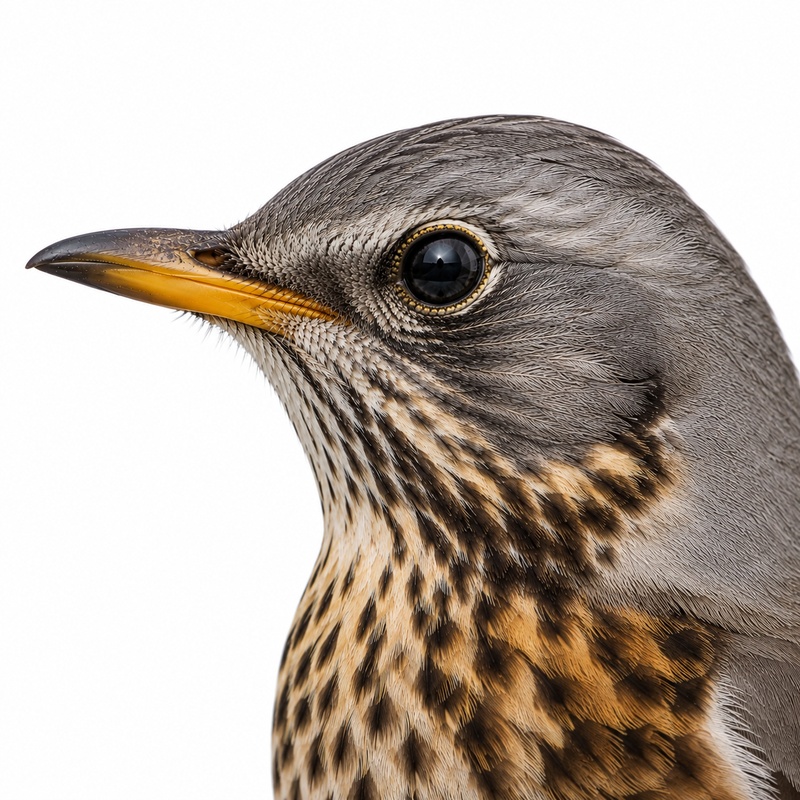
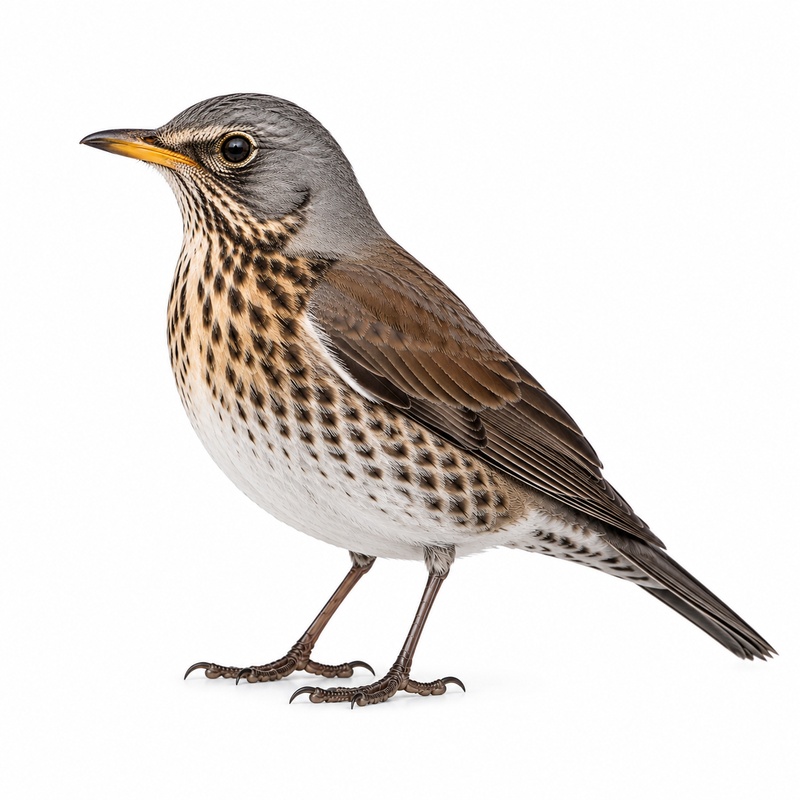
The Fieldfare , scientifically classified as Turdus pilaris , is one of the most easily recognizable European thrushes thanks to the distinctive contrast between its grayish head, brown back, dark tail, and heavily spotted pale breast . During autumn and winter, it can form very large flocks and is one of the migratory species whose presence in Italy varies most depending on the climatic conditions of central and northern Europe.
It belongs to the Turdidae family and the Turdus genus , the same as the blackbird, song thrush, redwing, mistle thrush, and ring-necked thrush. Compared to the song thrush and redwing, it is larger, has a more robust build, and has much more contrasting plumage.
The Fieldfare has a predominantly Euro-Siberian breeding distribution . It is widespread in central and northern Europe and the boreal regions of Asia, while during the winter, numerous individuals move towards western and southern Europe.
In Italy, it is primarily a regular migrant and winter visitor , but there is also a breeding population concentrated mainly in the Alpine region. Its breeding colonization of our country is relatively recent compared to the species' historical presence as a winter migrant.
One of the most fascinating characteristics of the Fieldfare is its ability to make large, irregular or irruptive movements . When intense cold, snow, or food shortages affect vast northern regions, thousands of individuals can rapidly move south, resulting in years of exceptional presence in Italy as well.
Cesena: identity card
| Common name | Cesena |
| Scientific name | Pilar turdus |
| English name | Fieldfare |
| Order | Passeriformes |
| Family | Turdidae |
| Gender | wing |
| Distribution | Europe and Northern and Central Asia |
| Presence in Italy | Regular migrant, wintering and nesting mainly in the Alpine region |
| Length | Approximately 24-27 cm |
| Wingspan | Approximately 39-42 cm |
| Weight | Generally around 80-140 g, with individual and seasonal variations |
| Breeding habitat | Sparse woods, forest edges, wooded countryside, meadows and pastures with trees |
| Winter habitat | Meadows, pastures, wooded countryside, orchards, vineyards, woods, hedges and areas rich in berries |
| Supply | Earthworms, insects and other invertebrates; fruits and berries especially in autumn and winter |
| Behavior | Highly gregarious outside the breeding season |
| Nesting | Often colonial or semi-colonial |
| Distinctive feature | Gray head and rump, brown back and dark tail |
| Hunting status in Italy | Huntable species according to national regulations and regional hunting calendars |
How to recognize the Cesena
The Fieldfare has a much more evident chromatic combination than the other Thrushes commonly found in Italy.
The gray head contrasts with the brown back, while the rump takes on grayish hues. The tail, however, is decidedly dark, almost black.
The underparts are light, with numerous dark spots especially on the chest and flanks.
The gray head
The greyish colour of the head is one of the most immediate characteristics for identifying the species.
In good light conditions the contrast with the brown-chestnut back is very evident.
This detail allows us to quickly distinguish the Fieldfare from the Song Thrush and the Redwing.
The brown back
The back has a characteristic brown-brown tone.
The combination of grey head, brown back and greyish rump creates a very particular pattern, difficult to confuse with other Italian thrushes.
The gray rump
The rump region has gray tones similar to those of the head.
During flight this feature becomes particularly useful for recognition.
The dark tail
The tail appears distinctly darker than the rest of the back.
The strong contrast between the grey rump and the almost black tail constitutes a further diagnostic element.
The chest of Cesena
The underparts have a light background, with cream and yellowish tones especially in the upper chest region.
Numerous dark spots cover the chest and flanks.
The central belly tends to appear lighter.
Wings
The wings are relatively long and robust and allow the Fieldfare to undertake significant migratory movements.
Flight generally alternates phases of active flapping with short, more relaxed stretches.
Male and female
Sexual dimorphism is not very evident.
In fact, males and females have very similar plumage and determining sex in the field is generally difficult.
Behavioral differences in particular can emerge during reproduction.
Young people
Juveniles generally have more mottled and less distinct plumage than adults.
The characteristic colors of the head and back become progressively more defined as they mature.
Fieldfare and Song Thrush: How to Tell Them Apart
| Feature | Cesena | Song Thrush |
|---|---|---|
| Dimensions: | Greater | minor |
| Head | gray | Bruna |
| Back | Brown | Brown-olive |
| Rump | Grey | Bruno |
| Tail | Very dark | Bruna |
| Winter behavior | Highly gregarious | Generally less gregarious |
Fieldfare and Redwing
Fieldfare and Redwing can be observed together during the winter, but the morphological differences are clear.
The Redwing – Turdus iliacus is smaller, has a prominent light eyebrow and characteristic rusty-red flanks.
The Fieldfare is larger and has the characteristic contrast between its grey head and brown back.
Cesena and Tordela
The Mistle Thrush – Turdus viscivorus is relatively similar in size, but has a much more uniform coloration.
The head and back of the Mistle Thrush are grey-brown, while the underparts show large, rounded dark spots.
The strong chromatic contrast characteristic of Cesena is completely missing.
Cesena and Merlo
The distinction from the adult Blackbird is normally immediate.
The male Blackbird is completely black with a yellow-orange beak, while the female is predominantly brown.
The Cesena, on the other hand, has a much more complex and contrasting colour.
The call of Cesena
The Fieldfare has a distinctive call, often heard during flight in flocks.
It consists of dry and relatively harsh notes, very different from the melodious song of the Song Thrush or the Blackbird.
Vocalization allows individuals to maintain contact while moving.
The song of Cesena
Territorial singing is heard mostly in breeding areas.
It is generally less melodious and complex than that of the Song Thrush and the Blackbird.
It comprises a succession of notes, chirps and relatively harsh sounds.
Why do we hear calls most in winter?
During migration and wintering, the species does not show the same intense territoriality as during the breeding season.
Since individuals frequently move in groups, contact calls become more important.
Worldwide distribution of Cesena
Turdus pilaris has a very wide Euro-Siberian distribution.
The breeding range includes much of central-northern and eastern Europe and extends across Russia to large regions of northern Asia.
It is one of the most numerous species in different countries of Northern Europe.
The Fieldfare is a monotypic species
Unlike other Turdidae which have numerous geographical subspecies, the Fieldfare is generally considered a monotypic species.
Therefore, distinct living subspecies are not normally recognized within the vast range.
The historical expansion of Cesena
The European range of the Fieldfare has not remained unchanged over time.
Over the last few centuries the species has progressively colonized new regions to the south and west.
This process also affected the Italian Alpine arc.
Cesena in Italy
In Italy the Fieldfare behaves as a regular migrant, wintering and nesting mainly in the Alpine regions.
The Italian breeding population constitutes the southern edge of the European breeding range.
The distribution during the winter is much wider and more variable.
Where does it nest in Italy?
Reproduction mainly occurs in the Alpine region.
ISPRA indicates a more consolidated presence in the Aosta Valley, Lombardy, Trentino and South Tyrolean sectors, from which the species subsequently expanded also towards other Alpine sectors.
The colonization of the Italian Alps
The reproductive presence in the Italian Alps is relatively recent compared to the history of the species.
The Cesena has progressively extended its range southwards, occupying mountain environments characterised by meadows, pastures and sparse woods.
The Alpine breeding habitat
The species prefers environments where open areas used for feeding alternate with trees and thickets used for nesting.
The combination of meadows, pastures, forest edges and groups of trees therefore represents a particularly favourable situation.
Cesena in Italy during the winter
The winter distribution is much wider than the breeding distribution.
Migratory individuals can reach the northern and central regions and, in favorable years, even southern Italy and the islands.
Attendance numbers can vary dramatically from season to season.
Autumn migration
As autumn progresses, northern populations gradually begin to move south and southwest.
The movement can intensify especially between October and November , but the distribution continues to change even during the winter.
A migrant different from the Song Thrush
Cesena does not always follow a strictly predictable migratory movement.
Many individuals may remain relatively far north when climate and food availability are favorable.
Only when conditions worsen do large southward movements occur.
What is a break-in?
The term irruption refers to a numerically very significant and often relatively sudden movement that takes large numbers of individuals outside the areas in which they would normally be present.
In Cesena these phenomena can be particularly evident.
Why do raids happen?
The main factors are:
severe frost;
persistent snowfall;
exhaustion of fruits and berries;
trend of food production in the northern regions;
weather conditions along the movement routes.
Does the cold always push the Cesenas south?
Not necessarily.
The Cesena is perfectly adapted to very low temperatures.
The main problem arises when cold and snow make food inaccessible.
If resources remain abundant, individuals can tolerate very harsh climatic conditions.
The role of snow
Snow prevents access to meadows and land where earthworms and other invertebrates are searched.
When fruit resources also decrease at the same time, moving can become indispensable.
Why do some years have very few Cesenas?
During a mild winter, with abundant food resources in central Europe, many individuals may have no reason to venture as far as the Mediterranean.
The shortage in Italy does not necessarily mean that the European population has collapsed.
Why do so many other vintages arrive?
A combination of intense cold and depleted resources can produce large southward movements.
Under these conditions, very large groups can suddenly appear in areas where the species was sparsely present just a few days before.
The night migration
Like other large migratory thrushes, the fieldfare can make significant movements during the night hours.
The animals then use the day to feed and recover energy reserves.
The routes through Italy
ISPRA ringing data show a strong concentration of reports in the Alpine area , especially Veneto and Lombardy, followed by Trentino-Alto Adige, Friuli-Venezia Giulia and Piedmont.
Significant reports also concern the Tuscan-Emilian Apennines and areas near the Romagna coast. :contentReference[oaicite:1]{index=1}
Does Cesena cross the Mediterranean?
Yes, but in much smaller numbers than other species of Turdidae.
ISPRA has reported that birds were detected during migration across the central Mediterranean, including individuals ringed on small Tyrrhenian islands. :contentReference[oaicite:2]{index=2}
Habitat of the Fieldfare during the winter
During the cold season, the species mainly uses territories in which it can rapidly alternate feeding and shelter.
Meadows and pastures are used for foraging for invertebrates, while hedges, trees and woods offer protection and fruit.
Cesena's favourite environments
| Meadows and pastures | ★ ★ ★ ★ ★ |
| Tree-lined countryside | ★ ★ ★ ★ ★ |
| Woods with clearings | ★ ★ ★ ★ ★ |
| Orchards | ★ ★ ★ ★ ★ |
| Hedges rich in berries | ★ ★ ★ ★ ★ |
| Vineyards | ★★★★ ☆ |
| Olive groves | ★★★★ ☆ |
| Forest edges | ★ ★ ★ ★ ★ |
| Large, completely enclosed forests | ★★☆☆☆ |
| Monocultures without margins | ★★☆☆☆ |
The Cesena in the meadows
Meadows and pastures represent some of the main feeding areas.
When the soil is soft and moist, the species mainly searches for earthworms and other invertebrates.
Large groups can spread out over a grassy surface while still maintaining constant control of the environment.
The Fieldfare in the orchards
Orchards can become especially important during the fall and winter.
Fruits left on the plants or fallen to the ground represent easily accessible energy sources.
The Fieldfare in the hedges
Hedges rich in berries constitute real food reserves.
Hawthorn, wild rose and many other shrubs can offer important resources during the cold season.
Cesena in the vineyards
After the harvest, bunches or individual grapes may remain accessible to birds.
In areas characterised by a mosaic of vineyards, hedges and groves, the species can find particularly favourable conditions.
Cesena in the olive groves
Olive groves can be used especially when inserted within diversified agricultural landscapes.
The presence of meadows, scrub, hedges and other crops significantly increases the overall availability of resources.
Cesena's food supply
The Fieldfare has an extremely variable diet throughout the year.
During spring and summer, invertebrates predominate , while during autumn and winter fruits and berries can become dominant.
What does the Cesena eat?
The diet includes:
earthworms;
beetles;
larvae;
other insects;
small molluscs;
fruits;
berries;
other seasonally available plant resources.
Earthworms
When the soil is moist, earthworms are one of the most used resources.
The fieldfare moves on the ground through rapid movements alternating with pauses during which it locates its prey.
The berries
During the winter, berries can become essential.
An area characterized by exceptional fruit production can attract and retain large groups for relatively long periods.
Wild fruits
The species can utilize numerous plants, including shrubs and trees that bear fruit throughout autumn and winter.
Rowan trees, hawthorns and other species can be particularly important in northern regions.
Cesena and apples
One of the most characteristic images of the Central European winter is represented by groups of Fieldfares feeding on apples left on the trees or fallen in the orchards.
During periods of heavy snow these resources can become particularly valuable.
The relationship between fruits and migration
Food availability can directly influence geographic distribution.
When a region still offers large quantities of berries, individuals may delay their move south.
When the resource is rapidly depleted, the movement can become sudden and massive.
Cesena as a seed disperser
By consuming berries and small fruits, the Fieldfare contributes to the dispersal of seeds.
Considering the great distances covered, the species can contribute to the transport of seeds even between relatively distant territories.
The gregarious behavior of the Cesena
The Fieldfare is one of the European Turdidae most characterised by group living.
During autumn and winter it can form flocks of tens, hundreds and, under favourable circumstances, even larger numbers of individuals.
Why does it form large flocks?
Herd life offers several advantages.
Larger numbers of individuals can locate new food sources more quickly and overall increase their ability to detect the arrival of a predator.
Mixed flocks
The Fieldfare can frequently associate with other Turdidae.
Among the most common companions we find:
Redwing;
Song Thrush;
Mistle Thrush.
Associations with the Redwing are particularly frequent in the northern and central European wintering areas.
How does a flock feed?
In meadows, individuals can spread out over a large area while maintaining a relatively short distance between them.
When a few birds take flight, the movement can quickly spread to much of the flock.
The dormitory
During the winter, several individuals may gather in common resting areas.
Relatively quiet trees and woods can be used as collective sleeping quarters.
The flight of Cesena
The flight is powerful, relatively rapid and suitable for long distances.
Flocks maintain a less compact structure than that observed in species such as the Starling.
The call of the flock
During flight, individuals frequently maintain contact through calls.
A flock can therefore be detected acoustically before it is even observed.
Reproduction of the Fieldfare
Reproductive biology presents a particularly interesting feature: the Fieldfare can nest in colonies or semi-colonial aggregations.
This strategy differentiates it from many other European representatives of the genus Turdus.
Colonial nesting
Multiple pairs may build their nests relatively close together.
Colony size varies greatly, and not all populations necessarily use this strategy to the same extent.
Why nest in groups?
One possible explanation concerns collective defense against predators.
Many adults can identify a danger more quickly and react to its presence together.
The defense of the colony
The Fieldfare is known for its particularly determined defensive behavior towards predators that approach its nests.
Adults may chase birds of prey and corvids and carry out repeated disturbance attacks.
A truly special defense
The fieldfare is also known for an unusual strategy: it can repeatedly defecate on the predator during mass attacks.
This behavior can stain the plumage of corvids and other potential predators, making the defensive action surprisingly effective.
Where does it build its nest?
The nest is generally placed on:
trees;
large shrubs;
branch forks;
other sufficiently solid plant structures.
What does the nest look like?
The nest has a sturdy cup-like structure.
Twigs, herbs, roots and plant material are used , often consolidated with earth or mud.
The interior is then finished with finer material.
How many eggs does it lay?
The clutch generally comprises 4-6 eggs , although variations are possible.
The eggs have blue-green hues and darker spots.
The incubation
Incubation normally lasts about two weeks.
The female does the main part of the incubation.
The chicks
The young are nestlings and are therefore born completely dependent on the adults.
While they are growing, they are fed mainly protein-rich food.
What do young people eat?
Adults carry to the nest mainly:
earthworms;
insects;
larvae;
other small invertebrates.
The availability of meadows and lands rich in soil fauna therefore represents a fundamental component of the reproductive habitat.
When do they leave the nest?
The young leave the nest after about two weeks, although they continue to depend on the adults for a certain period.
The ability to fly and power itself is increasing rapidly.
The annual cycle of the Cesena
| Period | Main phase |
|---|---|
| Winter | Wintering and possible large movements linked to cold and food availability |
| End of winter | Beginning of movements towards breeding territories |
| Spring | Pair formation and nesting |
| Spring-Summer | Reproduction and rearing of young |
| Late summer | Progressive dispersion and aggregation of individuals |
| Autumn | Migration to Western and Southern Europe |
| Late autumn | Further southward movement possible due to frost and snow |
The predators of Cesena
The species can be preyed upon by numerous raptors and carnivorous mammals.
Potential predators include:
Sparrowhawk;
Goshawk;
Peregrine Falcon;
other birds of prey;
Corvids, especially towards eggs and young;
Mustelids;
Fox;
Domestic and feral cat.
Group defense
Gregarious behavior can offer additional protection.
In a large group, the probability that at least one individual will quickly spot the arrival of a raptor increases.
Collective flight can also make it more difficult to concentrate the attack on a single subject.
Defense during nesting
During the breeding season, behavior can become much more aggressive.
Adults in a colony may cooperate in defense against corvids and birds of prey.
Cesena and the climate
Few species show the effect of weather conditions on winter distribution so clearly.
Fieldfare can tolerate very low temperatures, but it depends on the possibility of obtaining sufficient quantities of food.
Cold and food availability
A very low temperature may be tolerable when there is abundant fruit.
A less rigid temperature can instead become problematic when food resources are exhausted.
To understand the movements of the species, it is therefore necessary to analyse climate and food simultaneously.
Berry production
Many tree and shrub species exhibit strong annual variations in fruit production.
An exceptionally productive year can retain large quantities of fieldfares in the northern regions.
A poor year can instead favor early movements towards the south.
Can climate change affect Cesena?
Yes. Mild winters on average can alter the distances traveled by migratory populations.
If an increasing number of individuals manage to find favorable conditions in central and northern Europe, the need to reach the Mediterranean may decrease.
Can the Cesena therefore winter further north?
Yes. It is a phenomenon already compatible with the great flexibility of the species.
The wintering area does not represent a rigidly fixed geographical band, but can change in relation to environmental conditions.
Cesena and the agricultural landscape
During the winter the species particularly benefits from landscapes characterised by high structural diversity.
Meadows, orchards, hedgerows, copses, and berry-producing shrubs offer diverse and complementary resources.
The importance of permanent grassland
Permanent lawns can host large numbers of earthworms.
When the ground is not frozen they therefore represent one of the main feeding areas.
The importance of fruit trees
Fruit left on the trees or fallen to the ground can support large clusters during the winter.
Old orchards and scattered trees therefore have considerable ecological value.
The importance of hedges
Hedges produce berries, provide protection and create connections between different habitats.
Their elimination reduces the capacity of the territory to support birdlife during the cold season.
How to promote Cesena
Among the potentially beneficial interventions we find:
conservation of permanent grassland;
hedge maintenance;
protection of berry-producing shrubs;
conservation of old orchards;
maintenance of isolated trees;
conservation of small groves;
diversified management of the agricultural landscape;
reduction of habitat simplification.
Can the fieldfare be hunted in Italy?
Yes. The Fieldfare – Turdus pilaris is included among the huntable species provided for by Article 18 of Law 11 February 1992 n. 157.
National legislation places it, together with the Song Thrush and the Redwing, among the species for which the general hunting season is expected to be between the third Sunday of September and 31 January.
The actual hunting period, game bags and any restrictions must always be checked in the regional hunting calendar for the current season.
The Cesena in the Italian hunting tradition
The Fieldfare has a long tradition in hunting Thrushes, but has a characteristic that clearly distinguishes it from the Song Thrush: its presence can be much more irregular from one season to the next.
Years characterised by abundant arrivals may alternate with seasons in which the species remains relatively scarce.
The Cesena Pass
Autumn migration can be observed mainly in the northern regions and along the main routes towards the Peninsula.
However, the presence can continue to change throughout the winter due to movements caused by weather conditions.
The pace and the cold waves
The large concentrations observed during some winters are often associated with sudden climate deteriorations in central and northern Europe.
The fieldfare can therefore show significant movements even when the autumn migration itself has already ended.
The relationship with the wind
Wind direction and intensity can influence:
speed of movement;
flight altitude;
direction of routes;
choice of parking areas.
The importance of monitoring
For a species characterized by large annual fluctuations it is particularly important to distinguish between temporary variations in distribution and long-term demographic trends.
A year with few Fieldfares in Italy does not necessarily indicate an overall decrease in the European population.
Scientific ringing
Ringing data have allowed us to reconstruct the enormous movements of the species across the continent.
ISPRA has over a thousand Italian records of fieldfares ringed abroad, data that has contributed to the knowledge of the routes used by the species.
What does bird ringing teach us?
Through the findings it is possible to analyse:
origin of individuals;
migratory directions;
distances traveled;
timing of travel;
geographical fidelity;
longevity.
Fieldfare and Redwing: The Great Travelers Among the Turdidae
The fieldfare and the redwing are among the European representatives of the Turdus genus capable of making the most extensive longitudinal movements.
Eurasian populations may link breeding grounds far to the east with wintering grounds in western Europe and the Mediterranean.
The Fieldfare as a nomadic species in winter
Rather than simply considering it a migrant, in winter it is useful to think of the Fieldfare as a species with a strong nomadic component.
Groups can move progressively according to the availability of food resources.
When the food runs out, the flock leaves again.
A large group can quickly consume a concentrated resource.
When berries or fruit are scarce, the flock can suddenly abandon the territory and move even for considerable distances.
Cesena: main features
| Gregarious behavior | ★ ★ ★ ★ ★ |
| Migratory capacity | ★ ★ ★ ★ ★ |
| Tendency to irruptive movements | ★ ★ ★ ★ ★ |
| Adaptation to cold climates | ★ ★ ★ ★ ★ |
| Fruit addiction in winter | ★ ★ ★ ★ ★ |
| Using meadows for food | ★ ★ ★ ★ ★ |
| Recognizability of plumage | ★ ★ ★ ★ ★ |
| Colonial nesting | ★ ★ ★ ★ ★ |
| Traditional hunting importance | ★ ★ ★ ★ ★ |
| Annual variability of presences in Italy | ★ ★ ★ ★ ★ |
Curiosities about Cesena
It is one of the easiest thrushes to recognize: grey head, brown back and dark tail create a practically unmistakable combination.
It is highly gregarious: during the winter it can form flocks of hundreds of individuals.
It may associate with Redwings: the two species frequently form mixed groups in feeding areas.
It can nest in colonies: an uncommon feature among European thrushes.
It defends the nest vigorously: several pairs can cooperate against predators.
It can use its excrement as a defensive weapon: during attacks on corvids and other predators it can soil their plumage.
It is perfectly capable of withstanding very low temperatures: often it is the lack of food, rather than the cold itself, that forces it south.
Italian vintages can be completely different: climatic conditions and berry availability in Northern Europe determine strong variations in attendance.
It also breeds in Italy: breeding populations are concentrated mainly in the Alpine region.
Its Italian range was formed through a relatively recent colonization: the species has progressively extended its breeding territory southwards.
Fieldfare, Song Thrush, Redwing, and Mistle Thrush: Quick Comparison
| Species | Distinctive element |
|---|---|
| Cesena | Grey head, brown back, grey rump and dark tail |
| Song Thrush | Light chest with dense dark, point-shaped spots |
| Redwing | Light eyebrow and rust-red flanks |
| Tordela | Large size and large rounded spots on the underparts |
Why the Fieldfare is one of the most fascinating species for understanding the European winter
The Fieldfare – Turdus pilaris represents one of the best examples of how the distribution of a migratory bird can be determined not only by a biological calendar, but by the continuous interaction between climate and food availability.
During the summer, millions of fieldfares occupy a vast swath of Europe and northern Asia. With the arrival of autumn, a significant portion of the population gradually begins to migrate west and south.
But not all individuals necessarily need to reach the Mediterranean. If the winter remains mild and rowan, hawthorn, apples, and other resources are still abundant, large contingents may stop in Central Europe.
Even a change in the situation is enough for the distribution of birds to shift rapidly. A heavy snowfall can blanket meadows; a few days of frost can make it impossible to reach earthworms; a large concentration of fieldfares can quickly consume the available berries.
At that point entire groups resume movement.
This explains one of the phenomena that has most struck generations of observers and hunters: an area almost devoid of Fieldfares can fill with flocks in the space of a few days.
This is not necessarily a new phase of the normal autumn migration, but often true winter movements triggered by changing environmental conditions.
Their gregarious behavior makes these phenomena even more spectacular. Unlike the Song Thrush, often observed singly or in small numbers, the Fieldfare can move in very large flocks, sometimes together with Redwings.
Their diet also reflects this great adaptability. When the soil is soft, meadows and pastures provide earthworms and other invertebrates . When frost makes these prey unavailable, fruits and berries become essential.
The species is therefore constantly seeking territories in which the energy balance remains favorable.
Reproductive biology adds another exceptional characteristic. Fieldfares can form colonies and defend their nests collectively, a behavior that clearly distinguishes them from many other thrushes.
The Italian population also tells an interesting story. The species, originally confined primarily to the continent's northernmost regions, has gradually colonized the Alpine region and today regularly nests in various parts of our mountains.
From a hunting perspective, the Fieldfare belongs to the great Italian tradition of Thrushes, but the extremely high annual variability in numbers makes it particularly important to interpret the data correctly. Seeing few animals in a given season does not automatically mean that the European population is declining, just as an exceptional influx does not necessarily mean it has increased.
To truly understand its dynamics , long-term monitoring, ringing data, trends in reproductive populations and knowledge of climatic conditions are essential.
Knowing the Fieldfare – Turdus pilaris therefore means simultaneously understanding migration, winter nomadism, climate, food availability, gregarious behaviour, colonial nesting, ecology of the Turdidae and hunting tradition.
Few birds show as clearly that migration is not simply a journey between two fixed points, but a dynamic strategy in which animals continually respond to conditions encountered on the continent.