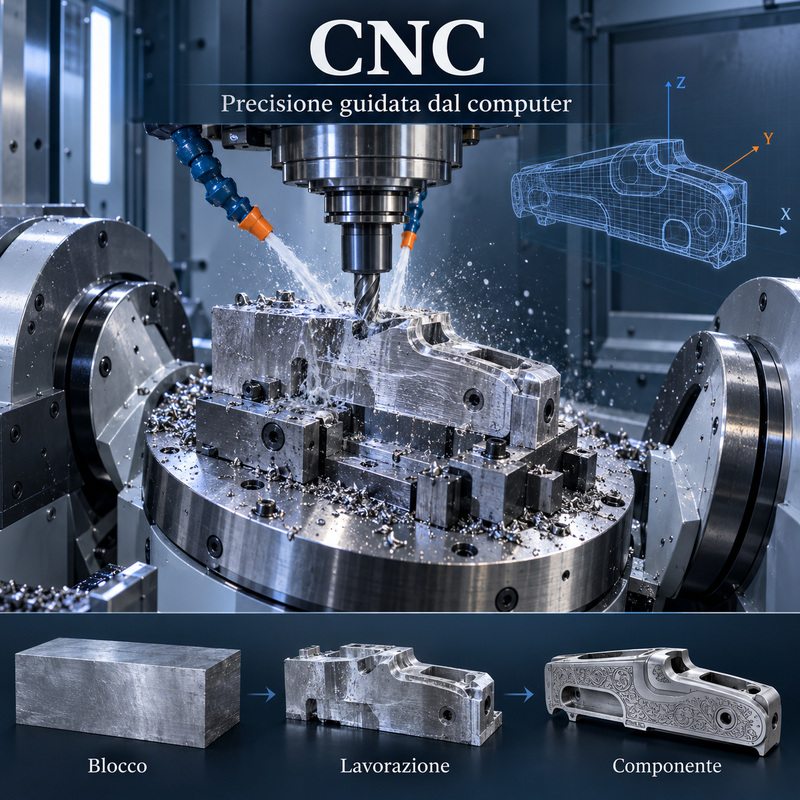
CNC , an acronym for Computer Numerical Control , identifies machine tools controlled by numerical instructions processed by a computer. Milling machines, lathes, grinders, and CNC machining centers transform a block or bar of metal into a component with complex geometries and very tight tolerances. In the gunmaking industry, this technology is used to produce action frames, receivers, bolts, triggers, slides, locking components, and numerous other parts requiring precision and repeatability.
What is CNC?
A CNC machine executes programmed movements along one or more axes. The computer controls the position, direction, and speed of the tools, as well as parameters such as spindle rotation, cutting depth, and feed rate.
The processing takes place by following a sequence of instructions that describes the path necessary to obtain the designed geometry.
Numerical control can be applied to different technologies:
- milling;
- turning;
- drilling;
- boring;
- rectification;
- electrical discharge machining;
- laser or water cutting;
- engraving and marking.
From project to component
The process usually begins with the creation of a three-dimensional model using a CAD ( Computer-Aided Design) program.
The model defines the component's shape, dimensions, holes, surfaces, radii, chamfers, and functional characteristics. A CAM ( Computer-Aided Manufacturing) program then transforms the geometry into toolpaths.
The software determines how the tools should move to remove material without causing collisions, deformations or overloads.
The work program
Machine instructions are commonly expressed through G-code . Each command can specify a position, movement, speed, or specific function.
The program checks:
- axis coordinates;
- spindle speed;
- tool feed;
- tool change;
- refrigerant supply;
- sequence of processes;
- positioning and repetition of cycles.
Before production, the toolpath can be simulated to identify potential errors and verify that the tool reaches all intended surfaces.
CNC milling
In milling, it is normally the tool that rotates, while the workpiece and tool head move along the programmed axes.
Differently shaped and sized cutters progressively remove material. The initial operations, called roughing, eliminate large quantities of metal. Subsequent finishing operations produce more precise and smooth surfaces.
CNC milling is used to create seats, guides, end faces, housings, ribs, and curved surfaces.
CNC turning
In turning, the workpiece rotates while the tool moves along controlled paths. This process is particularly suitable for producing cylindrical or rotationally symmetrical components.
In the arms industry it can be used to make:
- external profiling of the rods;
- threads;
- pins;
- bushings;
- shutter parts;
- recovery system components;
- elements intended for the assembly of accessories.
Modern turning centers can integrate live tools, also performing milling and drilling without moving the workpiece to another machine.
The axes of movement
The simplest machines move along three main axes: X, Y and Z. These allow the tool to be moved in the three directions of space.
Four- or five-axis machining centers add rotation and tilting motion. The workpiece can be accessed from multiple directions without having to be removed and manually repositioned.
Five-axis machining allows for the production of complex surfaces and reduces the number of setups, improving precision between different areas of the component.
The placement of the piece
Before processing, the material must be fixed in a stable manner using vices, brackets, chucks or dedicated equipment.
The placement must prevent any movement, but without deforming the component. Even a small shift can compromise dimensions, concentricity, and alignment.
When the piece needs to be turned or moved, references are used that allow the machine to precisely find the position of the surfaces already machined.
The tools
The choice of tool depends on the material, geometry, and required finish. Milling cutters, drills, reamers, boring bars, taps, and inserts made of highly wear-resistant materials are used.
Diameter, number of cutting edges, coating and geometry must be coordinated with rotation speed and feed.
A worn tool can cause uneven surfaces, out-of-tolerance dimensions, overheating, and vibration. Monitoring its lifespan is therefore an integral part of CNC manufacturing.
The refrigerant
During cutting, friction and chip deformation generate heat. A coolant can cool the tool and workpiece, reduce friction, and promote chip evacuation.
Its action helps to keep the temperature more stable and to limit dimensional variations during processing.
Some materials and operations can be machined dry or with minimal amounts of lubricant. The choice depends on the process and the required characteristics.
Dimensional accuracy
One of the main advantages of CNC is the ability to repeat movements with high precision. This allows for the production of series of components with very similar characteristics.
However, actual accuracy also depends on:
- machine rigidity;
- quality of tools;
- stability of the fixing;
- ambient temperature;
- wear of mechanical components;
- correctness of the program;
- quality of the material processed.
The presence of numerical control does not eliminate the need for measurements and checks.
Tolerance and repeatability
Tolerance indicates the permissible deviation from the nominal measurement. Repeatability , on the other hand, describes the ability to obtain the same result by performing the process multiple times.
A machine can very regularly repeat an incorrect position if the program, origin, or tool are set incorrectly.
Precision and repeatability must therefore be accompanied by correct programming, calibration and dimensional control.
Machining from solid
Many gunsmithing components are machined from solid steel or light alloy using CNC machines. The machine starts with a bar, plate, or block, and gradually removes the excess material.
The process allows for precise control of geometries and surfaces, but can be time-consuming and generate large amounts of chips.
The term "machined from solid" describes the production method, but it doesn't automatically certify quality or strength. Alloy, design, treatments, and controls remain crucial.
The production of bascules
A receiver can be CNC machined from a solid block, a forged blank, or a precision-cast component.
The machines produce external surfaces, internal housings, pin seats, closing surfaces and passages for mechanisms.
The mating areas require very tight tolerances. Depending on the type and quality of the weapon, some surfaces may subsequently be manually finished and adjusted.
The processing of shutters
Shutters require precise control of diameters, lugs, ramps, grooves, and contact surfaces. Geometric errors can affect sliding, closing, and headspace.
CNC turning and milling allow you to perform many operations while maintaining common references. Heat treatments and grinding can then be applied.
The surfaces that bear the thrust of the cartridge must be checked with particular attention.
The processing of the reeds
CNC can intervene in numerous phases of barrel production, including external profiling, chambering, threading, seat milling and muzzle machining.
Internal scoring can be achieved using different technologies, such as buttoning, broaching, cold hammering or single-edge removal.
Numerical control does not therefore identify a single method of manufacturing the barrel, but coordinates various operations in which precision and repeatability are required.
CNC and EDM
EDM machines can also be numerically controlled. The tool or wire follows programmed paths while electrical discharges remove the material.
The technology allows for the processing of hardened steels and the creation of internal profiles, edges, and geometries that are difficult to achieve using rotating tools.
In gun manufacturing it can be used for trigger group elements, molds, dies, extractors and other precision components.
CNC and microcasting
Investment casting and CNC are often used together. Investment casting produces a rough part close to the final shape, while the machine tool finishes the functional surfaces.
This combination allows you to limit the material removed without sacrificing precision in the most important areas.
The same principle is applied to forged blanks, which are subsequently milled, turned or ground.
CNC and manual work
Numerical control doesn't necessarily eliminate the artisan's intervention. In more valuable weapons, CNC machining and manual operations can be integrated.
The machine produces repeatable dimensions and geometries; the gunsmith can handle coupling, polishing, finishing, engraving, and functional testing.
Quality does not depend on the contrast between technology and craftsmanship, but on the ability to use each method at the most appropriate stage.
The advantages of CNC
Key benefits include:
- high precision;
- good repeatability;
- creation of complex geometries;
- reduction of manual errors;
- production of uniform series;
- program traceability;
- ability to automate multiple operations;
- control of cutting parameters.
Once the cycle has been optimized, the same sequence can be repeated on numerous components while maintaining constant characteristics.
The limits of CNC
Machinery, software, tools, and equipment are expensive. Cycle preparation requires specialized personnel and can be complex for small quantities.
Among the main limitations we find:
- high initial investment;
- need for competent programming;
- tool wear;
- risk of collisions in case of error;
- need for precise fixings;
- preparation and testing times;
- chip production in solid machining.
A program error can be repeated with great precision on all the parts produced. Human control therefore remains indispensable.
Dimensional controls
After machining, the component is checked using calipers, micrometers, comparators, optical projectors and three-dimensional measuring machines.
Inspections can also be performed during the cycle using probes installed on the machine. These instruments detect the position of the workpiece, tool wear, and the dimensions of certain surfaces.
The final check establishes whether the component falls within the tolerances foreseen by the project.
The subsequent finishes
The surface produced by the tool may show slight traces of the machining process. Depending on the application, grinding, honing, polishing, lapping, or sandblasting are applied.
The piece can subsequently be subjected to burnishing, nitriding, chrome plating, anodizing or other protective treatments.
Before finishing, any burrs and unwanted edges that could hinder assembly and operation must be removed.
Did You Know?
A modern five-axis machine can machine multiple sides of the same component without requiring constant repositioning. Reducing setup times limits the accumulation of errors and improves the fit between different surfaces.
In short (Italian only)
The CNC automatically controls the movements of machine tools used to mill, turn, drill, grind, or erode metal. The process starts with the CAD model and is transformed into toolpaths by CAM software.
In the gunmaking industry it allows the production of action frames, frames, bolts, barrels and mechanical components with high precision and repeatability.
The final result still depends on the design, material quality, machine rigidity, tooling, programming, treatments, and inspections. CNC technology is therefore an extremely advanced production tool, but it doesn't replace the expertise of technicians and gunsmiths.