DLC , short for Diamond-Like Carbon , is a family of thin coatings based on amorphous carbon used to improve surface hardness, wear resistance and smoothness of mechanical components.
The name literally means "diamond-like carbon," because its structure combines bonds typical of diamond with others more similar to graphite. It is therefore not a layer of natural diamond, but a technical coating deposited on the surface using vacuum or plasma-assisted processes.
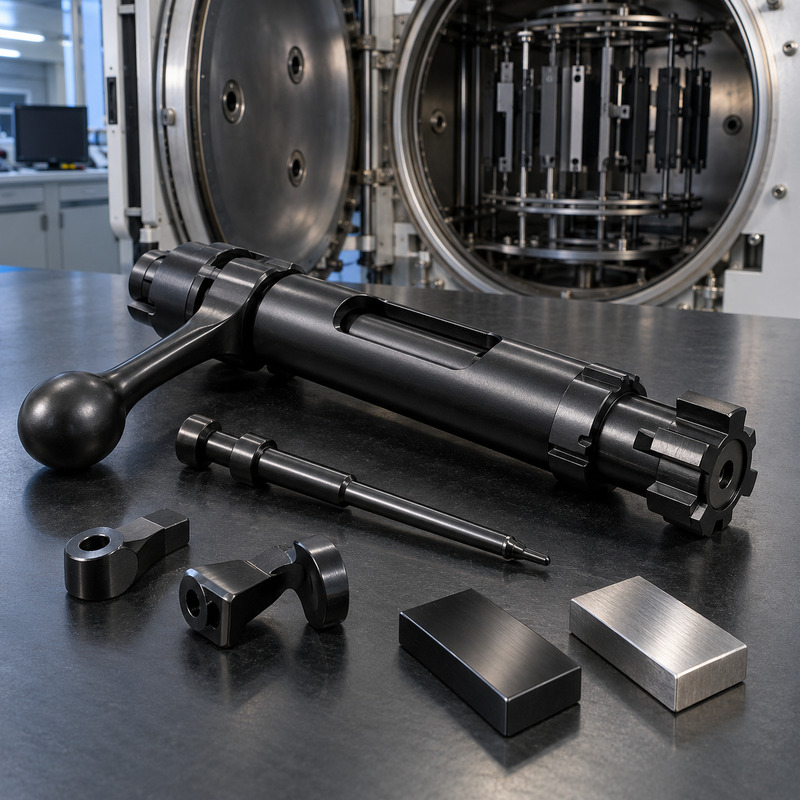
In the firearms industry, DLC can be applied to bolts, firing pins, trigger group components, pins, guides, and other parts subject to rubbing . The generally black or anthracite color also gives it a modern, uniform appearance.
What is Diamond-Like Carbon?
DLC is composed primarily of carbon arranged in an amorphous structure, meaning it lacks the regular crystalline ordering of diamond. Two main types of bonds can be present within it:
- sp³: characteristic bond of diamond, associated with high hardness;
- sp²: characteristic bond of graphite, which can contribute to its smoothness.
The ratio of these bonds, the presence of hydrogen, and the addition of other elements determine the characteristics of the coating. The term DLC therefore encompasses different materials, not a single product with universal properties.
The main families include:
- B.C: amorphous carbon devoid of hydrogen;
- BC:H: hydrogenated amorphous carbon;
- ta-C: tetrahedral amorphous carbon with a high percentage of sp³ bonds;
- ta-C:H: tetrahedral amorphous carbon containing hydrogen;
- Drugged DLC: coatings modified with silicon, tungsten, metals or other elements.
How the DLC is applied
The coating is deposited in a vacuum chamber through processes mainly belonging to PVD and PACVD or PECVD technologies.
PVD deposition
Physical vapor deposition, or PVD, transfers material from the source to the component through a very low-pressure environment. Carbon is vaporized or expelled from the source and subsequently condensed on the surface.
Possible techniques include sputtering, filtered cathodic arc, and other forms of ion deposition. Process parameters influence hardness, residual stresses, adhesion, and layer thickness.
PACVD or PECVD deposition
Plasma-assisted chemical vapor deposition uses carbon-containing gases activated inside the chamber. The plasma separates the molecules and allows the carbon to form a coating on the component's surface.
This technology often allows working at relatively low temperatures, making it possible to treat already hardened steels without excessively altering their metallurgical characteristics. Compatibility must, however, be verified based on the steel and the temperature required for the cycle.
Surface preparation
DLC is an extremely thin layer and cannot correct scratches, porosity, or manufacturing defects. The quality of the initial surface is therefore crucial.
Before deposition the component is normally subjected to:
- thorough degreasing;
- washing with specific products;
- possible polishing or grinding;
- ultrasonic cleaning;
- controlled drying;
- surface activation by plasma;
- removal of oxides and contaminants.
Oil residues, abrasive pastes, oxides, or fingerprints can prevent proper adhesion. Sharp edges and sudden geometric changes can also create critical areas.
Adhesion layers
An intermediate layer can be deposited between the metal and the DLC to improve adhesion and manage the differences in behavior between the coating and the substrate.
Depending on the cycle used, the intermediate layers can be made of chromium, titanium, silicon, or other materials. The overall structure can therefore be multilayered, even if it appears as a uniform black surface from the outside.
Interface selection is particularly important because some DLCs exhibit high internal stresses. Without proper deposition cycles, the layer may peel or detach under load.
Coating thickness
DLC is applied in thicknesses generally measured in micrometers . Depending on the process and function, the layer can vary from approximately less than a micrometer to a few micrometers.
The reduced thickness is an advantage for precision mechanical parts, but must be considered when calculating tolerances. The coating affects all surfaces reached by the process and can slightly modify:
- diameter of pins and seats;
- games between sliding parts;
- threaded couplings;
- dimensions of the support surfaces;
- geometry of the trigger components.
Surfaces that do not need to be coated are protected by masking. Application to a finished component therefore requires precise dimensional assessment.
DLC Hardness
Hardness can reach very high values, but varies considerably between different families. Coatings with a higher sp³ bond content, such as some ta-C, can be harder than hydrogenated formulations.
The declared hardness should not be confused with the hardness of the entire component. DLC forms a thin film supported by the underlying material. If the substrate is too soft, it can deform under load and cause the coating to crack or peel.
To obtain good performance it is therefore necessary that the hardness and preparation of the metal are compatible with the surface layer.
Friction reduction
One of the main advantages of DLC is its low coefficient of friction . Under favorable conditions, contact between a coated surface and a suitably prepared counterpart can be significantly smoother than between two untreated metal surfaces.
The actual value depends on several factors:
- DLC type;
- material of the opposing surface;
- initial roughness;
- contact pressure;
- temperature;
- presence and type of lubricant;
- humidity and working environment;
- speed of movement.
It's therefore incorrect to attribute a single friction coefficient to all DLCs. Some formulations work better dry, others in combination with a specific lubricant.
DLC and lubrication
The smoothness of the coating can reduce the amount of lubricant required in certain couplings, but it does not mean that every component can run completely dry.
Lubrication continues to perform several functions:
- reduces friction and temperature;
- removes abrasive particles;
- protects uncoated surfaces;
- limits corrosion in exposed areas;
- promotes the proper functioning of mechanisms.
For maintenance, the instructions of the weapon manufacturer and the treatment must be followed.
Wear resistance
The combination of hardness and low friction makes DLC particularly effective against adhesive and abrasive wear . It can limit scoring, seizing, and material loss in parts subjected to repeated movements.
However, performance depends on the correct design of the coupling. Local pressures
“` `
“`html
DLC: Features and Use in Hunting Weapons
DLC , short for Diamond-Like Carbon , is a family of thin amorphous carbon-based coatings used to increase the surface hardness, reduce friction, and improve the wear resistance of metal components.
The name literally means "diamond-like carbon," because its structure features a combination of bonds typical of graphite and diamond. However, it is not natural diamond nor a thick ceramic layer: DLC is a technical film just a few micrometers thick , deposited on the surface of the component using vacuum processes.
In the firearms industry, it can be applied to bolts, firing pins, trigger components, guides, pistons, locking surfaces, and other parts subject to sliding. The most common color is black or anthracite, but the aesthetic appearance is merely a consequence of the treatment and not its primary function.
What is Diamond-Like Carbon?
DLC is composed primarily of amorphous carbon, in which the atoms do not form a regular crystal lattice like that of diamond. The structure contains, in varying proportions:
- sp² bonds: associated with the graphite structure;
- sp³ bonds: associated with the diamond structure;
- possible hydrogen;
- any elements added to modify the properties of the coating.
The percentage and arrangement of these bonds influence hardness, elasticity, friction, thermal stability, and internal stresses. For this reason, the acronym DLC does not identify a single material with consistently identical characteristics.
The main DLC families
The technical classification distinguishes different types of coating. Among the most common are:
- B.C: amorphous carbon free or nearly free of hydrogen;
- BC:H: hydrogenated amorphous carbon;
- ta-C: tetrahedral amorphous carbon with a high percentage of sp³ bonds;
- ta-C:H: tetrahedral amorphous carbon containing hydrogen;
- Me-DLC: coating modified by the addition of metal elements;
- Yes-DLC: DLC containing silicon to modify friction, adhesion and environmental behavior;
- WC/C: system containing carbon and tungsten carbide, used in tribological applications.
The trade names used by manufacturers may not perfectly match this classification. To compare two treatments, you need to know at least the type of DLC, hardness, thickness, deposition temperature, and the nature of the interlayers.
How the DLC is applied
The coating is deposited in a vacuum chamber using processes mainly related to PVD and PACVD or PECVD technologies.
PVD deposition
Physical vapor deposition, or PVD, transfers the coating material to the component surface through physical processes such as cathodic arc, sputtering, or assisted evaporation.
The ionized particles reach the workpiece at a controlled energy and gradually form the film. Some very hard DLC variants, such as certain ta-C coatings, can be obtained using specific PVD techniques.
PACVD or PECVD deposition
Plasma-assisted chemical vapor deposition uses carbon-containing gases. The plasma fragments the molecules and allows the carbon atoms to deposit on the component, forming the coating.
This technology allows for processing at relatively low temperatures compared to other treatments, making it possible to coat various already hardened steels without necessarily altering their characteristics. Compatibility must, however, be verified for each material and metallurgical state.
Surface preparation
DLC is very thin and doesn't hide scratches, porosity, or manufacturing defects. On the contrary, it tends to faithfully reproduce the surface on which it is deposited.
Before treatment, the component is subjected to operations which may include:
- sanding or polishing;
- grinding of functional surfaces;
- washing and degreasing;
- ultrasonic cleaning;
- controlled drying;
- ionic cleaning inside the chamber;
- masking of areas that do not need to be coated.
Traces of oil, oxides, dust, or polishing residues can compromise adhesion. The quality of the preparation is therefore as crucial as the deposition process.
Adhesion layers
DLC is not always deposited directly on steel. One or more intermediate layers may be applied to improve adhesion, reduce stress, and create a transition between the metal substrate and the carbon film.
Materials that can be used for bonding layers include chromium, titanium, silicon, and metal carbides. The composition varies depending on the DLC, the base material, and the intended use.
A very hard coating applied to a very soft substrate can fail under the load because the underlying metal deforms. For this reason, the final performance depends on the entire system consisting of:
- component material;
- heat treatment;
- surface finish;
- adhesion layer;
- DLC coating;
- geometry and working conditions.
Coating thickness
The thickness of a DLC coating intended for mechanical components is typically in the order of a few micrometers . The exact value depends on the process and the application.
The reduced thickness allows for coating even parts manufactured with precise tolerances. However, it must be considered during the design process, especially when tight fits, calibrated seats, and sealing surfaces are involved.
A thicker layer is not automatically better. Increasing the thickness can increase internal stresses and the risk of detachment. The coating must be designed based on the load and the surface to be protected.
DLC Hardness
One of the main characteristics of DLC is its high surface hardness . Depending on the type, the coating can reach values much higher than those of treated steels.
Hardness is generally measured by nanoindentation and can range from approximately just over 1.000 HV to over 5.000 HV for some formulations with high sp³ bond content. This data must be interpreted in conjunction with elasticity, toughness, thickness, and adhesion.
An extremely hard but brittle or poorly adhering coating may perform worse than a less hard DLC that is better suited to component deformations.
Low coefficient of friction
DLC is used primarily for its tribological properties , i.e. the behavior of surfaces subjected to contact, friction and wear.
Under favorable conditions, the coefficient of friction against steel can be very low, often between 0,05 and 0,20 . The actual value, however, depends on:
- DLC type;
- antagonistic material;
- lubrication;
- contact pressure;
- roughness;
- temperature;
- environmental humidity;
- presence of contaminants.
The treatment can reduce sliding resistance and limit seizure phenomena, but does not automatically eliminate the need for lubrication specified by the manufacturer.
Wear resistance
The combination of hardness and low friction makes DLC effective against:
- adhesive wear;
- surface abrasion;
- microwelding between metal parts;
- scuffing and crawling;
- wear during running-in;
- damage under conditions of limited lubrication.
However, the coating does not make the component indestructible. Sand, metal debris, and hard particles can scratch the surface or create concentrated pressure sufficient to damage the film.
DLC in weapon components
In the weapons industry, DLC can be applied to components subjected to sliding, rotation, or repeated contact. Possible applications include:
- shutter body;
- shutter head and fins, when provided for by the project;
- striker;
- extractor and ejector;
- trigger group components;
- guides and sliding surfaces;
- pistons of semi-automatic systems;
- levers and pins;
- valve parts in air guns;
- components of knives and hunting tools.
Compatibility with the treatment must be specified by the manufacturer. Not all parts can be coated without altering clearances, dimensions, and functional characteristics.
DLC on the shutter
The shutter is one of the most interesting applications. The coating can make sliding smoother, reduce residue adhesion, and protect surfaces from wear.
The smoother feel also depends on the quality of the workmanship, the straightness of the guides, the tolerances, and the finish prior to treatment. DLC cannot correct a defective geometric fit.
On locking lugs and other surfaces subject to high contact pressures, substrate, hardness, thickness, and adhesion must be carefully evaluated. The coating does not increase the structural strength of the shutter and is not a substitute for proper heat treatment of the steel.
DLC in shooting groups
On levers, pins, and attachment surfaces, low friction can help smooth movement and limit wear. The result, however, depends on the geometry and proper surface polishing.
Film thickness must be considered with particular attention, because small dimensional variations can alter the functioning of components characterised by very tight tolerances.
corrosion protection
Amorphous carbon is chemically stable and can provide a barrier against moisture and corrosive agents. However, effective protection depends on the film's continuity, the presence of pores, edges, holes, and any damage.
Because the layer is very thin, a deep scratch can expose the underlying metal. Furthermore, some geometries can be difficult to coat evenly.
DLC can therefore improve corrosion resistance, but it should not be automatically considered waterproof or equivalent to complete corrosion protection. Maintenance of the weapon remains necessary.
Color and surface appearance
DLC generally has a color ranging from anthracite gray to deep black . Its appearance can be glossy, satin, or matte depending on the substrate preparation and the type of treatment.
Since the film reproduces the underlying surface:
- a polished steel usually produces a brighter appearance;
- a satin surface stays satin;
- tool marks and imperfections may remain visible;
- excessive roughness is not filled by the coating.
The aesthetic finish must therefore be prepared before deposition.
DLC and burnishing
Blackening is a chemical conversion of the steel surface that forms a black oxide layer. It provides a traditional appearance and corrosion protection that must be supplemented with oil.
DLC, on the other hand, is a vacuum-deposited coating that is much harder and has superior anti-friction properties. It's more expensive and complex, but can offer significantly higher wear resistance.
DLC and nitriding
Nitriding modifies the surface of steel through the diffusion of nitrogen. Unlike DLC, it doesn't just create a thin, overlapping film, but forms a modified layer that extends into the material.
The two treatments are not necessarily alternatives. In some systems, the substrate can be nitrided before the DLC is applied, resulting in a harder support surface. This combined treatment is sometimes referred to as a duplex system.
DLC and nitride-based PVD coatings
Coatings such as TiN, CrN and AlTiN are also deposited using PVD technologies, but have different compositions, colors and properties.
DLC is particularly valued for its low coefficient of friction. Nitrides can offer greater stability at elevated temperatures and specific wear and corrosion resistance properties.
The acronym PVD refers to the deposition process and not the coating material. Therefore, not all PVD coatings are DLC.
DLC and Cerakote
Cerakote is a ceramic-based composite coating applied in the liquid state and then cured. It can cover large surfaces, offer numerous colors , and improve weather protection.
DLC is deposited under vacuum, is generally thinner and is primarily designed to reduce friction and wear on mechanical surfaces.
In summary:
- DLC is particularly suitable for moving parts and those subject to rubbing;
- Cerakote is particularly suitable for the protection and colouring of external surfaces;
- the two treatments can perform complementary functions on the same weapon.
Limits of DLC treatment
Major limitations include:
- higher cost than traditional finishes;
- need for vacuum systems;
- very careful surface preparation;
- possible adhesion problems on unsuitable materials;
- risk of detachment if the substrate deforms;
- difficulty in uniformly lining deep cavities;
- inability to hide previous scratches and defects;
- need to protect threads and calibrated surfaces;
- local repairs generally impractical.
If the coating is damaged, restoration usually requires controlled removal of the layer and professional re-application.
Cleaning and maintenance
DLC surfaces are generally easy to clean because they have low friction and a reduced tendency for residue to stick. However, the manufacturer's instructions for the weapon and the treatment must be followed.
È consigliabile:
- remove dust and abrasive particles before operating the mechanism;
- use detergents compatible with the coating and the substrate;
- avoid abrasive pastes and aggressive polishes;
- apply the lubricant provided in the indicated points;
- check edges and contact surfaces;
- Do not modify or rectify coated components without technical verification.
The low friction coefficient doesn't mean the gun needs to run completely dry. Lubrication, quantity, and frequency should follow the manufacturer's instructions.
DLC Benefits
- high surface hardness;
- low coefficient of friction;
- excellent wear resistance;
- reduction of the risk of seizure;
- very low thickness;
- possible improvement of corrosion protection;
- ease of cleaning;
- elegant and technical black or anthracite look;
- possibility of application on precision components.
Final houghts
DLC is a technologically advanced coating, particularly suitable for gun parts subject to sliding, friction , and wear. It can improve operation, protect surfaces, and extend the service life of treated parts.
Performance doesn't depend solely on the brand name or declared hardness. The type of DLC, surface preparation, interlayers, thickness, component material, and actual application conditions must all be evaluated.
The treatment does not increase the structural strength of a part or correct imperfect machining or tolerances. When applied correctly to a suitable substrate, however, it represents one of the most effective solutions for combining hardness, smoothness, wear resistance, and an aesthetic finish.