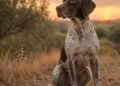
The Drahthaar , officially known as the German Drahthaar , is one of the most complete and versatile continental hunting dogs developed by the German school. Robust, athletic, intelligent, and boasting a distinctive hard, protective coat, it was selected with a specific goal: to create a companion capable of accompanying the hunter in almost all phases of the hunting action.
The Drahthaar is not just a pointing dog. It must be able to search, point, retrieve, bring back, work in water, follow a trail, and deal with difficult vegetation and weather conditions . It is precisely this versatility that represents the heart of the breed and distinguishes it from many dogs selected primarily for a single specialization.
Its philosophy stems from the German tradition of the Gebrauchshund , the truly useful and complete hunting dog. The large Drahthaar must therefore not only impress with the hardness of its coat or its physical power: above all, it must demonstrate balance, smell, connection, working ability before and after the shot, and great reliability.
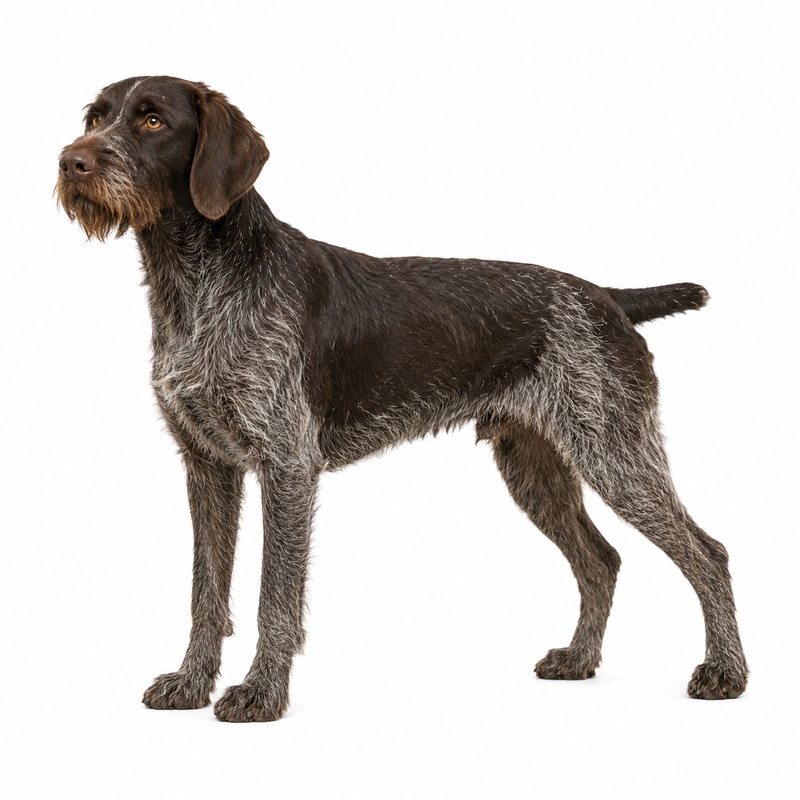
Drahthaar: identity card
| Official name | German Wirehaired Pointer |
| Commonly used name | Drahthaar |
| Italian name | German Wirehaired Pointer |
| country of origin | Germany |
| Hunting category | Multipurpose continental pointing dog |
| FCI Classification | Group 7 – Pointing Dogs |
| FCI Standards | N. 98 |
| Test of work | Expected |
| Size | Medium-large |
| Male height | 61-68 cm approximately |
| Female height | 57-64 cm approximately |
| cloak | Hard, close-fitting, thick and protective, with undercoat |
| Typical colors | Brown roan, black roan, brown with or without white chest patch |
| Temperament | Balanced, decisive, intelligent, energetic and very collaborative |
| Main attitude | Multipurpose hunting before and after shooting |
The main hunting skills of the Drahthaar
| Ferme | ★ ★ ★ ★ ★ |
| Smell | ★ ★ ★ ★ ★ |
| Search | ★ ★ ★ ★ ★ |
| I'm reporting | ★ ★ ★ ★ ★ |
| Recovery | ★ ★ ★ ★ ★ |
| Work in water | ★ ★ ★ ★ ★ |
| Work on the track | ★ ★ ★ ★ ★ |
| Resistance | ★ ★ ★ ★ ★ |
| Work in difficult vegetation | ★ ★ ★ ★ ★ |
| Connection with the conductor | ★ ★ ★ ★ ★ |
| Swift | ★★★★ ☆ |
| Hunting versatility | ★ ★ ★ ★ ★ |
The ratings provided are indicative and describe the aptitudes generally associated with the breed. The characteristics of each individual dog depend on its pedigree, selection, experience, training, and hunting use.
The Drahthaar in a nutshell: a true all-round hunting dog
To understand Drahthaar we must start from the philosophy that determined its selection.
The goal wasn't to create the fastest dog, the most spectacular pointer, or the most specialized retriever. Instead, German breeders were looking for a companion capable of doing many different things well.
The Drahthaar must find and stop the game before the shot, but its work continues even after: recovery, retrieving, watering and tracking are all part of the same functional concept.
It is precisely this completeness that makes it one of the most representative breeds of the German hunting dog tradition.
Origins and history of Deutsch Drahthaar
The modern formation of Deutsch Drahthaar began in Germany in the late 19th and early 20th centuries.
The selection developed in a period in which German hunters were trying to create increasingly complete and functional dogs, capable of tackling different game, terrain and climatic conditions.
A fundamental role was played by the ideas of Siegfried, Baron von Zedlitz und Neukirch , known in dog-loving circles under the pseudonym Hegewald.
His philosophy strongly supported the principle that work performance should have priority in selection.
The modern Drahthaar was therefore born through a selective program aimed at creating a robust, balanced dog, equipped with a protective coat and above all extremely versatile.
Hegewald and the philosophy of the all-purpose dog
The name Hegewald is closely linked to the history of the Drahthaar.
His fundamental idea was to build a dog capable of satisfying the real needs of the German hunter.
The dog had to be effective:
in searching, pointing, retrieving, in water, recovering and working on the trail.
Morphology therefore had to always be subordinated to function.
This concept has profoundly influenced the selection of the breed and continues to represent one of its most important characteristics today.
The breeds used in the training of the Drahthaar
The formation of the modern Deutsch Drahthaar involved different populations of wire-haired pointing dogs.
Among the breeds historically associated with the selective process, the Griffon Korthals, the Pudelpointer and the Stichelhaar are generally remembered , together with the contribution of the Deutsch Kurzhaar to consolidate some functional qualities.
The goal was not simply to mix different morphological characteristics, but to establish a coherent set of qualities:
functional coat, olfactory ability, pointing, retrieving, endurance, balance and versatility.
The birth of the Verein Deutsch-Drahthaar
At the beginning of the twentieth century, the selection of the breed was progressively organised through dedicated structures.
The work of German breeders contributed to defining a dog that was increasingly homogeneous in morphological and functional characteristics.
The selection process maintained a strong focus on working trials , considered fundamental to verify that the qualities required by the hunter were actually present in the breeders.
Morphology of the Drahthaar
The Drahthaar has a strong, athletic and harmonious build.
The structure must transmit power without becoming heavy, because the dog must be able to move for many hours on different terrains.
The body is muscular, the chest well developed and the limbs solid.
The head is one of the most distinctive parts of the breed. The beard and eyebrows give the dog its typical energetic and determined expression.
However, the entire morphology must remain functional to the work.
The Drahthaar's Head
The head must be in proportion to the body and sufficiently long.
The nose is developed, with open nostrils and suitable for olfactory work.
The eyes must express attention and confidence.
The characteristic eyebrows and beard derive from the structure of the wire hair and contribute to the typicality of the breed.
The beard should not be interpreted only as an aesthetic element, but as part of an overall coat developed to protect the dog during work.
The Drahthaar's wire-haired
The coat represents one of the most important elements of the breed.
The coat must be hard, close-fitting and dense , accompanied by an undercoat capable of offering protection against cold, humidity and vegetation.
The length must allow the dog to be protected without hindering its movement.
The ideal coat should not be excessively soft, woolly or long.
The hard consistency in fact represents a truly functional characteristic for the dog destined to work in brambles, undergrowth, swamps and challenging climatic conditions.
Why the Drahthaar's coat is so important
In the Drahthaar, the coat does not simply represent an element of the morphological standard.
It is a real natural protective equipment.
The dog must be able to walk through thick vegetation, enter cold water and work in difficult weather conditions while maintaining good skin protection.
The quality of the fur is therefore one of the elements that the hunter should carefully evaluate when choosing the subject.
The colors of the Drahthaar
Among the typical colors we find:
brown roan;
black roan;
brown with or without white chest patch.
Color distribution can vary greatly between subjects.
The hunting value of the dog does not naturally depend on the shade of the coat, but on the overall quality of the selection.
The Drahthaar on the hunt: how it works
The hunting Drahthaar must demonstrate a particularly interesting balance between initiative and cooperation.
During the search, he explores the terrain using wind and scent. When he spots an interesting scent, he must locate the game and stop it.
After the shot, the work changes completely: the dog must be able to recover and bring back the shot animal or help search for a wounded game.
This continuity between work before and after the shot represents one of the central characteristics of the breed.
The Quest for the Drahthaar
The search must be energetic, systematic and adapted to the terrain.
In open spaces the dog can increase the width, while in the woods and in dense vegetation it must spontaneously reduce the distance.
The Drahthaar is not selected for a large, exhausting search like that of some British specialists.
Its action must above all be useful, methodical and functional when encountering game.
The Drahthaar's sense of smell
Olfactory abilities are a fundamental component of the breed.
The Drahthaar must be able to work both on aerial emanations during the search and on olfactory information present on the ground when used for tracking and retrieving.
This olfactory versatility is particularly interesting because the dog must adapt the way it uses its nose to the task at hand.
The Drahthaar's stop
The point is naturally one of the fundamental characteristics of the Deutsch Drahthaar.
When the dog locates the game, it must stop moving confidently, maintaining its position and allowing the hunter to approach.
The point must be functional and accompanied by a good ability to control the game.
Experience and knowledge of the different species gradually allow the dog to become more precise.
The Drahthaar Guide
When the game tends to move on the ground, the Drahthaar must be able to lead.
The dog must maintain contact with the emanation by advancing cautiously.
Pheasant and other species prone to stalking require a special balance between determination and control.
A mature subject progressively learns to adapt the pressure exerted according to the behaviour of the game.
The report in the Drahthaar
The retrieve represents one of the most important qualities of the breed.
The dog must be able to retrieve killed game both on land and in water.
The natural predisposition must be consolidated through correct training, aimed at obtaining reliable behavior.
A complete Drahthaar must therefore demonstrate great willingness to cooperate even after the shot.
The Drahthaar and work in water
Water work is one of the specializations in which the Drahthaar can express its versatility very well.
The hard coat and undercoat help protect it in humid areas and cold waters.
The dog must demonstrate decisiveness in entering and the ability to swim effectively.
A good natural predisposition must, however, be developed through gradual and positive experiences.
Retrieving aquatic game
A properly trained Drahthaar can become an excellent assistant in the search and retrieval of aquatic game.
The dog must use its nose, sight and swimming ability to locate the head and bring it back to the handler.
The combination of protective coat, endurance and retrieving makes the breed particularly interesting for the hunter who frequents wetlands.
The Drahthaar on the trail
One of the characteristics that most distinguishes the Drahthaar from many pointing specialists is the ability to work on the track.
The dog can be trained to track wounded game using method and concentration.
This job requires a different behavior than hunting for feathered game.
The subject must reduce speed and amplitude and concentrate on the assigned track.
Drahthaar and recovery of injured ungulates
German tradition places great value on the recovery of wounded game.
A properly trained Drahthaar can help search for injured ungulates by using its olfactory abilities, perseverance and connection with the handler.
It should not be confused with an exclusive tracking specialist such as the Bayerischer Gebirgsschweisshund or the Hannoverischer Schweisshund, but its versatility allows it to also tackle this type of work.
The Drahthaar in the forest
The forest is one of the environments in which the Drahthaar manages to highlight many of its characteristics.
The protective coat allows the dog to tackle vegetation and undergrowth, while the athletic structure allows it to maintain prolonged work.
The search must adapt to the visibility and characteristics of the terrain, maintaining a good connection with the handler.
The Drahthaar in dense vegetation
Brambles, scrub and tangled vegetation represent environments in which the wire coat takes on a concrete importance.
The dog must enter decisively and continue to work even where other breeds more sensitive to vegetation may encounter greater difficulties.
Coat protection does not, of course, eliminate the need to check the dog after every outing.
The Drahthaar in woodcock hunting
Attitude: ★★★★★
The Drahthaar woodcock can become an extremely effective auxiliary.
The forest in fact values characteristics such as nose, connection, resistance, protective coat and the ability to adapt the search.
An expert must learn to read the terrain, identify the most promising remittances and interpret the emanations made complex by the wind and vegetation.
Its hardiness also represents an advantage on days characterised by brambles, rain and difficult climatic conditions.
Drahthaar and pheasant
Attitude: ★★★★★
The pheasant allows the Drahthaar to express almost all of its versatility.
Search, pointing, guiding and subsequent retrieval make this species particularly interesting for evaluating a complete dog.
The pheasant's tendency to stalk also tests intelligence and experience in managing the emanation.
Drahthaar and partridge
Attitude: ★★★★★
In open environments the Drahthaar can develop a wide and profitable search by effectively using the wind.
The partridge allows you to evaluate nose, method and precision in pointing.
However, the dog must maintain a sufficiently balanced action so as not to exert excessive pressure on the group.
Drahthaar and quail
Attitude: ★★★★★
Quail hunting requires precision in location and the ability to adapt the search to often relatively small spaces.
The Drahthaar can achieve excellent results thanks to the combination of smell, connection and point.
Drahthaar and partridge
Attitude: ★★★★★
Partridge hunting tests endurance and athletic ability.
The properly trained Drahthaar can handle terrains likeollinair and mountains maintaining great continuity.
Strong feet and physical preparation take on particular importance on the most demanding days.
Drahthaar and snipe
Attitude: ★★★★☆
The snipe requires olfactory precision and the ability to work in humid environments.
Drahthaar has particularly interesting characteristics for this type of soil thanks to its protective mantle and its predisposition to water.
What game can you hunt with the Drahthaar?
| Woodcock | ★ ★ ★ ★ ★ |
| Pheasant | ★ ★ ★ ★ ★ |
| Gray partridge | ★ ★ ★ ★ ★ |
| Quail | ★ ★ ★ ★ ★ |
| Partridge | ★ ★ ★ ★ ★ |
| Snipe | ★★★★ ☆ |
| Water game | ★ ★ ★ ★ ★ |
| Recovery of injured ungulates | ★★★★ ☆ |
The ideal soils for Drahthaar
| The Forest | ★ ★ ★ ★ ★ |
| Dense vegetation | ★ ★ ★ ★ ★ |
| Wetlands | ★ ★ ★ ★ ★ |
| Collina | ★ ★ ★ ★ ★ |
| Pianura | ★ ★ ★ ★ ★ |
| Mountain | ★ ★ ★ ★ ★ |
| Difficult terrain | ★ ★ ★ ★ ★ |
One of the Drahthaar's greatest strengths is its ability to adapt to extremely different territories.
Plains, forests, mountains and wetlands can all be tackled by the same dog by modifying its working method.
This characteristic represents one of the most evident expressions of the multipurpose philosophy that guided the selection of the breed.
How to recognize a good Drahthaar on the ground
A great Drahthaar should not be judged solely by the firmness or hardness of the coat.
We must observe the whole:
nose, search, connection, point, guided, retrieval, water, recovery, endurance, balance and adaptability.
The true quality of the breed emerges above all from the ability to move from one job to another while maintaining effectiveness.
A dog that is extraordinary at pointing but incapable of retrieving or working in water would represent only a part of the functional ideal of the German Drahthaar.
Character of the Drahthaar
The Drahthaar must have a balanced, confident, intelligent and determined character.
The dog's great energy and strong hunting motivation require an owner capable of building a consistent relationship.
The dog must be independent enough to make decisions on the ground but at the same time very cooperative.
Character quality is fundamental precisely because versatility requires the individual to face profoundly different situations.
The Drahthaar and the family
A properly socialized Drahthaar can develop a very close relationship with the family.
It must be remembered, however, that it remains an extremely active working dog.
He needs movement, mental stimulation and the opportunity to use his abilities.
An excessively sedentary life is not compatible with a breed selected to carry out numerous hunting tasks.
The relationship between Drahthaar and hunter
The connection represents one of the fundamental characteristics of the breed.
The dog must work independently without losing awareness of the handler's position and intentions.
This relationship becomes even more important in post-shot work, when dog and hunter must collaborate in search and recovery.
Drahthaar Training
The Drahthaar's training must be as complete as the breed itself.
Socialization
The young dog must gradually become acquainted with different people, animals, environments, noises and situations.
Recall
A reliable recall is an indispensable foundation for a dog intended to work in different environments.
First releases
The puppy must be able to explore and develop initiative without being constantly corrected.
Encounter with the wild game
Contact with real wild animals represents a fundamental phase of training.
Ferme
The natural predisposition must be progressively consolidated without excessively rigid interventions.
I'm reporting
Retrieving must be developed with great care because it is one of the central skills of the breed.
Work in water
The young dog should be gradually introduced to water through positive experiences.
Track
The first artificial slopes can be simple and short, progressively increasing in difficulty and time spent since their preparation.
Shooting habits
The introduction to shooting must occur gradually and always in association with positive experiences.
The Drahthaar and German working trials
German selective breeding culture places great importance on working trials.
The fundamental principle consists in evaluating the dog not only during the point, but through a set of qualities that reflect its real hunting usefulness.
Search, pointing, retrieving, water, tracking, character and collaboration contribute to building the profile of the multipurpose subject.
This selective philosophy has played a decisive role in maintaining the functional characteristics of the breed.
Drahthaar's athletic preparation
The dog's robustness should not lead one to think that it can work without proper training.
The Drahthaar must be able to cope with hours of searching, water, vegetation and difficult terrain.
The preparation must develop:
cardiovascular endurance, musculature, agility, recovery ability and foot strength.
Training must be progressive and maintained throughout the year.
Coat Care for the Drahthaar
Wire hair requires specific maintenance.
The main function must be to maintain hardness, density and protective capacity.
Excessive interventions that alter the natural structure of the hair can reduce its functionality.
After every outing, it is important to check the beard, ears, armpits, belly, limbs and interdigital spaces.
Drahthaar Care After Hunting
After days spent in the woods, in water or in thick vegetation, it is advisable to carefully check the dog.
Particular attention must be paid to:
eyes, ears, feet, pads, interdigital spaces, skin, chest and abdomen.
Foxtails, thorns, ticks and small lesions must be identified quickly.
After working in the water, it is also important to dry the dog properly and check its ears.
Drahthaar Health and Management
When choosing a puppy, you should favor breeders who carefully select based on health, character, functional morphology and working ability.
In a breed that is strongly oriented towards versatility, it is particularly important to know the real performance of the parents and ancestors.
The dog must also be kept at the correct weight and monitored through regular exercise, adequate nutrition, anti-parasite prevention and periodic veterinary checks.
Is the Drahthaar the right hunting dog for you?
| Ferme | ★ ★ ★ ★ ★ |
| Smell | ★ ★ ★ ★ ★ |
| I'm reporting | ★ ★ ★ ★ ★ |
| Work in water | ★ ★ ★ ★ ★ |
| Track | ★ ★ ★ ★ ★ |
| Resistance | ★ ★ ★ ★ ★ |
| connection | ★ ★ ★ ★ ★ |
| I work in the thicket | ★ ★ ★ ★ ★ |
| Adaptability to terrain | ★ ★ ★ ★ ★ |
| Versatility | ★ ★ ★ ★ ★ |
| Need for activity | ★ ★ ★ ★ ★ |
The Drahthaar is particularly suitable for the hunter who wants a single dog capable of dealing with numerous hunting situations.
It can be ideal for those who alternate hunting feathered game, wetlands, woods and different forms of retrieval.
However, it requires time, activity, thorough training and a handler willing to develop all its qualities.
Drahthaar: strengths and aspects to consider
| Key features | Aspects to consider |
|---|---|
| Exceptional versatility | Requires full training |
| Excellent sense of smell | It needs a lot of activity |
| Reliable stop | Line selection is crucial |
| Excellent report | Great energy must be directed |
| Great work in the water | Requires athletic training |
| Good ability on the track | Requires a consistent conductor |
| Very protective coat | The coat requires proper maintenance |
| Great resistance | It is not ideal for a sedentary lifestyle |
| Adaptability to terrain | Its completeness must really be cultivated |
Drahthaar and Kurzhaar: what are the differences?
The comparison between the Drahthaar and the Kurzhaar is particularly interesting because both represent great expressions of the German school of all-purpose hunting dogs.
The Kurzhaar has short hair and generally tends to express a more athletic, fast and light action.
The Drahthaar, on the other hand, has a hard, protective coat , which is particularly useful in water, thick vegetation and difficult climatic conditions.
Both can offer searching, pointing, retrieving and great versatility, but the Drahthaar is often particularly appreciated when hardiness and coat protection take on greater importance.
Drahthaar and Korthals
Drahthaar and Griffone Korthals are two important continental wirehaireds, but they have different histories and breeding philosophies.
The Drahthaar is deeply rooted in the German all-purpose dog system and is bred to perform numerous tasks before and after the shot.
The Korthals has its own identity and is particularly appreciated for its method, connection and ability to tackle difficult terrain.
Both possess protective coats and great versatility, but the choice should consider bloodlines, hunting style and handler preferences.
Drahthaar and Italian Spinone
The comparison between the Drahthaar and the Spinone Italiano pits two large wire-haired continental dogs against each other.
Spinone has a profoundly Italian style, characterised by method, rusticity and great olfactory capacity.
The Drahthaar, on the other hand, presents a selection strongly oriented towards complete versatility , including pointing, retrieving, water and tracking.
Both breeds can be extremely effective in difficult terrain, but through different working methods.
Drahthaar and Weimaraner
The Drahthaar and Weimaraner share the German tradition of being a complete hunting dog.
The Weimaraner has a distinctive gray coat and elegant build, while the Drahthaar has a harsh coat designed to provide more protection.
Both can be used before and after the shot and have a strong predisposition for collaboration.
The Drahthaar, however, tends to be particularly suitable for those who frequent more aggressive environments in terms of vegetation and climate.
Drahthaar or English Setter for woodcock?
The comparison is of particular interest to hunters who frequent the woods.
The English Setter is one of the great woodcock specialists and expresses its work through gallop, style and great olfactory ability.
The Drahthaar, on the other hand, offers greater rusticity, a protective coat and a versatility that also includes retrieving, water and tracking.
For those looking exclusively for a woodcock specialist, the specific forest pedigree can be of great importance; those looking for a dog that can be used in many forms of hunting will find the Drahthaar a clear advantage.
Similar breeds to the Drahthaar to know
Anyone who appreciates the German Drahthaar should also look into other important continental hunting dogs.
Kurzhaar – German short-haired, athletic and versatile pointing dog.
Griffon Korthals – continental, wire-haired, methodical and particularly effective in difficult terrain.
Spinone Italiano – historic Italian pointing dog with wire hair, robust and resistant.
Pudelpointer – German breed developed with a strong focus on hunting versatility.
Deutsch Stichelhaar – old German wire-haired pointing dog.
Weimaraner – a versatile German dog characterised by its typical grey coat.
Why choose a Drahthaar for hunting
The German Drahthaar probably represents one of the most complete expressions of the concept of a multipurpose hunting dog.
Its value comes from the union between smell, search, point, retrieval, water work, tracking, endurance, rusticity and connection.
The hard, protective coat allows it to tackle woods, brambles, swamps and difficult climatic conditions, while functional selection has maintained a strong working capacity before and after the shot.
It is therefore particularly suitable for the hunter who does not want an assistant limited to a single specialization, but wants a dog capable of adapting to different game and environments.
When it comes from a truly work-oriented selection, is correctly educated and develops all its aptitudes, the Drahthaar can become an extraordinarily complete hunting companion: a pointer when stopping is needed, a retriever when retrieving is needed, a swimmer when entering the water and a tracking dog when the work continues after the shot.