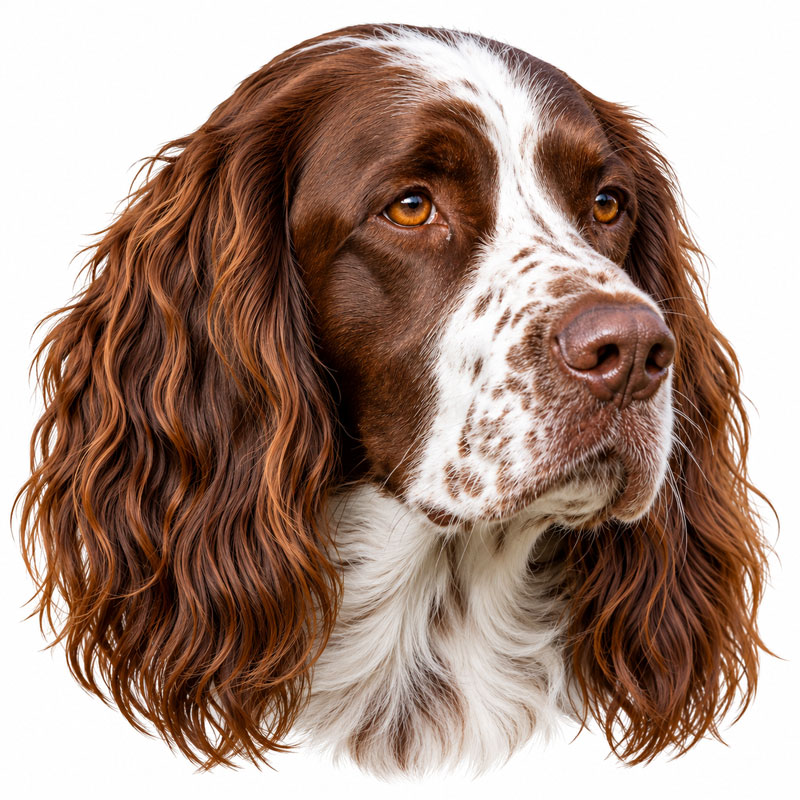
The French Spaniel, Also known as French Spaniel The French Spaniel is an elegant, long-haired continental pointing dog, belonging to the oldest French hunting tradition. Prized for the quality of its nose, its firm point, its endurance, and its cooperative nature, it represents a particularly interesting auxiliary for hunting feathered game in wooded areas, c.ollinari and plain.
Medium to large in size compared to other hunting spaniels, it has an athletic and harmonious build, a distinctive white and brown coat, and a generally sweet and balanced temperament. Its hunting style favors a methodical search, sufficiently wide but closely linked to the handler , in which olfactory precision and the ability to adapt take on greater importance than excessive speed.
Above all, it is a true pointing dog , capable of locating game, maintaining its scent, and coming to a decisive halt. Along with pointing, it combines a good retrieving ability with a natural versatility that makes it effective in retrieving and working in water. Its value is particularly evident in practical hunting, when it requires a combination of searching, caution, cooperation, and the ability to navigate different environments.

Épagneul Français: identity card of the breed
| Official name | French Spaniel |
| Italian name | French Spaniel |
| English name | French Spaniel |
| Origin | France |
| FCI Standards | 175 |
| Group | 7 – Pointing dogs |
| Section | 1.2 – Continental Pointing Dogs, Spaniel Type |
| Test of work | Expected |
| Male height | 56–61 cm at the withers |
| Female height | 55–59 cm at the withers |
| Standard tolerance | +2 cm / −1 cm |
| Construction | Braccoid, muscular, elegant and slightly elongated |
| cloak | Medium-long, silky, thick, with fringes |
| coloration | White and brown, with moderate mottling, speckles or roaning |
| Character | Balanced, docile, sociable, passionate about hunting |
| Specialization | Search and stop feathered game |
| Complementary skills | Retrieving, recovery and work in the water |
Origins and history of the Épagneul Français
The origins of the Épagneul Français can be traced back to the ancient chiens d'oysel , the bird dogs used in medieval France and mentioned in the hunting literature attributed to Gaston Phébus , author of the famous Livre de chasse . These auxiliaries were used to locate feathered game and assist the hunter in techniques prior to the spread of modern firearms.
The French term épagneul refers to a historical family of hunting dogs characterized by a generally longer coat than that of the pointer and a particular aptitude for tracking birds. The Épagneul Français occupies an important place in this tradition and is considered one of the historical references in the development of French spaniel-type dogs.
With the transition from hunting with nets and falcons to hunting with rifles, the demands changed profoundly. The dog had to not only locate birds, but also arrest them reliably , allowing the hunter to approach and prepare his shot. Selection therefore emphasized firmness, a good nose, stamina, and the ability to work in tandem with the man.
During the 19th century, the rise of other pointing breeds, especially British ones, contributed to changing the landscape of French hunting dog breeding. The preservation of the Épagneul Français gradually evolved through morphological definition and functional selection. The first standard was drawn up in 1891 by James de Connick , a fundamental step in the construction of the breed's modern identity.
In the twentieth century, the efforts of enthusiasts and specialized clubs helped preserve its characteristics. FCI recognition and the subsequent evolution of the standard consolidated the profile of an elegant and athletic dog, but above all capable of excelling in working trials and practical hunting. Even today, its value lies in the continuity between its ancient function as a bird dog and its modern specialization in pointing.
Morphology and physical characteristics
The French Spaniel is a medium-sized dog , strong without being coarse and elegant without appearing frail . The length of the body exceeds the height at the withers by approximately 2–3 centimeters, producing a slightly rectangular silhouette. This build allows for good range of motion, while the well-developed muscles and roomy chest promote endurance during hunting.
Head, eyes and ears
The head is carried proudly, proportionately and well-shaped, without excessive heaviness. The skull features prominent superciliary ridges and a progressive, moderately pronounced stop. The muzzle is slightly shorter than the skull, and a slightly convex nasal bridge is preferred by the standard to a perfectly straight one. The nose is brown, well pigmented, and has wide nostrils.
The oval, fairly large eyes, ranging in color from cinnamon to brown, give the breed a particularly sweet and intelligent expression. The ears are set back in line with the eyes, close to the head, and abundantly fringed. Their length is characteristic: carried gently forward, the cartilages should reach the beginning of the nose.
Trunk, limbs and movement
The neck is muscular, slightly arched, and free of dewlap. The back has a straight and stable topline, the loin is broad and powerful, and the croup is harmoniously sloped. The chest reaches to the elbow and has good capacity, necessary for sustained work. The limbs are lean and muscular, with correctly angulated shoulders and hindquarters capable of developing effective drive.
The feet are oval, with compact toes, strong nails, and resistant pads. The required gait is elastic, regular, energetic, and elegant , without excessive oscillation of the back. On the ground, the dog must be able to move fluidly, alternating trot and gallop according to conditions, without wasting energy.
Coat and colors
The coat is one of the French Spaniel's distinctive features. On the body, the hair is flat, silky, and dense , with slight waves permitted in certain areas. Longer, wavy feathering develops on the ears, behind the legs, and on the tail, while on the head, the hair remains short and fine.
The expected color is exclusively white and brown , with irregular markings, light to moderate speckles, and possible moderate roaning. The shades of brown can range from cinnamon to dark liver. A white blaze on the head is appreciated when properly proportioned, but its absence is permitted. The nose, the edges of the lips, and the eyelids must be brown and correctly pigmented.
The coat provides useful protection against vegetation, cold and humidity, but requires care after hunting, especially in fringed areas where thorns, seeds and small plant debris can remain.
The hunting aptitudes of the Épagneul Français
The French Spaniel's primary vocation is hunting feathered game using the search and point method . The breed combines a good sense of smell, a passion for hunting, and a willingness to cooperate, with a generally more measured style than the great British specialists of fast, wide-ranging hunting.
| Attitude | Orientation assessment | Feature |
|---|---|---|
| Search for feathered game | ★ ★ ★ ★ ★ | Methodical, adaptable and connected |
| Quality of the firm | ★ ★ ★ ★ ★ | Decisive and natural |
| Olfactory capacity | ★ ★ ★ ★ ★ | Good sensitivity to emanations |
| Hunting in the woods | ★ ★ ★ ★ ★ | Particularly interesting in mixed soils |
| Hunting in the plains | ★★★★ ☆ | Effective without exasperated search |
| I'm reporting | ★★★★ ☆ | Good natural predisposition |
| Work in water | ★★★★ ☆ | Good potential with proper preparation |
| Connection with the conductor | ★ ★ ★ ★ ★ | Generally close and collaborative |
| Physical endurance | ★★★★ ☆ | Good continuity in long runs |
| Large specialist search | ★★★ ☆☆ | It does not constitute the main purpose of the selection |
Ratings are indicative and describe the breed's general predispositions, not guaranteed results. Pedigree selection, training, experience, and individual dog quality can produce significant differences.
Search style, smell and point
The French Spaniel's search is characterized by a good combination of initiative, method, and connection . In open terrain, the dog can broaden its exploration, but tends to maintain a distance compatible with hunting cooperation. In woods and uneven vegetation, it naturally reduces its range, adapting its speed and direction to the possibilities offered by the environment.
Scent work is a fundamental aspect. A good subject uses air currents to intercept the game's scent and gradually changes pace when it detects a significant scent. The ability to distinguish a real presence from old or faint tracks improves with experience, especially when hunting birds that move a lot on the ground.
The French Spaniel's point must be clear, intense, and sufficiently stable . The standard places great importance on the dog's decisiveness in signaling game. Halting the action should not be interpreted as simple immobility: it is the consequence of correct olfactory localization, accompanied by the ability to maintain contact with the scent without causing premature flight.
When the game stalks away, controlled tracking may be necessary. The dog must then advance progressively, adjusting the pressure and maintaining cooperation with the hunter. This skill is particularly useful for pheasants, while for woodcock it takes on different characteristics due to the greater complexity of the scents in the undergrowth.
Woodcock hunting
La woodcock This represents one of the most interesting uses of the Épagneul Français. Its predisposition for methodical searching, its relationship with its handler, and its athletic structure allow it to tackle broadleaf forests, copses, forest edges, and environments withollinwhere the wild finds refuge.
In the woods, the challenge isn't just identifying a scent, but interpreting it correctly. Woodcocks can move on foot, change position, and utilize vegetation cover that disrupts air circulation. An effective dog must distinguish the trail left by the animal's passage from the actual presence of the game and reach a sufficiently safe point.
The French Spaniel can be particularly attractive to the hunter who prefers a thoughtful and well-organized search , in which distance does not become an obstacle to reaching the pointing dog. The ability to work continuously and without excessive dispersion can be an advantage in difficult woods, especially when visibility is limited.
Performance naturally depends on selection and experience. A dog primarily intended for woodcock hunting should be gradually introduced to forest work, developing sufficient independence to explore the vegetation without losing sight of the handler.
Pheasant, grey partridge, partridge and quail
Pheasant
Pheasant hunting highlights the French Spaniel's ability to combine tracking, pointing, and tracking. In fields, verges, and terrain with irregular vegetation, the dog must locate the scent and adapt to the behavior of game that frequently attempts to flee on foot. After a kill, the ability to retrieve allows the hunt to be completed, while in the case of a wounded animal, perseverance and precise scenting become crucial.
Grey partridge and partridge
Hunting grey partridge and partridge requires a dog capable of exploring the terrain using the wind correctly. In these situations, the French Spaniel must maintain an orderly search, wide enough to locate the birds, but not so aggressive as to cause them to continually flee prematurely. Careful approach and a solid point become crucial qualities, especially when dealing with wary flocks.
Quail
The French Spaniel can display a lively yet controlled search for quail in meadows, stubble, and suitable crops. The scents can be fragmented and require sensitivity and precision. A dog that works carefully, avoiding excessive acceleration when entering the target area, can enhance its pointing ability even on this small, migratory fowl.
Retrieval and work in water
The standard specifically recognizes the French Spaniel's ability to point and retrieve , in addition to its qualities as a pointer . This characteristic completes its hunting profile, allowing the dog to also contribute to operations after the shot.
Proper retrieval requires a firm but not excessively strong grip, a direct return to the handler, and an orderly delivery. Natural predisposition must be consolidated through progressive training, because enthusiasm and a desire to retrieve do not automatically guarantee reliability in difficult conditions.
The breed can also be trained for water work , taking advantage of its good physical structure and willingness to retrieve. However, it should not be confused with a Retriever specifically bred for this function or with a specialized water dog. Performance in wetlands depends on individual predispositions, water habits, and the training program.
When retrieving wounded game, the dog must be able to transition from a high-nose search to a more focused scent pattern. The ability to reconstruct a pheasant's movement or locate a bird fallen into vegetation is a highly useful skill and helps reduce the loss of wounded animals.
The ideal soils for the Épagneul Français
The French Spaniel's athletic build, protective coat, and adaptable search pattern allow it to tackle a variety of hunting environments. The breed thrives in mixed terrain, where fields, woods, meadows, and shrubs continually alternate, requiring the dog to adapt its behavior.
| Environment | Indicative attitude | Considerations |
|---|---|---|
| Broadleaf forests | ★ ★ ★ ★ ★ | Good context for linked search and work on woodcock |
| Collinwith woods and fields | ★ ★ ★ ★ ★ | Terrain particularly favorable to versatility |
| Meadows and crops | ★ ★ ★ ★ ★ | Suitable for pheasant, quail and other feathered game |
| Very open plains | ★★★★ ☆ | Effective, although not a specialist in large extreme search |
| Shrubby vegetation | ★★★★ ☆ | Good adaptability with coat maintenance |
| Wetlands | ★★★★ ☆ | Interesting for reporting, if properly prepared |
| Mountains and steep terrain | ★★★ ☆☆ | They require training, experience and evaluation of the conditions |
Character and relationship with the host
One of the most appreciated aspects of the French Spaniel is its character. The standard describes it as a balanced, honest, gentle, calm, and docile dog , capable of maintaining an intense hunting passion without necessarily displaying a nervous or overly independent temperament.
Docility is an important advantage in training, but it should not be confused with a total lack of initiative. When hunting, the dog must be able to make decisions, follow a command, and independently navigate a complex situation. Proper collaboration arises from a balance between these skills and the willingness to follow the handler's directions.
Outside of hunting, it can be an affectionate and sociable family companion, provided it receives exercise, olfactory stimulation, and opportunities for social interaction. Its hunting nature remains evident, however: a domestic garden is no substitute for working the land, and an exclusively sedentary lifestyle does not meet the needs of a dog bred for hunting.
Training: from puppy to hunting dog
The French Spaniel's training should capitalize on its natural predisposition to collaboration without suppressing its hunting initiative. In the first few months, socialization, recall, knowledge of the environment, and building a positive relationship with its handler are essential. The puppy must learn to explore the terrain and use its nose, while simultaneously maintaining the habit of checking the handler's position.
First outings and contact with game
Initial experiences should take place in safe environments, with progressive difficulty. The youngster should be able to encounter natural emanations, develop curiosity, and spontaneously point. The handler's intervention should be measured: too rigid a control in the early stages can reduce confidence and initiative, while unregulated freedom can make subsequent management of the search difficult.
Consolidation of the firm and the guided
When the natural point is consistently present, training can focus on stability, control of progress, and flight behavior. The lead must be constructed respecting the dog's sensitivity and the need to maintain a proper relationship with the emanation. The priority is to obtain a handler who understands the task, not simply a dog capable of executing commands in artificial conditions.
Introduction to shooting
The habit of firing a gun should be developed gradually, initially associating distant, controlled noises with positive situations. It's inappropriate to suddenly expose a young dog to close-range gunshots. Stability with firing also depends on individual temperament, but proper management reduces the risk of creating unnecessary fear.
Retrieval and work in water
Retrieving can be introduced with short exercises, rewarding spontaneous returns and handovers. Later, waiting, sending, and retrieving through vegetation can be added. For water, it's best to initially choose easy access, a safe bottom, and a favorable temperature, without physically forcing the dog to enter. The goal is to build trust, motivation, and reliability , not to achieve premature performance.
Health, nutrition and coat management
The French Spaniel requires physical preparation commensurate with the activity. Before the hunting season, it's best to gradually increase the duration and intensity of outings, avoiding directly transitioning from long periods of inactivity to very demanding days. Nutrition, hydration, and recovery must be appropriate for the dog's age, physical condition, and workload.
When choosing a puppy, it's important to turn to breeders who document the health, well-balanced temperament, and hunting qualities of their breeding stock . A veterinary evaluation and any orthopedic or genetic checks relevant to the breeding line are useful tools for responsible selection.
Coat maintenance requires regular brushing and a thorough check-up after every outing. Particular attention should be paid to the ears, fringes, tail, armpits, and spaces between the toes. These areas can accumulate awns, seeds, and plant debris. After working in the water, it's a good idea to dry the dog and check the condition of the ears. After more demanding days, the pads and joints should be checked.
Épagneul Français and other pointing breeds
Comparison with other breeds allows us to better understand the French Spaniel's identity. The differences reported represent general breeding and style trends, not absolute judgments on the quality of individual specimens.
| Razza | Distinguishing features | Comparison with Épagneul Français |
|---|---|---|
| Breton spaniel | More compact, bright and generally very dynamic | The Français is taller and has a more elongated silhouette |
| English Setter | Great tradition in hunting and pointing feathered game | The Français expresses a generally more measured continental approach |
| Picard Spaniel | Rustic, solid, suitable for difficult terrain | It shares the French tradition of the long-haired pointing dog. |
| Kleiner Munsterländer | German all-rounder, very connected and predisposed to retrieving | The Français has French origins and a tradition more centered on the firm |
| Large Münsterländer | Most powerful German all-rounder, black and white | It shares the large size and long hair, but differs in origin and selection |
| English Pointer | Great search, speed and specialist stop | The French favor a greater moderation of research and practical collaboration |
How to recognize a good French Spaniel on the ground
A good dog isn't judged solely by the beauty of its pointing or the elegance of its movement. It's important to observe how it organizes its search, how it exploits the wind, and how it reacts when it intercepts a scent. A quality dog must explore the terrain without systematically leaving unused areas , maintain a functional connection, and demonstrate confidence in locating game.
The point should be firm, but not accompanied by an excessive number of meaningless stops. When tracking, the dog must advance with sensitivity and control, while after the shot, it should demonstrate interest in the retrieve. It's also important to observe the continuity of the action: a dog that maintains concentration and performance after several hours demonstrates a hunting quality that is often more useful than simple initial speed.
Finally, temperament must remain balanced. The ideal dog knows how to work with passion, but also accepts recall, quickly regains focus after a mistake, and remains willing to cooperate even in difficult situations.
Which hunter is it suitable for?
The Épagneul Français is particularly suited to the hunter seeking an elegant, balanced pointing dog capable of working in a variety of terrains , without necessarily requiring the range and speed of a great British specialist. It can be an interesting choice for those who primarily hunt woodcock, pheasant, and other feathered game, placing value on precision, cooperation, and retrieving ability.
It's also suitable for those who want to build a daily relationship with their helper. Its sensitivity and docility require consistent training, preferably based on progression, motivation, and reinforcement of good behavior. However, it's not the most logical choice for those looking for a dog exclusively for large, aggressive pursuits or a helper to be used only occasionally without adequate training.
Why choose a Spaniel Français for hunting
The French Spaniel maintains a special position among European pointing dogs. Its historical roots date back to the tradition of medieval bird dogs, but modern selection has developed the qualities necessary for gun hunting: an effective search, a sensitive scent, a firm point, endurance, and a predisposition to retrieving.
Its strength doesn't lie in the exaggeration of a single characteristic. The ideal dog must be fast enough to explore the terrain, cautious enough not to jeopardize the encounter with game, independent enough to work, and cooperative enough to maintain an effective partnership with the hunter.
In the woods it can enhance its methodical search and connection, while in the fields and in the cold areasollinAri can take advantage of his athletic build and the quality of his nose. The white and brown coat, besides characterizing his appearance, completes a morphology in which elegance and functionality must remain closely united.
The gentle nature of the dog is another distinguishing feature, but it should not obscure the breed's deeply hunting nature. A properly selected French Spaniel should be a passionate hunter, capable of demonstrating decisiveness when hunting game and serenity in everyday life.
The Épagneul Français therefore represents a very interesting choice for the hunter who desires an authentic continental pointing dog: elegant yet resistant, methodical without being slow, endowed with a sure point and capable of combining hunting passion, olfactory sensitivity and collaboration in a companion with an ancient history and a well-defined identity.