NOT HUNTABLE
The stoat (Mustela erminea) is one of the most elegant and specialized small carnivores of the Italian Alpine fauna. Its long, slender body, short limbs, extraordinary agility, and, above all, the distinctive black tip of its tail make it a mustelid apparently similar to the weasel but easily distinguishable when observed carefully.
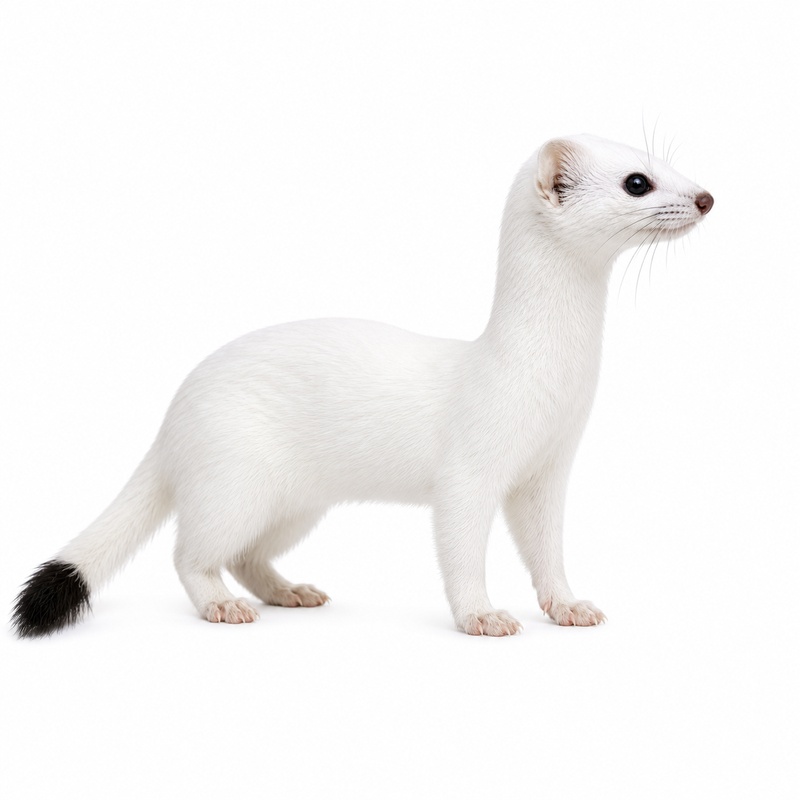
Its most famous image is that of the completely white animal moving across the snow, with only the black terminal brush of its tail. This winter coat, however, is not simply an aesthetic feature: it is the result of an adaptation to the environmental conditions of cold regions and allows the stoat to maintain effective camouflage even when the landscape is covered in snow.
In Italy, the species is closely associated with the Alpine region . It frequents high-altitude meadows, scree slopes, scrublands, forest edges, and humid mountain environments, and can range well above the treeline, reaching altitudes above 3.000 meters. The availability of small mammals remains one of the main factors determining habitat quality.
Like the weasel, the stoat is a predator specialized primarily in the prey of rodents and other small mammals . Its extremely flexible body allows it to penetrate directly into its prey's burrows, while its speed, sense of smell, and hearing allow it to locate and capture animals even under the snow.
The Italian population remains poorly understood. ISPRA emphasizes that there is still insufficient precise information on the status of the Alpine Stoat and that populations can exhibit strong seasonal and annual fluctuations, closely linked to food availability.
Ermine: classification, size and characteristics
| Common name | Ermine |
| Scientific name | Mustela erminea |
| English name | Stoat / Ermine |
| Order | carnivora |
| Family | mustelidae |
| Gender | Mustela |
| Head-body length | Approximately 20-30 cm, with males generally larger |
| Tail | Relatively long compared to that of the Weasel and always ending with a black tip |
| Weight | Generally in the order of a few hundred grams, with strong sexual dimorphism |
| Supply | Mainly micromammals, especially rodents; supplements with small birds, eggs, young lagomorphs and other prey |
| Habitat | Alpine meadows, scree slopes, scrublands, forest edges, mountain wetlands and high-altitude environments |
| Presence in Italy | Mainly Alpine arc |
| Behavior | Solitary, territorial, very active and highly predatory |
| Hunting status | Not included among the huntable species provided for by Law 157/1992 |
The body structure is typical of the Mustela genus : a long, narrow, and flexible body , short limbs, a relatively small head, and a neck barely distinguishable from the trunk. This conformation allows the stoat to slip into rodent burrows and move extremely quickly over rocks, vegetation, and snow.
The summer coat generally has a reddish-brown back and sides, while the throat, belly, and inner limbs are white or creamy white. The separation between the back and belly tends to be quite clear.
The tail is the most important feature: it is proportionally longer than that of the Weasel and has a terminal tip that is always black , regardless of the season and the colour of the rest of the body.
Sexual dimorphism is marked. Males can be significantly larger and heavier than females, and this difference also influences the size of their available prey and the size of their living spaces.
Stoat and Weasel: How to Tell Them Apart
The comparison with the Weasel (Mustela nivalis) is fundamental because the two species share a very similar body structure and can partly use the same alpine habitats.
The most obvious difference is the tail. In the stoat, it is relatively long and always ends in a prominent black tip ; in the weasel, it is much shorter and lacks this permanent dark tip.
| Feature | Ermine | Weasel |
|---|---|---|
| Scientific name | Mustela erminea | Mustela nivalis |
| Dimensions: | Generally larger | Generally minors |
| Tail | Longer | Very short |
| Tip of the tail | Always black | No permanent black tip |
| Winter coat | It can become completely white in cold populations | Varies according to geographical area |
| Italian habitat | Mainly alpine and mountainous | Much more widespread also in the plains etc.ollina |
During the summer, distinguishing the animal can require careful attention, especially when observed quickly. In winter, the Alpine Stoat's white coat often makes identification much more immediate, but the black tip of its tail remains the most reliable indicator.
The white winter coat: one of the most famous adaptations of the Alps
Seasonal coat transformation is one of the most fascinating aspects of stoat biology. As winter approaches, individuals from populations living in regions with persistent snow can replace their brown coat with an almost entirely white fur.
The tip of the tail, however, remains black. The result is a coloration perfectly suited to the snowy landscape and highly effective in reducing visibility to both prey and potential predators.
Molting doesn't simply depend on the presence of the first snowfall, but on seasonal cues, especially those related to photoperiod and environmental conditions. The transformation is therefore prepared well in advance of midwinter.
In spring the process reverses and the coat gradually turns brown on the dorsal side.
This specialization, however, can create a problem in changing weather conditions: an already white stoat on snow-free ground becomes extremely visible. For this reason, the shortening and irregularity of snow cover today represents a topic of great ecological concern.
Why does the tip of the tail remain black?
The terminal black brush is one of the most enigmatic features of the species. One of the most intriguing interpretations is that it may help deflect predator attacks.
A raptor spotting a small white animal in the snow might focus its attention on the fast-moving black dot, striking the tip of the tail instead of the vital body region.
This hypothesis should not be presented as an absolute and definitive explanation, but it offers an interesting example of how a seemingly unmimetic detail can nevertheless have an adaptive function.
In any case, from the point of view of field recognition, the black tip remains the most useful character of the entire species.
Habitat: a specialist in open alpine environments
In Italy, the stoat mainly frequents high-altitude grasslands, scrublands, scree slopes, and open mountain environments . ISPRA also reports the use of riparian forests and wetlands, while it generally avoids mature forests with little undergrowth and small mammals. :contentReference[oaicite:1]{index=1}
The species can live well above the upper limit of tree cover and reach altitudes above 3.000 metres . :contentReference[oaicite:2]{index=2}
The real key to the habitat, however, is not the altitude itself, but the presence of micromammals and structures that can be used as cover: boulders, scree, bushes, low walls, burrows and sufficiently complex vegetation.
An alpine meadow rich in voles can be an exceptionally productive environment, while a seemingly more “natural” forest but poor in small mammals may be unsuitable.
Distribution therefore follows mainly the combination of prey abundance, cover and climatic conditions.
Snow is not an obstacle: it is part of its habitat
For many small mammals, a deep snow cover seems like a barrier. For the stoat, however, it's an integral part of the winter environment.
Beneath the snow lies a space called the subnival environment , formed between the ground and the snow layer. Here, temperatures and conditions are relatively more stable, and numerous rodents continue to move and feed.
The stoat can penetrate this system through openings, tunnels and natural passages and continue hunting even when the surface is covered by tens of centimetres of snow.
ISPRA emphasizes that snow does not significantly limit its ability to move while hunting small mammals. :contentReference[oaicite:3]{index=3}
The ability to exploit the world beneath the snow is one of the adaptations that allow the species to live at altitudes where winter can last for many months.
Diet: A highly specialized predator
The stoat is a strictly predatory carnivore . Its plant component is negligible compared to that observed in the beech marten, pine marten, or badger.
Small mammals, especially voles and other rodents, generally form the basis of their diet. They may also be supplemented by shrews, small lagomorphs, birds, eggs, and other available prey.
The proportions vary depending on the environment. In alpine meadows rich in voles, the latter can completely dominate the diet.
Specialization on small mammals creates a very close relationship between predator and prey populations: when rodent numbers increase, the stoat finds favorable conditions; when they decline dramatically, the predator's population can also be affected.
Voles and small rodents: the heart of its ecology
Voles are ideal prey because they live in meadows and alpine environments, build networks of tunnels and can reach very high densities.
The stoat uses its sense of smell, hearing, and great exploratory ability to locate underground passages. Thanks to its slender body, it can enter tunnels directly and stalk its prey.
Another advantage comes from the ability to hunt both on the surface and in the underground or subnival system, greatly expanding the space in which it can search for food.
This explains why a small mustelid can exert very significant predatory pressure on micromammals despite living at relatively low densities.
How it hunts: speed, exploration and direct attack
The stoat uses primarily an active search strategy . It moves rapidly along walls, rocks, vegetation, and edges, continually inserting its head into cavities and following scent trails.
When it spots prey, it can chase it directly into its hiding place. This ability is one of the main advantages of its extremely elongated body.
The attack is generally directed at the neck and head region and is intended to quickly immobilize the small mammal.
If the prey is too large to be consumed immediately, it may be dragged to shelter and used later.
Food stocks and surplus killing
Like other small Mustelids, the Stoat can accumulate prey in excess of its immediate needs when it encounters a particularly favorable concentration.
This behavior allows you to create a reserve that can be used in the following hours or days.
The phenomenon is sometimes described as "excess killing," but it shouldn't be interpreted as a functionless behavior. For a predator with a high metabolic rate, conserving a resource when it's available can represent an important adaptive advantage.
The same logic helps to understand some episodes of multiple predation when a small mustelid enters an artificial space containing numerous prey unable to disperse.
Ermine and Variable Hare
In alpine environments, the Stoat can share territory with the Mountain Hare (Lepus timidus) , but the difference in size makes an adult a prey beyond the normal capacity of the small Mustelid.
Young Leporids can be caught and occasionally represent an important resource.
The species can tackle prey that is relatively large in relation to its weight, but the focus of its feeding strategy still remains on much smaller animals.
The relationship with the hare must therefore be considered opportunistic and not equivalent to that of predators such as the fox, golden eagle or lynx.
Birds, eggs and alpine fauna
Small birds, nestlings, and eggs may enter the diet, especially when found on the ground or in easily accessible cavities.
In alpine environments this can also concern young of ground-nesting species, but the real importance varies according to habitat and availability of rodents.
When small mammals are abundant, they generally constitute a much more convenient resource. In years when the main prey is scarce, the stoat can instead broaden its diet.
Pressure on birds must therefore be interpreted within the seasonal and annual variability of diet.
Ermine and Alpine Galliformes
For the hunting world, the possible relationship with the rock ptarmigan, the black grouse and other Alpine Galliformes is particularly interesting.
The stoat may prey on eggs, chicks and young if it can locate them, but is not normally a specialist predator of adults.
The actual extent of this predation depends primarily on rodent abundance. When vole populations decline, some predators may increase their use of alternative prey, including nests and young birds.
This mechanism may create indirect links between micromammal cycles and the reproductive success of Galliformes.
It is therefore much more correct to analyse the system as a whole than to simply attribute to the Stoat a fixed role as a predator of small Alpine game.
Metabolism: small body, huge needs
Like the weasel, the stoat pays a high price for its small size. Its body surface area is large relative to its volume, and heat is lost rapidly.
To maintain a stable body temperature, it must therefore sustain a very high metabolism.
This means that the availability of prey is not only important for reproduction, but also for daily survival. A prolonged period of food scarcity can quickly become critical.
In winter the problem is even greater because the low temperatures are compounded by the energy costs of travel.
However, the presence of good snow cover can offer advantages: the subnival environment is thermally more stable and at the same time allows access to rodents.
Territoriality and living spaces
The stoat normally leads a solitary and territorial life . Males and females occupy separate spaces for much of the year and meet mainly during breeding.
Males tend to have larger territories, capable of partially overlapping with those of multiple females.
The range depends greatly on the density of prey. In a prairie rich in voles, a relatively small area may suffice; in a sparsely populated area, the animal must travel much greater distances.
Scent markings and glandular secretions allow them to communicate their presence to other individuals without requiring continuous direct encounters.
Activities: day, night and snow
The stoat can be active both day and night . Its high energy requirements make it necessary to frequently alternate between hunting and resting phases.
In quiet territories it can be observed in full light, especially during the summer and during the periods in which it has to feed its young.
However, behavior changes with temperature, snow cover, disturbance, and prey activity.
On snow it can use slopes, scree slopes and areas of emergent vegetation, but a significant part of the activity can take place completely hidden beneath the surface.
Reproduction: a surprising biology
The stoat has one of the most unique reproductive strategies among the small mustelids. Mating normally occurs during the warm season, but apparent gestation lasts many months because of delayed embryonic implantation.
After fertilization, the embryo remains in a state of suspended development for a long time and only implants in the uterus several months later.
This mechanism allows births to be synchronized with spring, when the availability of rodents increases and climatic conditions become more favorable.
The female gives birth in a protected shelter, often using a rodent burrow, a rock cavity, or other sheltered space.
The pups are born blind and are completely dependent on their mother for the first few weeks.
An extreme peculiarity: very early sexual maturity of females
The reproductive biology of the stoat presents a surprising feature: females can reach reproductive capacity at an extremely early age.
This phenomenon is closely linked to delayed implantation. Mating occurs during the season when young females are still associated with their mothers, while actual gestation does not continue until many months later.
From an evolutionary point of view, this strategy allows us to rapidly exploit favorable conditions in environments where mortality and prey availability can vary enormously from one year to the next.
Males, on the other hand, reach reproductive maturity later.
Population Dynamics: Tracking Rodent Cycles
ISPRA emphasizes that the populations of the Stoat can show strong seasonal and annual fluctuations , similarly to those of the Weasel. :contentReference[oaicite:4]{index=4}
The main cause is the very strong connection to food resources. When voles and other small mammals become very abundant, survival and reproductive chances increase.
When prey populations collapse, the predator can experience rapid decline.
This relationship makes it difficult to assess the status of the species by observing it for only one or two years: a phase of apparent rarity may simply represent the low point of a normal ecological oscillation.
Distribution of the Ermine in Italy
In Italy, the stoat is mainly associated with the Alpine arc , where it occupies mountain and subalpine environments and can reach very high altitudes.
ISPRA documents the presence in bushy and wooded areas, high-altitude meadows, scree slopes, riparian forests and humid environments, with individuals also present above 3.000 metres above sea level . :contentReference[oaicite:5]{index=5}
The actual distribution is strongly linked to the presence of small mammals and can therefore be very irregular even within apparently similar territories.
Available information on the status of Italian Alpine populations remains insufficient, and ISPRA emphasizes the need to improve survey techniques and knowledge of habitat use. :contentReference[oaicite:6]{index=6}
Why is it so difficult to count the Ermine?
The species' small size, speed, and use of rocky environments make it extremely difficult to monitor.
An individual can cross a scree in a few seconds and spend most of the activity inside cavities or under the snow.
Camera traps traditionally installed for deer, chamois or other mammals may also be placed too high to properly detect an animal of this size.
Monitoring therefore requires devices positioned close to the ground, snow tracks, systematic observations and techniques specifically designed for small carnivores.
The scarcity of data should therefore not be automatically interpreted as a real scarcity of the species.
Climate change and winter coat
Changing snow conditions could represent one of the most interesting future challenges for the Alpine Stoat.
The white coat provides a huge advantage when the ground is snow-covered, but can become a disadvantage when the snow arrives late, melts early, or is severely disrupted.
A completely white animal on a dark scree becomes much more visible to both prey and predators.
The ability of populations to modify the timing and intensity of moulting over time could therefore play an important role in a climate characterized by increasingly variable snow seasons.
It's not just a question of camouflage: the reduction in snow also modifies the subnival microclimate and the distribution of rodents, which constitute the main food source.
Predators of the Ermine
The stoat is an extremely effective predator, but its small size also makes it a potential prey.
Diurnal and nocturnal birds of prey can catch it, as well as foxes, wild cats and other larger carnivores.
Speed, the use of scree and the ability to take refuge in very narrow cavities are the main defences.
The seasonal coat also reduces the likelihood of being spotted in snowy environments.
The simultaneous role of predator and prey places the stoat in a particularly interesting position within Alpine food webs.
Traces and signs of presence
The prints are small and show five digits , although some may be barely visible on the substrate.
In snow, loping gait often produces clusters of closely spaced tracks and can allow tracking for long distances.
The track can suddenly disappear when the animal enters under the snow or scree and reappear several meters further on.
The droppings are small, elongated and may contain hair and tiny bone remains of prey.
A certain determination from tracks alone can be difficult, especially in areas where the Weasel is also present.
Camera trapping and direct observation
To obtain good results, camera traps must be placed very close to the ground, near walls, scree slopes, narrow passages and the edges of meadows.
The videos are particularly useful because they allow us to observe the long black-tipped tail and the typical gait of the Mustela genus.
During winter, a color image of the white coat and black tail often allows for immediate identification.
Direct observations, however, are generally brief: the animal may stand upright to check its surroundings and then immediately disappear among the rocks and vegetation.
Legal status of the Ermine in Italy
The regulatory position must be precisely indicated.
Mustela erminea is not listed among the specially protected species in Article 2 of Law 157/1992. Among Mustelids, that article specifically mentions the pine marten, polecat, and otter, but not the stoat. :contentReference[oaicite:7]{index=7}
However, the stoat does not even appear in the national list of huntable species provided for by Article 18 of the same law. :contentReference[oaicite:8]{index=8}
It is therefore not a species subject to ordinary hunting in Italy.
As we have already seen for the Weasel, Beech Marten, and Badger, it is important to make a legal distinction between “non-huntable” and “particularly protected”: these are different concepts even if, from the point of view of ordinary hunting, both mean that the species cannot be killed.
Ermine and hunting activities
For the hunting world, the stoat is of particular interest in Alpine ecosystems. It shares the same territories as chamois, mountain hare, rock ptarmigan, black grouse, and other mountain game.
It can prey on the eggs and young of some birds, but the correct interpretation must start from its strong specialization on micromammals.
Vole population fluctuations can indirectly alter the use of alternative prey: in years when rodents are abundant, stoats tend to focus on that resource; when rodents are depleted, the likelihood of using other food categories increases.
This makes the species particularly interesting from the point of view of the management of alpine ecosystems, because the predator-prey relationship is not static but continuously changes according to natural cycles.
Hunters, gamekeepers and ungulate managers can also contribute to distribution knowledge by reporting documented observations, especially in areas where the status of the species is still little known.
Conservation: Protecting the complexity of Alpine environments
ISPRA emphasizes how environmental changes and disturbance can lead to rapid local disappearances of the stoat and highlights the need to improve knowledge on the distribution and dynamics of Alpine populations. :contentReference[oaicite:9]{index=9}
Protecting the species, therefore, goes beyond direct animal protection alone. It is essential to preserve alpine meadows, scree slopes, scrublands, wetlands, and a high population density of small mammals.
The simplification of mountain environments, the intensification of some activities, and the loss of ecological continuity can reduce the possibilities for shelter and food.
Climate change adds a new element, altering snow duration, the distribution of small mammals, and the seasonal correspondence between coat color and landscape.
The conservation of the stoat must therefore be included in the overall management of the high-altitude Alpine ecosystem.
Curiosities about the Ermine
- The tip of the tail remains black throughout the year and it is the best character to distinguish it from the Weasel.
- In winter many Alpine populations become completely white, except for the tip of the tail.
- It can live above 3.000 metres above sea level and well beyond the upper limit of the forest. :contentReference[oaicite:10]{index=10}
- Snow does not prevent hunting: can chase rodents directly into the subnival environment. :contentReference[oaicite:11]{index=11}
- It is strictly specialized in the predation of small mammals, especially voles and other small rodents.
- It can temporarily store prey when availability exceeds immediate need.
- It presents delayed embryonic implantation, which separates mating and the actual development of the pregnancy in time.
- Females have exceptionally early reproductive maturation, one of the most particular characteristics of the biology of the species.
- Populations can fluctuate significantly from year to year. following the trend of rodent populations. :contentReference[oaicite:12]{index=12}
- It is a predator but can also become prey itself of birds of prey and larger carnivores.
- In Italy it is mainly an alpine species and the state of the populations is still insufficiently known.
- It does not belong to the huntable species foreseen by article 18 of Law 157/1992. :contentReference[oaicite:13]{index=13}
The Ermine in the Hunting Encyclopedia
The stoat represents one of the most refined examples of mountain adaptation. Mustela erminea lacks the bulk of the badger, the arboreal agility of the pine marten, or the adaptation to water of the otter: instead, it has taken to the extreme the strategy of a small predator capable of entering directly into the world of its prey.
Its survival revolves around small mammals. Voles dig tunnels in the ground and under the snow; the stoat has exactly the body needed to follow them. Winter blankets the landscape in white, and predators alter its coat. The snow prevents many animals from moving freely, but for the stoat, it provides cover under which to continue hunting.
A comparison with the Weasel shows how two seemingly nearly identical species can occupy different habitats. The Weasel is widespread from the lowland countryside to the mountains; the Italian Stoat, on the other hand, reaches its peak expression in alpine environments, in high-altitude meadows and in scree areas above the treeline.
For the hunting world, it is also of particular interest due to its relationships with alpine fauna. It may consume the eggs and young of galliformes, but the extent of this predation varies with rodent populations. A decline in voles may temporarily shift the pressure to alternative prey, demonstrating once again that predatory dynamics cannot be understood by observing a single species in isolation.
The stoat also reminds us how incomplete our knowledge of seemingly more familiar fauna still is. ISPRA emphasizes that we lack adequate information on the true status of Italian Alpine populations and that strong natural fluctuations necessitate ongoing surveys. :contentReference[oaicite:14]{index=14}
It is precisely this combination of small size, extraordinary predatory efficiency, life under the snow, seasonal fur, and specialization for high-altitude environments that makes the Stoat one of the most fascinating carnivores of the entire Italian Alpine fauna.