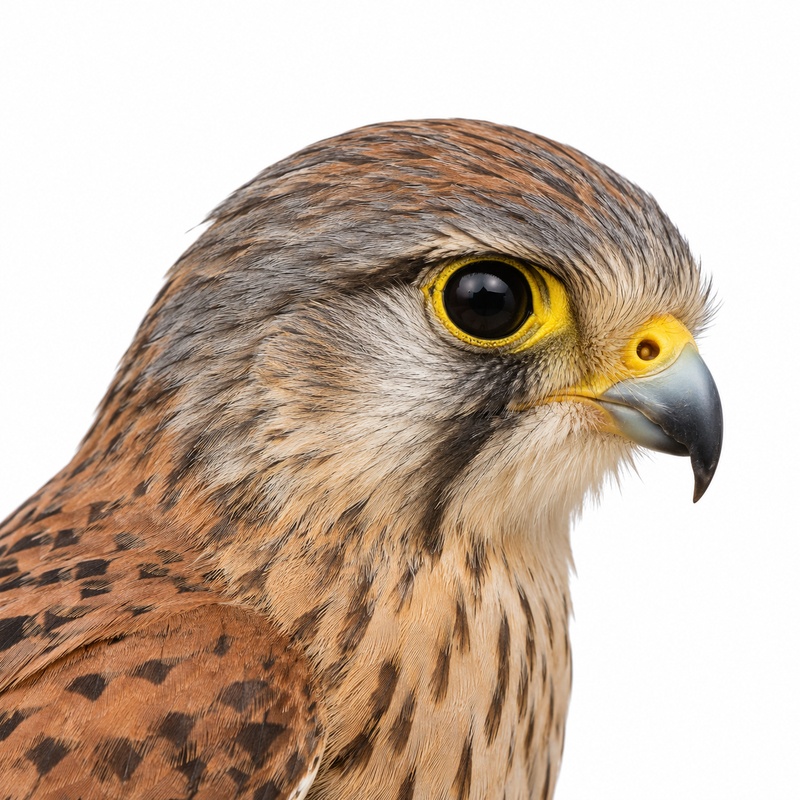
NOT HUNTABLE
The common kestrel (Falco tinnunculus) is one of the most widespread, recognizable, and adaptable diurnal birds of prey in the Italian fauna. Smaller and lighter than the peregrine falcon and the lanner falcon, it has developed a completely different predatory strategy: instead of relying on high-speed dives or prolonged pursuit of birds, it spends most of its activity scanning the ground for voles, mice, large insects, lizards, and other small prey.
The technique that made it famous is the so-called "holy spirit" flight . The kestrel remains almost motionless in the air, facing into the wind, while its wings and tail continuously correct themselves to maintain the same position relative to the ground. From that seemingly suspended point, it can analyze a portion of meadow or crop and rapidly descend when it spots prey.
It's a completely different technique from that of the Peregrine Falcon. Absolute speed matters relatively little: the Kestrel must above all be able to locate small animals hidden in the vegetation and reach them before they can take refuge in a burrow or under cover.
A second particularly interesting characteristic is the marked sexual dimorphism in its plumage . In the adult male, the head and tail are slate-grey and the back is reddish with black spots; in the female, the head, back, and tail remain predominantly reddish-brown and barred. It is therefore one of the Italian raptors in which the sex can frequently be recognized even from a distance, when observation conditions are good.
In Italy, the kestrel is widely distributed and extremely adaptable. Countryside, pastures, steppes, coasts, mountainous environments, suburbs, and residential areas can be utilized, provided there are sufficiently open areas for hunting and suitable nesting structures. Natural rock faces, old buildings, towers, bell towers, ruins, and agricultural structures can perform very similar functions.
From a hunting perspective, the kestrel is of interest primarily for its role in the natural predation of small mammals . It can certainly prey on small birds or young vertebrates, but it would be profoundly incorrect to interpret it as a major predator of small game: in most Italian territories, mice, voles, insects, and reptiles represent much more significant resources.

Kestrel: classification, size and characteristics
| Common name | Kestrel |
| Scientific name | Falco tinnunculus |
| English name | Common Kestrel |
| Order | Falconiformes |
| Family | Falconidae |
| Gender | Falcon |
| Subspecies present in Italy | Falco tinnunculus tinnunculus |
| Length | Approximately 32-35 cm |
| Wingspan | Approximately 70-80 cm |
| Weight | Generally in the order of about 150-300 g, with females on average heavier |
| Sexual dimorphism | Especially marked in plumage; female also slightly larger |
| Supply | Micromammals, especially voles and mice, as well as large insects, reptiles and small birds |
| Habitat | Countryside, pastures, crops, steppes, coasts, mountain environments, suburbs and cities |
| Italian distribution | Widespread across much of the national territory |
| Migratory behavior | Italian populations are largely sedentary or dispersed; winter arrivals come from more northern areas |
| Italian Red List | LC – Less Concern |
| Hunting status | Specially protected species; not huntable |
The Kestrel has the typical structure of the Falconides, but with proportions particularly suited to a hunt that requires maneuverability and ability to stay in the airThe wings are long and pointed, but less powerful than those of the Peregrine; the tail is relatively long and is an essential tool for maintaining stability during hovering flight.
The body is slender, the head relatively small, and the beak short and strongly hooked. As in other representatives of the Falco genus , the edge of the beak features the characteristic tomial tooth , used to quickly complete the kill of vertebrate prey.
Its legs are relatively thin but equipped with effective toes and claws. Unlike the peregrine falcon, which specializes in catching birds in flight, the kestrel primarily needs to capture small terrestrial animals, which it attempts to capture with an attack from above.
Male and female: one of the most evident dimorphisms among Italian birds of prey
Sex recognition is one of the most interesting aspects of the species. In adult males , the head and neck are slate-gray, the back is brick-red with small black spots, and the tail is grayish with a broad dark band near the tip.
The underside of the body is light, generally cream or tawny, with relatively sparse dark spots.
The female, on the other hand, has an overall more uniform, reddish-brown coloration. The head does not normally take on the gray typical of the adult male, and the back is heavily barred and spotted.
The female's tail also remains reddish and shows numerous dark transverse bars, while that of the adult male appears much more uniform and greyish.
The young resemble the female more closely and progressively acquire adult plumage through successive moults.
Kestrel, Lesser Kestrel, and Hobby: How to Tell Them Apart
The most important comparison concerns above all the Lesser Kestrel (Falco naumanni) , a very similar species and locally present even in the same landscapes of central-southern Italy.
The lesser kestrel is on average slightly smaller, has light-colored claws rather than dark ones, and the adult male has a less spotted back. However, the female and juveniles of the two species can be extremely similar.
The Eurasian Hobby (Falco subbuteo), on the other hand, has a more slender build, proportionally longer, sickle-shaped wings, and an extremely rapid and agile flight. The adult also has heavily streaked underparts and characteristic reddish hues in the subcaudal region.
| Feature | Kestrel | Lesser Kestrel | Eurasian Hobby |
|---|---|---|---|
| Scientific name | Falco tinnunculus | Falco naumanni | falco subbuteo |
| Dimensions: | Media | Slightly lower | Similar but more slender structure |
| Stationary flight | Very frequent | Possible but less characteristic | Not typical |
| Nail | Axe | Clear | Axe |
| Adult male | Reddish spotted back | Generally more uniform back | Very different structure and plumage |
| Hunting Strategy | Terrestrial prey spotted from above | Many insects and small terrestrial prey | Insects and small birds caught in flight |
The distinction between a female Kestrel and a Lesser Kestrel represents one of the cases in which a close observation or a good photograph may be necessary to reach a reliable determination.
The "Holy Spirit": How can it remain motionless in the air?
The kestrel's most characteristic behavior is to remain apparently still in the same spot in the sky . This is not true floating: its wings, tail, and body continually make tiny corrections.
The raptor faces into the wind and uses the airflow to produce the lift needed to compensate for gravity. If the wind is sufficiently favorable, it can limit its wingbeats; when it decreases, it must increase wing activity.
The long tail is opened and continuously oriented to control position and stability, while the wings vary their angle and frequency of beats.
Seen from the ground, the result is spectacular: the falcon seems suspended above a precise point, from which the traditional name of “holy spirit” derives.
The technique allows you to carefully observe a very limited area before moving a few dozen meters and repeating the search.
Why doesn't he always remain in the "holy spirit"?
Hovering is effective but comes at a certain energy cost. When a favorable perch is available, the kestrel can achieve the same result simply by remaining still on a post, wire, tree, or artificial structure.
This is why perching is a very common strategy. The falcon scans the terrain and, when it spots potential prey, takes off directly.
The choice between hovering and perching therefore depends on the wind, the structure of the territory, the height of the vegetation and the availability of dominant points.
An area rich in poles and power lines can concretely modify hunting behavior, allowing the animal to reduce energy expenditure.
Sight and ability to locate rodents
The kestrel has extraordinarily good eyesight, essential for spotting very small animals from several dozen metres above the ground.
Voles and mice often move through vegetation and may only be visible for a few seconds. The raptor must therefore quickly detect movement and determine whether it is actually prey.
A particularly interesting aspect concerns the ability of kestrels to perceive ultraviolet wavelengths as well . Urine traces left by rodents can reflect UV differently than the surrounding substrate.
This does not mean that the hawk “sees the mouse directly through its urine”, but that some areas frequently visited by micromammals can provide useful signals about their activity.
The selection of the hunting territory can therefore be based not only on the vision of the prey, but also on indirect clues of their presence.
Hunting technique: observation, descent and attack
Once the prey has been spotted, the kestrel quickly interrupts its hovering flight and begins its descent.
He can make a first fall, stop again at a lower altitude to correct his position and then complete the attack.
This multi-level technique allows you to progressively improve accuracy and reduce the risk of hitting the wrong spot.
In the final stage, the legs are projected forward and the claws grasp the prey . Small vertebrates are subsequently killed with the beak.
If the attack fails, the falcon may re-ascending and resume the pursuit, without generally engaging in lengthy ground chases.
Voles and mice: the heart of the diet
In many European regions, small mammals represent the most important component of the diet. Voles, field mice, and other small rodents are ideally sized and can reach very high densities in meadows and crops.
The relationship between kestrels and voles is particularly close. In years when rodent populations increase significantly, food availability improves and the raptor's reproductive success can also increase.
A single vole provides relatively little energy, but can be caught quickly and without the risks associated with attacking large prey.
The kestrel therefore represents one of the main natural predators of small mammals in Italian agricultural environments.
The role in agriculture
Mice and voles can consume seeds, roots and plant parts and, when they reach high densities, cause significant damage to crops.
The kestrel naturally contributes to their predation together with the buzzard, barn owl, little owl, fox, weasel and other predators.
This doesn't mean that a single pair can prevent every rodent population explosion. Population dynamics are much more complex.
The presence of the kestrel, however, represents a concrete example of ecosystem service : a wild predator spontaneously uses animals that can become problematic for agriculture.
Precisely for this reason, in some agricultural areas the installation of nest boxes and perches is used to encourage the presence of birds of prey without resorting exclusively to chemical rodent control.
Insects: an often undervalued resource
Large insects can be an important part of the diet, especially during summer and autumn.
Orthoptera, beetles, and other large invertebrates become especially valuable when they are abundant and easily accessible.
The kestrel can catch them on the ground or pick them up after short chases.
In young individuals, this component may be particularly important because insects are generally easier to catch than a fast rodent capable of reaching a burrow.
The species' diet therefore changes significantly with season, age and territory.
Lizards and other reptiles
In Mediterranean regions , lizards and small reptiles can account for a considerable portion of the diet.
Reptiles are particularly active during hot days and may expose themselves to rocks, walls and open surfaces to regulate their temperature.
The kestrel spots them from above and uses the same type of attack employed on small mammals.
The role of reptiles naturally increases in warmer areas and decreases in seasons when ectothermic activity decreases.
Birds in the diet: present, but not dominant
The kestrel can catch small birds , especially young, inexperienced ones or individuals surprised on the ground.
Passerines, small finches, and other species may enter the food spectrum, especially when rodents and insects are in short supply.
However, the Kestrel's structure is not specialized in aerial pursuit like that of the Peregrine, Lanner Falcon or Hobby.
Catching a small bird in flight is possible, but it does not form the basis of its predatory strategy.
Kestrel, Pheasant, Partridge and small game
For the hunting world, it is particularly important to get the ratio right.
An adult Pheasant or Partridge is vastly larger than a Kestrel's typical prey and does not normally make a realistic target.
Chicks or very small young animals can theoretically be captured if encountered in favourable conditions, but this is a completely different interaction from the predation exercised by a fox, a beech marten or a large accipiter.
The core of the food ecology remains made up of rodents, insects and reptiles.
Considering the Kestrel a significant predator of small adult game would therefore be biologically unfounded.
Habitat: the open-air raptor
ISPRA describes the Kestrel as a species capable of using a wide variety of environments, but especially emphasizes heterogeneous agricultural areas, open surfaces with sparse vegetation and herbaceous or shrubby areas . :contentReference[oaicite:2]{index=2}
Meadows, pastures, cultivated fields, uncultivated lands, coastal areas, garrigues and plateaus can provide excellent feeding surfaces when the vegetation does not grow so tall as to completely hide prey.
The species can also use mountainous environments, provided there is sufficient openness and availability of small vertebrates.
Dense forest, however, is poorly suited to its hunting technique. A kestrel can utilize the forest edge, but it is difficult to compete with raptors much more specialized in hunting among the trees.
The Kestrel in the cities
One of the reasons for the species' success is its ability to live even in urban centers . ISPRA explicitly highlights the ease with which the kestrel can establish itself in urban environments. :contentReference[oaicite:3]{index=3}
Towers, bell towers, historic buildings, warehouses, cornices, and industrial structures can replace natural rock cavities and walls.
To hunt, the bird of prey can use parks, railway areas, uncultivated land, suburbs, airports and green spaces.
Unlike the Urban Peregrine, which mainly feeds on pigeons and other birds, the City Kestrel often continues to search for small vertebrates and large insects on open surfaces.
A city can therefore simultaneously host two Falconides with completely different strategies.
The nest: almost always borrowed
Like other falcons, the Kestrel does not normally build a true nest of branches.
It can utilize cavities in rocks, buildings, old walls, niches, towers, and ledges. In the wild, it also uses old nests built by corvids and other species.
This flexibility allows them to nest in territories where large mature trees are relatively scarce.
Artificial nest boxes can be easily used when properly sized and placed in prey-rich environments.
It is precisely this characteristic that makes the kestrel one of the most suitable species for projects to increase birds of prey in agricultural countryside.
Reproduction: from laying to fledging
The breeding season generally begins in spring. After courtship and site selection, the female typically lays several eggs , often 4-6, with variations depending on food availability and environmental conditions.
Incubation lasts about a month and is primarily carried out by the female. During this phase, the male provides a significant portion of the food supply.
After hatching, the chicks are initially protected by the female, who distributes the prey brought by her partner.
As the energy demands of the brood increase, the female also gradually resumes hunting.
The number of small mammals available in the area can significantly influence reproductive success. A season rich in voles allows adults to more easily feed a large brood.
Young people and learning to hunt
After fledging, the young remain associated with the nest area for a certain period and continue to receive food from their parents.
The Holy Spirit technique doesn't immediately achieve adult efficiency. Young people must learn to control the wind, altitude, and position , and above all, to correctly interpret movements on the ground.
The first hunts included numerous mistakes: attacks on empty spots, attempts on insects and small animals that failed at the last moment.
Experience gradually transforms a young, flight-capable falcon into a truly efficient predator.
Territoriality, courtship and calls
During breeding, the kestrel defends an area around its nesting site. Interactions may include flight, chasing, and vocalizations.
The call consists of a series of high-pitched, repeated notes, particularly frequent when an individual arrives at the nest or senses a possible disturbance.
The male may offer prey to the female during courtship and in the stages preceding egg laying.
The pair does not necessarily have to exclusively defend the entire hunting territory: in highly productive environments, several kestrels may feed relatively close together, especially outside the breeding season.
Distribution of the Kestrel in Italy
The common kestrel is widespread throughout practically the entire country . ISPRA indicates that it is more frequent in the central-southern and island regions and more scarce or localized in some areas of the central-eastern Po Valley. :contentReference[oaicite:4]{index=4}
The species is present from the coastal strip to the mountainous environments and uses both natural landscapes and highly anthropized areas.
In Italy it is present with the nominal subspecies Falco tinnunculus tinnunculus . :contentReference[oaicite:5]{index=5}
Its extremely wide distribution reflects above all its ability to adapt to very different breeding sites and food resources.
Sedentary, migratory or both?
The answer depends on the population. In Mediterranean areas, many kestrels are sedentary or have relatively limited movements , while populations in northern Europe may undertake seasonal migrations to more favorable climatic areas.
During the winter in Italy, local individuals and subjects from other European regions can therefore be present simultaneously.
Juveniles are generally more dispersed than territorial adults and may make significant movements after independence.
This combination makes it difficult to interpret the number of individuals observable in a territory exclusively through the local breeding population.
Kestrels on Roads: Why They Use Poles and Wires
One of the most common images of the species is that of a Kestrel perched on a post or wire along a road.
These structures offer an excellent view of the surrounding grassy surfaces and allow the detection of small mammals with virtually no energy cost.
Roadside areas can also host high densities of small animals because they maintain different vegetation compared to the surrounding fields.
This advantage, however, comes with a risk. An attack on prey can bring the raptor close to the roadway and increase the likelihood of a collision with vehicles.
Electrocution: A Threat Far From Theoretical
Power lines are one of the main anthropogenic causes of mortality for numerous birds of prey.
The kestrel frequently uses supports as perches and can be electrocuted when the configuration of the line allows it to touch two elements with different potentials at the same time.
A recent ISPRA report on electrocution mortality in Sardinia reports as many as 184 kestrels found dead in the period 2003-2020 , the highest value among the species listed in the relevant table. :contentReference[oaicite:6]{index=6}
The data is particularly significant because it demonstrates how even a common species can suffer very high mortality in poorly designed infrastructures.
Securing the most dangerous supports can dramatically reduce the problem.
Rodenticides and secondary poisoning
The strong dependence on small mammals exposes the kestrel to a further risk: secondary poisoning from rodenticides.
A vole or mouse that has ingested an anticoagulant can remain active for some time and become particularly easy prey.
The bird of prey therefore ingests the toxic substance together with the prey.
Repeated exposures can cause accumulation and physiological problems even when the dose contained in a single rodent is not immediately lethal.
For a predator specialized precisely on these species, the management of rodenticides in the countryside and peri-urban areas is therefore an important aspect of conservation.
Intensive agriculture and habitat loss
The kestrel can live very well in agricultural landscapes, but this does not mean that any form of agriculture is favorable to it.
The systematic removal of hedges, uncultivated areas, grassy margins and small habitats reduces the availability of insects and small mammals.
Intensive pesticide use can further decrease the prey community and produce indirect effects along the food chain.
Extremely uniform agriculture can therefore offer large open areas but very little food.
On the contrary, a mosaic made up of cultivated fields, meadows, uncultivated land, ditches and rural structures can be extremely productive.
Nest boxes and practical conservation
Kestrels readily utilize artificial structures when properly designed. Nest boxes can therefore be an effective tool in areas lacking natural cavities or suitable buildings.
Simply placing a box, however, doesn't guarantee the species' presence. The surrounding area must offer sufficient food and tranquility.
In agricultural contexts, boxes can be associated with the maintenance of grassy strips, hedges and perches.
Integrated management can simultaneously benefit kestrels, barn owls, little owls and other natural predators of small mammals.
Conservation status of the Common Kestrel in Italy
The Italian Red List classifies Falco tinnunculus as LC – Least Concern . :contentReference[oaicite:7]{index=7}
The available national assessment highlights a very large range and a significant population. Therefore, the species currently does not present the level of risk observed for the Lanner Falcon or Eleonora's Falcon in Italy.
This doesn't mean, however, that all local populations are stable or that threats are absent. Agricultural intensification, electrocution, collisions, poisoning, and loss of breeding sites can cause regional declines even in an overall common species.
Correct assessment must therefore distinguish between a favourable national status and local conservation problems.
Legal status of the kestrel in Italy
The kestrel is a particularly protected species in Italy as it is a diurnal bird of prey.
Falco tinnunculus is not a huntable species.
National protection includes individuals and is integrated with the general protection granted to wild birds by European legislation.
An important element is that the kestrel is not included in Annex I of the Birds Directive , unlike species such as the peregrine falcon, lanner falcon, short-toed eagle, and golden eagle. The recent ISPRA report on electrocution lists it as LC and without an indication of inclusion in Annex I. :contentReference[oaicite:8]{index=8}
This distinction does not, of course, alter the ban on culling in ordinary Italian hunting activities.
Kestrel and hunting activity
The kestrel frequents many environments also used by wildlife of hunting interest and can be regularly observed during activity in the area.
Its presence, however, must be interpreted above all in relation to small mammals, insects and reptiles , not as an indication of significant pressure on pheasants, partridges, hares or other small adult game.
Hunters, on the other hand, can easily observe variations in the density of the species and understand how these are often linked to the conditions of the agricultural landscape and the presence of rodents.
The conservation of hedges, meadows, edges and small uncultivated areas, important for numerous species of hunting interest, simultaneously creates favourable habitat for the kestrel's prey and for the entire rural biodiversity.
The relationship between hunting management and birds of prey must therefore be interpreted within the context of the ecosystem itself and not through a simple contrast between predator and game.
Curiosities about the Kestrel
- The famous “holy spirit” flight is a real hunting technique and allows the falcon to precisely control a small portion of ground.
- Male and female are easily distinguishable: the adult male has a slate-grey head and tail, the female remains much more uniformly reddish-brown.
- The wings are pointed but the tail is relatively long., a fundamental adaptation to maintain stability during hovering flight.
- Micromammals form a fundamental part of the diet, especially voles and mice.
- It is able to perceive signals in the ultraviolet, a feature that can help it identify areas heavily frequented by rodents.
- It can use poles and wires as observation points, saving the energy needed for the holy spirit flight.
- It does not normally build a real nest but uses cavities, buildings, old nests and artificial boxes.
- It adapts easily to urban environments, as confirmed by the ISPRA summaries. :contentReference[oaicite:9]{index=9}
- It can live from the coast to the mountain environments as long as there is enough open space for hunting.
- The Lesser Kestrel is the Italian species with which it can be most easily confused., especially in the case of females and young people.
- Large insects and reptiles can become very important during the warm season.
- It is widespread practically throughout the Italian territory and is particularly common in the central-southern and island regions. :contentReference[oaicite:10]{index=10}
- It is classified as LC – Least Concern in the Italian Red List. :contentReference[oaicite:11]{index=11}
- Electrocution can be a major cause of mortality: 184 individuals have been documented dead in Sardinia between 2003 and 2020. :contentReference[oaicite:12]{index=12}
- It is particularly protected and cannot be hunted in Italy.
The Kestrel in the Hunting Encyclopedia
The kestrel is one of the best examples to understand how different hunting strategies can be within the same family. Falco tinnunculus, Peregrine Falcon and Lanner Falcon all belong to the FalconIdes, possess pointed wings, tomian teeth and great visual abilities, but they use these characteristics in profoundly different ways.
The Peregrine Falcon seeks above all to gain altitude and converts gravity into speed. The Lanner Falcon makes greater use of tracking and maneuverability in open spaces. The Kestrel, on the other hand, performs almost the opposite operation: instead of accelerating to maximum speed, it attempts to cancel out its motion relative to the ground . Pausing in the sky becomes the necessary condition for observing an animal that weighs just a few dozen grams and moves among blades of grass.
This technique explains the extraordinary relationship with the agricultural landscape. A low meadow full of voles can be vastly more valuable than a large, seemingly natural forest. A pole, a hedge, or an old farmhouse can further enhance the value of the land by providing roosts and breeding sites.
For the hunting world, recognizing this ecology is particularly important. The kestrel can certainly prey on small birds and occasionally young vertebrates, but its structure, weight, and predatory strategy immediately demonstrate that adult pheasants, adult partridges, and hares are not its normal prey . Its primary function in the countryside is primarily mice, voles, insects, and small reptiles.
Its remarkable adaptability explains why it remains one of the most widespread birds of prey in Italy. ISPRA (the Italian National Institute of Preservation and Research) considers it present throughout the country, with particularly high frequencies in central and southern regions and islands, and a good ability to colonize even urban environments. :contentReference[oaicite:13]{index=13}
Being common, however, doesn't mean being immune to problems. The electrocution data in Sardinia is particularly significant: 184 kestrels found dead between 2003 and 2020 in the analyzed series show how an infrastructure can exert a very high mortality rate even on a species in an overall good state of conservation. :contentReference[oaicite:14]{index=14}
The national classification as LC – Least Concern is therefore good news, but it must not make us forget the importance of the quality of agricultural landscapes, the reduction of poisons and the safety of power lines. :contentReference[oaicite:15]{index=15}
The kestrel is, ultimately, the falcon that has transformed immobility into a weapon: while other birds of prey chase or swoop down on their prey at spectacular speeds, it can pause in the wind, observe a few square meters of countryside, and transform an imperceptible movement in the grass into a precise capture.