Wounds inflicted by wild boar on hunting dogs are one of the most serious emergencies in hunting. In most cases, the damage isn't caused by a true bite, but by the blow inflicted by the dog's tusks, especially the lower canine teeth of males, which can cause deep, penetrating cuts.
A seemingly small skin lesion can conceal lacerations of muscles, blood vessels, nerves, and internal organs. Wounds to the chest and abdomen should therefore be considered potentially life-threatening, even when the dog remains standing and moving.
After any violent contact with a wild boar, the dog must be stopped, carefully checked and subjected to an urgent veterinary visit.
Bite or fang?
The wild boar can bite, trample or crush the dog, but the most characteristic injuries are caused by the tusks.
The movement of the head from bottom to top can determine:
- puncture wounds;
- deep linear cuts;
- lacerations of the skin and muscles;
- detachment of the subcutaneous tissues;
- penetration into the thoracic or abdominal cavity;
- multiple lesions along the path of the tusk;
- internal and external bleeding.
The entry point may be much smaller than the underlying damage. The fang may also enter one area and exit another, creating a contaminated tract that is difficult to assess without surgical exploration.
Areas of the body most affected
The locations most frequently involved are:
- chest;
- abdomen;
- groin;
- thighs and hind limbs;
- shoulders and forelimbs;
- neck;
- head and muzzle.
A single dog may have multiple wounds at the same time. After identifying the most obvious lesion, it is necessary to continue inspecting the entire body.
Why these wounds are particularly dangerous
The coat can hide blood, entry wounds, and lacerations. Furthermore, the dog's skin can shift relative to the underlying tissue during the strike: the visible skin lesion may therefore not be directly over the damaged muscle or affected organ.
Major complications include:
- external bleeding;
- internal bleeding;
- shock;
- pneumothorax;
- hemothorax;
- lung laceration;
- injury to the liver, spleen, intestine, or bladder;
- traumatic hernia;
- damage to nerves and large vessels;
- fractures;
- bacterial contamination;
- tissue necrosis;
- peritonitis or sepsis.
What to do immediately on the ground
The priority is to break up the fight without endangering other people or dogs. A wounded or immobilized boar may attack again and should still be considered dangerous.
Once you reach the dog:
- remove him from the collision area;
- call your veterinarian or emergency clinic immediately;
- check breathing and state of consciousness;
- quickly look for major hemorrhages;
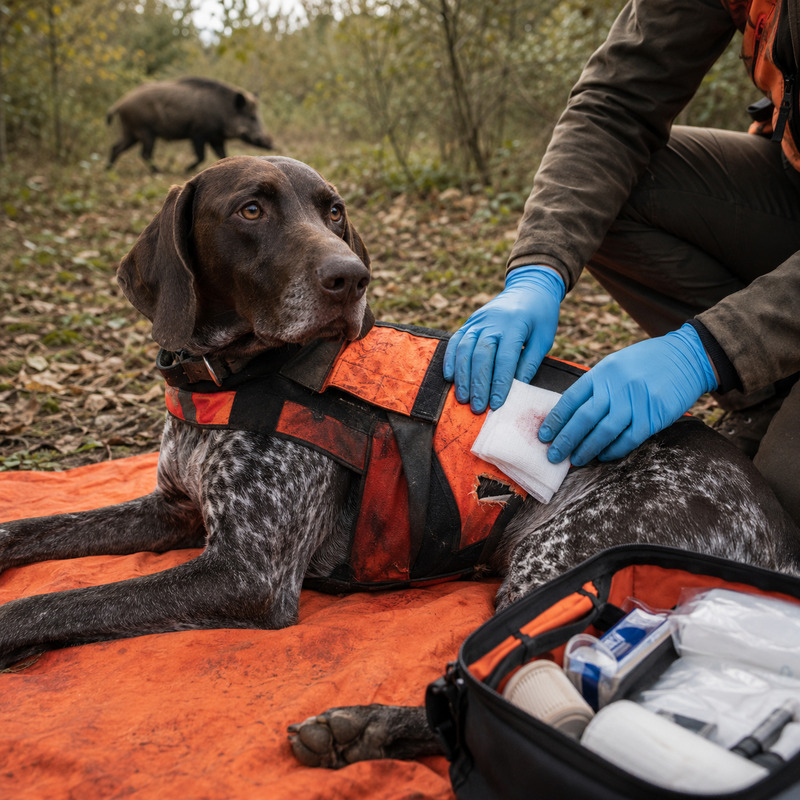
- apply pressure to bleeding wounds;
- limit movements;
- transport it without delay.
Field medications only serve to temporarily stabilize the dog during the transfer. They do not replace a veterinary examination.
Approaching your dog safely
An injured and frightened dog may even bite its owner. It's best to approach calmly, speak softly, and avoid sudden movements.
An improvised muzzle may only be used if the dog:
- breathe normally;
- he's not vomiting;
- there are no wounds on the muzzle;
- he did not lose consciousness;
- does not show heat stroke.
A muzzle should not be applied to a dog with difficulty breathing, facial trauma, or the need to vomit.
Rapid assessment of vital functions
Before focusing on the visible wound, it is necessary to evaluate the essential functions.
You need to check:
- airway patency;
- presence and quality of breathing;
- color of mucous membranes;
- presence of the pulse;
- level of consciousness;
- major bleeding;
- ability to stand upright.
Labored breathing, pale or bluish mucous membranes, a weak pulse, cold extremities, and loss of consciousness indicate a critical emergency.
How to stop a bleeding
In the presence of external bleeding, it is necessary to apply sterile gauze or a clean tissue and press directly on the wound.
The pressure must be:
- continues;
- determined but not unnecessarily violent;
- held for several minutes without continuously lifting the gauze;
- strengthened by adding more material on top of the already impregnated one.
Repeatedly removing the gauze can dislodge the forming clot and cause bleeding to resume.
If the position allows, a compression bandage can maintain pressure during transport. The bandage should not compromise breathing or circulation to the limb.
Use of tourniquet
A tourniquet can cause serious nerve and tissue damage. It should only be considered in cases of uncontrollable and potentially fatal bleeding from a limb, when direct pressure is insufficient and the rescuer knows how to use it correctly.
If applied, it is essential to note the exact time and inform the veterinarian immediately. It should not be hidden under blankets or bandages.
Penetrating chest wounds
A puncture can penetrate the chest wall and allow air to enter the pleural cavity. The lung can no longer expand normally, and a pneumothorax may develop.
Signs include:
- rapid, shallow breathing;
- great respiratory effort;
- abnormal movement of the chest and abdomen;
- suction noise from wound;
- presence of bubbles or foam;
- bluish mucous membranes;
- weakness or collapse.
The wound should be covered with sterile material and, if possible, with an occlusive dressing to limit air entry. Avoid excessive compression of the entire chest.
The dog should be held in a position that allows him to breathe better and transported immediately. He should not be forced to lie on his side if he is experiencing increased breathing difficulty.
Abdominal wounds
An abdominal wound can involve the muscles, liver, spleen, stomach, intestines, kidneys, bladder, and major vessels.
Possible signs include:
- abdominal pain;
- tense or progressively swollen abdomen;
- pale mucous membranes;
- weakness;
- rapid breathing;
- He retched;
- blood in urine;
- protrusion of tissues or organs;
- collapse.
The absence of external blood does not rule out internal bleeding. A dog with abdominal injuries should be examined even if it initially appears stable.
What to do in case of evisceration
If intestinal loops or other tissue protrude from the wound:
- do not attempt to reinsert them into the abdomen;
- do not manipulate them unnecessarily;
- do not apply direct pressure to the organs;
- cover them with sterile gauze moistened with saline solution;
- protect everything with a clean, loose dressing;
- transport the dog immediately.
If saline is not available, it is preferable to gently protect the tissues with clean material during transfer rather than leaving them exposed and drying.
Objects stuck in the wound
Branches, fragments, or other objects that have penetrated the tissue should not be removed in the field. They could compress a damaged vessel and temporarily limit bleeding.
The object must be stabilized with gauze or cloth around the base, preventing movement during transport. Removal must be performed in a veterinary setting, with the ability to immediately control bleeding.
How to recognize shock
Shock can result from blood loss, pain, chest trauma, or severe tissue damage.
Early signs may include:
- rapid breathing;
- rapid heartbeat;
- agitation;
- pale mucous membranes;
- altered capillary refill time;
- weak pulse;
- cold extremities.
In advanced stages the following may appear:
- severe weakness;
- reduction in body temperature;
- altered mental state;
- inability to get up;
- loss of consciousness;
- cardiovascular arrest.
The dog in shock must be kept still and protected from the cold, without overheating. It must reach a veterinary facility as quickly as possible.
How to transport an injured dog
Movement can aggravate bleeding, fractures, and spinal injuries. The dog should be moved as little as possible.
The following can be used for transport:
- a folding stretcher;
- a sturdy blanket;
- a sturdy jacket;
- a hard panel;
- a sheet supported by several people.
The head, neck, and spine should be kept as aligned as possible. A dog with breathing difficulties must be able to maintain the position that allows for better ventilation.
It is useful to call the clinic during the transfer, stating:
- time of the accident;
- affected area of the body;
- presence of hemorrhage;
- quality of breathing;
- state of consciousness;
- estimated time of arrival.
What not to do on the ground
While waiting for veterinary assistance you should not:
- close the wound with stitches, staples or glue;
- explore deeply with fingers or tools;
- extract stuck objects;
- reinsert detached organs;
- pour alcohol or hydrogen peroxide into the deep tissues;
- apply powders, colored sprays, or caustic substances;
- administer painkillers for human use;
- give food or large amounts of water;
- allow the dog to continue hunting;
- postpone the visit because the wound appears small.
The dog may require urgent sedation or anesthesia; for this reason, it is best not to feed the dog during transport unless otherwise directed by your veterinarian.
Why not use hydrogen peroxide in deep wounds?
Hydrogen peroxide can damage the cells necessary for healing and is not a substitute for surgical scrubbing. Alcohol and concentrated disinfectants cause pain and can further damage tissue.
Only gentle cleaning of the surrounding area is recommended, without delaying transfer. For deep wounds, the priority is stabilization, not hasty disinfection.
Veterinary evaluation
Upon arrival at the clinic, the priority is to stabilize breathing and circulation. A full examination of the wounds is performed after checking the patient's vital signs.
Investigations may include:
- clinical and neurological examination;
- complete blood count and biochemical profile;
- coagulation assessment;
- serial hematocrit monitoring;
- chest and abdominal x-rays;
- emergency ultrasound to check for blood or gas;
- computed tomography in selected cases;
- urine test;
- surgical exploration of the wound.
Tests may need to be repeated. Internal bleeding or lung injury may become more evident in the hours following the trauma.
Treatment in clinic
Treatment depends on the location and severity of the lesions and may include:
- oxygen therapy;
- venous access and fluid therapy;
- blood or blood component transfusion;
- analgesia;
- antibiotics;
- drainage of air or blood from the chest;
- thorough washing of wounds;
- removal of devitalized tissue;
- repair of muscles, vessels and organs;
- placement of drains;
- thoracic or abdominal surgery;
- hospitalization and intensive monitoring.
Because the wound is not always closed immediately
Fang wounds are typically contaminated with bacteria, soil, hair, and plant material. Immediately closing an inadequately cleaned cavity can trap microorganisms and dead tissue.
Depending on the case, the veterinarian may choose:
- immediate closure after careful washing and removal of damaged fabrics;
- closure with placement of a drain;
- delayed closing;
- controlled healing as an open wound;
- reconstruction using skin flaps.
Risk of infection
The wild boar's tusks and mouth, along with soil and vegetation, can introduce numerous bacteria into tissues. Deep wounds and areas of devitalized tissue offer favorable conditions for microbial proliferation.
Signs of infection include:
- increased pain;
- swelling;
- local heat;
- purulent discharge;
- bad smell;
- fever;
- demolition;
- opening of the points;
- blackening of the wound edges.
Antibiotics should be chosen by the veterinarian. In infected or resistant cases, a culture and sensitivity test may be necessary.
Post-trauma check-ups
Even after successful surgery, late complications can arise. During recovery, it is necessary to monitor:
- resting breathing;
- color of mucous membranes;
- appetite;
- body temperature;
- pain;
- swelling of the wound;
- amount and appearance of fluid in drains;
- urine and stool production;
- ability to walk.
Rapid breathing, a swollen abdomen, pale mucous membranes, collapse, vomiting, or sudden worsening of symptoms require immediate return to the clinic.
Recovery times
The time required to return to activity depends on the depth of the wound and the structures involved. A superficial skin injury has a very different outcome than a lung, intestinal, muscle, or tendon laceration.
Recovery must only take place after:
- complete healing of the wound;
- removal of stitches and drains;
- absence of infection;
- recovery of mobility;
- rebuilding muscle mass;
- veterinarian authorization.
Premature reentry into the field can cause wound reopening, hernias, bleeding, and new lesions.
Prevention of wild boar injuries
It is not possible to completely eliminate risk, but proper organization can reduce its frequency and severity.
Preventive measures include:
- specific training and reliable recall;
- choice of dogs suitable for experience and physical condition;
- use of GPS systems to quickly locate the dog;
- avoid releasing inexperienced subjects into particularly risky situations;
- do not overload tired or injured dogs;
- assess vegetation density and visibility;
- have an evacuation plan;
- find out the nearest veterinary clinic in advance;
- always carry a first aid kit.
Wild boar protective vest
A protective vest can reduce fang penetration in covered areas, especially the chest, abdomen, and part of the neck. However, it does not guarantee complete protection.
The bodice must:
- be the correct size;
- protect the chest and abdomen without restricting breathing;
- allow full mobility of the limbs;
- do not create chafing points;
- be easily visible;
- do not encourage excessive overheating;
- be checked after every impact.
Even when the vest does not have an obvious hole, the dog may have suffered compression trauma and should be examined.
First aid kit for wild boar hunting
A dedicated kit should include:
- disposable gloves;
- sterile gauze;
- non-adherent tablets;
- elastic and cohesive bandages;
- veterinary haemostatic material;
- saline solution;
- clean waterproof sheet;
- blunt-tipped scissors;
- thermal blanket;
- suitable muzzle;
- folding stretcher or sturdy sheet;
- emergency veterinary clinic numbers.
Materials must be checked before the season and replaced when expired, damaged or used.
When the dog needs to be examined
After direct contact with a wild boar, a veterinary evaluation is also advisable when:
- the hole in the skin appears small;
- the bleeding has stopped;
- the dog walks normally;
- the bodice appears intact;
- no obvious wound is visible;
- the dog wants to continue hunting.
Pain and agitation can temporarily mask symptoms. Conditions can rapidly worsen as adrenaline decreases or internal bleeding continues.
In short (Italian only)
Bite wounds and boar tusk wounds can cause deep and potentially fatal damage to hunting dogs. The chest and abdomen are the most dangerous areas, but any injury must be considered contaminated and more extensive than it appears externally.
On the ground, stop all activity, check for breathing and bleeding, apply direct pressure, protect the wounds, and transport the dog immediately. The wound should not be explored, sutured, or aggressively disinfected.
Any attack by a wild boar requires an urgent veterinary visit: prompt intervention can make the difference between a full recovery and irreversible consequences.