Phosphating is a chemical conversion treatment that transforms the surface of a metal into a crystalline layer of phosphates. It is used to improve corrosion protection, promote the adhesion of paints and coatings, and increase the surface's ability to retain oils and lubricants.
In the firearms industry, it is mainly used on steel components, such as barrels, frames, bolts, magazines, levers, and small parts . Parkerizing is a specific application of phosphating, particularly widespread on military and service weapons.
How it works
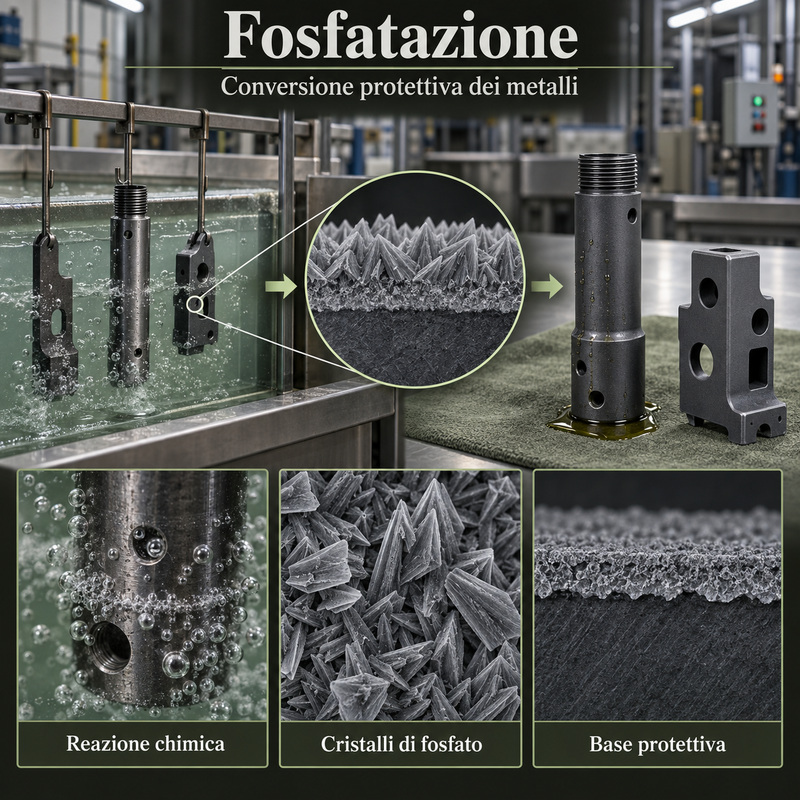
The component is immersed or treated with an acidic solution containing phosphates. The solution reacts with the metal, dissolving a microscopic amount in a controlled manner and promoting the formation of insoluble crystals that adhere firmly to the surface.
It's not a paint or a simple deposition. The layer is formed by a chemical reaction with the base material and is integrated into its surface.
The stages of the process
An industrial phosphating cycle generally includes:
- degreasing of the component;
- removal of oxides and contaminations;
- rinse thoroughly;
- possible activation of the surface;
- immersion in the phosphating bath;
- new rinse and neutralization;
- drying;
- final oiling, sealing or varnishing.
Each stage influences the uniformity, crystal size, adhesion and protective capacity of the layer.
Manganese phosphating
Manganese phosphating generally forms a thicker, darker, and more wear-resistant coating. Its porous structure effectively absorbs oil and lubricants, aiding the running-in and sliding of mechanical parts.
It is particularly suitable for armor components subject to friction and heavy use. The finish can vary from dark gray to black, with possible gray-green tones.
Zinc phosphating
Zinc phosphating typically produces a lighter coating with relatively fine crystals. It is primarily used to increase corrosion resistance and create a suitable base for subsequent paint applications.
It is widely used in the industrial production of metal components and can be used when a protective cycle consisting of phosphating and organic coating is desired.
Iron phosphating
Iron phosphating generally produces a thinner and lighter coating. It is primarily used as a primer for painting and offers less protection than manganese or zinc treatments when used alone.
The process is relatively simple and may be suitable for components that do not face particularly harsh environmental conditions.
The crystalline structure
The phosphated surface features a network of microscopic crystals. Their size, shape, and distribution depend on the metal, preparation, bath composition, temperature, and treatment duration.
The spaces between the glass allow oil, wax, sealants, or paint to absorb. Phosphating therefore often serves as the basis for a more comprehensive protection system.
Surface preparation
Oil, grease, rust, and residues prevent the solution from reacting evenly. The component must be thoroughly clean before treatment.
In the firearms industry, the surface can be prepared by sandblasting or controlled micro-sandblasting. This process removes old finishes and helps achieve a uniform matte appearance.
The role of activation
Before phosphating, an activator can be applied that promotes the formation of numerous small crystalline nuclei. This allows for a finer, more uniform layer.
Activation is especially important when the surface is to be painted later, because a regular structure improves the adhesion of the coating.
Oiling and sealing
The phosphate coating is porous and, if left completely dry, offers limited protection. Therefore, it is typically impregnated with anti-corrosion oil or coated with paints and sealants.
The oil fills the pores, reduces the steel's contact with moisture, and improves its sliding properties. Protection therefore depends on both the phosphating and the subsequent treatment applied.
corrosion protection
Phosphating slows corrosion processes and improves the steel's ability to retain protective substances. However, it does not provide a completely waterproof barrier.
If the surface loses oil, gets scratched, or is exposed to moisture for a long time, rust can still develop. Regular maintenance remains essential.
Wear resistance
Manganese phosphating can reduce direct surface contact during running-in and retain lubricant in sliding areas. For this reason, it is also used on gears, pins, and mechanical components.
However, the layer does not achieve the hardness achievable with nitriding, tempering, or hard chrome plating. Its main function is to provide a porous, protective surface suitable for lubrication.
Use in weapons
Phosphating can affect numerous steel components:
- reeds and castles;
- shutters and shutter holders;
- trolleys and drums;
- loaders;
- triggers and controls;
- compatible pins, levers and springs;
- small metal parts and accessories.
Areas with very tight tolerances, threads or mating surfaces may require specific masking and inspection.
Phosphating and Parkerizing
Phosphating is the general family of treatments based on the formation of phosphates. Parkerizing is the name commonly given to some manganese or zinc phosphating processes used primarily on weapons and military components.
The two words are often used synonymously, but technically phosphating encompasses a wider range of industrial processes and applications.
Phosphating and burnishing
Burnishing converts the steel surface into a layer of dark oxides, generally smoother and thinner. Phosphating, on the other hand, forms a porous crystalline structure capable of retaining a greater quantity of oil.
Burnishing is traditionally associated with more elegant finishes; phosphating favors a matte, functional, and low-reflective appearance.
Phosphating and nitriding
Phosphating is a surface conversion treatment that provides protection and lubricant absorption. Nitriding diffuses nitrogen into the steel, significantly increasing its hardness.
Nitriding generally provides greater wear resistance, while phosphating is simpler, cheaper and suitable as a base for oils and paints.
Phosphating and painting
The phosphated surface is an excellent base for paint. Its microstructure increases the contact area and promotes coating adhesion.
If the paint is scratched, the underlying phosphate layer can slow the spread of corrosion. For this reason, the two treatments are often included in the same protective cycle.
Color and appearance
Color may vary depending on the process and material:
- light grey;
- dark grey;
- matte black;
- gray-green;
- olive green after oiling and aging.
The shade alone doesn't reveal the type of phosphate or the quality of the treatment. The oil used can also significantly alter the final appearance.
Main benefits
- better corrosion protection;
- high oil holding capacity;
- good adhesion of paints and coatings;
- dull and not very reflective appearance;
- reduction of friction during running-in;
- relatively low thickness;
- process suitable for industrial production;
- generally moderate cost.
Limits of treatment
Phosphating does not make steel immune to corrosion and must be completed with oil, paint, or another protective coating. The coating can wear away on surfaces subject to constant friction.
The treatment is primarily intended for ferrous materials. Aluminum, brass, polymers, and other materials require different procedures and may be damaged by the solutions used.
Machine maintenance
Phosphated parts must be kept clean and lightly oiled. After exposure to rain, condensation, sweat, or salty environments, the component must be dried and the protection restored.
Wire brushes, abrasive compounds and aggressive polishes can wear away the crystalline layer and make the finish shiny and uneven.
A complementary treatment
Phosphating performs best when used in conjunction with oil, sealants, or paints . The crystalline layer prepares and protects the surface, while the absorbed or applied product completes the barrier against external agents.
This combination makes the treatment particularly suitable for armoury components intended for intensive use and difficult environmental conditions.