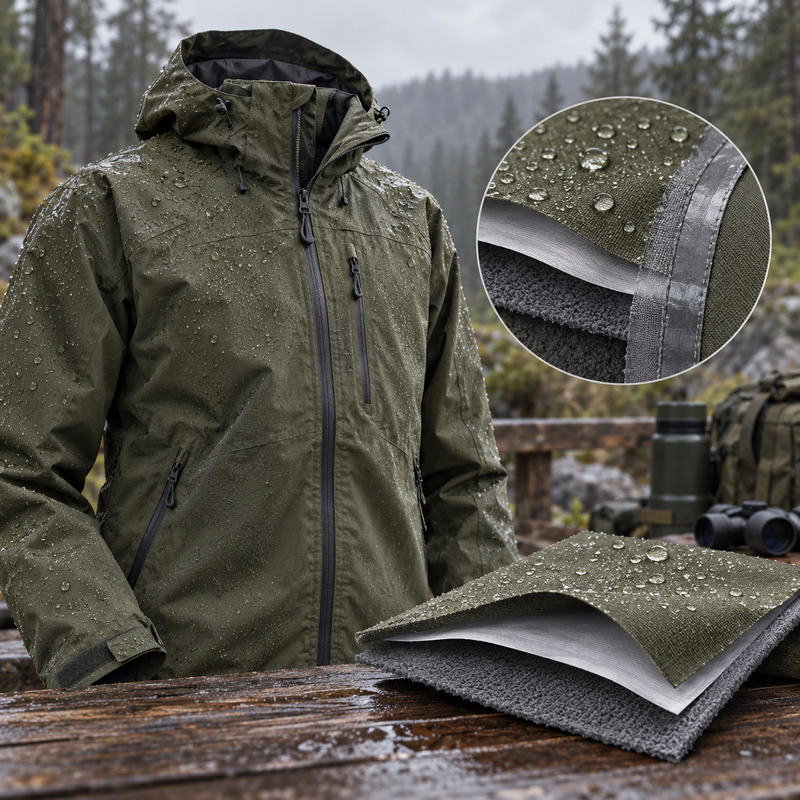
GORE -TEX® is a family of waterproof, windproof, and breathable technologies developed by W.L. Gore & Associates. It is used in the production of jackets, pants, gloves, and footwear for hunting, hiking, and professional outdoor activities.
It's incorrect to simply consider it a fabric. The system comprises an extremely thin membrane laminated to one or more textile materials, to which linings, protectors, seam taping, and water-repellent treatments can be added.
The presence of a membrane alone does not guarantee product quality. Waterproofness, breathability, resistance, silence, and durability depend on the overall construction of the garment or shoe.
The correct denomination
The official spelling is GORE-TEX® . Expressions such as “Goro-Tex,” “Goretex,” or “Gorotex” are sometimes used in common parlance, but they do not correspond to the registered name.
GORE-TEX® is a brand name, not a generic name, for all waterproof and breathable membranes. There are numerous alternative technologies on the market based on microporous membranes, monolithic membranes, or polyurethane coatings.
How the membrane works
The membrane creates a barrier against liquid water and wind, while simultaneously allowing some of the vapor produced by the body to pass through.
The operation is based on the combination of:
- membrane structure;
- surface properties of materials;
- difference in temperature and humidity between inside and outside;
- lamination with fabrics;
- seam protection;
- external water-repellent treatment.
Historical GORE-TEX® membranes were developed using expanded PTFE, or ePTFE . More recent generations also include membranes based on expanded polyethylene, or ePE . Material, construction, and performance can therefore vary depending on the line and year of production.
Waterproof and breathable
Waterproofness and breathability are not absolute opposites. Rainwater exists in a liquid state, while body moisture can pass through the system primarily in the form of vapor.
The membrane prevents external water from penetrating when the product is used within the intended limits, but allows some migration of vapor to the environment.
Perspiration is favored when:
- the inside is warmer and more humid than the outside;
- the outer fabric is not saturated with water;
- layers worn under the garment effectively transfer sweat;
- the user does not produce humidity faster than the system can dispose of it;
- the membrane and lining are clean.
In hot and very humid conditions, or during intense exercise, vapor can accumulate inside and condense. This wet feeling does not necessarily indicate a leak in the membrane.
Waterproof does not mean completely watertight
A waterproof garment must also protect the areas where the membrane is broken. Seams, zippers, vents, pockets, and adjustment systems are all potential entry points for water.
Protection therefore depends on:
- properly taped seams;
- water-resistant or flap-protected zippers;
- well-adjustable hood;
- tight cuffs;
- neck closure;
- length of head;
- quality of workmanship.
Water can enter footwear through the upper opening, even when the membrane and upper are in good condition.
The taped seams
During the manufacturing process, the needle pierces the laminate, creating small holes. To restore the continuity of the waterproof barrier, the seams are covered internally with special heat-sealed tape.
Tape width, application temperature, and pressure must be monitored. A loose, creased, or damaged tape may allow leaks.
Over time, the taping can become damaged due to:
- internal abrasion;
- repeated folds;
- incorrect washing;
- oil contamination;
- aging of adhesives;
- prolonged storage in warm, humid environments.
The DWR treatment
The outer fabric is normally protected with a DWR (Durable Water Repellent ) treatment . Its function is to collect water in drops and facilitate its runoff, delaying the saturation of the fabric.
DWR isn't the membrane and isn't the primary waterproof barrier. When it loses its effectiveness, the garment may still keep rain out, but the outer fabric will become soaked.
This phenomenon, often called wet-out , can cause:
- weight gain;
- reduction in breathability;
- feeling cold;
- slower drying;
- apparent sensation of infiltration.
The treatment can be reactivated or resumed by following the instructions on the product label.
Two-layer construction
In the two-layer laminate , the membrane is bonded to the outer fabric, while the inner lining remains separate.
This construction allows for the use of soft or insulating linings and is often chosen for garments intended for winter hunting. It can offer good comfort, but is generally heavier and bulkier than a basic three-layer construction.
Two and a half layer construction
In structures commonly referred to as two and a half layers , the outer fabric is laminated to the membrane, while the internal protection is entrusted to a print, a texture or a thin coating.
This solution reduces weight and volume, but may offer a less comfortable internal feel in direct contact with the skin and lower strength than more robust laminates.
The presence of this construction must be verified on the individual product, because GORE-TEX® families are not defined exclusively by the number of layers.
Three-layer construction
In the three-layer laminate , the outer fabric, membrane and inner support are combined to form a single material.
This configuration typically offers:
- good membrane protection;
- reduced movement between layers;
- light weight compared to many suspended liners;
- quick drying;
- high resistance to intense use;
- good compactness.
However, it can be stiffer and noisier, especially when using sturdy outer fabrics.
GORE-TEX® in hunting jackets
In a hunting jacket, the membrane must protect from rain and wind without excessively restricting movement. The design must also consider silence, ventilation, and resistance to vegetation.
The most important elements include:
- durable but low-noise outer fabric;
- adjustable hood without obstructing the view;
- ventilation zippers;
- pockets accessible even when wearing a backpack;
- reinforcements on shoulders and elbows;
- adjustable cuffs;
- taped seams;
- fit suitable for the shooting position.
The membrane is very thin and does not, by itself, provide resistance to brambles and abrasion. This depends primarily on the outer fabric and reinforcements.
Noise while hunting
Waterproof laminates can make rustling noises when bent or rubbed. The noise depends on the rigidity of the construction, the outer fabric, the temperature, and the number of layers.
For selective hunting or stalking, it may be acceptable to favor protection and lightness. When hunting in the woods or when approaching at close range, a soft and quiet outer surface may be preferable.
A brushed fabric reduces noise, but may retain more water and dry more slowly than a smooth surface.
GORE-TEX® in trousers
Pants must withstand contact with wet grass, mud, rocks, and vegetation. The knees, seat, and bottom of the legs are the areas most subject to wear.
A good waterproof pant can include:
- localized reinforcements;
- pre-shaped knees;
- side ventilation;
- internal gaiters;
- adjustable bottom;
- stretch fabric in specific areas;
- rain protected pockets.
The pressure exerted by kneeling on wet ground is a more demanding condition than simple rain and requires a laminate in good condition.
GORE-TEX® in boots
In footwear, the membrane is integrated into a sort of internal sock that envelops the foot. The joints are sealed and connected to the upper according to the intended construction.
The main advantages are:
- protection from rain, snow and wet grass;
- wind barrier;
- passage of a part of the internal steam;
- possibility of combining with leather or technical fabrics;
- comfort in cold and humid environments.
The breathability of the boot also depends on the lining, sock, insole, upper, and the intensity of the activity. If the foot produces more sweat than the system can transfer, the inside can become damp.
GORE-TEX® in gloves
In gloves, the membrane must move frequently and maintain sensitivity and grip. It can be inserted between the outer material and the lining or combined with other layers to reduce internal movement.
Water can enter through the cuff if the glove is worn incorrectly relative to the sleeve. Compression of the palm against wet surfaces is also a particularly challenging condition.
When choosing, the following must be considered:
- dexterity;
- thermal insulation;
- cuff length;
- wet grip;
- Abrasion resistance;
- compatibility with equipment controls.
The membrane does not produce heat
GORE-TEX® protects against water and wind, but it isn't necessarily an insulator. Warmth depends primarily on the insulation, lining, layers worn, and the amount of air trapped.
There are very light, uninsulated GORE-TEX® products intended to be used over other garments, and winter products with significant padding.
The presence of the brand therefore does not allow us to establish how warm a jacket or boot is.
Breathability and layering system
To take full advantage of the membrane, the inner layers must also wick away moisture. A wet cotton garment traps water close to the skin and dries slowly.
An effective system may include:
- intimate layer capable of wicking away sweat;
- thermal layer proportional to the temperature;
- waterproof and windproof shell;
- ventilation openings used before overheating.
Adjusting clothing while moving is often more effective than simply choosing a membrane with a high breathability rating.
How performance is measured
Waterproofness is often expressed as the height of a column of water that the material can withstand before penetration. Breathability can be expressed using values such as:
- MVTR: amount of vapor that passes through a surface in a given period of time;
- RET: resistance to the passage of steam;
- other methods established by internal rules or protocols.
Results obtained with different methods are not always directly comparable. Furthermore, data from new fabric does not necessarily describe the performance of the entire garment after use, contamination, and washing.
Why a garment may appear wet inside
The presence of internal humidity can depend on various causes:
- sweat condensation;
- DWR exhausted and outer fabric saturated;
- water entering through the neck, cuffs or zippers;
- pockets left open;
- damaged seams or taping;
- perforated membrane;
- contact with already wet clothing.
Before concluding that the membrane is leaking, it is necessary to identify the source of the moisture and check the condition of the entire product.
Washing GORE-TEX® garments
Properly washing a garment helps remove sweat, grease, and dirt that can reduce breathability. Always follow the instructions on the label.
Generally speaking, it is advisable to:
- close zippers and Velcro systems;
- use a small amount of mild liquid detergent;
- avoid powdered detergents, fabric softeners and bleaches;
- rinse thoroughly;
- do not use aggressive stain removers;
- dry according to the manufacturer's instructions;
- reactivate or renew the DWR when necessary.
A light heat treatment, when permitted by the label, can reactivate any residual water repellency. If water continues to bead on the fabric instead of forming beads, a new DWR product may be necessary.
Boot maintenance
Boots should be cleaned of mud and debris, rinsed with compatible products and left to dry at room temperature.
È consigliabile:
- remove insole and laces;
- open the flap completely;
- avoid radiators, stoves and hair dryers;
- treat the upper with compatible products;
- do not saturate the skin with non-recommended fats;
- Check seams and glues periodically.
Excessive heat can damage leather, membranes, foams and adhesives in the sole.
Damages and repairs
Brambles, thorns, metal edges, and abrasions can puncture the laminate. Small damage can sometimes be repaired with specialized patches, while extensive cracks or loose taping require professional intervention.
A standard household seam creates new holes in the membrane and must then be sealed with suitable materials. Impromptu repairs can limit breathability or worsen leaks.
GORE-TEX® and alternative materials
Competitor membranes may use:
- Expanded PTFE;
- expanded polyethylene;
- microporous polyurethane;
- monolithic polyurethane;
- hydrophilic polyester;
- combinations of membranes and coatings.
Some materials prioritize breathability and lightness, others stretch, quietness, cost, or ease of recycling. GORE-TEX® technology is an important solution, but it's not the only one available.
The comparison should be based on the complete product and actual conditions of use, not just the name of the membrane.
Environmental aspects
Traditional ePTFE membranes belong to the fluoropolymer family. The technical apparel industry is developing water-repellent materials and treatments with a different environmental profile, including ePE and DWR membranes free of certain fluorinated substances.
Not all products on the market belong to the same generation. To learn about their composition and environmental characteristics, please consult the documentation for each model.
Product durability, proper maintenance, repairability, and extended use help reduce its overall impact.
Benefits of GORE-TEX®
- high rain protection;
- effective barrier against the wind;
- transmission of a part of the body vapor;
- availability of lightweight or highly resistant constructions;
- use in clothing, footwear and gloves;
- performance suitable for difficult climatic conditions;
- consolidated production systems and controls;
- possibility of restoring the external water-repellent treatment.
Limitations of GORE-TEX®
- limited perspiration during very intense efforts;
- reduced performance when the outer fabric is saturated;
- possible noise from some laminates;
- higher cost than non-waterproof solutions;
- need for correct washing and maintenance;
- possibility of perforation or delamination;
- lack of thermal insulation unless combined with padding;
- performance dependent on the complete construction of the product.
How to choose a GORE-TEX® hunting product
Before purchasing it is useful to consider:
- type of hunting practiced;
- temperature and activity level;
- duration of exposure to rain;
- necessary resistance against brambles and rocks;
- silence of the fabric;
- presence of ventilation;
- weight and compressibility;
- membrane type and construction;
- ease of maintenance;
- fit and freedom of movement.
A sturdy, waterproof garment may be ideal for a rainy day, but may be too hot and noisy on a long march. The choice should be based on the actual use.
Final houghts
GORE -TEX® is a technology designed to combine waterproofness, windproofness, and breathability. Its performance depends on the integration of the membrane, outer fabric, lining, seams, and DWR treatment.
The membrane doesn't provide warmth, doesn't prevent sweat production, and doesn't make the garment indestructible. However, if used in a well-designed product and properly maintained, it can offer very effective protection in the cold, windy, and rainy conditions typical of many hunting activities.