The Jagdterrier , officially known as Deutscher Jagdterrier , is one of the most energetic, determined, and versatile hunting dogs in European hunting. Also known in Italy as the German Hunting Terrier , it embodies an impressive combination of courage, endurance, initiative, scenting abilities, and a passion for game in a compact build.
Originating in Germany through a highly work-oriented selection process, the Jagdterrier was not developed primarily as a show or companion dog, but as a complete hunting aid , capable of working underground, in the woods, in the most difficult vegetation and, with correct training, also on the trail and in retrieval.
In Italy, the Jagdterrier has found one of its best-known uses in wild boar hunting . Its compact size, agility, vocal ability, determination, and ability to penetrate vegetation allow a well-selected individual to become an extremely valuable companion in wild boar hunting. However, limiting the breed to wild boar hunting would be reductive: its history and selection demonstrate a dog designed for much broader hunting versatility.
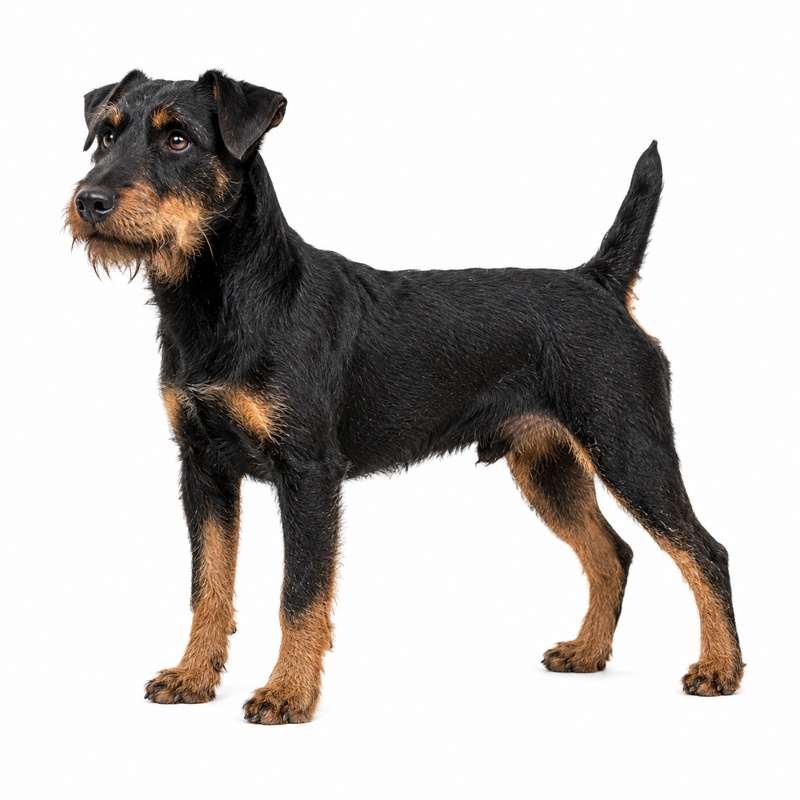
Jagdterrier: identity card
| Official name | German hunting terrier |
| Commonly used name | Hunting terriers |
| Italian name | German Hunting Terrier |
| country of origin | Germany |
| Hunting category | Multipurpose hunting terrier |
| FCI Classification | Group 3 – Terriers |
| Section | Section 1 – Large and medium-sized Terriers |
| FCI Standards | N. 103 |
| Test of work | Expected |
| Height at the withers | 33-40 cm |
| Structure | Compact, robust, functional and muscular |
| Hair | Hard and rough or smooth and thick |
| Characteristic colors | Black, dark brown or greyish-black with well-defined tan markings |
| Temperament | Courageous, determined, intelligent, energetic and tenacious |
| Main skills | Den, hunting in the thicket, wild boar, tracking and multipurpose work |
The main hunting skills of the Jagdterrier
| Coraggio | ★ ★ ★ ★ ★ |
| Determination | ★ ★ ★ ★ ★ |
| Work in the den | ★ ★ ★ ★ ★ |
| Wild boar hunting | ★ ★ ★ ★ ★ |
| I work in thick vegetation | ★ ★ ★ ★ ★ |
| Smell | ★★★★ ☆ |
| Work on the track | ★★★★ ☆ |
| Resistance | ★ ★ ★ ★ ★ |
| Agility | ★ ★ ★ ★ ★ |
| I'm reporting | ★★★★ ☆ |
| Work in water | ★★★★ ☆ |
| Hunting versatility | ★ ★ ★ ★ ★ |
The ratings are indicative and describe the aptitudes generally associated with the breed. Individual characteristics may vary significantly depending on pedigree, selection, experience, temperament, and training.
The Jagdterrier in a nutshell: a small specialist in real hunting
The Jagdterrier is one of those dogs whose size can be deceiving. Behind a relatively small frame lies a companion with great physical energy and, above all, a very strong hunting motivation.
Its fundamental characteristic is determination. When it comes to action, it must demonstrate initiative, perseverance, and the ability to cope with environments where other dogs might encounter greater challenges.
However, it is incorrect to interpret the Jagdterrier only as an extremely aggressive dog towards game. The true quality of a great specimen lies in the balance between courage, intelligence, and the ability to assess the situation.
A dog that faces every situation without any self-control isn't necessarily a good Jagdterrier. In practical hunting, especially wild boar, intelligence and caution can be as important as determination.
Origins and history of the Jagdterrier
The history of the Deutscher Jagdterrier is relatively recent compared to that of many ancient European breeds. Its modern development began in Germany in the years following the First World War.
A group of German hunters and dog handlers wanted to develop a terrier intended almost exclusively for hunting work, recovering characteristics considered fundamental for practical hunting: courage, hardiness, ability to work in dens, sense of smell, voice, endurance and versatility.
The project's primary goal, therefore, was not to create an elegant show dog. The priority was to create an authentic Gebrauchshund , that is, a functional working dog.
The birth of the Deutscher Jagdterrier
Among the protagonists of the formation of the breed is Walter Zangenberg , together with other German enthusiasts interested in the selection of an exclusively hunting terrier.
An important moment in the breed's history was the acquisition of several dark terriers from Fox Terrier lines. These specimens formed one of the foundations upon which the new breeding program was developed.
Subsequently, other working terriers were used with the aim of consolidating physical and above all functional characteristics.
In 1926 the Deutscher Jagdterrier-Club was founded , providing an organised structure for the selection of the new breed.
From the very beginning the basic principle was clear: the ability to work had to have absolute priority.
Why the Jagdterrier was primarily selected for work
The original philosophy of the Jagdterrier is one of the most interesting aspects of the breed.
German breeders wanted a dog capable of dealing with different hunting situations and not just a terrier specialized exclusively for underground work.
The dog had to possess useful qualities:
in the den, in the woods, on the trail, in the search for game, in water work and in retrieval.
This approach has created an extremely versatile terrier, in which the hunting nature still remains one of the central elements of selection today.
Morphology of the Jagdterrier
The Jagdterrier is a compact, muscular, and functional dog . Every element of its structure should be interpreted in relation to its work.
The relatively low height facilitates movement through vegetation and underground work, while a sufficiently robust build allows the dog to sustain physically demanding activities.
The chest must provide breathing capacity without becoming excessively large, because too large a size would compromise the ability to move effectively in the burrows.
The limbs must be solid and correctly angulated, while compact and resistant feet are a fundamental requirement for a dog destined to work on very different terrains.
The head of the Jagdterrier
The head of the Deutscher Jagdterrier is elongated and strong without appearing excessively heavy.
The jaws must be powerful and the dentition complete and functional.
The eyes are small, dark and well protected, while the ears are set high, V-shaped and carried close.
The overall expression should communicate focus, energy and determination.
The Jagdterrier's coat
The coat must offer effective protection when working in vegetation, in the forest and in difficult weather conditions.
The breed can have hard, rough hair or smooth, thick hair.
In both cases, the functional quality of the coat is more important than its aesthetic appearance: the fur must help protect the skin and body during hunting.
The colors of the Deutscher Jagdterrier
The Jagdterrier generally has a basic colouration of black, dark brown or greyish-black , accompanied by clearly defined tan markings.
Tan markings are normally present on the eyebrows, muzzle, chest, legs and rear region.
The result is a dark, discreet coat that contributes to the breed's distinctive and instantly recognizable appearance.
The Jagdterrier on the hunt: how it works
When hunting, the Jagdterrier must demonstrate energy, initiative and great determination.
Its performance can vary significantly depending on its intended use. When working in the den, it must navigate extremely confined spaces; in the forest, however, it must utilize its sense of smell, agility, and ability to penetrate vegetation.
On the trail, he must reduce impulsiveness and concentrate on the scent, while when working on wild boar he must combine courage and the ability to continuously evaluate the game's movements.
It is precisely this ability to tackle different tasks that explains why the Jagdterrier is considered one of the most versatile hunting terriers.
The Jagdterrier in the den hunt
Den work belongs to the fundamental tradition of hunting terriers and represents one of the historical specializations of the Jagdterrier.
Size, build, courage and determination allow the dog to operate in underground tunnels in search of game.
In this environment, the auxiliary must demonstrate not only courage, but also orientation, mobility, and intelligence.
The den, in fact, represents an extremely complex environment, in which excessive impulsiveness can quickly turn into a limitation.
Jagdterrier and fox
The fox has historically been one of the game animals most associated with terrier work.
The Jagdterrier must locate game, work with determination and use his voice to signal his action.
Courage and perseverance are essential, but they must be accompanied by balance and the ability to correctly interpret the animal's behavior.
Jagdterrier and badger
The badger also belongs to the hunting tradition in which particularly strong and determined terriers were historically used.
However, it is a physically powerful wild dog, capable of defending itself effectively. For this reason, a dog destined for such situations must possess not only courage, but also experience and judgment.
Naturally, use must take place exclusively in compliance with the hunting regulations in force in the area concerned.
The Jagdterrier in wild boar hunting
In Italy, the wild boar Jagdterrier is probably one of the best-known modern interpretations of the breed.
Its compact build offers several advantages. The dog can quickly penetrate thickets, traverse dense vegetation, and change direction with remarkable agility.
Its strong temperament also allows it to deal with challenging game such as wild boar without easily losing initiative.
But it is precisely in this use that a fundamental concept emerges: courage must not mean recklessness.
How a good Jagdterrier should work on wild boar
A good Jagdterrier on wild boar should have enough determination to find and maintain contact with the game, but at the same time he must learn to read the pig's reactions.
Continually getting too close can significantly increase the risk of injury.
The experienced subject progressively learns to use movement and voice to apply pressure while maintaining, when possible, a functional distance.
Reaction speed, agility and the ability to quickly change direction therefore become fundamental characteristics.
The advantage of the size contained in the stain
One of the reasons that have favored the diffusion of the Jagdterrier in wild boar hunting is the ability to move where larger dogs might encounter greater difficulties.
Brambles, Mediterranean scrub, undergrowth and particularly tangled vegetation constitute environments in which compact size and agility become concrete advantages.
The dog can quickly navigate narrow passages and change direction with great speed.
This characteristic does not, of course, eliminate the risks associated with confrontation with wild boars, but it contributes to the operational effectiveness of the breed.
The voice of the Jagdterrier
In dogs used for hunting game, the voice represents an important functional characteristic.
When the dog is working in thick vegetation and disappears from view, vocal behavior allows the hunter to interpret the position and development of the action.
In the lines selected for work, particular attention is paid to the dog's ability to use its voice in a manner consistent with the hunting action.
The Jagdterrier on the trail
A feature less known by the general public is the possibility of using the Jagdterrier also for tracking work.
A subject with good olfactory abilities and properly trained can follow a trail using concentration and perseverance.
However, this work requires a different behavior compared to the energetic action on the wild boar or in the den.
The dog must learn to reduce impulsiveness and maintain attention on the assigned trail, ignoring as much as possible the numerous olfactory distractions present on the ground.
Jagdterrier and recovery of injured ungulates
The Jagdterrier can also be trained to search for wounded hoofed game.
A good sense of smell, perseverance, and strong motivation can be attractive qualities for this job.
However, compared to specialists such as Bayerischer Gebirgsschweisshund, Hannoverischer Schweisshund or Alpenländische Dachsbracke, the Jagdterrier presents a different selective approach.
It was not born as an exclusive track specialist: its value lies above all in its versatility.
The Jagdterrier in the woods
The forest represents one of the environments in which the Jagdterrier can fully exploit its characteristics.
Agility, compact structure, endurance and the ability to penetrate vegetation allow the dog to explore particularly complex environments.
However, the well-connected subject must maintain a functional relationship with the handler, especially when vegetation prevents visual contact for long periods.
The Jagdterrier in the water
The versatility sought in the German selection also includes a good predisposition for working in the water.
Correctly introduced subjects can demonstrate decisiveness in entry and the ability to retrieve game even in aquatic environments.
Of course, the Jagdterrier should not be confused with a water retriever, but this ability represents a further element of its hunting versatility.
Retrieving in the Jagdterrier
Retrieving can also be within the capabilities of a properly selected and trained Jagdterrier.
Strong motivation towards game can be directed towards effective and collaborative recovery.
As always, education must be progressive and aimed at building trustworthy behavior without stifling initiative and passion.
The ideal terrain for the Jagdterrier
| The Forest | ★ ★ ★ ★ ★ |
| Mediterranean bush | ★ ★ ★ ★ ★ |
| Dense vegetation | ★ ★ ★ ★ ★ |
| Collina | ★ ★ ★ ★ ★ |
| Mountain | ★★★★ ☆ |
| Rough terrain | ★ ★ ★ ★ ★ |
| Wetlands | ★★★★ ☆ |
| Large open spaces | ★★★ ☆☆ |
The Jagdterrier probably expresses its characteristics at their best in complex environments , where agility and the ability to penetrate vegetation take on great importance.
It's therefore not a dog that requires large open spaces to demonstrate its effectiveness. Woods, scrub, and uneven terrain often represent its ideal habitat.
What game should you hunt with a Jagdterrier?
Boar
Attitude: ★★★★★
Agility, courage, voice and determination have made the Jagdterrier particularly popular in wild boar hunting, especially in areas characterised by thick vegetation.
Fox
Traditional Attitude: ★★★★★
Fox hunting is one of the historical uses of the German Hunting Terrier, especially in relation to underground work.
Injured ungulates
Recovery Aptitude: ★★★★☆
With specific training, the Jagdterrier can also make its sense of smell and perseverance available when working on the track.
Water game
Attitude: ★★★★☆
The predisposition to work in water contributes to the versatility of the breed, especially in subjects coming from lines in which this characteristic is maintained through selection.
How to recognize a good Jagdterrier on the ground
A great Jagdterrier should not be judged solely on its aggression towards game.
The really important features are:
passion, courage, balance, sense of smell, voice, perseverance, agility, orientation skills, connection and hunting intelligence.
The most difficult quality to achieve is probably the balance between determination and the ability to evaluate.
An extremely tough dog, incapable of interpreting wild animal behavior, may continually expose itself to dangerous situations. An intelligent dog, on the other hand, can use its qualities more effectively.
Character of the Jagdterrier
The character of the Jagdterrier is one of the aspects that must be better understood before choosing this breed.
It is generally an energetic, confident, determined and highly motivated dog to work.
Hunting has retained a strong sense of personal initiative and a remarkable intensity of character. For this reason, it requires a consistent owner, capable of building a solid relationship without needlessly resorting to excessively harsh methods.
This is not a dog that should be chosen solely for its small size or appearance. The Jagdterrier is first and foremost a working dog.
The Jagdterrier as a companion dog
A properly socialized Jagdterrier can naturally live within the family and develop a very intense relationship with the owner.
This does not mean, however, that it can be considered a traditional small companion dog.
Energy, initiative, curiosity and strong predatory motivation require physical activity, stimulation and proper management.
Lack of activity can promote difficult-to-manage behaviors, especially in subjects coming from lines that are highly selected for work.
The relationship between Jagdterrier and handler
The Jagdterrier must possess initiative, but this quality must develop within a functional relationship with the handler.
The recall and the connection take on particular importance because a dog strongly motivated by the game can be naturally led to move away or continue the action.
Building a solid relationship from a young age allows you to maintain greater control without reducing your natural passion for hunting.
Jagdterrier training
Jagdterrier training must begin early and proceed consistently.
Socialization
The puppy must be gradually accustomed to people, dogs, environments, noises and different situations.
Recall
A reliable recall is one of the most important exercises for a breed characterized by strong initiative and hunting motivation.
connection
During the first outings it is important to allow the young dog to explore while maintaining spontaneous attention towards the handler.
Introduction to the wild
Experience must be progressive. The dog must gain confidence without being pushed prematurely into situations beyond its capabilities.
Work on the track
The first slopes can be simple and short, progressively increasing in difficulty and time spent since their preparation.
Work in water
The introduction must take place gradually, avoiding negative experiences that could compromise the subject's natural predisposition.
Shooting habits
As with any hunting dog, the sound of the shot must be introduced gradually and associated with positive situations.
Athletic training of the Jagdterrier
Despite its small size, the Jagdterrier is an athletically demanding dog.
A day spent in the woods or scrub requires cardiovascular endurance, muscle strength, agility and strong feet.
Preparation must therefore be progressive and maintained throughout the year.
A trained dog not only works better, but maintains greater clarity when fatigue increases, an element particularly important in the most demanding hunting situations.
The safety of the Jagdterrier in wild boar hunting
Working with wild boar inevitably involves risks, and the Jagdterrier's great determination can increase exposure when the dog tends to get too close.
Selection should therefore reward not only courage, but also agility, intelligence and the ability to maintain a functional distance.
When hunting, it is important to carefully monitor the dog's condition and use tracking systems appropriate to the characteristics of the territory.
Experience remains one of the most important elements: many subjects progressively learn to better interpret the reactions of the game and to manage the confrontation more effectively.
Jagdterrier care after hunting
After each outing, it is advisable to carefully check the dog.
Particular attention should be paid to the eyes, ears, neck, chest, abdomen, limbs, feet and interdigital spaces.
Working in the bush can cause abrasions and small cuts or encourage the presence of thorns and plant debris.
In subjects used on wild boar, the checks must be even more careful, because small lesions can initially be hidden by the coat.
Jagdterrier Health and Management
The choice of puppy should favor breeders who seriously select health, character balance and quality of work.
In a breed characterized by great energy and determination it is particularly important to avoid the exaggerated selection of a single characteristic to the detriment of the overall balance.
A dog intended for hunting must also be kept at the correct weight, receive a diet appropriate for the activity, and follow a health and parasite prevention program agreed upon with the veterinarian.
Is the Jagdterrier the right hunting dog for you?
| Coraggio | ★ ★ ★ ★ ★ |
| Determination | ★ ★ ★ ★ ★ |
| Agility | ★ ★ ★ ★ ★ |
| Resistance | ★ ★ ★ ★ ★ |
| I work in the thicket | ★ ★ ★ ★ ★ |
| Work in the den | ★ ★ ★ ★ ★ |
| Boar | ★ ★ ★ ★ ★ |
| Smell | ★★★★ ☆ |
| Track | ★★★★ ☆ |
| Versatility | ★ ★ ★ ★ ★ |
| Ease for inexperienced owners | ★★☆☆☆ |
| Need for activity | ★ ★ ★ ★ ★ |
The Jagdterrier is particularly suitable for the hunter who wants a compact, energetic, resistant and truly versatile dog.
It can be particularly interesting for those who practice wild boar hunting in areas characterized by woods and dense vegetation, but also for those who wish to enhance its other working skills.
However, it is a choice that should be carefully considered by those looking for a very calm dog or who have little time to dedicate to activities, training and work.
Jagdterrier: Strengths and Aspects to Consider
| Key features | Aspects to consider |
|---|---|
| Great courage | Very intense temperament |
| High hunting versatility | Requires a consistent conductor |
| Small size | Great need for activity |
| Exceptional agility | Strong predatory motivation |
| Excellent in the thicket | The recall must be carefully attended to |
| Great determination | Excessive hardness can increase the risks on wild boar |
| Good ability on the track | He is not an exclusive recovery specialist |
| Resistance and rusticity | Not ideal for completely inexperienced owners |
Jagdterrier and Fox Terrier: What are the differences?
The comparison between the Jagdterrier and the Fox Terrier is particularly interesting because the history of the two breeds has some points of contact.
The Deutscher Jagdterrier was developed through a selection process strongly focused on hunting performance and versatility.
The Fox Terrier also has important working origins, but over time a significant part of the international selection has also been oriented towards exhibitions and companionship.
In the Jagdterrier, however, the preservation of hunting skills has remained one of the fundamental objectives.
Jagdterrier and Dachshund
The Jagdterrier and the Dachshund may share some uses, especially in the tradition of underground work, but they are morphologically and character-wise very different dogs.
The Jagdterrier has longer limbs and a particularly agile structure, which allows it to express considerable speed even outside its den.
The Dachshund, on the other hand, has a highly specialized build, with very short limbs and an elongated body.
Both can demonstrate courage, sense of smell and perseverance, but through different modes of operation.
Jagdterrier and Alpenländische Dachsbracke
The comparison between Jagdterrier and Alpenländische Dachsbracke allows us to distinguish two profoundly different hunting philosophies.
The Alpenländische Dachsbracke specializes in tracking and retrieving injured ungulates, where method, concentration, and perseverance are essential qualities.
The Jagdterrier, on the other hand, has a generally more explosive temperament and was developed as a versatile auxiliary dog capable of dealing with dens, thickets and different forms of hunting.
Both can work on the track, but their selective heritage and their way of approaching the work remain different.
Jagdterrier and Segugio in wild boar hunting
Comparing Jagdterriers and wild boar hounds means comparing very different operating methods.
The Jagdterrier relies primarily on agility, determination, and the ability to quickly enter thickets. Traditional hounds, on the other hand, can develop broader and more sustained actions, exploiting their voice, sense of smell, and ability to track.
In some teams, the different characteristics can be considered complementary, but the organization of the work must be carefully evaluated in relation to the territory, hunting methods and characteristics of the individual dogs.
Similar breeds to the Jagdterrier to know
Those who appreciate the Jagdterrier can also learn more about other breeds with significant hunting abilities.
Fox Terrier – historic British terrier originally selected for hunting work.
Jack Russell Terrier – small, energetic terrier, also born within the British fox hunting tradition.
Parson Russell Terrier – Athletic and functional terrier developed to accompany hunting activities.
Dachshund – a highly specialized but surprisingly versatile dog, also used in various forms of hunting work.
Alpine Dachsbracke – Austrian dog of particular interest for those who wish to delve deeper into tracking and the recovery of ungulates.
Why choose a Jagdterrier for hunting
The Deutscher Jagdterrier represents one of the most interesting expressions of the European concept of a multipurpose hunting dog.
In a few centimetres of height he concentrates courage, agility, resistance, smell, voice, determination and an extraordinary motivation to work.
In wild boar hunting, its ability to move through thick vegetation and face challenging situations has greatly favored its diffusion, but the true value of the breed emerges when one considers the entire functional heritage for which it was selected.
Den, woods, water, tracking and retrieval are in fact part of a philosophy in which the dog must first of all be useful to the hunter.
When it comes from a serious selection, is educated with balance and entrusted to a handler capable of managing its energy and character, the Jagdterrier can become an exceptional helper: small in size, but endowed with a hunting personality and a working capacity enormously superior to what its size might lead one to imagine.