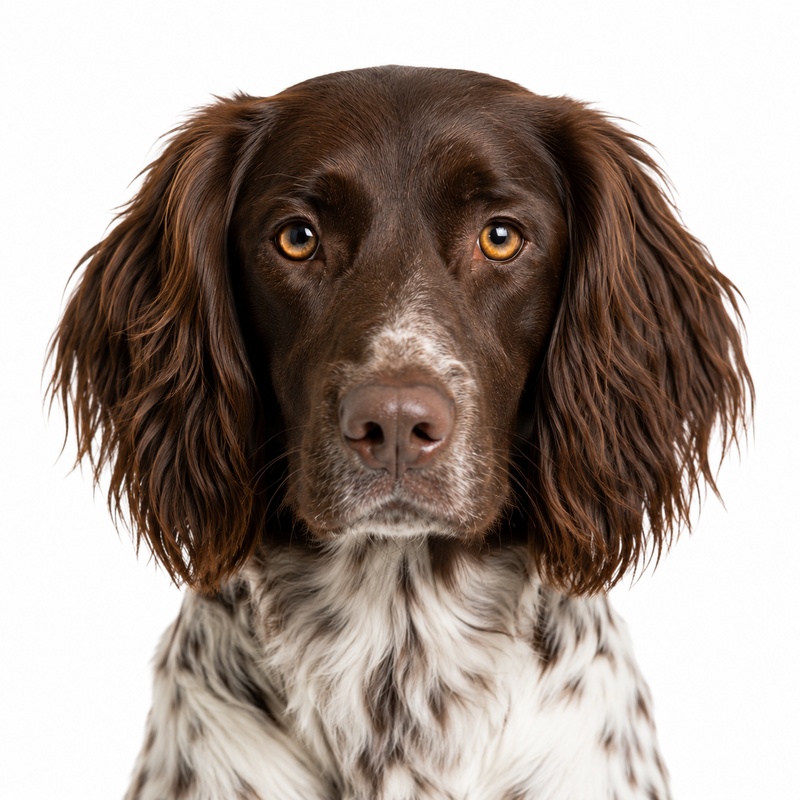
The Kleiner Münsterländer , known in Italy as the Piccolo Münsterländer , is one of the most interesting multipurpose hunting dogs of German tradition. It is a continental pointing dog of the Epagneul type, medium-sized, elegant yet robust, with an excellent nose, a strong passion for hunting, a predisposition for pointing, great retrieving ability, and a particularly close relationship with its handler.
Its true distinguishing feature is its versatility . The Kleiner Münsterländer was not created to excel only in hunting on the plains or exclusively in working in the woods: it must be able to adapt to different environments and functions, working before and after the shot, on feathered game, in retrieving and in water.
German breeding has strongly maintained the concept of the complete dog. The ideal subject must possess enough autonomy to effectively explore the terrain, while simultaneously maintaining a constant connection with the hunter . He must search with passion, point confidently, tackle vegetation and water without hesitation, and retrieve downed or wounded game with perseverance.
Compared to other large German all-rounders such as the Drahthaar, Kurzhaar or Pudelpointer, the Petit Münsterländer has a more compact build and a medium-long haired Spaniel type. This structure, combined with a generally very cooperative character, makes it particularly interesting for those looking for a dog capable of working in the forest, collina, plains and wetlands without losing sensitivity and connection.

Kleiner Münsterländer: technical data sheet of the breed
| Original name | Kleiner Munsterländer |
| Italian name | Small Münsterländer |
| country of origin | Germany |
| FCI Code | 102 |
| FCI Group | Group 7 – Pointing Dogs |
| Section | 1.2 – Continental Pointing Dogs, Spaniel Type |
| Test of work | Yes |
| Use | Versatile hunting dog for fields, woods and water |
| Ideal height for men | 54 cm at the withers |
| Ideal height for females | 52 cm at the withers |
| Tolerance provided by the standard | ± 2 cm |
| Construction | Medium, strong, harmonious and elegant |
| cloak | Dense, medium length, straight or slightly wavy, close-fitting and water-repellent |
| Colors | White-brown or brown roan, with brown patches, coat or speckles |
| Tack markings | Allowed in certain areas according to the standard |
| Temperament | Intelligent, balanced, collaborative, passionate and persevering |
| Main skills | Search, point, retrieve, work in forest and water |
Origin and history of the Kleiner Münsterländer
The documented selection of the Kleiner Münsterländer began in the northern German region of Münsterland around 1870. Hunting dogs capable of performing different functions, derived from ancient flushing and pointing dogs, had long been present in this area.
These dogs were prized by hunters primarily because they combined a passion for hunting with a good nose, pointing ability, and retrieving ability . They were therefore not dogs specialized exclusively for hunting, but rather assistants who accompanied the hunter in various phases of the action.
At the beginning of the twentieth century, interest in the conservation and systematic selection of this breed increased. In 1912, a club dedicated to the small Münsterländer was founded in Germany, with the aim of preserving their characteristics as an independent hunting breed.
In 1921 Friedrich Jungklaus developed the first breed standard, laying the foundations for a selection process that over time would continue to prioritize both morphology and hunting performance.
The modern result is a dog that is highly recognizable and still deeply connected to its function: a medium-sized helper capable of working with great effectiveness in open fields, in the woods and in water.
A versatile dog in the fullest sense of the term
To call the Petit Münsterländer simply a "pointing dog" would be an understatement. The breed officially belongs to Group 7, but its functional selection extends far beyond just pointing.
The dog must possess an effective search , detect the scent, and properly arrest the game. After the shot, it must be able to locate and retrieve the downed animal. If the game is wounded, it must use its nose and perseverance to complete the recovery.
In the water, he must enter decisively and face the retrieve of the waterfowl; in the woods, he must adjust his distance and maintain a closer connection with the handler.
Versatility therefore does not consist in knowing many separate exercises, but in the ability to move from one function to another without losing balance and availability for work.
General appearance: balance between strength and elegance
The Kleiner Münsterländer is a medium-sized dog, with a strong, harmonious, and elegant build . The standard insists that the overall impression must always clearly demonstrate suitability for hunting.
The body is slightly longer than the height at the withers, with an ideal ratio of approximately 1:1,1. This proportion allows for a build that is compact enough to maintain agility and elongated enough to promote ample movement.
The back is strong and muscular, the loin short and powerful, the croup relatively long and well developed.
The chest is deeper than it is wide, with well-sprung ribs. This configuration allows for good breathing capacity without weighing down the body excessively.
The whole thing must therefore convey the feeling of a dog capable of covering ground continuously without losing precision and endurance.
Head and expression
The head is noble, lean, and proportionate to the body. The skull is flat or only slightly arched, and the stop is not very pronounced but clearly recognizable.
The muzzle is strong, long and straight , a characteristic consistent with a dog with a good sense of smell and also intended for carrying game.
The truffle must be entirely brown and well pigmented.
The jaws are powerful and the dentition is normally complete, with a scissor bite.
The general expression should show intelligence and alertness without heaviness or coarseness.
Eyes and ears
The eyes are medium-sized and should be as dark brown as possible . They should be neither protruding nor excessively deep-set.
The eyelids must fit properly, helping to protect the eye when working in vegetation.
The ears are broad, set high and close to the head, tapering towards the tip.
They should not be excessively long: the pavilion should not go beyond the corner of the mouth.
This construction maintains the typical Spaniel appearance without producing such an abundant ear that it becomes a handicap during hunting.
Neck, back and topline
The neck is in proportion to the rest of the body and gradually widens towards the body. The nape is slightly arched and well-muscled.
The topline slopes slightly and evenly, with a well-defined withers.
The back is solid and muscular , while the loin must be short, broad and powerful.
This structural solidity allows it to withstand prolonged action on different terrains and to face numerous changes of direction without losing balance.
Arts and movement
The forelegs are strongly boned and should be straight and fairly parallel when viewed from the front. The shoulders are well muscled and correctly angulated.
The hindquarters are powerful, with long, muscular thighs and solid joints.
The feet are round, compact and equipped with strong pads , an essential element in a dog destined to move quickly from soft terrain to woods, stones, meadows and humid areas.
The movement must be harmonious, broad and capable of covering ground with good hindquarters.
It's not about a spectacular stride for its own sake: what counts is the economy of movement , essential for maintaining efficiency throughout an entire day's hunting.
The cloak: protection without hindering work
The coat of the Kleiner Münsterländer is dense, of medium length, straight or only slightly wavy and close to the body . It must also possess water-repellent qualities.
The density of the cover has a very specific function: to protect the dog from adverse weather conditions, vegetation and small injuries without excessively hiding the body structure.
The forelimbs are feathered, while the hindquarters have a greater amount of hair down to the hocks. The tail is characterized by a prominent flag.
The coat should not become excessively long or curly. Too much coverage can trap mud, water, and plant matter, impairing functionality.
White-brown and brown roan
The typical coloration includes white and brown or brown roan , with different distributions of spots.
Brown patches, a brown coat, or speckles may be present.
A white list on the head is also permitted.
The standard also allows for special tan markings, known as Jungklaus markings , which may appear on the muzzle, above the eyes and in other defined areas.
Completely single-coloured subjects do not belong to the correct type foreseen by the standard.
Character: great passion, but with balance
The Kleiner Münsterländer must be intelligent, very willing to learn, lively but balanced and stable.
One of the most interesting characteristics is the relationship with its handler. The breed tends to maintain close contact and is often described as having a strong team spirit.
This predisposition, however, should not diminish the passion for hunting. The dog must possess a strong and persistent predatory instinct , a keen interest in game, and steady nerves.
True balance lies in combining strong hunting motivation and willingness to lead.
The connection with the hunter
The Petit Munsterländer should not work as a completely independent dog. Even when the search expands, it must remain attentive to the handler's position and movement.
This connection is especially useful in mixed terrain, where the optimal distance is constantly changing.
In a large meadow, the dog can spread out more; entering a forest, it should naturally reduce its search and maintain closer contact.
The ability to adapt the distance without constant corrections represents one of the most interesting qualities of the truly versatile subject.
The search in the plain
In open terrain the Kleiner Münsterländer can develop a sufficiently wide and dynamic search, but generally less extreme than the great English specialists of the large search.
The goal is not to cover the maximum space in the shortest time possible, but to explore the terrain with method, nose and connection.
The dog must use the wind and the arrangement of the vegetation to intercept the emanations, progressively modifying its path according to the conditions.
An effective search must therefore be rational before being spectacular.
The stop: natural and functional
Pointing is naturally one of the breed's core skills. When the dog detects the presence of game with sufficient certainty, it must stop and hold its position.
The Kleiner Münsterländer should not simply block the action mechanically: he must show a conscious firmness , derived from the correct interpretation of the emanation.
If the game moves on the ground, it may be necessary to accompany it with a controlled guide.
The quality of the point depends on the nose, experience, prudence and confidence in interpreting the smell.
Work on the Pheasant
The Pheasant is one of the ideal game birds for observing the versatility of the Lesser Munsterland.
The dog must methodically search, locate the scent, stop and, if necessary, carefully follow a subject stalking through the vegetation.
After the shot, you must quickly move into the recovery phase.
A wounded pheasant can run very far from the point of fall and the dog must then use his nose and perseverance to complete the search.
Within the same action , search, point, guide, marking and retrieve are required.
Grey Partridge and Partridge
Partridges and Grey Partridges require a dog capable of working with great sensitivity on the scent and maintaining a sufficiently orderly search in open terrain.
When encountering a group, the dog must avoid excessive pressure which could cause premature flight.
The point must be secure and far enough away to allow the hunter to approach.
These wild animals allow us to particularly well evaluate the quality of the nose, prudence and precision.
Woodcock: adaptability and connection in the forest
In the woods the situation changes completely and the Woodcock represents a very interesting test bed.
The dog must reduce the distance, maintain greater attention towards the handler and interpret emanations made complex by vegetation, irregular wind and humidity.
One of the strengths of the Kleiner Münsterländer is its ability to adapt to the forest.
The medium build facilitates movement through vegetation and undergrowth, while the coat offers protection without becoming overly bulky.
A good subject must know when to widen and when to gather: this spontaneous modulation of the search is one of the most valuable characteristics for the practical hunter.
Feathered game in mixed habitats
The hunting ground rarely remains uniform throughout the day. A route may cross fields, ditches, rows of trees, woods, and wetlands.
The Petit Münsterländer was developed precisely to deal with these changes without requiring a different dog for each environment.
This flexibility is one of the reasons why the breed is particularly appreciated in the Central European tradition.
Water work: a fundamental component of the breed
The relationship with water should not be considered an afterthought. The standard specifically requires that the dog possess natural aptitude for working in fields, woods, and water.
The Kleiner Münsterländer must therefore enter with determination, swim effectively and maintain motivation during the recovery.
The thick, water-repellent coat offers important protection, especially in the cold seasons.
True aquatic ability is demonstrated when the dog continues to work with concentration even after repeated entries, without turning the water into a simple game.
Hunting and retrieving ducks from the water
When hunting Anatidae, the Small Münsterländer can demonstrate another aspect of its versatility.
After the kill, he must observe the fall, reach the point and recover the game.
When the duck is injured, the job becomes much more complex: it can swim, dive, or enter marsh vegetation.
The dog must then combine sight, smell, swimming ability and perseverance.
The function is reminiscent of a Retriever, but is integrated into a dog that also searches and points before shooting.
The report: an integral part of the work
The standard explicitly considers the ability to bring game back to the hunter as one of the natural qualities required of the breed.
Carryover should therefore not be seen as a secondary exercise to be added later.
The dog must have a natural predisposition to catch and return to the handler.
Training must transform this predisposition into reliable behavior, with correct grip, direct return and orderly delivery.
The search for the wounded wild animal
One of the most important qualities of the all-purpose dog is the ability to intervene when the game does not remain exactly at the point of fall.
A pheasant may run through vegetation; a duck may wander across water; a seemingly dead game bird may start moving again.
The Kleiner Münsterländer must therefore possess sufficient perseverance and olfactory ability to continue the search.
This function also has a very important ethical value because it helps reduce the loss of wounded game.
The nose in the work after the shot
Scent work changes completely after a kill. Before the shot, the dog primarily uses scent to locate and stop the game; after the shot, it may find itself having to reconstruct its movement.
A complete subject must be able to move from a high-nose search to a much closer and more methodical search.
This ability to change modes represents one of the most interesting differences between a truly versatile dog and a pure pointing specialist.
Puppy training
In the young Kleiner Münsterländer, above all, curiosity, a passion for hunting and a desire to collaborate must be maintained.
The first experiences should be simple and positive. The puppy must learn to explore without feeling constantly controlled, but at the same time, he must build a very strong recall.
The connection with the handler must be developed through changes of direction, walks in natural terrain and exercises in which the dog spontaneously learns to control the person's position.
Excessive pressure too early can reduce initiative and confidence; a completely permissive upbringing can instead encourage excessive independence.
Introduction to game
The first experiences with game must allow the young dog to spontaneously develop interest, search and point.
The conductor should observe a lot and intervene little in the initial stages, avoiding turning each meeting into a rigid exercise.
The natural predisposition to point must be progressively strengthened, subsequently building stability in flight and when shooting.
Introduction to water
The breed's good aquatic predisposition does not justify forced introductions.
The puppy should initially encounter shallow, safe water with a favorable temperature.
A little fetch or the example of an experienced dog can spontaneously facilitate the entrance.
Confidence must grow progressively until reaching natural and determined swimming.
The shot and nervous stability
The standard considers fear of game and gunshots to be incompatible with the breed.
Nervous stability is in fact an indispensable quality for a dog that must work closely with hunting action.
The introduction to detonations must however be progressive and correctly associated with positive situations.
An error in management can create problems even in a genetically well-predisposed subject.
The relationship between autonomy and cooperation
The Little Münsterländer must possess a good deal of personal initiative, but his ideal style remains strictly cooperative.
In the forest, the dog may be out of sight of the handler for short periods and must be able to continue working independently.
When he returns to open ground he must be able to widen his search again without losing his bearings.
This ability to change autonomy and distance according to the context constitutes one of the most sophisticated qualities of the breed.
Kleiner Münsterländer and Großer Münsterländer
Comparisons with the Großer Münsterländer are inevitable, but the Piccolo Münsterländer should not be considered simply a smaller version of the Grande Münsterländer.
The two breeds share membership in the German Spaniel-type pointing dog family and a strong all-purpose nature, but have developed separate histories and standards.
| Feature | Kleiner Munsterländer | Large Münsterländer |
|---|---|---|
| Size | Medium and relatively compact | Greater |
| Colour | Brown-white or brown roan | White black |
| Setting | polyvalent | polyvalent |
| Field, forest and water | Very suitable | Very suitable |
| I'm reporting | An integral part of the work | Especially important even after the shot |
The most immediate difference remains size and coloration, but the two breeds must be evaluated as autonomous canine entities.
Kleiner Münsterländer and Epagneul Breton
The comparison with the Brittany Spaniel is particularly interesting because both are relatively compact and very versatile continental pointing dogs.
The Breton generally tends to have an even more compact structure and a very bright and dynamic look.
The Kleiner Münsterländer has a longer coat and a German tradition strongly oriented towards full work before and after the shot , including retrieving from water.
Both breeds can, however, be exceptional helpers on feathered game when they come from truly functional lines.
Kleiner Münsterländer and Pudelpointer
The Pudelpointer is taller, more robust, and has a completely different, hard coat. However, it shares with the Kleiner Münsterländer the great German concept of versatility.
Both must be able to work on plains, woods and water and competently deal with the phases following the shot.
The Pudelpointer can show a search more markedly influenced by the Pointer, while the Münsterländer retains a Continental Spaniel attitude and a generally very close connection with the handler.
Kleiner Münsterländer and Drahthaar
The German Drahthaar is probably the best-known example of the large, multipurpose German dogs.
Compared to the Drahthaar, the Petit Münsterländer is more compact, has a medium-long coat and an overall more elegant and light appearance.
The Drahthaar can show greater rusticity in particularly hard terrain, while the Kleiner can be extremely interesting for those looking for a smaller, sensitive and collaborative dog.
Hunting qualities of the Kleiner Münsterländer
- Great versatility between fields, woods and water.
- Excellent nose and good ability to interpret the emanation.
- Natural and reliable stop.
- Great predisposition for retrieving.
- Good aquatics and water-repellent coat.
- Strong connection with the conductor.
- High learning ability.
- Intense but generally balanced hunting passion.
- Search adaptability according to the terrain.
- Good perseverance in the recovery of wounded game.
- Medium size very practical also in transport and management.
Things to consider before choosing a Kleiner Münsterländer
The Petit Münsterländer should not be chosen solely for its elegant appearance or relatively manageable size.
It is a true hunting dog with a strong predatory instinct and a great need for activity . A subject from functional lines can possess very high levels of energy and motivation.
The breed also requires a close relationship with its owner. It's not the ideal dog for those looking for a companion to leave alone for much of the year and only use during a few hunting days.
For the hunter, it is particularly important to evaluate the quality of work, health, character and tests of the breeders, avoiding basing the choice exclusively on morphology.
Family life and socialization
One of the interesting elements of the standard is the breed's compatibility with family life . A well-trained dog is generally attentive and friendly with people and displays good social behavior.
This does not, of course, eliminate the need for proper socialization.
The young dog should be familiar with people, other dogs, environments, transportation, water, and different surfaces.
Stability outside the hunt is as important as passion during the hunt.
Physical activity and mental stimulation
The Kleiner Münsterländer needs exercise, but above all mental and olfactory work.
A long walk can physically tire a dog, but it is no substitute for activities such as searching, retrieving, scent exercises, and herding.
The breed was created to collaborate and solve problems. Leaving it completely untasked would mean missing out on a fundamental part of its genetic makeup.
Coat care after hunting
The medium-long coat requires regular maintenance, especially after working in the vegetation.
The fringes, tail, ears, armpits and interdigital spaces can retain seeds, thorns, mud and small branches.
After working in the water, it is advisable to check the ears and skin and let the dog dry completely.
The coat should not be clipped in a way that alters its protective and water-repellent function.
The Kleiner Münsterländer in the Hunting Encyclopedia
The Kleiner Münsterländer perfectly represents one of the fundamental principles of German hunting dog breeding: the hunter should not necessarily need a different dog for each phase of the action, but can rely on an assistant capable of carrying out numerous tasks while always maintaining a high level of cooperation.
Its history reflects precisely this need. The ancient dogs of the Münsterland had to locate game, point it, work in the forest, and retrieve. Modern selection has transformed these skills into a recognizable and relatively homogeneous type without losing their original function.
The breed does not take any single specialization to extremes. It does not possess the exasperatingly broad pedigree of a Pointer selected for great trials, it does not have the armored coat of a Drahthaar, and it is not a purebred Retriever. Its strength lies in reaching a high level in many different functions.
On the plains, it can search widely and exploit the wind. In the woods, it can gather its wits and maintain a closer relationship with the hunter. When faced with game, it must stop confidently. After a shot, it must transform into a retrieving dog. When faced with water, it must not hesitate.
This ability to switch roles is what truly defines versatility.
Personality plays a decisive role. The standard calls for an intelligent dog, capable of learning, passionate yet balanced, and with a strong team spirit. These characteristics allow the hunter to develop a very refined relationship with his assistant.
Closeness to the handler, however, does not mean a lack of initiative. When the dog enters a patch of woodland or tracks a wounded pheasant, it must be able to use its nose and experience independently.
The ideal combination therefore works through a continuous alternation between autonomy and cooperation.
The morphology also reflects the same philosophy. The medium size facilitates movement and handling, the deep chest ensures endurance, the coat protects from water and vegetation, and the fringed tail completes the typical profile of the long-haired continental pointing dog.
Compared to the Grosser Münsterländer, the Piccolo maintains a more compact build. Compared to the Pudelpointer, it appears lighter and less rustic in its coat. Compared to the Drahthaar, it offers a softer, more spaniel-like type, but remains a true working dog.
For the Italian hunter, it can be particularly interesting in mixed territories. A day can begin in the plains hunting pheasant, continue in the woods hunting woodcock, and end near a wetland. The Kleiner Münsterländer was specifically selected so as not to have to change its identity when the environment changes.
Its value is even more evident after the shot. A pointing dog that perfectly locates game but fails to retrieve it when wounded leaves a fundamental part of the action unfinished. The Munsterländer, on the other hand, integrates retrieval into its functional heritage.
The Kleiner Münsterländer is therefore one of the most complete medium-sized continental pointing dogs: elegant but authentically hunting, capable of combining searching, pointing, retrieving, aquatic skills and connection with the handler in a single auxiliary built to accompany the hunter from the field to the woods and to the water without losing effectiveness and passion.