Machining from solid is a manufacturing process by which a component is obtained by removing material from a solid block of steel, light alloy, or other metallic material. In the firearms industry, this technique is used primarily to produce receivers, actions, frames, bolts, slides, monoblocks, and other structural elements that require high dimensional precision, mechanical strength, and perfect fit.
The expression “machined from solid” therefore indicates that the piece is not created through moulding, die casting or assembly of multiple parts, but is progressively sculpted within a compact mass by milling, turning, drilling, grinding and electrical discharge machining.
How solid machining is done
The process typically begins with a bar, billet, or metal block previously selected based on the required characteristics. The material undergoes various mechanical processes until the final component geometry is achieved.
The main phases of solid machining can include:
- rough cutting in the dimensions necessary for production;
- roughing, during which a large amount of material is rapidly eliminated;
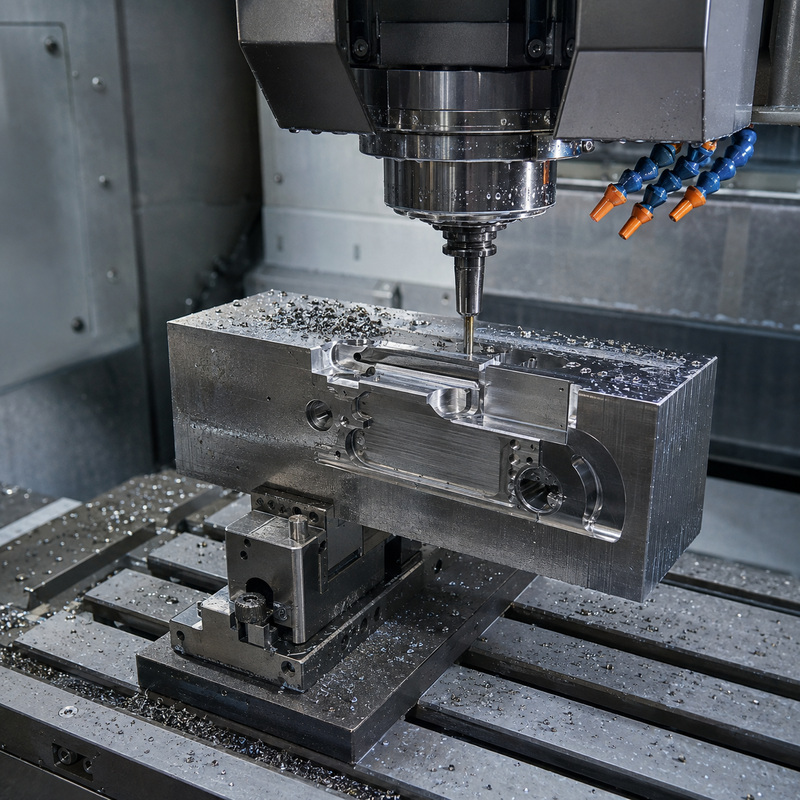
- CNC milling of the external surfaces and internal cavities;
- turning of cylindrical or axisymmetric parts;
- drilling and boring of the seats intended for pins, screws and mechanical parts;
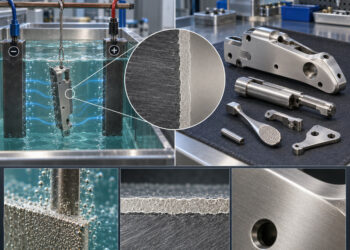
- electroerosion to obtain complex internal profiles, precise edges and cavities that are difficult to reach with conventional tools;
- thermal treatments to increase hardness, toughness and wear resistance;
- grinding and finishing of functional surfaces;
- dimensional control using traditional instruments or three-dimensional measuring systems.
At the end of the production cycle, the component can be subjected to polishing, burnishing, chrome plating, nitriding, anodizing, Cerakote or other protective and decorative treatments.
CNC machines in modern gun manufacturing
The spread of CNC machining centers has profoundly transformed solid machining. Modern four- and five-axis machines can simultaneously operate on multiple surfaces, reducing the number of workpiece repositionings and maintaining extremely tight tolerances.
The machining program is developed starting from a three-dimensional model created with CAD software. Using CAM systems, the geometry is translated into the paths that the tools will follow to progressively remove the material.
This technology allows for the production of highly complex components with remarkable repeatability. The precision of the machine, however, does not eliminate the need for manual operations: in higher-quality weapons, the inspection, adjustment, and finishing performed by the gunsmith remain essential.
The machining of the action from solid
The action is one of the components where machining from solid blocks plays a key role. In break-action shotguns, it houses the trigger mechanisms, helps lock the gun, and must withstand the stresses generated by firing.
To produce a solid action frame, one generally starts from a block of high-strength alloy steel or, for particularly lightweight guns, from a billet of high-strength aluminum alloy, commonly referred to in the industry as Ergal. In the latter case, steel inserts or reinforcements can be applied in the most stressed areas.
The external surfaces, pin seats, support surfaces, lock housings, and cavities for the internal mechanisms are machined from the initial block. The amount of material removed can be considerable, and in some cases, the weight of the finished component represents only a fraction of that of the original blank.
In high-end side-by-side, over-and-under, and express guns, mechanical processing is often followed by a lengthy manual adjustment phase . The gunsmith checks the contact between the action, monobloc, lugs, pins, and locks, working on the surfaces until a precise and uniform fit is achieved.
Actions and frames of rifles machined from solid
In bolt-action rifles, the action or frame can be machined from a solid alloy or stainless steel bar. Machining includes the bolt channel, ejection port, barrel seat, locking surfaces, and the mountings for the trigger and stock.
Particular attention is paid to the surfaces on which the bolt lugs rest. Their geometry influences pressure distribution, the safety of the weapon, and the repeatability of the bolt positioning after each loading cycle.
In actions intended for precision shooting, machining from solid also allows elements such as the optics rail, the recoil lug or specific stiffening systems to be integrated directly into the frame , reducing the number of separate components.
Shutters, carriages and small components
Solid machining is also used for bolts, semi-automatic pistol slides, metal handguards, trigger guards, levers, triggers, and other components. In these cases, the choice of material and production cycle depends on the stresses to which the part will be subjected.
A solid bolt can be produced from a single steel bar or constructed with a separate head, then attached to the body. The first solution reduces the number of assembled parts, while the second can facilitate production, differentiated treatments, and the possible replacement of certain parts.
In pistol slides, CNC milling allows for the creation of guides, internal seats, ejection ports, grip notches and red dot provisions while maintaining high geometric precision.
The materials used
The choice of material is determined by the component's function, the level of stress, and the desired final weight. Among the materials most frequently used in machining from solid are:
- carbon steels and alloy steels, used for action frames, bolts and locks;
- stainless steels, appreciated for their resistance to corrosion and atmospheric agents;
- high-strength aluminum alloys, used to lighten bascules, castles, chassis and accessory components;
- titanium alloys, used in specialized applications where low weight, strength and durability are required;
- brass and bronze, intended mainly for historical, decorative details or specific mechanical components.
It's not enough to simply define a material as "steel" or "aluminum." The quality of the resulting part depends on the chosen alloy, the structure of the blank, the heat treatments, and the correct design of the component.
Machining from solid, forging and casting: the differences
The term "from solid" should not be confused with the type of blank from which the process begins. A component can be milled from a rolled billet, but also from a previously forged blank. In both cases, the final geometry is achieved through material removal.
With forging , the metal is deformed by pressure or hammering, orienting its structure according to the shape of the piece. This process can offer excellent mechanical characteristics, especially when the fiber flow is properly designed.
With casting , on the other hand, the metal is brought to a liquid state and poured into a mold. Modern microcasting techniques can produce high-quality components with geometries very close to the final ones, reducing processing times and the amount of material removed.
Machining from solid parts is therefore not automatically superior to any other production method. Final quality depends on the correct combination of material, design, process, treatments, and controls . A forged and correctly machined component can offer excellent performance, just as a well-designed investment casting can be perfectly suited to its intended function.
The advantages of machining from solid
In the arms sector, the main advantages of this technology are:
- high dimensional precision and production repeatability;
- possibility of obtaining complex geometries and perfectly defined surfaces;
- excellent control of the couplings between the parts;
- absence of weld lines or joints in the main body of the component;
- possibility of modifying the project by intervening on the CNC program without creating new complex molds;
- great flexibility in the production of limited series and customized weapons;
- possibility of leaving additional material in the most stressed areas;
- high level of finishing, particularly important in fine weapons.
Limitations and costs of the process
Machining from solid also has some disadvantages. It requires expensive machinery, specialized tools, accurate programs, and can be lengthy machining times. Furthermore, a significant portion of the initial material is converted into chips.
During milling, it's important to monitor temperatures, vibrations, tool wear, and residual stresses. Unbalanced removal can cause workpiece deformation, especially when producing thin walls or deep cavities.
The cost therefore depends not only on the value of the material, but also on the number of placements, machine hours, geometric complexity, subsequent treatments and the amount of manual work required for finishing.
Is “machined from solid” always synonymous with higher quality?
In business parlance, the term "machined from solid" is often used as a marker of prestige. However, the definition alone does not guarantee that the component is superior.
A part made from unsuitable materials, machined to imprecise tolerances, or subjected to incorrect heat treatments may be inferior to a high-quality forged or investment cast component. To properly evaluate a weapon, you need to consider the entire manufacturing process, not just the method used to shape the metal.
Solid workmanship expresses its maximum value when combined with a proper design, certified materials, precise machinery, rigorous controls and, in fine weapons, the expertise of the gunsmith in charge of the final adjustment.
Industrial processing and intervention of the gunsmith
Modern CNC technologies allow us to achieve levels of precision once hard to imagine, but the quality of a weapon doesn't depend solely on the machine. In advanced industrial products, the precision of the process allows for interchangeable components and highly consistent assemblies.
In artisanal and high-end weapons, however, machining from solid blocks often represents the starting point for subsequent manual operations. The gunsmith checks the contacts, eliminates minor imperfections, adjusts the locks, and prepares the surfaces for engraving and finishing.
The combination of digital technology and artisanal know-how allows for the creation of mechanically efficient, aesthetically refined components designed to maintain precision and functionality over time.
Conclusions
Machining from solid parts is one of the most important techniques in modern gunmaking. It allows for the creation of receivers, actions, bolts, and other components from a single block of metal, featuring complex geometries, tight tolerances, and high structural strength.
Its value lies not only in the quantity of metal removed, but in the ability to control every stage of production: from the choice of alloy to CNC programming, from heat treatments to dimensional verification, up to any manual adjustments. It is precisely the balance between these elements that distinguishes a simple mechanical process from a truly high-quality gunsmithing project.