The European hare , scientifically Lepus europaeus , is one of the most representative mammals of Italian and European agricultural environments and one of the species that has most influenced the history of hunting with hounds . Extremely fast, elusive, and equipped with extremely developed senses, it lives primarily in open spaces and spends a good part of the day motionless in its lair, becoming more active from dusk until night.
Unlike the wild rabbit, the hare does not normally dig underground burrows . Instead, it relies on small depressions in the ground, called burrows, in which it remains perfectly camouflaged. When disturbed, it can suddenly break out and develop an extremely rapid escape, characterized by acceleration, changes in direction, and strategies aimed at confusing potential pursuers.
For the hunter, and especially for the tracker, the hare is a game animal of extraordinary interest. Its hunt doesn't end with the chase: it begins with the search for the night's passing , continues with the approach, the identification of the lair, and the flushing, finally transforming into the actual stalking. It is precisely this complexity that makes the hare one of the most selective game animals when evaluating a tracker's olfactory qualities, method, voice, initiative, and communication.

European hare: identity card
| Common name | European hare or common hare |
| Scientific name | Lepus europaeus |
| Class | Mammalia |
| Order | Lagomorpha |
| Family | Leporidae |
| Gender | lepus |
| Body length | Approximately 50-70 cm |
| Weight | Generally around 3-5 kg, with individual and geographical variations |
| Main habitat | Open countryside, cultivated fields, meadows, pastures, uncultivated land and diverse agricultural environments |
| Supply | Herbivorous |
| Activities | Mainly crepuscular and nocturnal |
| Rifugio | Surface burrow on the ground |
| Playback | Prolonged, with multiple births throughout the year |
| Gestation | Approximately 41-42 days |
| Little ones | Generally 1-4 per birth, with variations |
| Hunting status in Italy | Huntable species according to national regulations and regional calendars |
How to recognize the European Hare
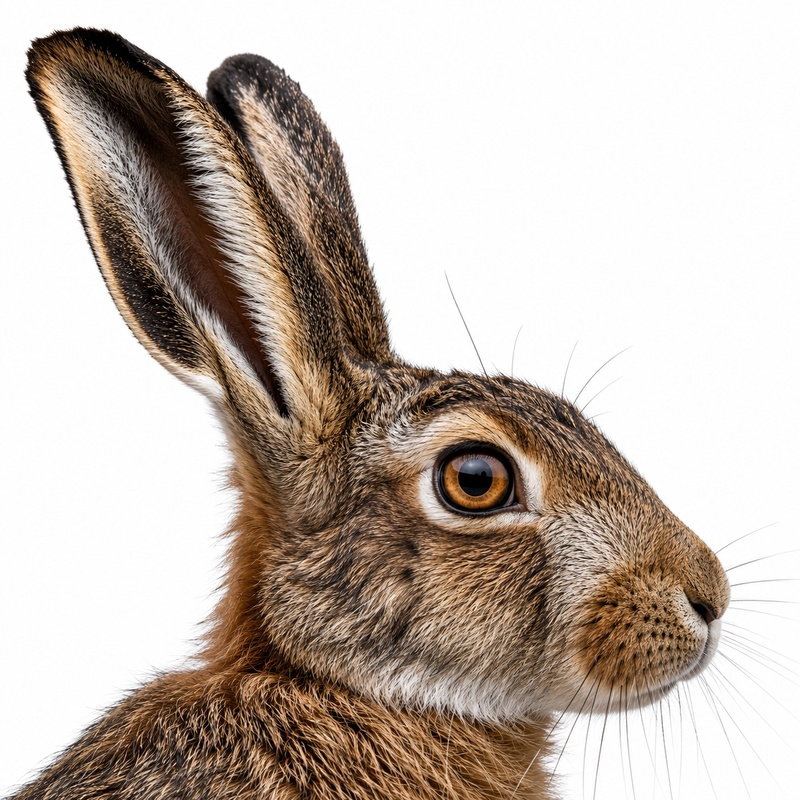
The European hare has an instantly recognizable silhouette. Its body is slender, its hind legs are much longer and more powerful than its front legs , and its ears reach considerable size.
The coat varies in tone from brown to fawn, with grayish and blackish highlights. The underparts are generally lighter.
One of the most useful features for recognition is the long ears with black tips . The tail is also distinctive: short, white underneath and darker on top.
The hare's big ears
The long ears are not just a morphological feature. The hare also has extremely developed hearing.
The ears can be oriented independently to locate the origin of noises and allow the animal to perceive possible threats before they reach a critical distance.
Their large surface area also contributes to the dispersion of body heat.
The eyes and the field of vision
The eyes are large and set laterally on the head. This position provides a very wide field of vision , particularly useful for an animal that lives primarily in open environments.
The hare can therefore control a large portion of the surrounding space without having to constantly move its head.
The hind legs: the engine of escape
The long hind legs are one of the most obvious adaptations of the species.
Powerful musculature allows for impressive acceleration and long leaps. The hare's entire anatomy is designed to allow for rapid and extremely dynamic escape.
The front legs, which are decidedly shorter, are mainly involved in support and trajectory control.
How fast does a hare run?
The European hare is one of the fastest land mammals in the European fauna.
During an escape, it can reach speeds of around 60-70 km/h for short stretches , although the actual speed depends on the terrain, the individual and the conditions of the escape.
But more than just top speed, the ability to accelerate quickly and change direction is important.
Male and female: how to tell them apart?
Sexual dimorphism is not very evident . Males and females are very similar in appearance and size, and certain sex identification from a distance is generally difficult.
During the breeding season, behavior can provide some indication, but it is not a reliable method of determination.
Hares and wild rabbits: what are the differences?
The European hare should not be confused with the wild rabbit, Oryctolagus cuniculus.
The hare is generally larger and slimmer, has proportionally longer hind legs and ears, and leads a different life.
The rabbit uses underground burrow systems, while the hare normally spends its daytime rest in a surface burrow.
Even the young are profoundly different: hares are born already covered in fur, with their eyes open and able to move, while rabbit babies are born much less developed inside the burrow.
Distribution of the European Hare
Lepus europaeus It is widely distributed in Europe and parts of western Asia. The species is particularly associated with plains and collinand characterized by open landscapes.
Over the course of history, it has also been introduced by humans into various areas outside its original range.
The European Hare in Italy
In Italy, the European hare is present above all in continental and peninsular Italy , with highly variable distribution and density depending on environmental characteristics and wildlife management.
It is a typical rural species, but can occupy very different environments as long as there is a simultaneous availability of food, open areas and sufficient shelter.
Italian hares are not all the same
When speaking generically of "hare" in Italy, it is necessary to make an important distinction.
In addition to the European hare, Lepus europaeus , in our country there are other taxa of the genus Lepus of great conservation interest.
The Italian hare, Lepus corsicanus , is present in central and southern Italy and in Sicily. It is a distinct species that deserves its own profile. The mountain hare, Lepus timidus , is also present in the Alpine region.
These species should not be confused with the European hare, because they have different distribution, ecology and management status.
Habitat of the European Hare
The hare prefers open environments and agricultural mosaics.
The best landscapes aren't necessarily completely uniform. The simultaneous presence of cereals, meadows, forage crops, uncultivated lands, small woodlands, hedgerows, and edges can provide food resources and shelter during different periods of the year.
The European Hare's favourite habitats
| Diversified agricultural campaigns | ★ ★ ★ ★ ★ |
| Meadows and forage crops | ★ ★ ★ ★ ★ |
| Cereals | ★ ★ ★ ★ ★ |
| Uncultivated herbaceous land | ★ ★ ★ ★ ★ |
| Pastures | ★★★★ ☆ |
| Vineyards and diversified permanent crops | ★★★★ ☆ |
| Margins and hedges | ★★★★ ☆ |
| Very closed woods | ★★☆☆☆ |
| Highly urbanized areas | ★☆☆☆☆ |
The hare and agriculture
The relationship between the European hare and agriculture is very close.
The historical spread of open agricultural landscapes has created favorable conditions for the species in many regions. However, intensive agriculture and landscape simplification can have the opposite effect.
Large monocultures, the elimination of borders, the reduction of uncultivated land, and a decline in plant diversity can make the territory less suitable for a more complex agricultural mosaic.
The Hare's Lair
The hare does not normally build a true den. During the day, it uses a small depression in the ground called a burrow.
It may be found among grass, turf, plant debris, bushes or other elements capable of interrupting the animal's silhouette.
The choice of den takes into account numerous factors, including wind, temperature, exposure, cover and the ability to control the surrounding environment.
Does the hare always stay in the same den?
No. The same individual can use different dens depending on the season, climate, agricultural work and disturbance.
Knowledge of the territory allows the hare to select the most favorable place from time to time.
Why is it so difficult to see a hare in its den?
The coat color blends perfectly with the ground and vegetation.
Furthermore, the hare can remain completely still even when a threat approaches.
This behavior greatly reduces the likelihood of being visually detected.
When is the hare active?
The European hare is mainly active during twilight and nocturnal periods.
As the light fades, it leaves its den and begins to move towards the feeding areas.
During the night it can roam the territory feeding and leaving on the ground that succession of emanations which assumes enormous importance in hunting with hounds.
The morning remittance
Before or after dawn, the hare tends to gradually end its nocturnal activity and reach the place chosen to spend the day.
The final path to the lair may be anything but direct.
The animal may make changes in direction and other movements that make it more difficult to follow the trail back to the shed.
What does the European hare eat?
The hare is a herbivore and its diet changes considerably throughout the year.
Can consume:
wild herbs;
grasses;
cereals;
legumes;
sprouts;
leaves;
cultivated plants;
bark and twigs during periods of reduced food availability.
The hare and the alfalfa
Forage crops, and alfalfa in particular , can represent a very important food resource.
The availability of young, nutrient-rich vegetation makes these areas particularly attractive during certain times of the year.
Does the hare drink?
The hare can take in a significant part of the water it needs through plant foods.
This does not mean that it does not use open water when available, but its physiology allows it to live even in environments where surface sources are not particularly abundant.
Ceceotrophy in hares
Like other lagomorphs, the hare has a particular digestive system also based on cecotrophy.
Some of the digested material is produced in the form of soft, nutrient-rich stools, which are re-ingested.
This process allows for the recovery of vitamins, microbial proteins and other nutrients produced during fermentation in the cecum.
Reproduction of the European Hare
The European hare has a high reproductive capacity, essential to compensate for a natural mortality rate that can be considerable, especially in young animals.
The breeding season can extend for many months, generally from late winter into summer and, under favourable conditions, even beyond.
The spectacular spring chases
During the breeding season, several hares can be observed chasing each other in the fields even during the day.
These pursuits are linked to sexual activity and competition between individuals.
It is one of the times of the year when a normally discreet species becomes particularly visible.
The “boxing” of hares
One of the best known behaviors is the so-called boxing.
Two animals rear up on their hind legs and quickly strike each other with their front legs.
Contrary to popular belief, it is not necessarily two males fighting: it is often the female who pushes away an overly insistent male.
How long is gestation?
Gestation lasts approximately 41-42 days.
The female can have multiple births during the breeding season, with litter size varying depending on the time of year, age and environmental conditions.
How many pups does a hare give birth to?
A litter generally comprises one to four leverets , although variations may occur.
Average litter size tends to change during the breeding season.
The little hares
The young hares are called leverets.
Unlike newborn rabbits, they come into the world already covered in fur, with their eyes open and with a notable degree of motor development.
This feature is fundamental because the species does not have an underground den in which to protect its offspring.
Do all the hares stay together?
The mother tends to leave her young hidden and relatively separated from each other, thus reducing the chance that a predator will locate the entire litter.
The hares remain motionless in the vegetation and the female returns mainly to feed them.
For this reason, a seemingly lonely child should not automatically be considered abandoned.
Breastfeeding the hares
Hare milk is very nutritious and allows the mother to limit the number of visits to her offspring.
This strategy reduces the time spent near the young and therefore also the risk of attracting predators to their hiding place.
Superfetation in the European Hare
One of the most peculiar aspects of the reproductive biology of the hare is the ability, documented in the species, to start a new pregnancy when the previous one is not yet fully terminated.
This phenomenon, known as superfetation , contributes to the high reproductive potential of the European hare and represents one of the most interesting biological characteristics of the species.
The annual cycle of the European hare
| Period | Main activity |
|---|---|
| Winter | Reduction of reproductive activity and use of available resources |
| Late winter-spring | Sharp increase in reproductive activity |
| Spring | Birth and growth of the first litters |
| Summer | Continuation of reproduction and growth of young |
| Late summer-autumn | Progressive reduction in reproductive activity |
| Autumn-winter | Phase of greater territorial stability |
The hare's predators
The European hare occupies an important position in food webs of open ecosystems.
Hares are particularly vulnerable, while adults can be preyed upon especially when sick, debilitated or caught in unfavorable conditions.
Predators may include various carnivorous mammals and large birds of prey, with varying importance depending on the territory and age class of the hare.
The hare's defense strategy
The hare bases its survival on an extremely effective sequence:
identify the danger;
remain still and camouflaged;
assess the distance of the threat;
to leave suddenly;
use speed and changes of direction to avoid pursuit.
The Hare's Escape
Escape is not simply about running in a straight line at maximum speed.
An experienced hare uses its knowledge of the terrain, changes direction, crosses different surfaces and can use roads, ditches, crops and other elements to complicate the pursuit.
It is precisely this ability that makes following particularly difficult.
Is the hare retracing its steps?
While moving and especially near the shed, the hare can perform maneuvers that can make interpreting the track complex.
Crossings, changes of direction and overlaps can create difficulties even for experienced hounds.
These behaviors are traditionally referred to by hounds as some of the hare's tricks.
Tracks of the European Hare
The footprints clearly show the different structure of the limbs.
During normal gait and especially when running, the large hind legs are projected in front of the forelegs.
For this reason, the typical track often has two rear footprints that are larger and more advanced than the front ones.
The hare's droppings
The feces are generally small, round or slightly flattened, with a fibrous consistency and variable color depending on the diet.
Their presence can represent a useful clue for identifying areas frequently used by the species.
How to recognize the presence of a hare
Among the main signs of presence we find:
footprints;
excrement;
dens;
usual paths and passages;
power traces;
direct observations especially at dawn and dusk.
Is the European hare territorial?
The hare uses a familiar area, but spatial behavior should not be interpreted as rigid exclusive territoriality.
Areas used by different individuals may overlap, and the size of the space occupied varies according to sex, season, density, and resource availability.
How far does a hare move?
Daily commutes can vary considerably.
In very favorable habitats, food and shelter may be found relatively close together; in poorer landscapes the animal may be forced to travel greater distances.
The reproductive period can also determine an increase in mobility.
The Hare and the Rain
Rain and humidity influence both the behavior of the hare and the persistence of the emanations on the ground.
For the bloodhound these conditions are particularly important because they can radically change the difficulty of searching and approaching.
The Hare and the Wind
The wind influences the choice of lair and the spread of the emanation.
The hare can choose positions that allow it to make the most of protection, temperature and the ability to perceive what is happening in the surrounding environment.
The hare in the heat
During hot days it tends to reduce its activity in the central hours and to use dens capable of offering favourable microclimatic conditions.
Most of the feeding activity is concentrated in the cooler hours.
The hare with the snow
Snow makes tracks and paths much more visible, but at the same time it alters food availability and camouflage possibilities.
The European hare, unlike the mountain hare , does not develop a completely white winter coat.
Wildlife management of the European hare
Modern management of the species should start first and foremost from the quality of the habitat.
Hares density depends on a complex set of factors: food availability, landscape structure, climate, juvenile mortality, predation, disease, agricultural activities, and hunting pressure.
Environmental improvements for the hare
Interventions that can benefit the species include:
maintenance of diversified crops;
conservation of borders;
presence of meadows and forage crops;
maintenance of uncultivated land;
reduction of the extreme simplification of the landscape;
careful management of agricultural work during reproductive periods.
Why not just enter hares?
An area incapable of supporting a natural population is unlikely to become suitable simply by artificially increasing the number of animals present.
Management should therefore address the causes that limit the population and not just the immediate numerical size.
Habitat, carrying capacity and reproductive success are fundamental elements for obtaining stable populations over time.
Native hares and repopulations
The topic of repopulation takes on particular importance in the management of the European hare.
The introduction of animals from farms or from different geographical areas must be evaluated taking into account health, genetic, ecological and behavioural aspects.
The conservation of local populations capable of reproducing naturally is generally a highly valuable management objective.
Leading causes of mortality
The mortality of the European hare is due to multiple factors.
Among those that can affect populations we find:
predation;
illnesses;
unfavorable weather conditions;
agricultural processes;
road investments;
reduction in habitat quality;
hunting pressure.
Can the European hare be hunted in Italy?
Yes. The European hare, Lepus europaeus , is among the huntable species provided for by Italian hunting legislation.
National legislation identifies a general period for the hare between the third Sunday of September and 31 December.
However, it is essential to check the hunting calendar of the Region or Autonomous Province concerned , as more restrictive periods, bag limits, hunting methods and specific territorial provisions may be established.
Beware of the Italian Hare
The presence in Italy of the Italian hare, Lepus corsicanus , makes correct identification and knowledge of territorial regulations particularly important.
The Italian hare is a distinct species from the European hare and is of high conservation interest.
In areas where distributions may affect neighboring or overlapping territories, management must therefore take into account the presence of different species.
Hunting the European Hare with hounds
Hare hunting with hounds is one of the oldest and most technically complex forms of European hunting dog breeding.
The key moment isn't just the spotting. A good deed begins long beforehand, with the dog's ability to identify and interpret the trail left by the hare during its nocturnal journeys.
Traditionally, the action can be divided into different phases: searching for the pass, approaching, tracking and following.
The search for the past
In the early morning hours, the hounds search for the scent left by the hare during the night.
This phase requires a nose, method and experience.
The dog must distinguish a useful trail from the numerous emanations present on the ground and gradually understand which path leads to the shed.
What is hare puree?
With the term passa the sleuth indicates the track left by the animal during its movements.
However, not all parts of the track have the same utility.
The dog's job also consists of understanding the correct direction and identifying the path that leads to the den.
The juxtaposition
The juxtaposition represents one of the most technical and fascinating phases.
The dogs advance, gradually interpreting the hare's scent and trying to reconstruct the path that leads to the shed.
A good team must work with initiative but also in an orderly fashion, avoiding turning uncertainty into a disorganized search.
Why can matching be difficult?
Temperature, humidity, wind, soil type, vegetation, and the time elapsed since the hare's passage profoundly influence the quality of the emanation.
Furthermore, the hare can perform complex movements before reaching its lair.
The hound therefore has to solve a real olfactory problem.
I find it
As the dogs reach the shed area, the tension of the action gradually increases.
The hare can remain motionless until the pressure becomes unbearable and then suddenly take off.
The scout represents the transition between working on the night trail and chasing on the fresh trail.
The sequel
After the discovery, the real follow-up begins.
The hare runs using speed, knowledge of the territory and continuous changes of direction.
The hounds must maintain olfactory contact and quickly reconstruct the line even when the game performs maneuvers capable of momentarily interrupting the scent.
The voice of the hound
The voice represents one of the most fascinating elements of hare hunting.
Through tone, rhythm and intensity, the experienced hound dog handler can interpret what is happening even without seeing the dogs.
The voice can change between searching, approaching, finding and following, transforming the action into a real sound narration.
The foul in the follow-up
When dogs temporarily lose the trail, what is commonly called a foul in tracking jargon occurs.
The ability to solve it is one of the most important qualities of the hound.
The dog must slow down, check the terrain and find the point from which the hare continued.
The Hare's Tricks
The European hare is famous among hounds for its ability to put dogs in difficulty.
During the escape you can:
sudden changes in direction;
returns;
road crossings;
passages on difficult surfaces;
long leaps;
sudden changes in escape rhythm.
The hound's ability to solve these problems often distinguishes a good dog from a great specialist.
Which dogs are particularly suited to hare hunting?
| Italian Smooth-Haired Hound | ★ ★ ★ ★ ★ |
| Italian Wirehaired Hound | ★ ★ ★ ★ ★ |
| Apennine Hound | ★ ★ ★ ★ ★ |
| Maremmano hound | ★ ★ ★ ★ ★ |
| Ariegeois | ★ ★ ★ ★ ★ |
| Petit Bleu de Gascogne | ★ ★ ★ ★ ★ |
| Porcelain | ★ ★ ★ ★ ★ |
| Beagle | ★ ★ ★ ★ ★ |
| Harrier | ★★★★ ☆ |
The stars indicate general aptitude for the type of work and are not an absolute ranking. Bloodline selection, individual characteristics, experience, and training are key factors.
The Italian Hound on the hare
The Italian Hound represents one of the symbolic breeds of the national hare tradition.
Nose, approach ability, voice and stamina allow you to face all phases of the action.
Over time, Italian selection has produced highly specialized lines specifically for hare work.
The Apennine Hound on the hare
The Apennine Hound , also known as the Small Italian Harehound, is closely linked to hare hunting.
Its agile structure and working method make it particularly interesting in the c terrainsollinrivers and Apennines, where game can take advantage of the constant changes in slope and vegetation.
The Ariégeois on the hare
The Ariégeois belongs to the great French tradition of the chiens courants and is particularly appreciated for working the hare.
Finesse of nose, application and ability to work in packs make him a specialist of great interest to dog lovers.
The Beagle on the Hare
The Beagle has a long tradition of hunting lagomorphs.
Compact, resistant and with a great passion for tracking, it can work effectively in packs while maintaining a lively and persistent following.
Hare hunting: single dog, pair, or pack?
The hare can be hunted using a single hound, a pair or a whole pack.
Each configuration allows you to appreciate different characteristics.
A single dog must independently solve all the problems on the trail. A well-matched pair can combine complementary qualities. The pack, on the other hand, adds the complexity of teamwork , in which the subjects must collaborate without creating confusion.
Fundamental qualities of the hare hound
A good specialist hound should possess:
great olfactory capacity;
method in research;
ability to approach;
initiative;
perseverance;
ability to resolve fouls;
correct entry;
connection with other dogs and with the handler;
physical endurance.
The emanation of the hare
The work of the hound depends on the ability to perceive the odorous particles left by the game and their permanence in the environment.
Therefore, no single trail is ever the same. Humidity, temperature, wind, soil, vegetation, and the time elapsed since passage profoundly alter olfactory conditions.
Favorable terrains and difficult terrains
A cool, sufficiently moist soil can offer very different conditions than a dry, dusty, or sun-heated surface.
Asphalt, rocks, roads and heavily weathered surfaces can interrupt or make the continuity of the emanation extremely weak.
It is precisely in difficult conditions that the hound's ability to reason on the trail emerges.
Why is the hare one of the most difficult game for the hound?
The difficulty arises from the combination of several factors.
The hare is fast, knows its territory perfectly, can make sudden changes of direction and cross surfaces on which the emanation becomes difficult to follow.
Furthermore, the dog has to deal with two completely different problems: first a relatively old night track , then, after having found it, a fresh track made by a fleeing animal.
The European Hare: main characteristics
| Swift | ★ ★ ★ ★ ★ |
| Agility | ★ ★ ★ ★ ★ |
| hearing | ★ ★ ★ ★ ★ |
| Field of view | ★ ★ ★ ★ ★ |
| Mimicry | ★ ★ ★ ★ ★ |
| Adaptation to agricultural environments | ★ ★ ★ ★ ★ |
| Nighttime activity | ★ ★ ★ ★ ★ |
| Ability to elude hounds | ★ ★ ★ ★ ★ |
| Canine interest | ★ ★ ★ ★ ★ |
| Importance in hunting tradition | ★ ★ ★ ★ ★ |
Curiosities about the European Hare
It does not normally live in a burrow: it spends its resting hours in a simple depression in the ground.
The young are born already very developed: they have open eyes, are covered in fur and can move shortly after birth.
It can reach very high speeds: its powerful hind legs allow acceleration and escapes in the order of 60-70 km/h for short distances.
The famous “boxing” is not necessarily a fight between males: it can be a female rejecting a suitor.
Practice cecotrophy: a sophisticated digestive adaptation that allows you to utilize a plant-based diet more efficiently.
It has a particular reproductive biology: the phenomenon of superfetation has been documented in the European hare.
It is above all a nocturnal animal: many of the tracks that the hound interprets in the morning reveal the movements made in the preceding hours.
Why the European Hare is a symbolic species of hound hunting
Few species have contributed as much to the selection of European hunting dogs as the European hare . Generations of hound breeders have selected their hounds precisely based on their ability to interpret the tracks of this game.
The challenge isn't simply catching up with a fast animal. The real challenge begins when the hare isn't even visible yet.
The hound must locate a trail left during the night , understand its direction, separate it from the other emanations, and follow it to the shed. Only then does the scent arrive and a second, completely different phase begins.
While tracking, the hare relies on speed, changes in direction, and knowledge of the terrain. When the trail seems to break, the dog must slow down, search, interpret, and resolve the fault. It is in these moments that the dog's nose, experience, initiative, and hunting intelligence come to the fore.
However, the European hare is also a species deeply tied to the quality of the countryside. Its presence depends on the availability of food, the diversity of crops, the presence of meadows and uncultivated land, and the possibility of finding shelter year-round.
Understanding Lepus europaeus therefore means simultaneously understanding agroecosystem ecology, wildlife management, animal behavior, and hound culture . And it is precisely this combination that makes the hare one of the great protagonists of the Italian and European hunting tradition.