NOT HUNTABLE
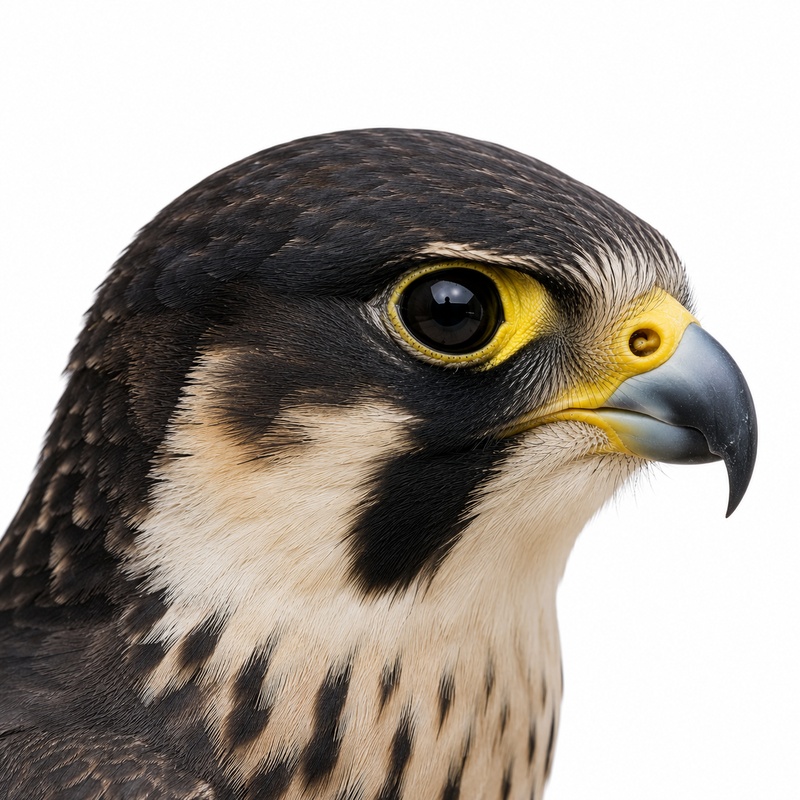
The Eurasian Hobby (Falco subbuteo) is one of the most elegant and specialized aerial hunters in the Italian fauna. Its light body, extremely long and pointed wings, relatively short tail, and extraordinary maneuverability allow it to directly pursue small, fast-moving birds and large insects in flight, occupying a predatory niche very different from that of the Common Kestrel and, despite some morphological similarities, even from that of the Peregrine Falcon.
Seen from a distance, it resembles a particularly slender little peregrine. However, when it begins to hunt, its true specialization immediately emerges: the Hobby can launch itself after swallows, house martins, swifts, starlings, and other small birds , constantly changing speed and direction in chases in which maneuverability is at least as important as absolute speed.
It is also one of the few Italian birds of prey for which large insects captured in flight can be of considerable importance. Dragonflies, beetles, and other insects are intercepted directly in the air and can be carried to the beak with a paw and consumed without interrupting flight. This ability makes the Hobby particularly effective over wetlands, meadows, forest edges, and other environments where large numbers of winged insects gather during the summer.
Its reproductive biology presents another very particular characteristic: the Hobby nests late . Arriving from Africa in spring, it occupies the breeding territory and normally lays its eggs only when many other bird species are already fledging. This coincidence is no coincidence: during the period when the young Hobbies require greater quantities of food, the territory simultaneously offers many inexperienced young birds and a great abundance of insects.
In Italy, it is a migratory and breeding species , distributed mainly in the northern and central regions, with more discontinuous presences in the south and on the islands. It mainly frequents landscapes where woods, tree rows, and tree trunks alternate with meadows, pastures, cultivated fields, wetlands, and other open spaces used for hunting.
The Hobby is a particularly protected and non-huntable bird of prey . The Italian breeding population is considered to be in overall favorable condition, and the species is classified as LC (Least Concern), although habitat transformation, loss of large trees, pesticide use, and mortality along migratory routes can cause problems at a local scale.
Hobby: classification, size, morphology and recognition
| Common name | Eurasian Hobby |
| Scientific name | falco subbuteo |
| English name | Eurasian Hobby |
| Order | Falconiformes |
| Family | Falconidae |
| Gender | Falcon |
| Length | Approximately 29-36 cm |
| Wingspan | Approximately 74-84 cm |
| Weight | Generally around 130-340 g, with females being on average larger |
| Sexual dimorphism | Limited in plumage; females are on average larger and heavier |
| Supply | Small birds and large insects caught mainly in flight |
| Habitat | Mosaics of woods and open spaces, countryside, wetlands, pine forests, poplar groves and riparian environments |
| Italian phenology | Regular migrant and nesting bird |
| Wintering | Mainly sub-Saharan Africa |
| Consolidated historical estimate of the Italian population | Approximately 500-1.000 breeding pairs; data not comparable to a current national census |
| Italian Red List | LC – Less Concern |
| Hunting status | Specially protected species; not huntable |
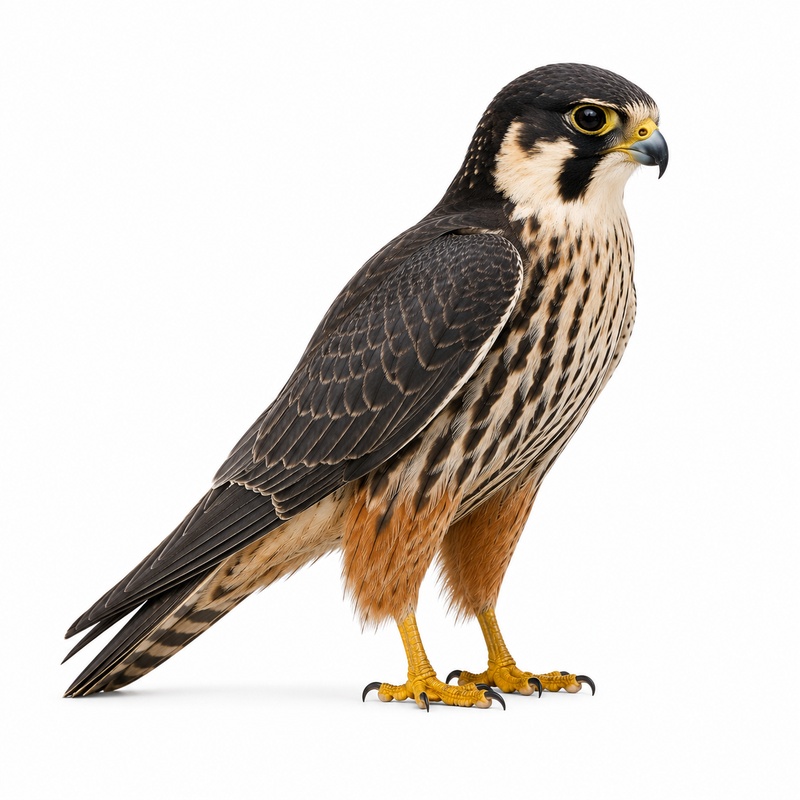
The Hobby has one of the most characteristic silhouettes among the small ones FalconEuropean ides. The wings are extremely long, narrow and pointed, so much so that under certain conditions its profile can resemble that of a large swift. The tail is relatively short compared to the length of the wings, and the body appears much slimmer than that of the peregrine falcon.
The adult upperparts are dark slate-gray. The head has a dark crown and two prominent blackish whiskers that contrast with the pale cheeks. The underparts are whitish or creamy and marked with numerous dark longitudinal streaks.
Probably the most striking feature of the adult is its lower body: the thighs and undertail are intensely reddish or rusty-red . This detail, often described as the Hobby's "red trousers," can be clearly visible even during flight at close range.
Males and females are very similar in coloration, while the female is on average larger. The dimorphism is therefore much less obvious than that of the kestrel.
As in the others Falconides, the beak has the characteristic tomial tooth, used to quickly complete the kill of vertebrate prey after capture.
Young and old: the "red trousers" come with maturity
Juveniles are overall browner in color than adults. The upperparts have pale edges to the feathers, which can create a more scaly appearance, while the underparts are heavily streaked.
The thigh and undertail region does not yet have the intense rusty red of the adult and tends to be lighter or tawny.
Age recognition is therefore possible above all when observation allows the simultaneous evaluation of the colouration of the upper parts, the lower pattern and the shade of the subcaudal region.
After successive moults, the young gradually takes on the characteristic adult appearance.
Hobby, Peregrine Falcon, and Kestrel: Three Falcons, Three Completely Different Strategies
The Hobby may resemble a small Peregrine Falcon , but its proportions are much more slender. Its wings appear extraordinarily long in relation to its body, its silhouette is lighter, and its entire flight conveys a sense of greater elasticity.
The Peregrine is much larger and more compact, has a robust chest, and frequently uses attacks from above, where altitude and speed play a key role. The Hobby, on the other hand, relies heavily on maneuverability and tracking.
A comparison with the kestrel highlights even greater differences. The kestrel has a relatively longer tail, a slower flight, and hunts primarily small mammals and terrestrial animals, often using its famous "holy ghost." The hobby, on the other hand, is built to chase anything that flies.
| Feature | Eurasian Hobby | Peregrine Falcon | Kestrel |
|---|---|---|---|
| Dimensions: | Small-medium | Significantly greater | Similar or slightly lower |
| Structure | Very slender | Compact and powerful | Slim but with a long tail |
| Forwards | Very long and pointed | Long, pointed and more robust | Pointed but proportionally less extreme |
| Adult character | Rusty red thighs and undertail | Large mustache and massive build | Male with grey head and tail |
| Main technique | Air chase | Interception and dive | Land hunting, even with holy spirit |
| Characteristic prey | Small birds and large insects | Small and medium-sized birds | Micromammals, insects and reptiles |
The fundamental difference can therefore be summarized in three images: the Peregrine falls from above, the Kestrel stops in the wind, the Hobby chases.
The flight: one of the FalconEurope's most agile
In the Hobby, the ratio of wing area to weight and wing shape allows for an extraordinary combination of speed and maneuverability . The bird of prey can accelerate rapidly, perform tight turns, and continuously change altitude and direction.
During normal flight, it alternates rapid flapping of its wings with short glides. In hunting flight, its posture changes continuously and can resemble that of a large swift or a giant swallow.
The long, pointed wing reduces drag and promotes high speed. The tail plays a role in corrections and, above all, in the sudden braking required when the prey changes direction.
This structure allows the Hobby to tackle some of the most difficult aerial prey available in our territory: small, light and extraordinarily maneuverable birds.
Aerial hunting: it's not enough to be fast, you have to predict the prey.
Catching a vole on the ground and catching a swallow in flight present completely different predatory problems. Aerial prey has three-dimensional freedom of movement and can instantly change speed, altitude, and direction.
The Hobby must therefore employ a true interception strategy . It cannot simply head towards the spot where it sees prey: it must predict where it will arrive and progressively close the distance.
Pursuit may involve rapid turns, climbs, descents, and sudden changes in attitude. The falcon attempts to force its prey to perform energy-expensive maneuvers while simultaneously maintaining a position from which it can launch the final attack.
When it reaches the necessary distance, it throws its legs forward and grabs the bird with its claws.
Speed remains important, but the Lodolaio's real strength is the combination of acceleration, control and the ability to change trajectory.
Swallows, House Martins, and Swifts: The Hobby's Extreme Challenge
Swallows, House Martins, and Swifts are among the most agile birds in the European sky. Their morphology is specifically specialized for flight, and their ability to change direction makes them extremely difficult for most predators to catch.
The Lodolaio is one of the few Falconides capable of chase them directly in the air.
This doesn't mean that every attack is successful. On the contrary, many attempts fail, and the very difficulty of the capture requires great experience.
Newly fledged birds may be more vulnerable because they have even less flying ability than adults. This becomes especially important during the falcon's breeding season.
It is no coincidence that the Hobby begins to reproduce relatively late: when its young need large quantities of food, the environment also offers a notable availability of young Passerines and Hirundinids that have just fledged.
Larks and small open-air birds
The Italian name itself traditionally recalls the relationship with the Lark , even if the diet should not be limited to this single species.
Small and medium-sized passerines crossing meadows, crops and other open environments can become prey when intercepted away from cover.
Starlings, finches and other small birds can be used differently depending on the territory and the season.
The choice reflects above all an energetic principle: the hawk must balance the quantity of food obtainable with the cost and probability of success of the pursuit.
Dragonflies: an extraordinarily important resource
Among the most fascinating characteristics of the species is the ability to hunt dragonflies and other large insects directly in flight.
Wetlands can produce huge concentrations of Odonata during the summer and become extremely favorable feeding areas.
The Hobby intercepts the insect with one leg, continues flying, and then brings the prey to its beak. The entire operation can be accomplished without landing.
A large insect naturally contains much less energy than a bird, but it also has a much lower capture cost. When thousands of insects are available in the same space, this strategy can become extremely cost-effective.
Insects are also particularly important during periods when the falcon does not have to feed a large brood and during certain phases of migration.
The Hobby can eat while flying
The ability to manipulate prey in flight is one of the most characteristic skills of the raptor.
After catching a dragonfly or other large insect, the hobby can transfer it from its feet to its beak and consume it directly in the air.
The wings continue to provide lift and direction simultaneously, while one leg is temporarily used to manipulate food.
This coordination demonstrates how deeply the species is adapted to spending most of its feeding activity without coming into contact with the ground.
Moths, Beetles and other large insects
The entomological component isn't limited to dragonflies. Large beetles, orthopterans, lepidopterans, and other winged insects can also be part of the diet.
Their importance varies depending on the season and environment. Meadows and crops can provide large quantities of insects during the summer, while in wetlands and waterways, different species often dominate.
At times, the hawk can concentrate its activity on a single insect emergence for hours, exploiting a temporarily very abundant resource.
Small mammals and terrestrial prey: a decidedly secondary role
The Hobby may occasionally utilize small terrestrial vertebrates, but its morphology clearly indicates that this is not its main specialization.
Compared to the kestrel, it has a much more sky-oriented feeding strategy and small mammals, reptiles and other terrestrial prey tend to be of much less importance.
An opportunistically available resource can of course be used, but the exception must not be transformed into the ecological character of the species.
Hobby and small game: what is the real relationship?
For the hunting world, the Hobby represents a particularly simple case to interpret once its specialization is understood.
Its size and hunting technique orient it towards small flying birds . An adult pheasant, an adult partridge, or a hare are completely outside the normal size category of its prey.
Young small game birds can of course be used, and the hawk may occasionally exploit other opportunities, but it does not exert significant pressure on adult traditional small game.
Even for migratory hunting species such as some thrushes, predation must be considered part of normal natural mortality and evaluated in relation to the extraordinary variety of small birds that can be used by the falcon.
The Hobby therefore occupies a niche much closer to that of a specialized predator of aerial microfauna than to that of a large game predator.
Habitat: trees for breeding, open sky for hunting
The Hobby primarily frequents landscapes where wooded areas and large open spaces coexist . Broadleaf forests, pine forests, poplar groves, tree rows, and riparian vegetation can offer breeding sites, while meadows, cultivated fields, and wetlands constitute important hunting areas.
A completely enclosed forest is unsuitable for aerial stalking. At the other extreme, a completely treeless plain may not offer suitable nesting sites.
The ideal situation is therefore once again an environmental mosaic.
The floodplains of large rivers are particularly interesting because they can combine poplar groves, riparian forests, crops, watercourses, and large concentrations of insects and small birds.
Some of the highest Italian and European densities of the species have historically been recorded along the Po and its main tributaries.
The nest: the Hobby does not build it
One of the most important features of reproduction is that the Hobby does not normally build its own nest.
It uses old structures built by other arboreal species, especially corvids. Abandoned crow nests can be particularly favorable sites.
The species can also use nests of other birds of prey or birds of compatible size, provided that the structure is stable and the location offers sufficient tranquility.
This behavior allows them to save the energy needed for construction but at the same time creates an indirect dependence on the presence of species capable of building large nests in trees.
An exceptionally late reproduction
The Hobby has one of the latest reproductive calendars among Italian birds of prey. Egg laying generally occurs around June, so weeks or months after that of many others Falconwas.
This characteristic is closely linked to migratory phenology and food availability.
When the chicks hatch, many small birds belonging to other species are emerging from their nests. Swallows, passerines, and other potential young prey are therefore particularly abundant.
At the same time, summer produces large quantities of dragonflies and other insects.
The Hobby has therefore synchronized the moment of maximum energy needs of its family with one of the periods of maximum availability of aerial prey.
Laying, incubation and growth of young
The clutch normally comprises 2-3 eggs , with possible variations.
Incubation lasts approximately a month and is primarily carried out by the female. During this phase, the male plays a central role in capturing and transporting prey.
After hatching, the female initially stays very close to the young and distributes the food brought by the male to them.
As the brood grows, the need for food increases significantly and the female also gradually returns to participating more intensely in predatory activity.
The young leave the nest about a month after hatching, but remain dependent on the adults as they perfect their flying and hunting skills.
Learning to catch something that flies
For a young Hobby, taking flight is only the beginning of the most complex phase. Flying is relatively simple compared to catching another animal that can fly.
Young animals must learn to keep their distance, anticipate a turn, assess the speed of their prey, and choose when to abandon a costly pursuit.
During the weeks following fledging, play, mutual chasing and attempts to catch insects can be observed.
These behaviors represent true natural training in which coordination and predictive ability progressively improve.
Migration: A hawk connecting Italy to sub-Saharan Africa
The Italian Hobby is a long-distance migrant . Once breeding is complete, individuals gradually leave European territories and head south.
The populations of the Western Palearctic spend the winter primarily in sub-Saharan Africa. The journey therefore requires crossing the Mediterranean and then vast African territories.
In spring the movement is made in the opposite direction and the first individuals reach Europe again.
In Italy the spring transition is particularly evident above all between April and May , while the autumn transition mainly affects September and October.
The presence of the species in Italy is therefore strongly seasonal: the Hobby is essentially the falcon of the warm season.
Why does it arrive so late compared to other birds of prey?
A resident Golden Eagle or Buzzard can start breeding very early because they do not have to return from Africa and use prey that is available year-round.
The Hobby, on the other hand, depends heavily on insects and small flying birds , resources that reach maximum abundance in the warm season.
Arriving too early would mean sustaining the costs of the territory at a time when a fundamental part of its prey is still relatively scarce.
The migratory and reproductive calendars therefore form a single strategy perfectly adapted to the seasonal cycle of resources.
Distribution of the Hobby in Italy
In Italy, the Hobby is a migratory nesting species with an uneven distribution . Its largest numbers are found in the Po Valley and various regions of central Italy.
Riverine areas, tree-lined agricultural mosaics and areas rich in poplar groves can support particularly interesting densities.
Presence becomes more irregular in the Alps and in many southern regions, while in Sicily and Sardinia nesting is historically more localized.
The distribution must, however, be interpreted with caution because a highly mobile, late-arriving and relatively inconspicuous falcon may be underestimated in poorly monitored areas.
How many Hobbies nest in Italy?
The classic ISPRA national summaries have indicated a population in the order of 500-1.000 nesting pairs.
However, it is important not to present this interval as a current national census. The estimate is derived from previous knowledge bases and, while it continues to represent a useful reference for understanding the population size, it needs to be read in conjunction with the most recent distributional information and regional atlases.
The Italian Red List, however, considers the species to be in the LC – Least Concern category and the available assessments do not indicate a national population close to threatened conditions.
For a technically rigorous Encyclopedia it is preferable to always distinguish between a consolidated estimate and the number actually recorded in a given year.
Wetlands: It does not nest in water, but they can be essential for feeding
The Hobby is not an aquatic bird of prey, but ponds, marshes, lakes, rivers and rice paddies can become exceptionally productive hunting areas.
The waters in fact produce enormous quantities of dragonflies and other winged insects and at the same time attract swallows, house martins and numerous small birds.
A single wetland can therefore concentrate both of the falcon's main food categories in the same space.
The conservation of ponds, riparian zones and small wetlands consequently takes on a much broader value than just species directly linked to water.
Agriculture: The Hobby needs lively countryside
The Hobby can use the agricultural landscape very well, especially when it maintains a heterogeneous structure.
Rows of trees, large poplar groves, meadows, cultivated fields, ditches, and small streams create a mosaic capable of simultaneously providing nests and food.
Extremely intensive agriculture can instead reduce insects through the massive use of pesticides and simplify bird communities.
The elimination of tree rows and large trees also reduces the availability of nests abandoned by corvids.
The quality of the habitat therefore depends not only on the cultivated surface, but on the structural biodiversity of the countryside.
Pesticides and insect reduction
For a species that consumes large quantities of insects during certain periods of the year, declining entomological biomass can represent a significant problem.
Pesticide use can act directly by reducing prey abundance and indirectly by contaminating the food chain.
The transformation of meadows, wetlands and borders also leads to a reduction in the habitats in which many insect species complete their life cycle.
The Hobby thus shows how the conservation of birds of prey cannot be separated from the protection of the apparently much smaller organisms that form the basis of the food web.
Tree felling and loss of breeding sites
The reliance on old arboreal nests makes the conservation of large trees and mature forest cores important.
A seemingly uninteresting tree may contain the old nest of a Jackdaw which the following year will become the breeding site for a pair of Hobby.
Cuts made during the incubation or rearing phase can also lead to reproduction failure.
Forestry and agricultural greenery management should therefore take into account the presence of birds of prey, especially during the summer months, a relatively late period compared to many other nesting species.
Electrocution, collisions and mortality along migration
Like other birds of prey, the Hobby can be exposed to power lines, cables, collisions and other infrastructure.
The great flight capacity does not eliminate the risk, especially for young and inexperienced individuals.
Long-distance migration adds further threats. A falcon born in the Po Valley may cross several countries before reaching its African wintering grounds.
Illegal persecution, loss of resting habitats, infrastructure and weather conditions are therefore addressed along the entire route.
The conservation of a migratory species cannot therefore be guaranteed exclusively within Italian borders.
Relationship with other hawks
The simultaneous presence of Peregrine, Kestrel, Lanner Falcon and Hobby in the same country demonstrates how broad ecological diversification can be within the same genus.
The Peregrine mainly uses birds intercepted through attacks in which altitude and speed are of enormous importance.
The Lanner Falcon is best suited for prolonged pursuits in open spaces.
The kestrel looks mainly downwards and locates small terrestrial prey.
The Hobby, on the other hand, focuses a significant part of its ecology on what moves in the sky but on a much smaller dimensional scale than the Peregrine.
This separation allows multiple species to share part of the territory, limiting direct competition.
Conservation status of the Hobby in Italy
The Red List of breeding birds in Italy classifies the Hobby in the LC – Least Concern category.
The species has a relatively large national range and is not currently considered among the Falconmost threatened Italian ides.
The picture is profoundly different from that of the Lanner Falcon, whose population is very small and fragmented.
A favorable national classification, however, does not mean the absence of local problems. Declines in insects, loss of mature trees, transformation of the countryside, and mortality during migration can produce regional variations that deserve monitoring.
Legal status of the Hobby in Italy
The Hobby is a particularly protected species in Italy as it is a diurnal bird of prey.
Falco subbuteo is not a huntable species.
National protection concerns individuals and their reproductive stages and is integrated with the general protection granted to wild birds by Community legislation.
The Hobby is not included among the species in Annex I of the Birds Directive , a situation different from that of the Peregrine and Lanner Falcons, but this obviously does not change the ban on culling provided for by Italian legislation.
Particular attention must be paid to breeding sites because late nesting can overlap with agricultural and forestry work which, for many other species, occurs when the breeding season is already almost over.
Hobby and hunting activities
For the hunting world, the Hobby represents above all a species to be properly understood and not a predator of direct management interest.
Its diet includes small birds and large insects and the pressure on traditional small game is consequently very limited.
The importance of the species lies rather in its ability to indicate the quality of the landscape. A territory capable of supporting a pair must offer suitable trees for nesting, large quantities of insects, and a rich community of small birds.
Many of the interventions that benefit wildlife of hunting interest – maintaining hedges, conserving rows, protecting wetlands, reducing agricultural simplification – simultaneously produce favorable conditions for the Hobby.
Hunters who spend many hours in the countryside can also provide valuable observations on a species that is not always easy to count, especially by identifying territorial pairs and hunting areas used regularly during the summer.
Curiosities about the Hobby
- It is one of FalconEuropean ids more specialized in chasing small birds in flight.
- The wings are so long and pointed that they resemble those of a large swift.
- Adults have characteristic rust-red thighs and undertails, the famous “red trousers”.
- It can catch Swallows, House Martins and Swifts directly out of the air.
- Dragonflies can be a very important component of the summer diet.
- It can catch an insect with one paw, bring it to its beak and eat it while continuing to fly.
- It does not normally build its own nest, but often uses old corvid nests.
- It is one of the latest nesting birds of prey in Italy.
- Spawning normally occurs around June, when many potential prey are bringing the young to fledge.
- It is a trans-Saharan migrant and normally spends the winter in sub-Saharan Africa.
- The Italian spring transition is particularly evident in April-May and the autumn one in September-October.
- The highest densities in Italy have historically been recorded in the agricultural and floodplain areas of the Po Valley.
- The historically consolidated national estimate is in the order of 500-1.000 pairs, but should not be interpreted as a national census updated to 2026.
- The Italian Red List classifies it as LC – Least Concern.
- It is particularly protected and cannot be hunted in Italy.
The Hobby in the Hunting Encyclopedia
The Hobby is perhaps the falcon that best represents the difference between absolute speed and predatory agility . It doesn't reach the fame of the Peregrine and doesn't possess its impressive dives, but it daily faces prey that belongs to the most maneuverable species in the sky: swallows, house martins, small passerines, and large insects.
To succeed, flying fast isn't enough. The Falco subbuteo must continually read its prey's trajectory, predict a turn, correct its position, and decide when pursuit is still worthwhile. It's a type of hunt in which a few centimeters and a few tenths of a second can make the difference between success and failure.
Comparison with other Italian falcons makes this specialization even more evident. The Kestrel can pause in the air and observe the terrain; the Peregrine gains altitude and transforms gravity into speed; the Lanner Falcon uses power and pursuit in open spaces. The Hobby, on the other hand, has taken its lightness, maneuverability, and ability to pursue small aerial prey to the extreme.
Even its breeding calendar is built around this strategy. While many Italian raptors already have well-developed young, the Hobby may still be in the early stages of breeding. Its late laying means that the peak feeding season coincides with summer, when millions of insects are in flight and countless small birds have just left their nests.
The ideal landscape reflects the same complexity. A forest isn't enough, nor is an open field: you need trees for nesting and large spaces for hunting . Poplar groves, rows of trees, streams, meadows, crops, and wetlands can all come together to form a perfect landscape.
For this reason, the conservation of the Hobby also involves a countryside rich in elements that might at first glance seem secondary. An old poplar tree with an abandoned crow's nest can become a breeding center for a pair; a small wetland can produce thousands of dragonflies; a system of hedges and meadows can support the community of small birds on which the falcon depends.
For the hunting world, it's especially important to avoid a generic interpretation of birds of prey as equivalent predators. The Hobby's size and strategy are incompatible with significant predation on traditional small adult game. Its feeding world revolves primarily above them, in the skies occupied by small birds and insects.
Finally, its migration adds an extraordinary element. Every year, a falcon that has raised its young among the poplar groves of the Po Valley or in the countryside of central Italy leaves its territory, crosses the Mediterranean, and reaches sub-Saharan Africa. The following spring, it must retrace its steps to return to a European breeding ground.
The Hobby is therefore the great acrobat among the small Italian falcons: a predator that has transformed its extremely long wings, lightness, and flight control into instruments capable of tackling some of the most difficult prey to capture in nature, those that have not a path to escape along but the entire sky.