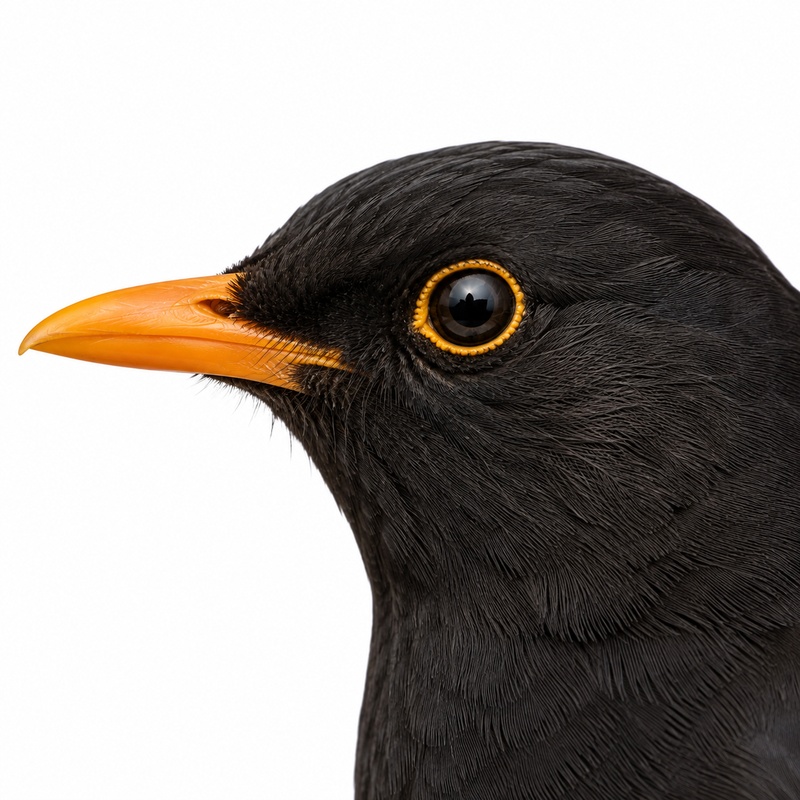
The blackbird , scientifically classified as Turdus merula , is one of the best-known and most easily recognizable passerines in European fauna. Widespread in the countryside, in woods, hedgerows, parks, and even in the heart of cities, it represents one of the most interesting examples of a wild species capable of profoundly adapting to human-induced land transformation.
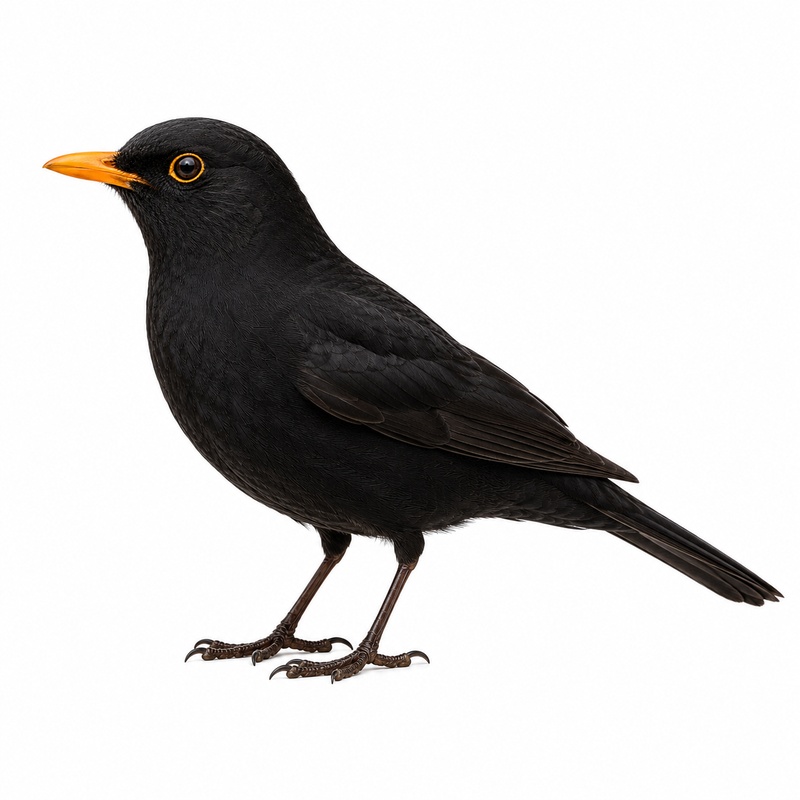
The adult male is unmistakable: its plumage is completely black , with a yellow-orange beak and orange eye ring standing out. The female, on the other hand, is brown, with lighter, mottled hues on the breast, while the juveniles have even more spotted plumage.
The blackbird belongs to the Turdidae family , the same as the song thrush, redwing, fieldfare, mistle thrush, and ring-necked thrush. While sharing some anatomical and behavioral characteristics with them, it has a particularly developed ability to adapt to human-influenced environments.
In Italy, it is a breeding, partially sedentary, migratory, and wintering species . Resident individuals can spend the entire year in the same territory, while in autumn, blackbirds arrive in our country from the northernmost and easternmost regions of Europe.
This overlap between resident and migratory populations makes the Italian biology of Turdus merula particularly interesting and allows the species to be encountered practically year-round.
Blackbird: identity card
| Common name | Merlo |
| Scientific name | turdus merula |
| English name | Eurasian Blackbird |
| Order | Passeriformes |
| Family | Turdidae |
| Gender | wing |
| Distribution | Europe, North Africa and large parts of Asia |
| Presence in Italy | Nesting, partially sedentary, migratory and wintering |
| Length | Approximately 23-29 cm |
| Wingspan | Approximately 34-38 cm |
| Weight | Generally about 80-125 g |
| Habitat | Woods, thickets, hedges, wooded countryside, parks, gardens and urban environments |
| Supply | Insects, earthworms, other invertebrates, fruits and berries |
| Nest | Among bushes, trees, hedges and artificial structures |
| Eggs | Generally 3-5 |
| Characteristic of the male | Black plumage with yellow-orange beak |
| Characteristic of the female | Brown plumage with lighter, mottled chest |
| Hunting status in Italy | Huntable species according to national regulations and regional hunting calendars |
How to recognize the Blackbird
The Blackbird has a relatively robust build for a Passerine, with an elongated body, rounded head, relatively long legs and a characteristically well-developed tail.
When on the ground, it frequently proceeds through a succession of small leaps, stopping suddenly to observe the environment or search for invertebrates.
Males and females are easily distinguishable, especially in adult individuals.
The male Blackbird
The adult male has almost completely uniform black plumage.
The most striking contrast is produced by the yellow or yellow-orange beak and the eye ring of the same colour.
During the breeding season these shades can become particularly intense.
The male's yellow beak
The beak is one of the most easily recognizable features.
In adult males it generally takes on a shade that varies from intense yellow to orange.
In young males and in individuals that are not yet fully mature the color may be less bright.
The periocular ring
There is a thin yellow-orange ring around the eye of the adult male.
In combination with the beak and black plumage it creates the characteristic appearance of the male Blackbird.
The female Blackbird
The female has a completely different appearance.
The plumage is predominantly brown , with darker shades on the back and generally lighter in the ventral region.
The chest and throat may show mottling or light streaking.
The female's beak
The female's beak is normally less bright than that of the male.
It can present brown, yellowish or relatively dark shades, with variations related to age and season.
Male and female compared
| Feature | Male | Female |
|---|---|---|
| Plumage | Black | Bruno |
| Beak | Yellow-orange in adults | Generally darker or brownish |
| Periocular ring | Clear yellow-orange | Not very obvious |
| Chest | Uniform black | Brown and sometimes mottled |
| Dimensions: | similar | similar |
| Mimicry | Moderate | Very high |
The young people of Merlo
The young have a completely different plumage than the adult male.
They have predominantly brown and reddish tones , with numerous light spots and streaks.
This juvenile plumage is more reminiscent of that of other representatives of the genus Turdus.
When does the young male turn black?
The transformation occurs progressively with successive moults.
Young males may have black areas mixed with the brown feathers of juvenile plumage for a certain period.
As the bird matures, its plumage gradually takes on the uniform black appearance characteristic of the adult.
Blackbird and Starling: How to Tell Them Apart?
From a distance, a male Blackbird might be confused by an inexperienced observer with a Starling.
However, there are numerous differences.
| Feature | Merlo | Cancellation |
|---|---|---|
| Scientific name | turdus merula | Sturnus vulgaris |
| Body | More elongated | More compact |
| Tail | Relatively long | Più corta |
| Plumage | Uniform black in males | Dark iridescent and often spotted |
| Movement on the ground | He frequently jumps | Walk quickly |
| Social behavior | Often solitary or in small groups | Highly gregarious |
Blackbird and Song Thrush
The female Blackbird can be confused from a distance with the Song Thrush – Turdus philomelos.
The Song Thrush, however, has a very light chest covered with evident dark spots in the shape of a point or drop.
The female Blackbird, on the other hand, appears overall more uniform and brown.
Blackbird and Mistle Thrush
The Mistle Thrush – Turdus viscivorus is generally larger and has very light underparts with large rounded spots.
Behavior and flight pattern also contribute to the distinction.
Blackbird and Ring-necked Blackbird
The Ring-necked Blackbird – Turdus torquatus is probably the Italian relative that most closely resembles the male Blackbird.
However, the adult male has a characteristic white crescent on the chest , which is completely absent in the common blackbird.
The Ring-necked Blackbird is also strongly associated with mountain environments.
The Blackbird's Song
The Blackbird has one of the richest and most melodious songs of the European avifauna.
The male emits a succession of clear, variable flute-like phrases , often interspersed with short pauses.
Each individual can develop slightly different vocal characteristics.
When does the Blackbird sing?
Singing activity increases as the breeding season approaches.
The song can be heard as early as late winter and becomes particularly intense during spring.
The hours of dawn and dusk are often the busiest times.
The song at dawn
The Blackbird is one of the protagonists of the so-called dawn chorus.
Before and immediately after sunrise, males use elevated perches from which their song can spread over a wide area.
Where does he sing?
The male frequently chooses:
elevated branches;
treetops;
antennas;
roofs;
chimneys;
other elevated structures.
The important thing is to have a position from which the singing can be transmitted effectively.
Why does he sing?
Singing has two main functions.
It allows the male to signal to females the presence of the male and at the same time to communicate to other males that the territory is occupied.
The alarm call
In addition to its melodious song, the Blackbird has very different alarm vocalizations.
When disturbed, it can emit a rapid series of dry, repeated, and easily recognizable notes.
These vocalizations can also alarm other animals in the vicinity.
The Blackbird as a sentinel of the forest
Those who regularly frequent woods and thickets are well aware of the characteristic alarm call of the Blackbird.
A disturbed individual may fly noisily from the vegetation and repeatedly produce its call.
In this way it can indirectly signal the presence of a human or a predator to numerous other animals.
World distribution of the Blackbird
Turdus merula has a vast range that includes much of Europe, regions of North Africa and a large portion of Asia.
The species has numerous geographical populations and different subspecies.
It has also been introduced by humans to other parts of the world.
A polytypic species
The Blackbird is a polytypic species , that is, divided into different geographical subspecies.
Different populations may show differences in size, plumage color, and other characteristics.
The Blackbird in Europe
It is one of the most widely distributed birds on the continent.
It is present from the Mediterranean regions to northern Europe.
However, the migratory strategy changes considerably with latitude.
The Blackbird in Italy
The Blackbird is one of the most widespread nesting birds in our country.
ISPRA reports it in the Peninsula, in Sardinia, in Sicily and in the smaller islands , from sea level up to mountain environments compatible with the presence of arboreal vegetation. :contentReference[oaicite:1]{index=1}
Its great ability to use different environments allows it to reach very high densities locally.
Is the Blackbird sedentary?
The answer is: it depends on the population.
Many Italian individuals are sedentary or only perform local movements.
Populations from northern European regions are much more migratory.
Resident populations and migrant populations
During autumn and winter in Italy the following can be found simultaneously:
Resident Blackbirds;
migrants in transit;
individuals from central-northern Europe who winter in Italy.
This overlap makes the population structure present during the cold season very complex.
Where do migratory blackbirds come from?
Northern and eastern European populations tend to move south and southwest with the arrival of the cold season.
The Mediterranean basin represents one of the main wintering areas.
The ringing data therefore demonstrate important connections between Italy and numerous European countries. :contentReference[oaicite:2]{index=2}
The autumn migration of the Blackbird
Migratory movement increases progressively during autumn.
October and November are generally very important months for the transit of contingents coming from the northern regions.
Intensity and timing can change significantly from one year to the next.
The night migration
A significant part of the movement takes place during the night.
This strategy is common to many migratory passerines and allows them to use the daylight hours mainly for feeding and recovering energy.
The islands during migration
The Mediterranean islands can be of great importance when traveling.
ISPRA also reports captures and migratory observations on the major and small Tyrrhenian islands, where many individuals represent subjects actively migrating across the Mediterranean. :contentReference[oaicite:3]{index=3}
Spring migration
As spring approaches, individuals that have spent the winter in the Mediterranean gradually begin their journey towards their northern nesting grounds.
Movements are influenced by temperature, weather conditions and geographic origin.
Blackbird Habitat
One of the great secrets of the Blackbird's success is its extraordinary ability to use very different habitats.
The fundamental element is generally the simultaneous presence of arboreal or shrubby vegetation and areas of land on which to search for food.
The Blackbird's favorite environments
| Woods with undergrowth | ★ ★ ★ ★ ★ |
| Hedges | ★ ★ ★ ★ ★ |
| Mediterranean bush | ★ ★ ★ ★ ★ |
| Tree-lined countryside | ★ ★ ★ ★ ★ |
| Orchards | ★ ★ ★ ★ ★ |
| Olive groves | ★ ★ ★ ★ ★ |
| Urban parks | ★ ★ ★ ★ ★ |
| gardens | ★ ★ ★ ★ ★ |
| Woods completely devoid of undergrowth | ★★★ ☆☆ |
| Large areas completely devoid of trees | ★★☆☆☆ |
The Blackbird in the Woods
The forest represents one of the original habitats of the species.
Forest formations characterised by a well-developed undergrowth are particularly favourable , in which the animal can find protection, food and breeding sites.
The Blackbird in the Mediterranean scrub
The Mediterranean scrub offers numerous resources.
Dense shrubs provide shelter and nesting, while berries and small fruits become important food sources, especially during autumn and winter.
The Blackbird in the Hedges
Hedges represent one of the most favorable habitats in the countryside.
Offline:
protection;
nesting sites;
fruits and berries;
connection between different environments.
The presence of hedges can therefore significantly increase the quality of an agricultural land.
The Blackbird in the orchards
Orchards can simultaneously provide nesting trees, foraging grounds for invertebrates, and fruit for food.
However, the quality of the habitat depends greatly on the management methods of the soil and spontaneous vegetation.
The Blackbird in the Olive Groves
Olive groves , especially traditional ones set in diverse landscapes, can be visited regularly.
Hedges, low walls, spontaneous vegetation and small woods further increase the suitability of the area.
The Blackbird in the cities
One of the most interesting characteristics of Turdus merula is its ability to live in urban environments.
Parks, gardens, flowerbeds, tree-lined avenues and courtyards can host very large populations.
ISPRA reports the Blackbird even in small green spaces within urban centers. :contentReference[oaicite:4]{index=4}
Why has the Blackbird adapted so well to cities?
The urban environment offers numerous resources:
lawn irrigation;
large quantities of earthworms;
ornamental trees and shrubs;
fruits;
relatively mild winter temperatures;
numerous nesting sites.
The ability to tolerate human presence has allowed the species to fully exploit these opportunities.
Urban Blackbirds and Forest Blackbirds
Urban populations may develop different behaviors than individuals living in natural environments.
They may exhibit a shorter flight distance , begin breeding activity earlier, and alter their singing times in relation to artificial lighting.
The Blackbird and urban lighting
Artificial light can alter the natural perception of the day-night cycle.
In some cities, blackbirds can start singing very early, sometimes when it is still night.
This behavior represents an interesting example of the effects of urbanization on animal biology.
Blackbird Feeding
The Blackbird has an extremely varied diet and can be considered an omnivorous animal with a strong insectivorous and frugivorous component.
The composition changes significantly during the seasons.
What does the blackbird eat?
The diet may include:
earthworms;
beetles;
larvae;
caterpillars;
snails;
spiders;
other small invertebrates;
berries;
fruits;
seeds and other plant resources.
The Blackbird and the Earthworms
The earthworm represents one of the prey items most typically associated with the Blackbird's feeding behavior.
The animal may suddenly stop on the lawn, tilt its head slightly and locate the invertebrate in the ground.
It then grabs it with its beak and extracts it with a series of controlled movements.
Does the blackbird really listen to earthworms?
During the search the animal uses various sensory signals.
The characteristic tilt of the head should not be interpreted simply as a casual gesture: it allows a careful inspection of the area where the prey might be located.
Sight and perception of small ground movements play an important role.
The Blackbird turns the leaves
In the undergrowth it can be observed quickly moving dry leaves and small plant fragments.
This behavior serves to discover insects, larvae and other invertebrates hidden under the litter.
The noise produced can often reveal the animal's presence before it is even seen.
Autumn nutrition
During autumn the importance of fruits and berries gradually increases.
Plant resources allow for rapid energy accumulation, which is particularly important for migratory individuals.
Winter nutrition
As invertebrates decline, fruits and berries can become a key component.
The Blackbird can use numerous wild and cultivated plant species.
The berries of the Mediterranean scrub
In Mediterranean environments, different shrubs produce fruit that is available during autumn and winter.
These resources can support both resident individuals and migratory contingents arriving from Northern Europe.
The Blackbird as a seed disperser
By eating fruits and then moving around, the Blackbird contributes to seed dispersal.
Ingested seeds can be carried far from the mother plant and subsequently expelled in the droppings.
The species therefore also plays an important ecological function in the propagation of numerous plants.
Reproduction of the Blackbird
The breeding season can start relatively early, especially in regions with mild climates and urban environments.
As spring approaches, males become highly territorial and intensify their singing.
The male's territory
The male defends an area where the pair can feed and nest.
Singing is the main tool for signaling the owner's presence to other males.
Fights between males
When two males come into direct contact, chasing and territorial confrontations may occur.
Animals can fly short distances from each other and assume aggressive postures.
The courtship
The male uses song, postures and movements to attract the female.
The formation of the pair precedes the search for a suitable nesting site.
Where does it build its nest?
The Blackbird has considerable flexibility in choosing the site.
Can nest:
between the branches of a shrub;
in the hedges;
on small trees;
among creepers;
on building protrusions;
inside artificial structures;
in other sufficiently sheltered places.
What does the nest look like?
The nest has a sturdy cup-shaped structure.
It is made using twigs, herbs, roots, leaves and plant material.
The internal part is also consolidated with earth or mud, creating a surprisingly resistant structure.
Who builds the nest?
Construction is carried out mainly by the female.
The work can take several days and involves numerous trips to transport the material.
How many eggs does a blackbird lay?
A clutch generally comprises 3-5 eggs.
The eggs typically have a blue-green hue with brown spots or streaks.
The incubation
Incubation generally lasts about 12-14 days.
The female does most of the incubation.
The Blackbird's little ones
The chicks are nestlings.
At birth they are underdeveloped, lack the full capacity for thermoregulation and are completely dependent on adults.
How are they powered?
As they grow, the parents continuously carry to the nest:
earthworms;
larvae;
insects;
other small invertebrates.
The animal component allows the young to grow very quickly.
When do they leave the nest?
The young may leave the nest after about two weeks , when they do not yet have the flight efficiency of an adult.
For a few days they remain hidden in the vegetation and continue to be fed by their parents.
Why aren't young people on land necessarily abandoned?
It is common to encounter young Blackbirds apparently alone on the ground or in the bushes.
This stage is part of normal development: adults generally continue to care for and nurture them.
Multiple broods in the same season
The Blackbird can lay two or more broods during a breeding season when environmental conditions are favorable.
This high reproductive capacity contributes to the success of the species.
The annual cycle of the Blackbird
| Period | Main phase |
|---|---|
| Winter | Presence of residents and wintering contingents from other European regions |
| End of winter | Increased territorial activity and singing |
| Spring | Nesting and first clutches |
| Spring-Summer | Reproduction, raising of young and possible subsequent broods |
| Late summer | Youth dispersion and territorial changes |
| Autumn | Migration and arrival of contingents from Northern Europe |
The Blackbird's Predators
Eggs, juveniles and adults can be preyed upon by numerous species.
Potential predators include:
sparrowhawk;
goshawk;
hawks and other birds of prey;
crows;
mustelids;
fox;
domestic and feral cats;
other opportunistic predators.
The reaction to danger
The Blackbird can react through different strategies.
When in vegetation it can remain hidden until the last moment and then produce a sudden and noisy flight.
In open spaces, it can quickly move away along the ground or fly towards a bush.
The Flight of the Blackbird
Flight is rapid and relatively direct over longer distances.
Inside hedges and woods, however, the animal shows great maneuverability.
The tail plays an important role in controlling the trajectory.
The characteristic movement of the tail
After landing, the Blackbird can repeatedly raise and lower its tail.
This behavior represents one of the most characteristic elements of the posture of the species.
The Blackbird on the ground
Most of the feeding takes place on the ground.
The animal frequently proceeds through a succession of short jumps interspersed with pauses.
During these breaks, observe and listen carefully to your surroundings.
The Blackbird in Autumn
Autumn represents a time of great change.
Migratory individuals are gradually added to the local populations and at the same time the availability of berries and fruits increases.
Woods, scrubland, olive groves, hedges and orchards can therefore host significantly higher numbers of blackbirds than in summer.
The Blackbird in winter
During the cold season, food availability becomes one of the main factors determining distribution.
Individuals can concentrate in areas rich in fruits, berries and soils where it is still possible to find invertebrates.
The frost
Frozen ground makes finding earthworms much more difficult.
Under these conditions, the importance of plant resources further increases.
The snow
Persistent snow cover can make access to the terrain impossible.
Populations can therefore make local movements towards less snowy or more climatically favourable areas.
The urban blackbird during the winter
City environments can offer more favorable conditions than the surrounding countryside.
Slightly higher temperatures, irrigated lawns, ornamental shrubs with berries and the availability of food can favor overwintering.
The urban success of the Blackbird
The process of urbanization of the Blackbird represents one of the most interesting phenomena in European ornithology.
Populations that originally lived mainly in woods and countryside have progressively colonized parks and cities.
Today in many areas of Europe the Blackbird is one of the most common urban birds.
Has the blackbird become domesticated?
No. It remains a wild species.
Urban individuals have simply developed a greater tolerance for human presence and have learned to exploit the resources present in the city environment.
Does the Blackbird recognize its own territory?
Adults may show strong fidelity to breeding territories and commonly used areas.
Precise knowledge of hedges, shelters, feeding points and escape routes is an important advantage.
Spring territoriality
During the breeding season, behavior changes profoundly.
Males that can tolerate each other at short distances during the winter become highly territorial.
Singing is the main tool for delimiting space.
The Blackbird and the Garden
Relatively small gardens can accommodate a couple when they have:
shrubs;
trees;
accessible lawn or land;
quiet areas for nesting.
The species is therefore able to live even in very fragmented green spaces.
The ecological role of the Blackbird
The blackbird is not only a consumer of insects and fruits.
Through its diet it performs different functions in the ecosystem.
Invertebrate Control
By consuming earthworms, larvae, insects and other small animals, it participates in the food webs of the ecosystems in which it lives.
Plant dispersion
Through the consumption of fruits it contributes to the transport of seeds.
Hedges and thickets can therefore also expand thanks to the activity of fruit-eating birds.
The Blackbird as prey
The species in turn constitutes a food resource for birds of prey and other predators.
It therefore occupies an important position in both natural and urban ecological networks.
Is the Blackbird decreasing?
Unlike many agricultural species, the overall European picture of the Blackbird is relatively favourable.
Its extraordinary ecological flexibility and ability to colonize urban environments have contributed to the success of the species.
Long-term European analyses have identified the Blackbird among the species that have contributed significantly to the overall numerical increase of some components of the European avifauna. :contentReference[oaicite:5]{index=5}
Does this mean it doesn't need natural habitats?
No.
The ability to live in cities does not eliminate the importance of woods, thickets, hedgerows, orchards and diverse countryside.
Different populations use different habitats and the conservation of environmental quality remains fundamental.
The Blackbird and the Drought
Prolonged periods of drought can reduce the availability of earthworms and other surface invertebrates.
Extremely dry soils become more difficult to use.
The species can therefore change its diet and feeding areas.
The Blackbird and the cold waves
Frost and snow can be especially challenging for individuals who rely on the soil for food.
Under these conditions, berry-rich forests and urban environments can become important refuge areas.
The Usutu virus and the Blackbird
The blackbird is one of the European species that can be affected by the Usutu virus , a flavivirus transmitted mainly by mosquitoes.
In certain areas and epidemic years, significant mortality rates have been observed in local populations.
This phenomenon demonstrates how even a common and numerous species can be temporarily affected by significant health factors.
Blackbird, Song Thrush, Redwing, and Fieldfare
| Species | Main feature |
|---|---|
| Merlo | Black male with yellow beak, widely resident and urbanized |
| Song Thrush | Light chest with dense dark, point-shaped spots |
| Redwing | Light eyebrow and characteristic reddish coloration of the flanks |
| Cesena | Gray head, brown back and larger size |
Can blackbirds be hunted in Italy?
Yes. The Blackbird – Turdus merula is included among the huntable species provided for by Article 18 of Law 11 February 1992 n. 157.
The current national text places the Blackbird among the species for which the general collection period is foreseen from the third Sunday of September to 31 December . :contentReference[oaicite:6]{index=6}
Actual hunting must, however, be carried out in compliance with the regional hunting calendar for the current season , which may establish specific periods, bag limits, days and other limitations.
Why does the Blackbird close before other Thrushes under national legislation?
The Blackbird is placed by national legislation in a different category to the Fieldfare, the Song Thrush and the Redwing , for which Article 18 provides for a longer general range.
This distinction must be kept in mind especially because the four species are often generically grouped together in hunting parlance as “thrushes”.
The Blackbird in hunting tradition
The Blackbird has long been part of the culture of hunting thrushes in Italy.
The sampling mainly affects the autumn months, when the residents are joined by migratory contingents from the northern European regions.
ISPRA has dedicated a specific publication to Italian thrushes, analyzing biology, migration, age-class recognition, and aspects related to culling management. :contentReference[oaicite:7]{index=7}
The Blackbird's autumnal passage
As autumn progresses, migratory movements progressively increase.
The pace depends on several factors:
temperatures in Northern Europe;
wind direction;
atmospheric pressure;
food availability;
weather conditions along the route.
Blackbirds migrate at night
Most travel occurs during the night hours.
At dawn, individuals may stop at rest and feeding areas, where they quickly try to recover the energy used during the journey.
The importance of rest areas
Resource-rich woods, scrublands, hedgerows, and olive groves can represent important feeding areas during migration.
The quality of these habitats is therefore important not only for resident blackbirds, but also for those coming from thousands of kilometres away.
The Blackbird and the Olive Tree
Mediterranean olive-grove environments have historically represented territories frequented by Thrushes during autumn and winter.
The simultaneous presence of fruit, spontaneous vegetation, hedges and surrounding scrub can create particularly favourable conditions.
The Blackbird and the Berries
During the cold season, hedges and berry-producing shrubs can become important points of concentration.
The presence of these resources can strongly influence the local distribution of individuals.
Habitat management for the Blackbird
Although the species is adaptable, some environmental characteristics can significantly increase the quality of the territory.
Among the favorable interventions we find:
hedge conservation;
maintenance of the undergrowth;
protection of berry-producing shrubs;
conservation of small groves;
maintenance of vegetated margins;
less intensive management of parks and gardens;
forest litter conservation;
reduction of the simplification of agroecosystems.
Why are hedges so important?
A single hedge can perform numerous functions simultaneously.
It can be used for nesting, hiding, feeding and moving around the territory.
Hedges rich in berry-producing plant species are even more valuable during autumn and winter.
The undergrowth
A forest completely cleared of low vegetation offers fewer opportunities than a structurally complex forest formation.
The undergrowth represents an important feeding, nesting and refuge environment.
Blackbirds in Gardens: How to Encourage Them
A garden can become beneficial through relatively simple management.
Shrubs, hedges, unpaved ground, and a variety of vegetation offer much more beneficial conditions than a completely artificial space.
Why avoid pruning everything during the spring?
Hedges and shrubs may contain active nests.
Drastic interventions during the breeding season can therefore accidentally destroy broods.
Careful vegetation management represents an important contribution to urban fauna.
The Blackbird as an indicator species of urban adaptation
Few species demonstrate so clearly how a wild animal can adapt to the transformations brought about by humans.
Merlo has succeeded in transforming parks and gardens into functional equivalents, at least partial, of the original forest habitats.
Blackbird: main characteristics
| Environmental adaptability | ★ ★ ★ ★ ★ |
| Adaptation to urban environments | ★ ★ ★ ★ ★ |
| Quality of singing | ★ ★ ★ ★ ★ |
| Sexual dimorphism | ★ ★ ★ ★ ★ |
| Power supply capacity on the ground | ★ ★ ★ ★ ★ |
| Importance of fruits and berries | ★ ★ ★ ★ ★ |
| Migratory capacity of northern populations | ★★★★ ☆ |
| Spring territoriality | ★ ★ ★ ★ ★ |
| Diffusion in Italy | ★ ★ ★ ★ ★ |
| Cultural importance | ★ ★ ★ ★ ★ |
Curiosities about the Blackbird
Only the adult male is completely black: females and juveniles have predominantly brown plumage.
The male's beak becomes yellow-orange: together with the eye ring, it represents one of the most evident characteristics of the adult.
It has one of the most melodious songs in European cities: each male uses a succession of flute-like and variable phrases.
It often sings before dawn: in urban centers, artificial lighting can further advance the start of singing activity.
It is a large consumer of earthworms: its foraging behavior in meadows is one of the most characteristic of the species.
It turns over the leaves of the undergrowth: the noise it makes while searching for small invertebrates can reveal their presence.
It can nest practically inside cities: hedges, balconies, creepers and artificial structures can be used as breeding sites.
The young leave the nest before they are fully capable of flying: therefore, finding one on the ground does not necessarily mean that it has been abandoned.
In Italy, resident and migratory blackbirds coexist: during the autumn, individuals arrive from northern Europe.
It contributes to the spread of plants: by consuming berries and fruits it transports seeds across the territory.
Why the Blackbird is one of the most representative species of the Italian fauna
The Blackbird – Turdus merula – might seem, due to its widespread distribution, a simple and almost predictable species. In reality, its biology tells one of the most interesting stories of adaptation in European fauna.
The blackbird is simultaneously a bird of the woods and of the city. It can live in the thick Mediterranean scrub, foraging for earthworms under the leaves of an oak grove, and, a few hours later, be observed in a meadow in the center of a large city.
This ability depends above all on its extraordinary flexibility. It is not tied to a single food source: during spring and summer it can feed mainly on earthworms, insects, and larvae , while in autumn and winter the importance of fruits and berries increases significantly.
Reproduction also demonstrates remarkable adaptability. A Mediterranean scrub bush, a country hedge, a climbing plant on a wall, or an artificial structure can all become suitable nesting sites.
The city has thus offered the blackbird many of the characteristics it originally sought in natural environments: trees and shrubs, soil rich in invertebrates, water, protection, and nesting sites. In exchange, the animal has had to modify some of its behavior, reducing its flight distance and learning to coexist with noise, light, and human presence.
The Italian situation is made even more interesting by migration. A blackbird observed in a garden in June is most likely linked to the local breeding population; one present in the same area in November may have arrived from central or northern Europe after a journey of hundreds or thousands of kilometers.
This overlap between residents, migrants, and winter visitors demonstrates the importance of avoiding considering a species simply as "sedentary" or "migratory." Profoundly different strategies can coexist within the same species.
Even from a hunting perspective, the Blackbird belongs to the long Italian tradition linked to the Turdidae. Modern management, however, must correctly distinguish between local populations and migratory contingents and simultaneously consider harvesting and habitat quality.
Maintaining hedges, undergrowth, Mediterranean scrub, and berry-producing shrubs is important not only for the Blackbird, but for an entire community of small birds.
The presence of the blackbird in our cities should not, therefore, obscure its wild origins. Behind the black male singing from an antenna at dawn, there still exists the same turdus, adapted for thousands of years to European forests.
Knowing the Blackbird – Turdus merula means simultaneously understanding the ecology of Turdidae, partial migration, urban adaptation, seasonal feeding, reproductive biology, hunting management and the relationship between wildlife and territorial transformation : a species common only in appearance, but extraordinarily complex from a biological point of view.