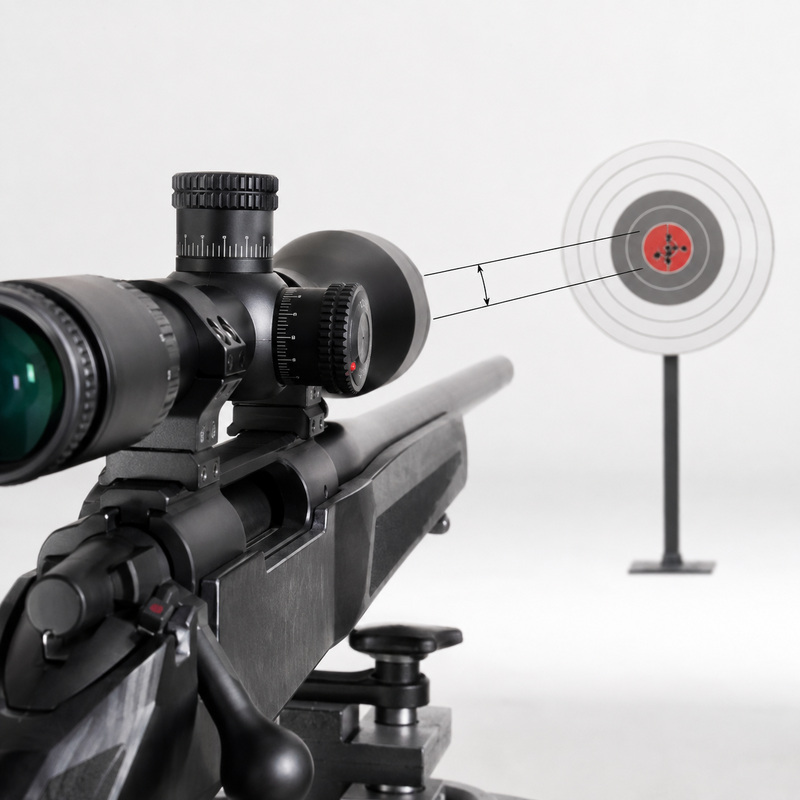
MOA , short for Minute of Angle , is a unit of angular measurement used in shooting to indicate the accuracy of a weapon, the apparent size of a target , and the amount of corrections made using the turrets of an optic.
The MOA is therefore not a fixed linear measurement, like a centimeter or a millimeter. Being an angular measurement, the portion of the target corresponding to one MOA increases proportionally to the distance.
How much is an MOA?
A circle is divided into 360 degrees, and each degree is divided into 60 minutes of angle. Therefore:
- 1 MOA corresponds to 1/60 of a degree;
- at 100 meters it is equivalent to approximately 2,91cm;
- at 200 meters it is equivalent to approximately 5,82cm;
- at 300 meters it is equivalent to approximately 8,73cm;
- at 500 meters it is equivalent to approximately 14,54cm;
- at 1.000 meters it is equivalent to approximately 29,09 centimeters.
In the Anglo-Saxon system, one MOA measures exactly approximately 1,047 inches at 100 yards . In everyday language, it is often approximated as one inch at 100 yards, but this simplification can produce appreciable errors at long distances.
Formula to calculate MOA in centimeters
To find the linear displacement corresponding to a given number of MOA, the following formula can be used:
Displacement in centimeters = Distance in meters × MOA × 0,0291
For example, a 2 MOA correction at a distance of 300 meters results in a point of impact shift equal to:
300 × 2 × 0,0291 = 17,46 centimeters
The MOA in the adjustment turrets
The turrets on a riflescope allow you to adjust the point of impact for elevation and windage. Each adjustment, commonly called a click , moves the reticle or optical system by a given fraction of an MOA.
The most common adjustments are:
- 1/4 MOA per click: four clicks correspond to one MOA;
- 1/8 MOA per click: eight clicks correspond to one MOA;
- 1/2 MOA per click: two clicks correspond to one MOA;
- 1 MOA per click: mainly used on some red dots and systems intended for rapid fire.
At 100 meters, a turret with a 1/4 MOA adjustment moves the point of impact approximately 7,3 millimeters per click . The same click will produce a movement of approximately 14,5 millimeters at 200 meters and approximately 21,8 millimeters at 300 meters.
Practical example of correction
If at 100 meters the center of the group is 5,8 centimeters below the aiming point, you need to make an upward correction of about 2 MOA. With a turret with 1/4 MOA per click, you will therefore need:
2 MOA × 4 clicks = 8 clicks up
Before intervening, it is always necessary to check the indications on the turret or in the optics manual, because the indicated direction of rotation normally refers to the movement of the point of impact.
How to Calculate a Rifle's Accuracy in MOA
MOA is often used to express the accuracy of a rifle or a specific gun-ammunition combination. A rifle defined as "sub-MOA" is theoretically capable of producing groups less than one MOA under the specified testing conditions.
To calculate the group size in MOA in the metric system you can use this formula:
MOA = group size in centimeters ÷ distance in meters × 34,38
A 3 centimetre group obtained at 100 metres corresponds to approximately:
3 ÷ 100 × 34,38 = 1,03 MOA
The pattern measurement should be taken as the distance between the two furthest impacts, measured center to center . Alternatively, the overall external dimensions are measured and the bullet diameter is subtracted.
It's also important to specify the number of shots. A three-shot group may appear very tight, while a five- or ten-shot group generally provides a more significant indication of the system's actual accuracy.
Reticle MOA and Turret MOA
In a modern riflescope the reticle subdivisions can be expressed in MOA and used for:
- compensate for the drop of the projectile without acting on the turrets;
- correct the effect of the wind;
- measure the impact variance;
- estimate the size or distance of a target;
- quickly make a second correct shot.
It is preferable that the reticle and turrets use the same unit of measurement . A scope with an MOA reticle and MOA turrets allows you to observe a deviation through the reticle and directly transfer the same value to the turret, without conversions.
MOA and first or second focal plane
In riflescopes with a reticle in the first focal plane , the MOA subdivisions maintain their angular value at any magnification. The reticle appears to grow and shrink with the image, but the relationship to the target remains constant.
In riflescopes with a reticle in the second focal plane , however, the reticle subdivisions correspond to the declared values only at a specific magnification, usually indicated by the manufacturer. Using the markings at a different magnification without performing the necessary conversion can result in incorrect corrections.
MOA and MRAD: What are the differences?
MOA and MRAD or MIL are both angular units. The MOA system is traditionally associated with the Anglo-Saxon world, while the milliradian integrates more easily with the metric system.
- 1 MOA corresponds to approximately 2,91 centimetres at 100 metres;
- MIL 0,1 corresponds to 1 centimeter at 100 meters;
- MIL 1 corresponds to 10 centimetres at 100 meters;
- MIL 1 equals approximately 3,438 MOA.
Neither system is inherently more accurate. Actual accuracy depends on the turret graduations, the mechanical quality of the optic, and the shooter's ability to apply adjustments correctly. The best choice is generally the one that allows for intuitive and consistent operation, avoiding mixing reticles and turrets expressed in different units.
What does a 20 MOA canted slide indicate?
The 20 MOA designation applied to a scope mount or rail indicates a mechanical tilt between the action axis and the scope axis. The rear of the mount is slightly higher than the front, causing the scope to initially point downward relative to the barrel axis.
During zeroing, this inclination allows you to recover some of the scope's vertical travel and have a greater amount of upward adjustment. 20, 30, or 40 MOA inclined bases are therefore used primarily for long-range shooting , when the trajectory drop requires significant corrections.
A tilted base does not make the rifle more accurate or alter the ballistics of the ammunition. It simply serves to position the scope's adjustment field in a more favorable position. On some combinations intended for short ranges, excessive tilt may even prevent proper zeroing.
The MOA in the red dots
In red dot sights, the MOA value can indicate both the click adjustment and the angular size of the illuminated dot . A 2 MOA dot covers about 5,8 centimeters of the target at 100 meters, while a 6 MOA dot covers about 17,5 centimeters.
A small dot improves accuracy and covers a smaller portion of the target. A larger dot is generally quicker to acquire, especially at close range and on moving targets. The choice must therefore take into account the intended use, the expected distance, and the lighting conditions.
True MOA and Shooter's MOA
True MOA is the mathematically correct minute of angle and corresponds to 1,047 inches at 100 yards. Shooter's MOA , also called Inch Per Hundred Yards or IPHY, approximates it to exactly one inch at 100 yards.
The difference is minimal at short ranges, but increases progressively. At 1.000 yards, ten true MOA corresponds to approximately 104,7 inches, while the IPHY approximation assumes 100. For ordinary hunting shooting, the difference is often negligible; for long-range precision shooting, it's important to know which system is actually used by the optics and ballistic calculations.
Common mistakes when using MOAs
- consider the MOA an invariable linear measure;
- to state that one MOA always corresponds to three centimeters;
- forget that displacement increases with distance;
- confusing full MOAs with single click values;
- mix MOA reticle and MIL turrets without converting;
- using a second focal plane reticle at the wrong magnification;
- confusing the size of the red dot with the mechanical accuracy of the weapon;
- attribute a 20 MOA inclined base to a direct improvement in accuracy;
- evaluate the accuracy of the weapon on the basis of a single particularly favorable shot group.
The Practical Value of MOA in Hunting and Shooting
Knowing the MOA allows hunters and shooters to translate an observed deviation on the target into a precise and repeatable correction. Its use isn't limited to long-range shooting: it's also useful when zeroing a standard hunting scope, checking the accuracy of ammunition, and choosing the right size for a red dot sight.
The fundamental principle is simple: the MOA measures an angle, not a distance . Once this concept is understood, it becomes possible to correctly calculate clicks, groups, compensations, and apparent dimensions at different distances, consciously exploiting the possibilities offered by modern riflescopes.