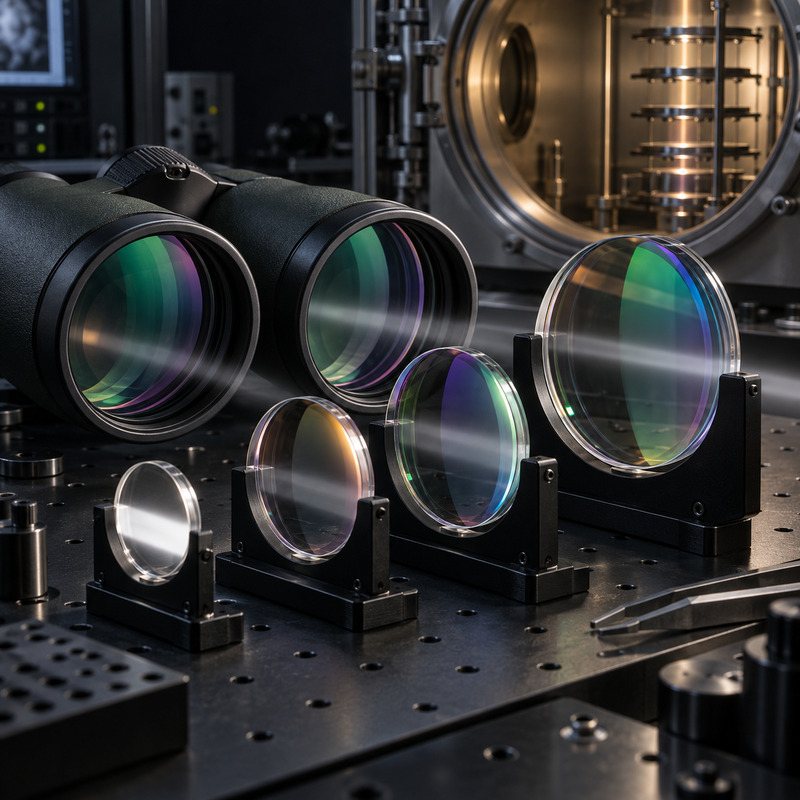
Multicoating refers to the application of multiple , very thin layers of optical materials to the surfaces of lenses. These coatings are primarily designed to reduce reflections, increase light transmission, and improve contrast, color fidelity, and image sharpness.
Multicoating is used in riflescopes, binoculars, spotting scopes, rangefinders, collimators, and optical devices intended for observation. Similar coatings, but designed for different wavelengths, are also applied to the germanium lenses of thermal imaging devices.
There is no single universal multicoating. The number of layers, materials, thickness, and deposition method are chosen based on the glass, surface area, spectral range, and required performance.
Why an uncoated lens reflects light
When light passes from air to glass, some of it passes through the surface, while some is reflected. On common, uncoated optical glass, the loss can be approximately 4% for each air-to-glass surface area , although the value varies with the refractive index and the angle of incidence.
A single lens has two surfaces. A telescope or binoculars contains numerous elements and can therefore have many surfaces through which light passes. If none of these were coated, the losses would be cumulative, and a significant portion of the light would not reach the eye.
Internal reflections can also generate:
- contrast reduction;
- ghost images;
- halos around light sources;
- glare;
- loss of detail in shadows;
- chromatic dominants;
- reduced target readability against the light.
How an anti-reflective treatment works
An anti-reflective coating consists of transparent layers whose refractive index is different from that of glass. Each layer has an extremely thin thickness, comparable to the wavelength of light.
The waves reflected by the different interfaces can be caused to interfere with each other destructively. Some of the reflections are thus canceled out and more light passes through the lens.
A single-layer coating can be very effective at a specific wavelength, but less effective across the rest of the visible spectrum. By layering multiple layers with different indices and thicknesses, the anti-reflective effect can be extended across a broader band.
What does multicoating mean?
In commercial jargon, multicoating usually means that at least one optical surface has been treated with multiple anti-reflective layers . However, the definition alone does not indicate how many surfaces have been coated.
The most common terms are:
- Coated: at least one surface has an anti-reflective treatment;
- Fully coated: all air-glass surfaces are treated, generally with a single layer;
- Multi-coated: at least one surface has a multi-layer treatment;
- Fully multi-coated: All air-glass surfaces are normally multi-coated.
These terms are commercial conventions and do not fully describe the quality of the system. Two lenses declared fully multi-coated can use very different materials, processes, and designs.
Structure of a multilayer coating
A multicoating can consist of a few layers or numerous overlapping depositions. Each material is chosen for its refractive index, transparency, and compatibility with the substrate.
A multi-layer project must control:
- reflectance at different wavelengths;
- overall transmission;
- color neutrality;
- behavior at angles of incidence;
- adhesion to glass;
- moisture resistance;
- thermal stability;
- mechanical durability.
The number of layers should not be considered in isolation. A poorly designed or applied coating with a high number of layers may perform worse than a simpler, properly optimized system.
Vacuum deposition
Coatings are typically applied inside vacuum chambers. The material is vaporized or transformed into energetic particles that deposit on the lens, forming extremely thin films.
Technologies that can be used include:
- thermal evaporation;
- electron beam evaporation;
- sputtering;
- ion assisted deposition;
- plasma processes;
- proprietary technologies developed by manufacturers.
Assisted deposition allows for compact, uniform, and well-adhered layers. Thickness and composition must be controlled with great precision, as even minimal variations can alter the optical response.
Light transmission
Transmission expresses the percentage of light that passes through the system. It is important to distinguish between:
- single surface transmission;
- transmission of a lens;
- transmission of the entire instrument;
- transmission at a certain wavelength;
- average transmission across the entire visible spectrum.
A very high percentage on a single surface does not automatically represent the overall performance of the scope. Light must pass through all lenses, any prisms, the reticle, and other system elements.
To compare two lenses, it is necessary to verify that the declared values were obtained using equivalent criteria.
Contrast and reflection reduction
The benefit of multicoating isn't just increased brightness. By reducing stray light, the treatment can improve contrast and make fine details easier to read.
This effect is particularly important:
- at dawn and dusk;
- when observing against the light;
- in the woods with alternating areas of light and shade;
- with the sun low on the horizon;
- when there are reflections on the water or snow;
- when observing wild animals with a coat that is not very contrasted with the background.
A lens with high transmission but poor stray light control can produce a bright but dull image. Quality therefore depends on the balance between transmission, contrast, aberration correction, and internal flare control.
Color fidelity
A treatment should convey the different components of the visible spectrum in a balanced way. If some wavelengths are attenuated more than others, the image may take on a yellow, green, blue, or reddish cast.
In some systems, the transmission profile is deliberately optimized to increase contrast under certain conditions. This does not necessarily mean that the colors are perfectly neutral.
Color fidelity is particularly important in spotting scopes, while in a riflescope the ability to quickly distinguish the target from the background may be a priority.
The color of the reflections on the lens
Multi-coated lenses may exhibit green, blue, purple, amber, or reddish reflections. This is the portion of light that the coating continues to reflect.
The visible color does not allow us to establish:
- how many layers are present;
- how much light is transmitted;
- whether all surfaces are treated;
- the resistance of the coating;
- the overall quality of the optics.
A very intense and conspicuous reflection does not necessarily indicate superior performance. Effective treatment can produce relatively weak reflections that vary depending on the viewing angle.
Multicoating in riflescopes
In a riflescope, multicoating involves the objective lens elements, the magnification group, the internal lenses, and the eyepiece. The quality of the coating helps maintain contrast and reticle readability in difficult lighting conditions.
Overall performance also depends on:
- lens diameter;
- exit pupil;
- selected magnification;
- glass quality;
- aberration correction;
- internal diaphragms;
- blackening of surfaces;
- tube geometry;
- lattice quality.
A great lens cannot fully compensate for a poor anti-reflective coating, just as an excellent multicoating cannot correct a poor optical design.
Multicoating in binoculars
Binoculars contain numerous optical surfaces and can greatly benefit from comprehensive coatings. In addition to the lenses, prisms must also be considered.
Different coatings may be present in models with roof prisms:
- anti-reflective treatments: increase transmission on air-glass surfaces;
- phase correction: improves contrast and resolution by compensating for the phase shifts introduced by the prism;
- reflective coatings: they increase the efficiency of surfaces that need to reflect light;
- dielectric layers: allow high reflectivity over a wide range of the spectrum.
These coatings perform different functions. The term "fully multi-coated" when referring to lenses does not automatically guarantee the presence of phase correction or dielectric coatings on the prisms.
Hydrophobic and oleophobic treatments
Exterior surfaces can receive additional coatings designed to repel water, grease, and dirt. These treatments do not perform the same function as anti-reflective multicoating, although they can be integrated into the same system.
A hydrophobic coating can:
- promote the flow of water drops;
- reduce dirt adhesion;
- make cleaning easier;
- limit fingerprinting;
- protect the underlying optical layers.
However, it does not provide a perfectly sharp image in heavy rain and is not a substitute for proper lens protection.
Anti-scratch treatments
Some systems include a more abrasion-resistant outer layer. However, no coating makes a lens completely scratch-proof.
Sand and mineral dust particles can be harder than the surface layer. Rubbing them with a cloth can cause permanent micro-scratches.
The declared resistance must also be distinguished from the hardness of the underlying glass. A thin coating can protect against light abrasions, but not against impacts or contact with sharp objects.
Multicoating in thermal optics
Thermal imaging lenses also receive multilayer anti-reflective coatings, but these are designed for bands other than visible light.
A germanium lens intended for a LWIR sensor must transmit primarily radiation in the range of approximately 8 to 14 micrometers . The materials and coating thicknesses are therefore different from those used on binoculars or a daytime spotting scope.
The visible color of the treatment applied to germanium does not directly indicate its efficiency in the infrared.
Multicoating in laser rangefinders
A rangefinder must transmit both the light used for observation and the laser wavelength. The treatment is therefore designed to handle both functions.
Low transmission in the laser band could reduce the amount of energy reaching the target or returning to the sensor, affecting the usable range and the ability to measure poorly reflective surfaces.
Multicoating and twilight vision
During twilight, the amount of available light decreases and the eye's color sensitivity changes. A good multicoating helps preserve light and contrast, but it cannot generate additional brightness.
Performance depends on the combination of:
- transmission of the entire system;
- lens diameter;
- enlargement;
- exit pupil;
- internal contrast;
- quality of the user's eye;
- weather.
The so-called twilight factor is a geometric value calculated from the magnification and lens diameter. It does not take into account the quality of the glass, transmission, or the effectiveness of coatings.
Resistance to humidity and temperature changes
Hunting optics are used in rain, snow, cold, and severe temperature fluctuations. The coating must adhere to the glass and maintain its properties over time.
A quality multicoating is designed and tested to resist:
- umidità;
- thermal cycles;
- condensation;
- repeated cleaning;
- exposure to sunlight;
- moderate abrasions;
- contamination by oils and organic residues.
Watertightness and internal dry gas filling prevent fogging inside the instrument, but these are features separate from the lens coating.
How to clean a multi-coated lens
Cleaning must be carried out avoiding dragging abrasive particles onto the surface.
The general procedure includes:
- remove dust with an air pump;
- use, if necessary, a very soft optical brush;
- apply a specific lens liquid to the cloth and not directly onto the optics;
- gently wipe with a clean microfiber cloth;
- avoid forceful movements and excessive pressure;
- Let the surface dry before applying the lens covers.
Do not use plain paper, dirty cloths, household cleaners, harsh solvents, or abrasive products. Even repeated contact with your fingers can leave greasy residues that are difficult to remove.
How to evaluate multicoating
Consumers can rarely directly analyze the composition of the coating. However, they can evaluate the overall behavior of the lens by observing:
- backlight contrast;
- presence of ghost images;
- color fidelity;
- readability of details in the shadows;
- image uniformity;
- quality at the edges of the field;
- ease of cleaning;
- resistance of the treatment over time.
The faintness or color of the frontal reflex is not sufficient to classify an optic. The evaluation should be carried out under real-world conditions, possibly comparing instruments with similar magnification and diameter.
Advantages of multicoating
- increased light transmission;
- reduction of internal reflexes;
- contrast enhancement;
- reduced ghosting;
- better readability against the light;
- possible increase in color fidelity;
- superior performance at dusk;
- possibility of integrating hydrophobic and anti-scratch protections.
Limitations and aspects to consider
- the term multicoating does not automatically indicate all treated surfaces;
- there is no single commercial standard for denominations;
- the number of layers alone does not determine the quality;
- the color of the reflections does not measure the transmission;
- treatments can be damaged by incorrect cleaning;
- the coating does not correct optical design defects;
- the transmission must refer to the entire system;
- Visible and infrared coatings are not interchangeable.
Final houghts
Multicoating is one of the key elements in the quality of a spotting scope, binocular , or rangefinder. By reducing light reflected off the numerous internal surfaces, it increases transmission, contrast, and image readability.
However, the mere presence of the word "multi-coated" is not enough to judge an instrument. It is necessary to consider how many surfaces are treated, the efficiency across the entire spectrum, the resistance of the coating, and the overall quality of the optical design.
A well-designed multicoating works in concert with glass, prisms, apertures, and lens geometry. It is this integration, more than the stated number of layers or the color of the reflections, that determines the optic's actual performance under hunting conditions.