Il Nova Scotia Duck Tolling Retriever, often simply called Great, is one of the most original and specialized retrieving breeds in the international canine panorama. Born in Canada and developed in the province of Nova Scotia, it was not selected only to retrieve shot game: its traditional work includes a very particular technique, the tolling, through which the dog attracts the curiosity of the ducks by swimming, running and playing along the shore while the hunter remains hidden.
It is therefore a Retriever with a different functional history than the Labrador, Golden Retriever, and Flat-Coated Retriever. Its breeding combines retrieving, water work, agility, speed, attentiveness to the handler, and a lively demeanor that becomes an integral part of the hunting action . Once the ducks approach and are threatened, the same dog immediately switches roles and is sent to retrieve the downed or wounded animals.
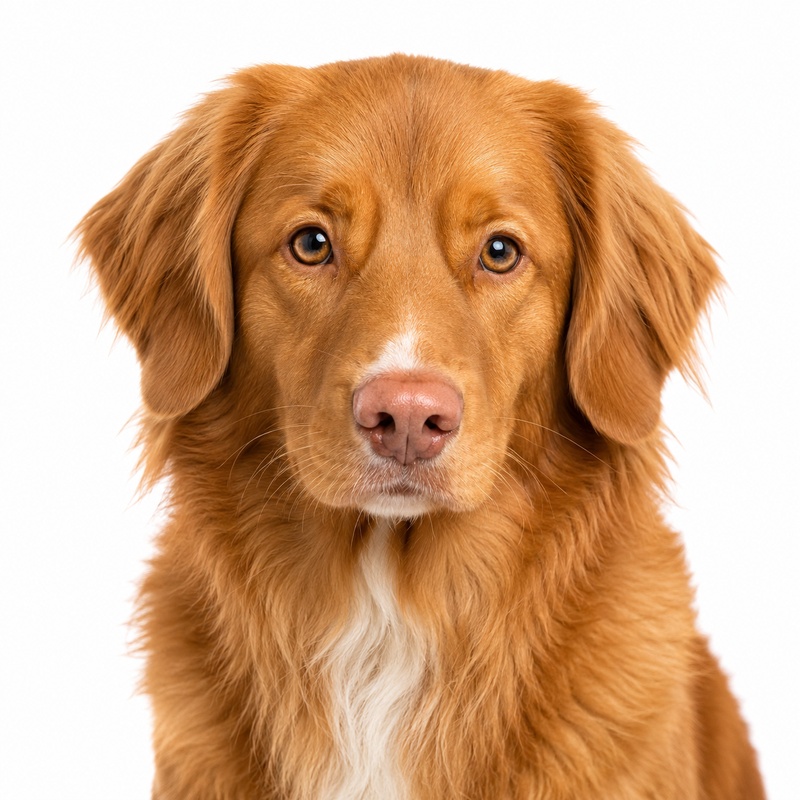
The Toller is a medium-sized, compact, and highly athletic dog, recognizable by its red or orange coat, waterproof double coat, and richly fringed tail. Its build must convey strength without heaviness: it was bred to move quickly along the banks, repeatedly wade into even cold water, swim vigorously, and retrieve large game.
Behind its elegant and seemingly light appearance lies a true working dog . It is intelligent, quick to learn, sensitive to its handler, and has a strong desire to retrieve. This combination makes the Nova Scotia extremely attractive to waterfowl hunters who want to work with a dynamic, technical, and highly cooperative dog.
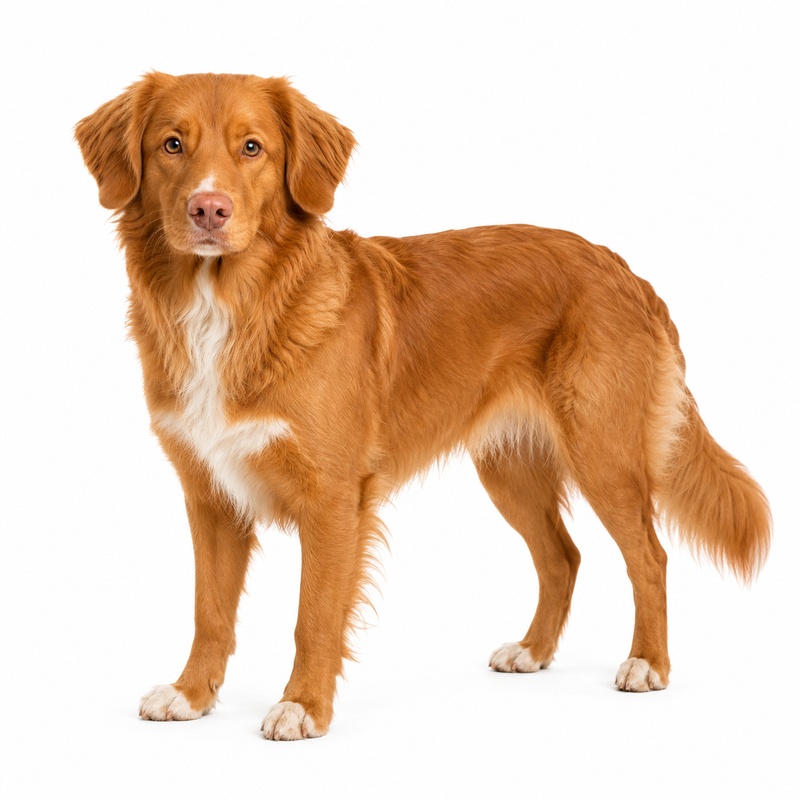
Nova Scotia Duck Tolling Retriever: breed data sheet
| Official name | Nova Scotia Duck Tolling Retriever |
| Common name | Great |
| country of origin | Canada |
| Province of origin | Nova Scotia |
| FCI Code | 312 |
| FCI Group | Group 8 – Retrievers, Flushing Dogs and Water Dogs |
| Section | 1 – Retrievers |
| Test of work | Yes |
| Original use | Calling of ducks by tollinge subsequent recovery of the killed or wounded game |
| Size | Media |
| Ideal height for men | 48-51 cm |
| Ideal height for females | 45-48 cm |
| Tolerance provided by the standard | 2,5 cm more or less |
| Indicative weight of adult males | 20-23 kg |
| Indicative weight of adult females | 17-20 kg |
| cloak | Double coat, waterproof, medium length, with thick undercoat |
| Colors | Different shades of red or orange |
| White marks | Possible on the tip of the tail, feet, chest and head |
| Main hunting aptitude | TollinI bring back aquatic game |
| Work environment | Wetlands, lagoons, ponds, rivers, lakes and adjacent lands |
| Relationship with water | Excellent |
| Temperament | Intelligent, energetic, sensitive, determined and collaborative |
Origin and history of the Nova Scotia Duck Tolling Retriever
The Nova Scotia Duck Tolling Retriever was developed in the Nova Scotia, on the east coast of Canada, starting in the early 19th century. The region, characterized by rugged coastlines, bays, estuaries, lakes, and large populations of waterfowl, created ideal conditions for the selection of a dog specialized in hunting ducks.
The principle behind the breed was as simple as it was ingenious. Hunters had observed how some ducks showed curiosity toward small reddish animals moving along the shore. North American tradition often associates this behavior with the red fox, capable of attracting the ducks' attention through intermittent movements along the water's edge.
From this observation came the selection of a dog capable of artificially reproducing the same mechanism. The subject had to be small and agile enough to move quickly along the shore, visible by its reddish coloring, and above all willing to run back and forth continuously retrieving small objects thrown by the hunter.
When the ducks, intrigued by the movements, approached the target area, the dog disappeared and the hunter could carry out the hunt. At that point, the Toller returned to the scene as a Retriever, retrieving the downed or wounded animals from the water.
This dual function – first attracting and then retrieving – still constitutes today the element that clearly distinguishes the Nova Scotia from other large Retrievers.
The breed was subsequently codified and officially recognized in Canada. The Fédération Cynologique Internationale definitively recognized it in 1981 and included it in Group 8, Section 1, among retrievers with working trials.
Tolling: the hunting technique that created the breed
To truly understand the Nova Scotia Duck Tolling Retriever we must start from the meaning of the term tollingIn the hunting context, it indicates the ability to attract aquatic birds through a sequence of movements visible from the water's surface.
The hunter remains hidden behind natural or artificial cover and repeatedly throws a small object along the bank: a ball, a lightweight dumbbell, or, traditionally, a piece of wood. The toller quickly starts, retrieves the object, and returns to the handler.
The action is repeated several times. The dog appears, disappears behind the vegetation, and reappears running, wagging its large, fringed tail and maintaining an extremely dynamic demeanor.
Ducks located at a distance may react to the sequence by gradually approaching the shore. The effect relies on the ducks' curiosity and attention to an unusual but not immediately threatening movement.
When the birds reach a favorable position, the dog must immediately stop playing and remain under control. This very step demonstrates the level of training required: an effective Toller must transition from an extremely exciting activity to a state of complete cooperation in a matter of moments.
After a kill, the dog is sent to retrieve. It must locate the game, swim to it, catch it correctly, and bring it back to the handler with a firm but gentle grip.
The Toller is not just a smaller Retriever
Its relatively compact appearance might lead one to describe it simply as a smaller version of a Labrador or Golden Retriever. However, this would be a very superficial interpretation.
The selection of the Nova Scotia favored a set of specific characteristics: quick reaction, ability to accelerate, strong motivation for retrieving, great endurance, agility on the banks and a particular behavioral liveliness.
The Labrador traditionally tends to express a very powerful, stable, and methodical work. The Toller can appear faster, more electric, and more reactive. It's a difference in style rather than size.
The dog must in fact be lively enough to maintain the interest of the anatids during the time.olling, but controlled enough to immediately stop the action when required.
This combination of functional excitability and self-control is probably one of the most challenging but also most fascinating aspects of the breed.
General appearance and construction
The FCI standard describes the Nova Scotia as a medium-sized dog, powerful, compact, balanced, and well-muscled . The bone structure should be sufficiently substantial to ensure strength during work, but never so heavy as to compromise agility and speed.
The topline is essentially horizontal. The back is short and straight, the loins strong and muscular, and the chest deep, with the sternum reaching approximately to the elbow.
The ribs should be well sprung without becoming excessively rounded. The belly has a moderate tuck-up, maintaining an athletic profile but not excessively tucked-up.
The entire construction must convey the feeling of a dog capable of starting quickly, changing direction, swimming for a long time and carrying game without losing efficiency.
Head and expression
The head has clean lines and a slightly wedge-shaped shape. The skull is relatively broad but only slightly rounded, with flat cheeks and a moderate stop.
The muzzle tapers progressively toward the nose without becoming pointed or weak. The jaw must retain sufficient strength to carry even a large bird.
The standard teeth are complete and the correct bite is a tight scissor bite . For a Retriever, the quality of the mouth is not a purely morphological detail: the dog must be able to firmly hold game without damaging it.
The eyes are medium-sized, set well apart, and slightly almond-shaped, ranging in color from amber to brown. The expression should be intelligent, alert, and friendly.
Many Tollers exhibit a characteristic, almost melancholic expression when at rest. When they begin to work, however, this changes completely and is replaced by intense concentration.
Ears, neck and tail
The ears are triangular, medium-sized, and set relatively high and far back. They are covered with fringes on the rear edge, while the tips are shorter.
The neck is muscular, well-set, and of medium length, without a dewlap. It should allow the dog to swim effectively while maintaining a natural head position and to carry game without unbalancing its movement.
The tail is one of the most characteristic features of the breed. It is broad at the base, richly covered with hair and fringes, and reaches at least to the hock.
During work he is often in constant motion. In tolling this element takes on particular visual importance: the fringed tail, generally lighter than the body, accentuates the dog's movements along the shore and contributes to the particular image of the breed in action.
Limbs, webbed feet and swimming ability
The forelegs should be straight, parallel, and solidly boned. The shoulders are muscular and well laid back, allowing for good reach of the front.
The hindquarters are powerful and muscular, with good angulation and low hocks. Rearward drive is essential both when running and when entering the water and swimming.
The feet represent a very important functional element: they are strongly webbed , compact and equipped with thick pads.
The webbing increases the useful surface area during propulsion in the water and contributes to the great swimming efficiency of the breed.
The Nova Scotia must not simply be a dog that “knows how to swim”: the standard considers it a strong and capable swimmer , selected to work even in cold water.
Coat: A double coat built for cold water
Nova Scotia has very harsh climatic conditions, and the Toller was selected to carry out reporting even in particularly cold waters . The coat must therefore guarantee thermal protection and waterproofness.
It has a double coat. The outer coat is medium-long and soft, while the undercoat is much thicker and softer. This combination creates a barrier that reduces water penetration to the skin and limits heat loss.
The outer coat is normally straight, although it may have a slight wave on the back. During the winter, more fur may form in the throat area.
More developed fringes are present behind the ears, on the throat, on the limbs and especially on the tail.
The quality of the coat must always be evaluated according to its use: a coat that is aesthetically spectacular but too open, lacking in undercoat or incapable of protecting from water does not respond to the original function of the breed.
Red, orange color and characteristic white spots
The coat can be various shades of red or orange . The fringes and the underside of the tail are generally lighter.
Many individuals exhibit very distinctive white markings. The standard normally permits white on the tip of the tail, on the feet within certain limits, on the chest, and in the form of a star or stripe on the head.
An excellent quality subject should not, however, be penalized simply because it lacks all white.
Nose, lips and eyelids can be black or pigmented in shades harmonizing with the coat color.
The characteristic red is not only an aesthetic element: it is deeply rooted in the historical image of the dog used in the tolling of the anatidae.
Character: intelligence, energy and sensitivity
The Nova Scotia Duck Tolling Retriever is a dog very intelligent, attentive and quick to learnHowever, the ease with which one understands the exercises can become a double-edged sword: a person with great initiative quickly learns both the right and the wrong habits.
They typically have a strong bond with their handler and a remarkable ability to communicate. Excessively harsh methods can undermine trust and the quality of their work, while consistent, progressive, and motivating training allows them to fully utilize their abilities.
He shouldn't be interpreted as a constantly calm and placid dog. He was bred to be energetic and ready for action . When he understands that a retrieving job is about to begin, he can quickly switch from a state of rest to a very high level of concentration.
This energy, however, requires self-control. A Toller who constantly runs, shouts, and anticipates commands loses much of his hunting effectiveness. The goal of training is therefore to maintain motivation without allowing it to become frenzied.
The relationship with the hunter
The Toller works primarily through close collaboration with the handler. In tolling must carefully follow the throwing of the object, start immediately, retrieve it and return without moving away unnecessarily.
When retrieving, however, he must accept directions even from a distance, especially when a wounded game falls into a difficult area or is pushed by the current.
A good dog therefore maintains a balance between personal initiative and willingness to be led . Too much dependence on the hunter produces a dog incapable of independently resolving a complex retrieve; excessive independence, on the other hand, makes control difficult.
Functional selection aims precisely at the ability to switch from one mode to another depending on the situation.
Retrieving from the water: the main specialization
After the tolling, the fundamental function of the race is the aquatic game retrievalThe dog must enter the water without hesitation, quickly reach the point of fall and begin the search when the game is not immediately visible.
Retrieving a dead animal is relatively simple. Managing an injured wild animal capable of swimming, diving, reaching vegetation, or drifting with the current is much more challenging.
In these situations, perseverance, olfactory ability, interpretation of the environment and resistance come into play.
The Toller must continue the search even if the first attempt does not produce results, while remaining open to the handler's instructions.
Once the animal is reached, the grip should be firm but loose . The Retriever should not grip excessively or damage the game during transport.
Ground carry and versatility
Although the history of the breed is closely linked to aquatics, the Toller is an all-round retriever and can also work effectively on land.
The combination of smell, agility and a strong desire to retrieve makes it possible to use it to search for game that has fallen into vegetation, fields, woods or other cover.
The relatively compact size is an advantage in terrain where a very heavy Retriever might encounter greater difficulty.
His style tends to be fast and dynamic , with great willingness to repeat numerous retrieves without losing motivation.
Duck hunting: the Toller's natural terrain
Mallards, Teals, Wigeons, Pintails, Gadwalls and other Anatidae represent the context in which the history of the breed takes on its most complete meaning.
In a typical stalking situation, the dog must be able to remain calm and invisible when not called upon . A Retriever that constantly moves or breaks cover can alarm birds before they enter the hunting area.
When is the t used?olling, however, the situation is completely reversed: the dog's movement becomes intentional and represents part of the strategy itself.
After the hunt, control becomes essential again. The Toller must observe, memorize the fall, and only move when commanded.
This alternation between immobility, movement, waiting and retrieving constitutes one of the most technical elements of the breed.
Fall Marking and Memory
A good retriever must be able to mark the spot where game falls. This doesn't mean simply watching the animal fall, but creating a spatial representation precise enough to reach the spot even after a few seconds.
Multiple kills may also occur during a hunt. The dog must remember multiple points and tackle them in the order established by the handler.
The ability to mark greatly reduces the time needed to search and allows the dog to concentrate its sense of smell on the area that is actually useful.
In Nova Scotia, visual attention, memory, and a strong motivation to retrieve can combine particularly effectively.
Blind retrieve: when the dog didn't see the game fall
One of the higher levels of Retriever training is the so-called blind retrieve , that is, the retrieval of prey whose fall has not been directly observed by the dog.
In this case, the handler knows the approximate position and must send the Toller in the correct direction through voice commands, gestures and whistle.
The dog must advance even when instinctively inclined to explore another area, stop at a distance when requested and change direction according to instructions.
Once you reach the correct area, switch from leading to searching independently using your sense of smell.
The blind retriever represents one of the best demonstrations of the relationship between obedience, trust and autonomy required of a truly complete Retriever.
Puppy training
With the Toller, training must begin early, but without turning the puppy into a dog subjected to continuous formal exercises.
The first quality to protect is the spontaneous desire to bring back . Small, soft objects, very short sessions, and great gratification upon return allow for a progressively built collaboration.
It's important to avoid chasing the puppy when he's holding the object: this can easily turn fetch into an escape game. It's much more helpful to invite him toward the handler and make the handover feel like a positive part of the exercise.
At the same time, recall, self-control, and the ability to wait must be developed. These foundations will become indispensable when the dog is exposed to game and water.
Entry into the water must be gradual and positive. A frightened puppy, forced into the water, can develop a completely avoidable distrust.
Reporting and self-control: two qualities that must grow together
A common mistake is to focus exclusively on the enthusiasm for retrieving. In Nova Scotia, motivation is often already very high; what must be developed with equal attention is the ability to not start.
The adult dog must witness a fall without jumping up on its own, wait for the command, and accept the handler's decision as to which animal to retrieve first.
This quality is often defined as steadiness and is fundamental both in hunting and in working trials.
The goal is not to dampen enthusiasm, but to teach the dog that the ability to retrieve depends precisely on maintaining control.
The whistle and the remote conduction
In humid areas, wind, water, and distance can make the voice ineffective. Whistling therefore becomes an essential tool.
The dog can learn distinct signals for recall, stop, and change of direction . In addition, the handler can use gestures to direct the Retriever to the right, left, or forward.
The development of these commands must begin on land and at short range. Only once the response is consolidated should the complexity, distance, and presence of distractions be progressively increased.
A well-trained Toller can thus be controlled at tens of meters from the hunter even when the dog has no direct information on the game's location.
Work on the wounded wild animal
Retrieving injured animals is probably the most ethically important function of the retriever. Apparently lost prey may still be alive and quickly move away from the point of fall.
The Toller must therefore possess perseverance . It is not enough to reach the indicated point and return a few seconds later: it is necessary to explore, use the sense of smell and interpret any tracks.
In injured aquatic animals, the difficulty is increased because the animal can dive and resurface at a distance. The dog must carefully observe the surface and react quickly.
In dense marsh vegetation, it may be necessary to combine smell and hearing to follow movements.
It is precisely in these situations that a well-trained Retriever demonstrates its value much more than simply retrieving a perfectly visible animal.
Main hunting qualities
The Nova Scotia Duck Tolling Retriever combines numerous functional characteristics that explain the success of the breed in the activity for which it was created.
- Very strong retrieving instinct, essential for maintaining motivation even during prolonged sessions.
- Great aquatics and ability to work even in cold water.
- Agility and speed, essential during the tollinge in movements along irregular banks.
- Good olfactory capacity, necessary to recover game that is not immediately visible.
- Intelligence and trainability, useful for remote control and complex reporting.
- Perseverance in the search for injured animals.
- Memory of the falls and ability to manage multiple reports.
- Good grip, strong enough to carry game but without damaging it.
- High resistance, necessary during long hunting days and repeated entries into the water.
Advantages and aspects to evaluate in hunting work
Among the main advantages we naturally find the versatilityThe Toller brings together in a single subject tolling, water retrieval, land retrieval, search and conduct skills at a distance.
Its relatively small size is another practical advantage. It's easy to transport in a car, shed, or on a small boat, and takes up less space than larger retrievers.
The downside is that high energy requires proper management. A poorly trained Toller can become overly excitable , anticipate commands, and lose precision just when maximum self-control is needed.
It's also a sensitive dog. Inconsistent or unnecessarily harsh handling can worsen performance rather than improve it.
It's therefore not necessarily the ideal Retriever for those who simply want a quiet dog to be used a few times a year without any real training. It performs best when regularly involved in work and builds a technical as well as emotional relationship with its handler.
Comparison with Labrador and Golden Retriever
| Feature | Nova Scotia | Labrador Retriever | Golden Retriever |
|---|---|---|---|
| Size | More compact | Greater | Greater |
| Tolling | Original specialization | Not characteristic | Not characteristic |
| Bring back to the water | Excellent | Excellent | Excellent |
| Style | Fast, responsive and dynamic | Powerful and methodical | Collaborative and regular |
| Sensitivity | high | Variable | Generally high |
| Need for activity | high | High in working subjects | Medium to high |
| Weight and size | Inferior | Superior | Superior |
There's no universally best Retriever. The choice should depend on the type of hunting, the territory, the herding style, and the time the owner can dedicate to training.
The Nova Scotia becomes particularly interesting when looking for a compact, extremely dynamic and technically sophisticated Retriever , especially for use on water sports.
Daily life and the need for movement
A dog bred to run, swim, retrieve and work for many hours cannot be considered simply a pet for which short daily outings are sufficient.
The Toller requires physical and mental activity . Walking, swimming, retrieving, searching, and training are much more effective tools than simply running aimlessly.
Mental stimulation is particularly important because an intelligent, inactive dog tends to find something to do on its own, which may not always be in accordance with the owner's intentions.
Apartment living isn't impossible when the dog gets adequate activity, but a large home space never replaces work, exercise, and relationships.
Relationship with family and other dogs
A properly socialized individual typically develops a very close relationship with its family. It can be affectionate and involved, but often maintains a more sensitive and less indiscriminately outgoing personality than the stereotypical image of some Retrievers.
Early socialization with people, environments, noises, and other dogs is essential to growing into a well-balanced, confident adult.
The standard considers shyness undesirable in adults . A working dog must, in fact, face new environments, noises, water, boats, and unpredictable situations without losing stability.
Coat care after hunting
The double coat requires relatively simple but regular maintenance. After a day in the water, it's a good idea to carefully check the ears, paws, interdigital spaces, tail, and fringe.
Mud, seeds, plant material, and small foreign bodies can get trapped in the coat. Thorough brushing allows you to detect them before they cause irritation.
The undercoat is lost in significant quantities during shedding periods and requires more frequent brushing.
The coat should not be shaved: its double-layer structure performs a fundamental thermal and protective function.
The Nova Scotia Duck Tolling Retriever in the Hunting Encyclopedia
The Nova Scotia Duck TollinThe Retriever occupies a truly unique position in hunting dog breeding. Many breeds have been bred to find game, others to stop it, and still others to chase or retrieve it. The Toller adds a very rare function: It can participate in the hunting strategy even before the animal is killed, attracting the ducks through its own behavior.
It is precisely this peculiarity that explains its appearance and character. The reddish coloration, the striking tail, the agility, and the great propensity for fetch are not independent elements: they are part of the same functional system.
When the hunter throws a small object along the shore, the dog runs, retrieves it, and returns. What might seem like a simple game to an observer becomes a technique developed through generations of selection. The dog's intermittent movement attracts the ducks' attention and entices them to approach.
But the work doesn't end with the tolling. After the hunting action the second half of the breed emerges: the Tenacious and aquatic retrieverAn animal shot down a hundred meters from the shore, blown by the wind into a reed bed, or still capable of diving requires a dog that knows how to swim, observe, search, and persevere.
The Nova Scotia must therefore combine qualities that might seem contradictory. It must be very lively when the work requires movement, yet perfectly still when the hunter must remain hidden. It must be independent during a complex search, yet accept remote guidance in a blind retrieve. It must possess a grip strong enough to carry an adult duck, yet delicate enough not to damage it.
Its build is also the result of these compromises. With an ideal height of approximately 45-51 centimeters depending on the sex, it remains noticeably more compact than many other retrievers, yet possesses sufficient muscle and bone structure to work in challenging conditions. The double, waterproof coat and heavily webbed feet are a constant reminder that this is a breed built around water.
For the modern hunter, the Toller can represent an extremely interesting choice, but it must be selected and trained for what it truly is. Its growing popularity as a companion dog should not obscure its functional identity: energy, retrieving, water, and cooperation are central to the breed and not simply accessory characteristics.
A properly selected and trained Nova Scotia can therefore become much more than a dog tasked with retrieving dropped objects. It is a collaborator capable of participating in multiple phases of the action, reading water, remembering falls, following directions from a distance, and continuing the search when the injured game seems lost.
It is this union between the ancient Canadian technique of tollinIt is the qualities of a modern retriever that make the Nova Scotia Duck Tolling Retriever one of the most original and technically fascinating breeds in the entire hunting dog world.