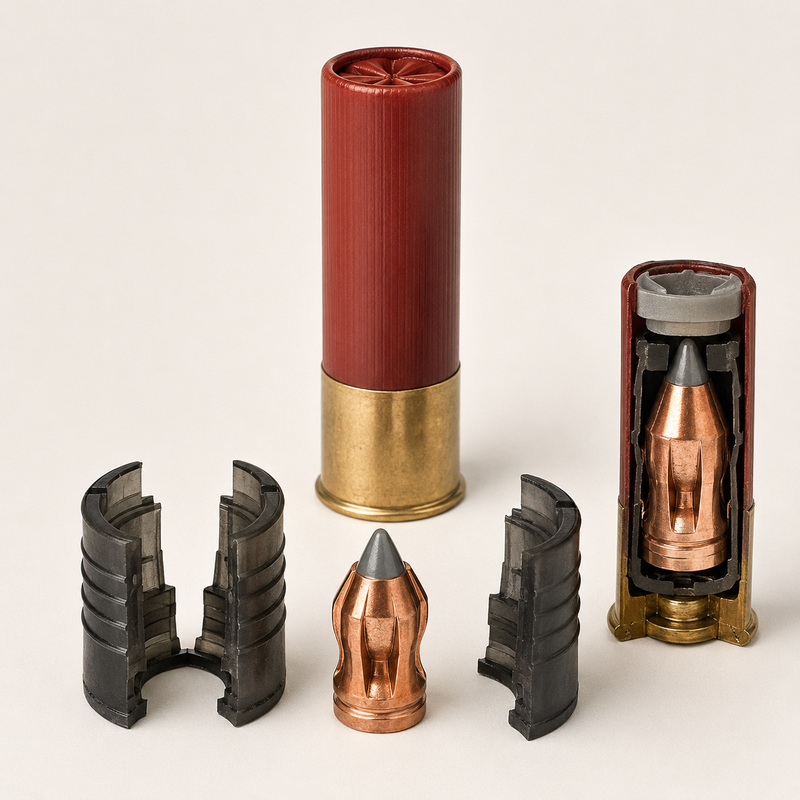
Sabot balls , more correctly called slug sabots when used in shotgun shells, are single-ball ammunition in which the projectile has a diameter smaller than that of the barrel bore. The difference in diameter is compensated for by a lightweight casing, generally made of plastic, called a sabot.
The sabot centers the projectile in the barrel, ensures a gas seal, and transmits the rotation imparted by the rifling. After exiting the muzzle, the sabot opens or separates due to aerodynamic pressure, while the projectile continues on its own toward the target.
This system allows the use of a more aerodynamically shaped projectile than traditional Foster or Brenneke balls in rifled shotguns designed to fire shotshells, generally achieving greater accuracy, a flatter trajectory and better conservation of energy.
What does sabot mean?
The French word sabot literally means "hoof." In ballistics, it refers to a lightweight structure that encases or supports a projectile with a diameter smaller than that of the barrel. The principle is not exclusive to hunting ammunition: similar solutions are also used in artillery and in certain undersized military ammunition.
In hunting cartridges, the sabot is normally made of two or more polymer elements . These form a sort of container around the bullet and separate shortly after passing through the muzzle.
What is a sabot ball cartridge made of?
A modern sabot rifle cartridge generally features the following elements:
- cartridge case made of plastic with metal base;
- trigger and propellant charge;
- wadding or sealing system of gases, sometimes integrated into the sabot;
- plastic clogs, sized to properly engage the rifling;
- under-calibrated bullet made of lead, lead alloy, copper or other material;
- eventual hollow point or polymer tip, intended to improve aerodynamics and expansion.
The bullet, in shape and construction, resembles a modern rifle bullet. It frequently features ogival profiles, tapered tails, hollow points, and polymer inserts. Some models are constructed of monolithic copper, while others use a lead core encased in a metal jacket.
How the sabot works in the barrel
Upon firing, the pressure generated by the combustion of the propellant pushes the entire projectile-saflet assembly forward. It is the outer jacket of the sabot that comes into contact with the barrel walls and the grooves.
The rifling imparts a rapid rotational motion to the entire assembly. The sabot transfers this rotation to the projectile, which is thus gyroscopically stabilized. Once past the muzzle, the various parts of the sabot are struck by the air, open up, and rapidly slow down, separating from the projectile.
Regular, symmetrical separation is essential for accuracy. If one part of the sabot remains attached to the projectile longer than the other, it can create imbalance and alter the trajectory.
Sabot balls and rifled barrels
Sabot bullets perform best with a fully rifled barrel . In this type of barrel, the sabot can stably engage the rifled barrel throughout its travel, transferring the spin necessary for stabilization to the projectile.
Some ammunition manufacturers declare it compatible with rifled chokes , but this must be verified on the specific product. A rifled choke only imparts rotation to the final section of the barrel and doesn't always achieve the same consistency as a fully rifled barrel.
Using a standard smoothbore barrel is generally not recommended for accuracy. Without sufficient spin, an undersized bullet may not stabilize properly. Before use, it is therefore essential to check the ammunition manufacturer's instructions and those of the gun manufacturer.
Differences between a sabot ball and a traditional slug ball
Projectile diameter
The traditional smoothbore bullet typically has a diameter close to the internal diameter of the barrel, even if it features ribs, cavities, or other features that allow it to pass safely. In sabot ammunition, however, the actual projectile is significantly undersized and is brought to the required diameter by the plastic casing.
Stabilisation phase
Sabot bullets are designed to receive gyroscopic stabilization from the barrel's rifling. Foster bullets and many other traditional slugs intended for smoothbore barrels rely primarily on mass distribution and aerodynamic drag to maintain a sufficiently stable orientation.
The ribs visible on many Foster bullets, often incorrectly referred to as true rifling, serve primarily to facilitate their deformation and passage through the barrel and compatible chokes.
Aerodynamic shape
A sabot bullet can adopt a more elongated and aerodynamic shape, similar to that of a rifle bullet. A traditional large-diameter slug typically has a greater frontal surface area and loses velocity more rapidly.
Accuracy and distance
With a properly matched gun and ammunition, a sabot can deliver significantly tighter groups and a smoother trajectory. This doesn't mean, however, that every sabot ammunition is automatically accurate in any barrel: rifling twist, sabot geometry, bullet weight, and velocity must work together harmoniously.
Internal ballistics
The sabot performs several functions during its passage through the barrel:
- keeps the bullet perfectly centered;
- contributes to the sealing of propellant gases;
- protects the bullet from direct contact with the bore of the barrel;
- transfers the rotation generated by the rifling;
- It can reduce some of the friction compared to a full caliber metal bullet.
The behavior of plastic materials varies with temperature, pressure, and barrel geometry. For this reason, accuracy can vary between different types of ammunition, even when the bullet and declared velocity appear similar.
After numerous shots, plastic deposits may also form in the grooves. Excessive buildup can affect accuracy and requires cleaning with products and procedures compatible with the barrel.
External ballistics
The main aerodynamic advantage of the sabot ball comes from the possibility of using a narrower, more profiled projectile. Compared to a conventional slug, this configuration can offer:
- more favorable ballistic coefficient;
- less loss of speed during flight;
- more tense trajectory;
- reduced sensitivity to crosswinds;
- greater residual energy at medium-long distances;
- accuracy closer to that of a rifle, within the limits of the system.
Actual performance, however, depends on the individual load. Weight, muzzle velocity, bullet shape, twist rate, and firearm quality can produce significantly different results. Operating ranges should therefore not be determined solely based on commercial claims, but through pattern testing and knowledge of the trajectory of the specific firearm-ammunition combination.
Terminal ballistics
Hunting sabot bullets are generally designed to combine penetration, expansion, and mass conservation . The main configurations include:
- hollow-point ball, designed to expand on impact;
- ball with polymer tip, which improves the aerodynamic profile and can help initiate expansion;
- shirt-covered ball, with a lead core protected by a metal jacket;
- monolithic copper ball, characterized by high weight retention and good penetration capacity;
- ball with core tied to the shirt, intended to limit the separation of the components.
A relatively light and fast bullet can offer a flatter trajectory and rapid expansion. A heavier or more robustly constructed bullet, on the other hand, tends to favor penetration and mass conservation. The final result also depends on the residual velocity and the resistance encountered.
12 gauge and 20 gauge
Sabot cartridges are most popular in 12 and 20 gauges . The 12 gauge allows the use of relatively heavy bullets and offers high energy levels, but is accompanied by a recoil that can be considerable.
The 20-gauge uses smaller, lighter bullets, but it shouldn't be automatically considered less effective. The smaller frontal section improves penetration, and the aerodynamic shape allows for good velocity retention. In smaller weapons, however, even the 20-gauge's recoil can be noticeable.
In both cases it is essential to check the length of the cartridge chamber, permissible pressure, type of barrel and expressly declared compatibility.
Advantages of sabot balls
- generally superior accuracy in fully rifled barrels;
- more tense trajectory than traditional slugs;
- better conservation of speed and energy;
- possibility of using technologically advanced expansive projectiles;
- smaller frontal surface of the projectile during flight;
- good penetration capacity;
- useful performances in hunting ungulates, where permitted by law.
Limitations and disadvantages
- need for a rifled barrel or a configuration expressly approved by the manufacturer;
- generally unsatisfactory accuracy in normal smoothbore barrels;
- higher cost than traditional balls;
- possible plastic residues inside the grooves;
- results very sensitive to the match between weapon and ammunition;
- often significant recoil, especially in faster loads;
- need to carefully check trajectory and point of impact.
Sabot ball and choke
A sabot cartridge shouldn't be chosen based solely on its nominal caliber. The presence of a choke, whether fixed or interchangeable, requires special attention. Some products can be used with specific rifled chokes , while others are intended exclusively for fully rifled barrels.
It's incorrect to automatically extend the recommendations for a single model to all ammunition. Always follow the manufacturer's instructions for the firearm, barrel, choke, and cartridge.
Accuracy and choice of ammunition
Two sabot cartridges of the same caliber can produce very different patterns in the same weapon. This variability depends on the interaction between:
- weight and length of the projectile;
- barrel rifling pitch;
- initial velocity;
- material and rigidity of the sabot;
- regularity of separation after the sprint;
- reed harmonics;
- aiming system and shooting quality.
The fastest or most expensive ammunition isn't necessarily the most accurate. The choice must be made through comparative tests, using a stable support and verifying not only the size of the pattern, but also the consistency of the point of impact.
Hunting use
Sabot bullets were developed primarily for hunting ungulates with rifled shotguns. They are particularly popular in countries and areas where regulations limit, or have historically limited, the use of traditional rifles.
In Italy, hunting use must be evaluated in light of national and regional legislation and the current hunting calendar , considering the huntable species, caliber, energy, type of weapon and permitted hunting methods.
The increased potential accuracy does not eliminate the need for correct target identification, trajectory knowledge, and safe seabed. The sabot's parts also separate in the first few meters in front of the muzzle: people, instruments, and obstacles must remain clear of this area.
Sabot in muzzle-loading weapons
The same principle is also used in some modern muzzle-loading weapons. A sub-caliber bullet is inserted into a plastic sabot, allowing it to be used in a larger-diameter barrel. The rifling acts on the sabot, which transfers spin to the bullet and separates after firing.
Despite their conceptual similarity, muzzleloading components and sabot shotgun shells are not interchangeable. Each system should be used exclusively according to the manufacturer's specifications.
Conclusions
The sabot ball represents a technically advanced solution for transforming a rifled shotgun chambered for shotshells into a system capable of launching aerodynamic, undersized projectiles. The sabot ensures centering, gas sealing, and spin transmission, then separates from the projectile immediately after exiting the barrel.
Compared to traditional slugs, sabots can offer superior accuracy, a flatter trajectory, and better performance at medium to long ranges. However, these advantages only emerge when the ammunition, twist rate, and barrel characteristics are properly matched. Checking the manufacturer's specifications and testing the specific cartridge in practice are therefore essential.