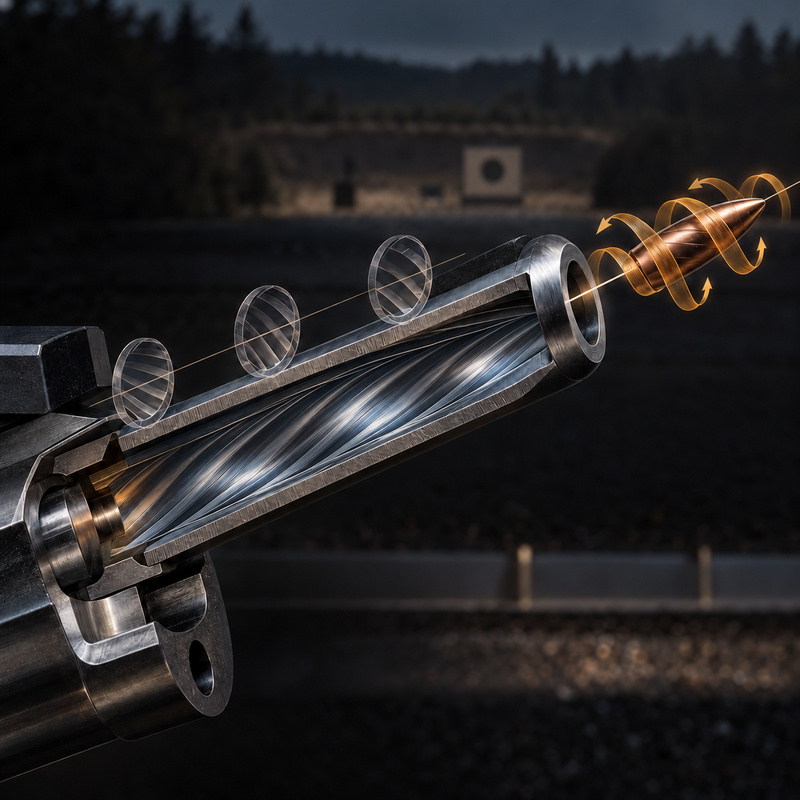
The twist rate, also known as twist rate , is the distance required for the helical rifling rifling in the barrel to impart a complete rotation to the projectile. A 1:10 twist, for example, means that the projectile completes one full rotation for every 10 inches of travel. This rotation generates the gyroscopic stability needed to keep the tip aligned along its trajectory. The correct match between twist rate and projectile depends primarily on its length, diameter, velocity, and atmospheric density, not simply on its weight.
WHAT IS THE RIFLING PITCH?
The barrel of a rifle features a series of grooves and ridges arranged in a helical pattern. When the bullet passes through the bore, it is guided by the rifling and begins to rotate around its longitudinal axis.
The pitch indicates the longitudinal distance over which the propeller completes one complete rotation. It can be expressed in inches or, more rarely, in millimeters.
The most common indications take forms such as:
- 1:7 – one full rotation every 7 inches;
- 1:8 – one full rotation every 8 inches;
- 1:10 – one full rotation every 10 inches;
- 1:12 – one full rotation every 12 inches.
In the metric system you may encounter indications such as 1:250 mm, that is, one full rotation every 250 millimetres.
FAST STEP AND SLOW STEP
A step is defined as rapid when it completes the rotation in a relatively short distance. A 1:7 step is therefore faster than a 1:10 step.
A stride is defined as slow when it requires a greater distance to complete a revolution. A stride of 1:12 is slower than a stride of 1:9.
The terminology can be confusing at first because a smaller number after the colon identifies a faster rotation:
- 1: 7: faster rotation;
- 1: 9: intermediate rotation;
- 1: 12: slower rotation.
Therefore, the values are not compared as simple absolute numbers, but rather the distance required to perform a rotation is considered.
WHY THE BULLET MUST ROTATE
An elongated projectile flying without rotating would be aerodynamically unstable. Air forces would tend to progressively increase its inclination until it would cause very large oscillations or even overturning.
The rotation imparted by the rifling transforms the projectile into a gyroscopic body. Like a top, it tends to maintain the orientation of its axis and resist disturbances that attempt to deviate it.
Stabilization, however, does not keep the projectile perfectly still. During flight, its axis undergoes small movements called precession and nutation , which normally tend to reduce when stability is adequate.
GYROSCOPIC STABILITY
The ability of the projectile to maintain a stable attitude is referred to as gyroscopic stability . It is often represented by the stability factor Sg.
In general terms:
- a value that is too low indicates insufficient stabilization;
- an adequate value indicates a correct stability margin;
- a very high value indicates a rotation greater than strictly necessary.
The Sg factor is not a fixed characteristic of the bullet alone. It varies with the twist rate, velocity, bullet size, and air density.
A bullet that is adequately stable under a given condition may have a smaller margin if the velocity decreases or if it is used in a denser atmosphere.
LENGTH MATTERS MORE THAN WEIGHT
Weight is often used to indicate which projectile can be stabilized by a given pitch. This is a practical simplification, but the most important geometric parameter is the length of the projectile in relation to its diameter.
For the same caliber, a longer bullet generally requires a faster spin. Heavy bullets also tend to be longer, which is why weight is commonly associated with the need for a faster spin.
However, two bullets of the same weight can have different lengths if they are made of different materials or structures. Consequently, they may require different twist rates.
THE ROLE OF MATERIAL DENSITY
The density of the material influences the length required to achieve a given weight. Lead is very dense and allows a large mass to be concentrated in a relatively small volume.
A solid copper or copper alloy bullet, for the same weight and caliber, is generally longer than a traditional lead-containing bullet. The increased length may require a faster twist rate.
For this reason, it's not always correct to choose the pitch based solely on the weight expressed in grains. It's necessary to consider the structure and actual length of the projectile.
THE RELATIONSHIP BETWEEN CALIBER AND LENGTH
Stability also depends on the length-to-diameter ratio, sometimes referred to as length in calibers . A bullet that is long relative to its diameter has a greater tendency to deviate from its correct attitude and requires more vigorous spin.
A short, large-diameter bullet can be stabilized with a relatively slow pitch. A very tapered, long bullet, even if it isn't exceptionally heavy, may require a faster pitch.
Modern high-ballistic-coefficient designs often feature long nose cones, tapered tails, and sleek geometry. These features improve aerodynamic efficiency but increase overall length.
RIFLING PITCH AND ROTATION SPEED
The twist rate determines how many rotations the bullet makes as it travels a given distance. The muzzle velocity, on the other hand, determines how quickly that distance is traveled.
The rotation speed therefore depends on both parameters:
- rifling pitch;
- linear velocity of the projectile.
A projectile launched at a higher velocity from the same barrel also achieves a higher number of rotations per minute. If the velocity decreases, the initial rotational speed also decreases proportionally.
HOW TO CALCULATE RPM
When the pitch is expressed in inches, the twist rate can be estimated by relating the muzzle velocity to the distance required to complete one rotation.
A bullet leaving a barrel with a 1:10 pitch makes one rotation for every 10 inches of travel. At normal rifle ammunition velocities, it can therefore reach rotational velocities exceeding hundreds of thousands of revolutions per minute.
The value is very high because the bullet travels in just one second a distance equivalent to thousands of times its own rifling twist.
This rotational speed should not be confused with linear speed, expressed in meters per second or feet per second.
DOES ROTATION DECREASE DURING FLIGHT?
After exiting the barrel, the bullet progressively loses velocity due to air resistance. Spin rate also decreases, but generally much more slowly than linear velocity.
The projectile can therefore retain a large portion of its spin even when the velocity of travel has significantly decreased.
As a result, the margin of gyroscopic stability can increase during some phases of flight. This does not mean that the projectile becomes immune to aerodynamic disturbances, especially when passing through the transonic regime.
CONSTANT STEP AND PROGRESSIVE STEP
Most rifled barrels use a constant pitch : the distance required to complete one rotation remains the same along the entire length of the barrel.
There are also barrels with a progressive twist , called gain twist . In this case, the rifling begins with a relatively slow rotation and becomes progressively faster towards the muzzle.
The progressive pitch can reduce the initial stress on the bullet and gradually impart the final spin. Its effectiveness depends on proper design and matching with the ammunition.
RIGHT STEP AND LEFT STEP
Rifling can be right-handed or left-handed. A right-handed rifling causes the bullet to spin clockwise when viewed from the rear as it travels away; a left-handed rifling produces the opposite motion.
Most modern rifled barrels use a right-hand twist, but historical and contemporary examples with a left-hand twist exist.
The direction of rotation does not in itself determine greater precision. However, it does influence the direction of some secondary phenomena, such as gyroscopic drift.
RIFLING PITCH AND GYROSCOPIC DRIFT
The rotation of the bullet contributes to the so-called gyroscopic drift or spin drift . A bullet stabilized by right-handed rifling tends, at long ranges, to develop a small deviation to the right; with left-handed rifling, the deviation occurs in the opposite direction.
The phenomenon arises from the interaction between rotation, gravity, aerodynamic resistance and the progressive orientation of the projectile along the curved trajectory.
At normal hunting distances, gyroscopic drift is often limited. It becomes more significant as distance and flight time increase.
GYROSCOPIC STABILITY AND DYNAMIC STABILITY
Gyroscopic stability indicates the initial ability of the projectile to avoid tipping over thanks to rotation.
Dynamic stability , on the other hand, describes how the projectile's axis of motion evolves during flight. A projectile may be gyroscopically stable upon exiting the barrel, yet exhibit oscillations that slowly dampen or increase under certain conditions.
Aerodynamic shape, mass distribution, speed and flight regime contribute to dynamic stability.
PRECESSION AND NUTATION
The bullet doesn't always fly with its axis perfectly aligned with its trajectory. Immediately after exiting the muzzle, it may exhibit a slight inclination.
The tip then describes conical movements around the direction of advance. The larger and relatively slower movement is called precession ; the faster and smaller-amplitude movement is called nutation.
When the bullet and pitch are properly matched, these movements generally tend to be reduced, allowing the bullet to stabilize aerodynamically.
WHAT HAPPENS WHEN YOU PACE TOO SLOWLY
If the pitch does not impart sufficient rotation, the projectile may be marginally stable or completely unstable.
Possible effects include:
- increased dispersion;
- persistent oscillations;
- reduction in aerodynamic efficiency;
- faster loss of speed;
- oval holes on the target;
- lateral impact of the bullet in the most obvious cases.
The elongated or lateral hole is often referred to as keyholing . It represents a clear sign of instability, but a bullet can be unstable even without completely toppling.
WHAT HAPPENS WITH A VERY QUICK STEP
A faster-than-necessary pitch increases rotation speed. In most modern combinations, moderate overstabilization does not automatically cause a noticeable loss of accuracy.
Extremely high round counts, however, can increase stress on the jacket and core. Very light, thin, or structurally delicate projectiles can be subjected to considerable centrifugal forces.
Very rapid rotation can also make small concentricity defects or imbalances in mass distribution more evident.
CAN THE BULLET DISINTEGRATE?
Under particular conditions, a fragile projectile launched at high velocity from a very rapid pace can suffer structural failure after exiting the barrel.
Centrifugal forces can overcome the strength of the jacket or material, especially if the bullet has already been heavily scored by the rifling.
The phenomenon is not common with properly designed projectiles used under the intended conditions, but it demonstrates that the rotational velocity also represents a mechanical stress.
OVERSTABILIZATION
The term overstabilization is often used generically to indicate a projectile that rotates faster than necessary.
A certain stability reserve is usually desirable because it compensates for variations in temperature, velocity, and air density. A bullet that is barely at the limit under favorable conditions may become unstable in denser air or lower velocity.
At very long ranges, excessive rotation can limit the bullet's ability to perfectly follow the curvature of the trajectory, slightly increasing the angle with respect to the airflow. For most hunting applications, however, this effect is less significant than the risk of insufficient stabilization.
THE ROLE OF INITIAL SPEED
At the same pitch, a higher muzzle velocity produces a higher rotational speed. A lower muzzle velocity, however, decreases the rpm.
Stability can therefore vary between ammunition that use the same projectile but develop different velocities.
Even a shorter barrel can produce, in some combinations, a lower muzzle velocity and slightly reduce the stability margin, while maintaining the geometric pitch of the rifling unchanged.
AIR TEMPERATURE AND DENSITY
Cold, dense air exerts greater aerodynamic force on the projectile and requires a greater margin of stability. Warm, less dense air, on the other hand, tends to make stabilization more favorable.
Temperature can also affect the initial velocity through the behavior of the propellant powder. In very cold conditions, a higher air density and a slightly lower velocity can therefore combine.
A bullet that is marginally stable on a warm day may perform worse in winter conditions.
ALTITUDE AND STABILIZATION
As altitude increases, atmospheric pressure decreases and the air generally becomes less dense. The projectile encounters less resistance and requires less gyroscopic action to maintain stability.
A combination with marginal performance at sea level may therefore exhibit better performance at altitude. Conversely, a configuration tested in the mountains may have less margin if subsequently used in denser air.
The assessment must consider the entire atmospheric density, not just the geographic altitude.
THE GREENHILL FORMULA
The Greenhill formula is one of the best-known historical methods for estimating the pitch required to stabilize a projectile. It relates the diameter and length of the projectile through an empirical constant.
The formula is relatively simple and can provide a preliminary indication, but it does not accurately consider all the factors important for modern high aerodynamic efficiency projectiles.
Velocity, mass distribution, material density, and atmospheric conditions require more comprehensive models.
MILLER'S FORMULA
Don Miller 's stability formula offers a more comprehensive assessment than the Greenhill method. It takes into account weight, diameter, length, wheelbase, speed, and weather conditions.
The result is expressed through an estimate of the gyroscopic stability factor. This method also remains a mathematical model and depends on the accuracy of the input data.
For bullets with particular structures or mass distributions, specific models or data provided directly by the manufacturer may be required.
RIFLING TAP AND BALLISTIC COEFFICIENT
The declared ballistic coefficient assumes that the projectile is flying with adequate stability. A projectile that oscillates excessively presents a greater surface area to the airflow and can lose velocity more rapidly.
Insufficient stabilization therefore prevents the theoretical aerodynamic efficiency of the projectile from being fully exploited.
A correct pitch does not directly increase the geometric ballistic coefficient, but it allows the bullet to better express its expected performance.
STEP AND PRECISION
Rifling pitch is essential for stability, but it is not the only factor that determines accuracy.
A barrel with an adequate pitch can still produce unsatisfactory patterns due to:
- quality or condition of the cane;
- damaged muzzle crown;
- inconsistent ammunition;
- dimensional incompatibility of the projectile;
- bedding or flotation problems;
- unstable optics or mounts;
- excessive heating;
- inconsistent shooting technique.
The correct step is therefore a necessary, but not sufficient, condition for obtaining good precision.
RIFLING PITCH AND BARREL WEAR
Faster rifling forces the bullet to accelerate more angularly. This increases the stress on the contact surfaces between the bullet and the rifling.
However, barrel wear depends above all on temperature, pressure, quantity and characteristics of the gases, bullet velocity and volume of burned powder.
It is therefore incorrect to automatically attribute shorter barrel life to rapid-fire alone. This phenomenon must be evaluated in the overall context of the cartridge and the conditions of use.
HOW TO MEASURE THE PITCH OF A ROD
The pitch value is usually declared by the gun or barrel manufacturer. When this information is not available, it can be verified by observing the distance required for a reference fixed to a rod to complete a full rotation along the rifling.
The measurement must be performed with the gun completely unloaded, using suitable materials and without damaging the bore and crown.
The result may show small differences due to the measuring method, the grip of the cleaning element and manufacturing tolerances.
THE DECLARED STEP AND THE REAL ONE
The pitch given in the specifications is usually a nominal value. The actual barrel may have a small tolerance compared to the indication.
A rod declared as 1:10 might therefore complete the rotation in a slightly longer or shorter distance. In most combinations, the difference is irrelevant.
However, when the bullet is close to the stability limit, even small variations in pitch, velocity or temperature can contribute to modifying the available margin.
A cliché to be cleared up
It's incorrect to say that a given bullet weight always requires the same pitch. Weight is only an indirect guide, because the fundamental geometric variable is, above all, length.
It's also not true that a faster pitch is always more accurate. A greater rotation provides a greater margin of stability, but it can increase the stress on the projectile and make any imbalances more evident.
The ideal pitch is one that reliably stabilizes the intended projectile under real-world conditions of use, maintaining an adequate margin without introducing unnecessarily high stresses.
DID YOU KNOW THAT?
- A 1:8 step is faster than a 1:12 step.
- Projectile length is more important than weight alone in determining the required pitch.
- A monolithic copper bullet is generally longer than a traditional one of the same weight.
- The rotation speed can exceed several hundred thousand revolutions per minute.
- Linear velocity decreases more rapidly than rotational velocity.
- Cold, dense air reduces the margin of stability.
- The direction of the rifling determines the direction of the gyroscopic drift.
- An oval hole in the target may indicate an unstable bullet.
- Moderate overstabilization is usually preferable to a marginal condition.
- The progressive pace becomes faster as you move towards the sprint.
FOR THE HUNTER
The bullet selection must be compatible with the barrel pitch. Before using new ammunition, it's a good idea to check the gun and bullet manufacturer's instructions.
Grain weight alone is not sufficient to determine compatibility. Modern monolithic or high ballistic coefficient bullets can be longer than traditional products of the same weight and therefore require a faster pitch.
The target test must evaluate not only the size of the pattern, but also the shape of the holes. Oval or lateral impacts require stopping the test and verifying the barrel and ammunition match.
For winter use or in particularly dense air conditions, it is advisable to avoid combinations with too little stability. A reliable configuration must function properly under all foreseeable conditions of use.
IN SUMMARY
The rifling twist rate indicates the distance required for the bullet to complete one complete rotation inside the barrel. A value like 1:10 means one revolution every 10 inches.
Rotation generates the gyroscopic stability needed to keep the projectile oriented along its trajectory. Projectiles that are longer than their diameter generally require faster pitches.
Stability also depends on velocity, atmospheric density, projectile structure, and mass distribution. Weight is a useful guideline, but it shouldn't be the sole criterion.