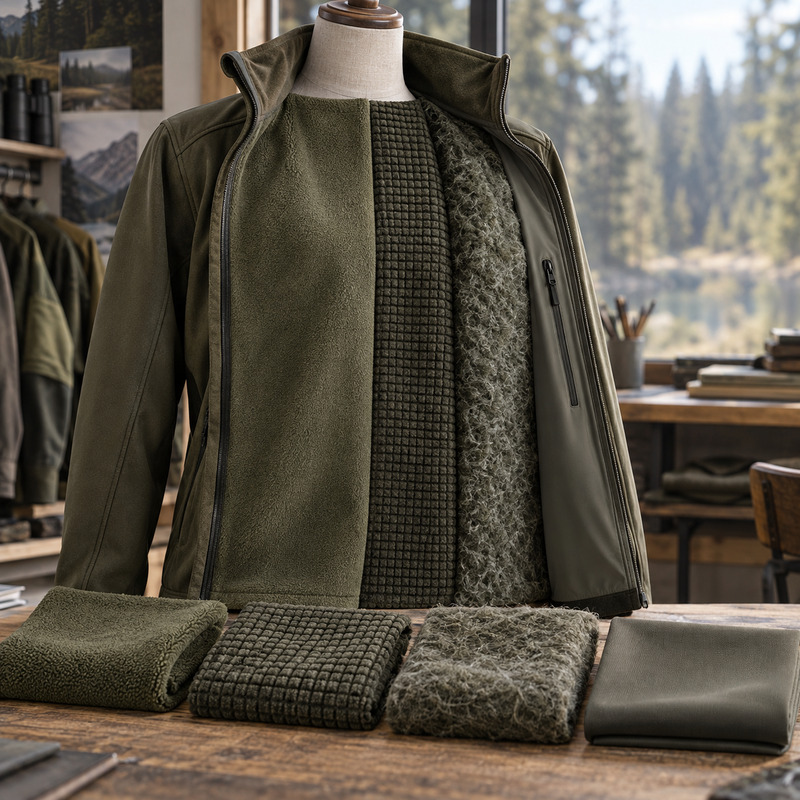
Polartec® is a brand specializing in the development of technical fabrics for outdoor, sports, professional, and military apparel. The name is often used synonymously with fleece, but it doesn't identify a single fiber or material.
The range includes fabrics designed to perform different functions: moisture management, thermal insulation, stretch, wind resistance, and weather protection. In hunting apparel, these technologies can be used in base layers, fleeces, insulated jackets, softshells, and waterproof garments.
Two products bearing the Polartec brand may therefore have completely different compositions, weights, structures, and performance characteristics. Evaluating them requires understanding the specific technology used and the fabric's position in the clothing system.
Polartec is not a fiber
Polartec is not the generic name for a textile fiber, such as polyester, polyamide, or elastane. It is a brand name associated with a family of patented or proprietary constructions and technologies.
Fabrics may contain, depending on the product:
- virgin or recycled polyester;
- polyamide;
- elastane;
- wool;
- polymeric membranes;
- combinations of hydrophilic and hydrophobic fibers;
- specific treatments and finishes.
The composition must be checked on the garment's label. The presence of the label doesn't automatically indicate which fibers were used.
The birth of synthetic fleece
Polartec's modern history is linked to Malden Mills, an American textile company that developed one of the first modern synthetic fleeces in the early 1980s. The goal was to create a material that offered insulation, lightness, and quick drying without using traditional heavy wool.
The polyester fabric was processed to create a soft, voluminous surface that could retain air. In 1991, the Polartec brand was introduced, under which numerous textile technologies were subsequently grouped.
Synthetic fleece transformed outdoor clothing with features such as:
- low weight;
- good thermal insulation;
- drying speed;
- ease of maintenance;
- softness;
- possibility of producing different weights and structures.
How fleece insulation works
A fleece doesn't produce heat. Its function is to retain a layer of relatively immobile air within the textile structure. Air is a poor conductor and slows the loss of body heat.
The insulating capacity depends on:
- thickness of the fabric;
- fiber volume;
- amount of trapped air;
- processing density;
- compression exerted by the other layers;
- presence of wind;
- humidity level;
- fit of the garment.
A very bulky fleece can be warm but easily penetrated by wind. For this reason, it's often worn under an outer jacket or combined with denser constructions or protective membranes.
Polartec Fleece Series
The Polartec Fleece Series represents the evolution of classic synthetic fleece. It features soft, insulating fabrics available in a variety of weights, thicknesses, and finishes.
The lightweight versions can be used as a thin midlayer, while the heavier ones are suitable for lower temperatures and less intense activities.
In the hunting sector, classic fleece is appreciated because it can offer:
- good heat-to-weight ratio;
- relatively quiet surface;
- comfort while waiting;
- faster drying than many natural materials;
- ease of matching with other layers.
Not all versions are windproof or waterproof. A standard fleece can be very permeable to air and require an outer layer on windy days.
Polartec Thermal Pro
Polartec Thermal Pro includes insulating fabrics made with advanced knit structures. They can have surfaces similar to wool, traditional fleece, velvet, or short-haired faux fur.
Different constructions allow for varying warmth, breathability, compressibility, and durability. Thermal Pro is typically used for technical fleeces, jackets, and midlayers intended for cold weather.
For the hunter it can be indicated during:
- cold weather ambushes;
- autumn and winter activities;
- breaks after a walk;
- use under a windbreaker;
- situations where a soft, low-noise surface is required.
Polartec High Loft
Polartec High Loft uses very bulky fibers capable of creating numerous air pockets. The goal is to achieve high insulation with a relatively low weight.
The material is soft and compressible, but high pile can be more exposed to wear, compression, and the accumulation of plant debris. Therefore, it is often protected by an outer fabric.
It is particularly suitable as a thermal layer during low-intensity activities or during waiting phases, while it can be excessively hot during a strenuous walk.
Polartec Power Grid
Polartec Power Grid features a geometric structure of ridges and channels on the inside. The ridges come into contact with the body and retain heat, while the channels promote air circulation, weight reduction, and vapor vapor transfer.
This construction allows to obtain a fabric:
- light;
- breathable;
- compressible;
- quick drying;
- suitable for moisture management;
- efficient as a first or second layer.
Power Grid is interesting for stalking, mountain hunting and all situations in which the hunter produces a lot of heat during movement but still requires a certain amount of insulation.
Polartec Power Dry
Polartec Power Dry is designed primarily for next-to-skin layers. It uses a dual-surface construction that promotes moisture transfer from the inside to the outside.
Sweat is distributed over a larger surface area, facilitating evaporation. The fabric can thus help reduce the sensation of dampness during activity.
In hunting clothing it is used for:
- underwear;
- lightweight technical layers;
- summer clothing;
- mountain hunting;
- activities characterized by frequent variations in intensity.
Moisture management doesn't mean the fabric prevents sweating. Its function is to help transport and evaporate sweat produced by the body.
Polartec Power Stretch
Polartec Power Stretch is a four-way stretch fabric designed to stretch and recover with movement. It typically has a relatively smooth, durable outer face and a soft, moisture-wicking inner face.
It can be used for:
- tight-fitting mid-layers;
- stretch trousers;
- articulated inserts;
- gloves and headgear;
- technical shirts;
- areas of the head that require high mobility.
Power Stretch Pro is a version designed to offer greater resistance and durability of the outer surface. Actual performance may vary depending on the composition and specific construction chosen by the garment manufacturer.
Polartec Power Wool
Polartec Power Wool typically combines a merino wool inner face with a synthetic outer shell. The goal is to leverage the thermal regulation and comfort properties of wool with the durability and moisture management of synthetic fibers.
The two components are not simply mixed randomly, but distributed across the different surfaces of the fabric to perform specific functions.
Power Wool can be used for technical underwear, shirts and midlayers intended for variable conditions.
Polartec Alpha
Polartec Alpha is a highly open and breathable synthetic insulation, originally developed for activities involving alternating intense movement and static phases.
The structure allows heat and vapor to escape more easily than many traditional paddings. This helps limit overheating during activity.
Alpha is typically inserted between an outer fabric and a lining or used in specific technical garments. Its open structure is not normally intended to function alone as complete protection against wind, rain, and vegetation.
In the hunting sector it is particularly interesting for:
- cold-climate wandering hunting;
- mountain trips;
- activities with frequent variations in intensity;
- lightweight, breathable jackets;
- situations in which it is necessary to limit the accumulation of sweat.
Polartec Power Air
Polartec Power Air uses a construction in which insulation fibers are enclosed within small textile structures or cells. These pockets trap air and contribute to insulation.
The structure was also developed to reduce the release of fiber fragments compared to some traditional fleeces. The manufacturer claims reductions that depend on the comparison and the test method used.
Power Air can offer a more compact surface, good elasticity and resistance, making it suitable for mid-layers and garments intended for frequent use.
Polartec Power Fill
Polartec Power Fill is not a fleece, but a synthetic insulation. It's inserted between the outer and inner fabrics of jackets, vests, and other insulating garments.
It's designed to offer warmth, lightness, compressibility, and stability. The versions declared by the manufacturer use material from post-consumer recycled plastic bottles.
In the hunting field, it can be used in garments intended for hides, cold climates and breaks, when greater insulation is needed than that provided by a simple layer of light fleece.
Polartec Wind Pro
Polartec Wind Pro uses a denser construction than traditional fleece to increase wind resistance without requiring a fully windproof membrane.
According to the manufacturer, it can offer up to four times more wind resistance than a conventional synthetic fleece, while maintaining a certain breathability.
It represents an intermediate solution between:
- very open and breathable fleece;
- windproof softshell;
- laminated head with membrane.
It can be useful during active hunting in cool and moderately windy conditions. However, it should not be automatically considered waterproof.
Polartec Windbloc
Polartec Windbloc uses a polyurethane membrane to achieve very high wind protection and some resistance to external moisture.
Compared to a fleece without a membrane, it can offer greater protection when waiting or in exposed areas, but it usually has lower air permeability.
It is therefore more suitable when the priority is to block the wind, while for intense aerobic activities it may be less ventilated than Power Grid, Alpha or a traditional fleece.
Polartec Power Shield
The Polartec Power Shield family is closely linked to the development of softshell fabrics. These materials seek to combine weather protection, stretch, durability, and moisture management.
More protective versions can use waterproof and breathable membranes. Power Shield Pro is designed for harsh conditions and can be made with different combinations of outer fabric, membrane, and lining.
Waterproofing and breathability performance must be assessed on the specific fabric version and the finished garment. Seams, zippers, and construction all influence the overall result.
Polartec NeoShell
Polartec NeoShell is a waterproof, air-permeable technology developed to promote heat and vapor exchange during intense activity. It has been used in jackets, pants, and technical garments for mountaineering and outdoor activities.
Its historical importance lies in having promoted an approach in which water protection was combined with limited direct air permeability, rather than relying solely on vapor diffusion.
The availability of individual technologies and names may change over time; to find out the performance of a particular garment, please consult the specific technical data sheet.
Polartec Delta
Polartec Delta is designed for warm conditions. It uses a construction that combines hydrophilic and hydrophobic yarns to distribute moisture, promote airflow, and reduce the cling of wet fabric to the skin.
Unlike materials that try to wick away and dry sweat as quickly as possible, Delta is designed to support the body's natural evaporative cooling.
It may be interesting for:
- summer hunting;
- dog training in warm seasons;
- long walks;
- high intensity activity;
- hot, dry climates.
Polartec AirCore
Polartec AirCore is a weatherproof technology that uses a nanofiber membrane. It is designed to combine water resistance, controlled air permeability, and vapor vapor transfer.
The technology can be applied to garments intended for intense activities where it is necessary to maintain protection from the outside without completely blocking air exchange.
As with any waterproof and breathable material, actual performance depends on the specific construction, stitching and conditions of use.
Which Polartec should you choose for hunting?
The choice depends on the activity, the climate and the position of the fabric in the layering system.
| Need | Indicative technology |
|---|---|
| Layer in contact with the skin | Power Dry or Delta |
| Lightweight, breathable insulation | Power Grid |
| Elasticity and freedom of movement | Power Stretch or Power Stretch Pro |
| Isolation during intense activity | Alpha |
| Heat in static phases | Fleece Series, Thermal Pro or High Loft |
| Greater wind resistance | Wind Pro |
| Wind protection with membrane | Windblock |
| Protection from rain and wind | Power Shield Pro or other waterproof technologies in the range |
The table indicates the main function, but each technology is available in different variants. Final behavior must be verified on the completed garment.
Polartec in the wandering hunt
While stalking, the body produces heat and sweat. Excessive insulation can cause overheating during the climb and cooling when activity slows.
In these conditions the following may be useful:
- Power Dry as an underwear layer;
- Power Grid as a lightweight midlayer;
- Power Stretch in areas requiring mobility;
- Alpha as active insulation;
- Wind Pro in cool, breezy conditions.
It is generally preferable to use multiple adjustable layers rather than one very heavy garment.
Polartec in stalking hunting
During a stakeout, movement is limited and heat production decreases. In this case, insulation and protection from the wind become priorities.
Fleece Series, Thermal Pro, High Loft, and Power Fill can offer greater thermal protection. In windy conditions, they should be paired with a suitable outer layer or a construction like Windbloc.
Fleece compressed under layers that are too tight loses some of its air volume and therefore its insulating capacity.
Noise while hunting
Many Polartec fleeces have a soft, relatively quiet surface, a useful feature for selective hunting and situations that require discreet movement.
However, the noise level depends on the overall garment. A rigid membrane, a very compact outer fabric, zippers, and reinforcements can produce noise even when the inner layer is soft.
Before purchasing, it is useful to rub the fabric and simulate arm movements in a quiet environment.
Resistance to brambles and vegetation
Traditional fleece is generally not the best solution as an outer layer in heavy soil. The surface can:
- retain seeds and plant residues;
- get caught in thorns;
- suffer abrasions;
- develop pilling;
- get damaged in the areas of contact with the backpack and straps.
In these environments, fleece can be worn under a durable shell or chosen in a version with a more compact outer surface, such as some Power Stretch Pro, Power Air or softshell constructions.
Polartec and waterproofness
The Polartec brand doesn't automatically mean waterproof. A traditional fleece may absorb little water in its fibers, but it still allows rain to easily pass through the gaps in its structure.
To achieve waterproof protection, you need specially designed materials, suitable membranes, taped seams and protected zippers.
Even the surface water-repellent treatment should not be confused with waterproofing: it slows down external wetting, but does not necessarily replace a continuous barrier.
Breathability and sweat management
Breathability is not equal across the range. Power Grid, Power Dry, and Alpha prioritize moisture wicking and ventilation, while Windbloc and more protective materials further reduce direct airflow.
The choice must consider the balance between:
- intensity of activity;
- outside temperature;
- wind;
- rain;
- duration of static phases;
- amount of sweat produced individually.
No fabric can completely wick away moisture if the body produces sweat faster than the system can transport and evaporate it.
Advantages of Polartec fabrics
- Broad specialization: There are materials designed for different functions.
- Good heat-to-weight ratio: particularly in insulating constructions.
- Drying speed: Many products use synthetic fibers that are not very absorbent.
- Moisture Management: some structures move and distribute sweat.
- Breathability: Power Grid and Alpha are designed for dynamic activities.
- Elasticity: Power Stretch follows your movements and recovers your shape.
- Modularity: fabrics can be placed in a layered system.
- Variety of weights and finishes: allows you to adapt the garment to different climates and activities.
Limitations of Polartec fabrics
- Very different performances: The brand alone does not describe the behavior of the product.
- Variable wind protection: Many classic piles are easily penetrated by air.
- Non-automatic waterproofing: It is present only in specific constructions.
- Possible pilling: Rubbing and washing can form surface pellets.
- Sensitivity to flames and heat: Ordinary polyester can melt when exposed to high temperatures.
- Possible accumulation of plant residues: especially in high-pile fabrics.
- Release of microfibers: may occur during use and washing of synthetic materials.
- Cost: Proprietary fabrics can increase the price of the garment.
Pilling and wear
Pilling is the formation of small clumps of fibers on the surface of fabric. It can be caused by rubbing against backpacks, straps, seats, and other items.
Quality constructions use yarns and finishes designed to limit this phenomenon, but no fleece is completely immune to wear and tear.
The most exposed areas are:
- shoulders;
- flanks;
- elbows;
- cuffs;
- belt contact area;
- areas crossed by the backpack shoulder straps.
Polartec and recycled fibers
Polartec has introduced fabrics containing polyester made from post-consumer bottles and other recycled materials. The actual percentage should be checked in the specific fabric data sheet or on the garment label.
The use of recycled fibers doesn't eliminate all environmental concerns. Durability, repairability, microfiber release, finishing treatment, and the recyclability of the finished product remain important factors.
A durable garment, used for a long time and properly maintained can reduce the need for frequent replacements.
How to wash a Polartec garment
Care must follow the instructions on the label, because a garment can combine multiple fabrics, membranes, zips, and treatments.
In general it is advisable to:
- close zippers and Velcro systems;
- wash at moderate temperature;
- use the correct amount of detergent;
- avoid aggressive bleaches;
- do not use fabric softeners when not recommended;
- reduce the heat of the dryer;
- avoid high temperature iron;
- wash the garment only when necessary;
- evaluate the use of a system capable of retaining some of the microfibres.
Fabric softeners can leave residues that can interfere with moisture management and some surface finishes.
How to recognize a real Polartec fabric
Authentic fabric is typically identified by the garment manufacturer through tags, documentation, or specific designations. The mere word "fleece" doesn't mean the material is Polartec.
Before purchasing it is useful to check:
- full name of the technology;
- fibrous composition;
- fabric weight when declared;
- intended function;
- presence of a membrane;
- percentage of recycled material;
- maintenance instructions;
- description provided by the manufacturer of the item.
Frequently Asked Questions about Polartec
Are Polartec and fleece the same thing?
No. Fleece is a general category of fabric, while Polartec is a brand that encompasses fleece and numerous other technologies.
Are all Polartec fabrics warm?
No. Some are designed for insulation, while Delta and Power Dry are primarily intended for heat and moisture management.
Is Polartec waterproof?
Only a few technologies are designed for waterproof protection. Classic fleece shouldn't be considered waterproof.
Does Polartec fleece protect you from the wind?
A traditional fleece offers limited protection. Wind Pro features a more windproof construction, while Windbloc uses a windproof membrane.
Which Polartec is suitable for stalking?
Power Dry, Power Grid and Alpha are particularly interesting for dynamic activities, but the choice depends on the temperature and other layers.
Which Polartec is suitable for stakeout?
Thermal Pro, High Loft, Fleece Series, and Power Fill can offer more insulation, preferably combined with wind protection.
Can Polartec be machine washed?
Generally yes, but the instructions for each individual garment must be followed, especially when membranes and water-repellent treatments are present.
Is Polartec fleece quiet?
Many designs are relatively quiet, but the noise level depends on the surface area, the membrane, and the overall structure of the head.
Conclusions
Polartec doesn't identify a single material, but a family of textile technologies designed to manage heat, sweat, stretch, wind, and precipitation. The range includes insulating fleeces, baselayer fabrics, insulation, softshells, and waterproof materials.
When it comes to hunting apparel, the choice should be based on the activity. Power Grid, Power Dry, and Alpha are particularly suited to intense movement; Thermal Pro, High Loft, and Power Fill favor insulation; Wind Pro and Windbloc offer different levels of wind protection.
The Polartec name alone isn't enough to determine a garment's performance. It's important to check the specific technology, composition, construction, and intended function. A proper layering system allows you to leverage these materials while maintaining an effective balance of warmth, breathability, mobility, and protection.