The term prepreg comes from the English pre-impregnated and refers to a semi-finished product in which the reinforcing fibers are already impregnated with a controlled amount of resin. It therefore does not identify a particular fiber, but a technology used to produce lightweight, strong, and structurally efficient composite materials.
In the firearms and hunting industry, prepregs are primarily used to produce carbon fiber stocks, structural components, carbon-coated barrels, grips, accessories, and equipment . The ability to precisely control the fiber layout and resin content allows for parts with characteristics that are difficult to achieve with traditional manual lamination.
What is a prepreg?
A prepreg is essentially made up of two elements:
- reinforcing fibers, which provide strength and rigidity;
- polymer matrix, which keeps the fibres together, transfers loads and protects the reinforcement from external agents.
The fibers can be carbon, glass, aramid, or other materials. The matrix is generally made of a thermosetting resin , often epoxy, already mixed with the hardener and partially stabilized. Prepregs with thermoplastic matrices are also available, intended for different production processes.
In thermosetting prepregs, the resin is normally in an intermediate state, called B-stage : it is stable enough to allow cutting and handling of the material, but is not yet fully cured. Final cross-linking occurs during the next curing cycle using heat and, depending on the process, pressure or vacuum.
Prepreg does not mean carbon fiber
Prepreg and carbon fiber are not synonymous. Carbon fiber is one possible reinforcement, while prepreg is the semi-finished product obtained by pre-impregnating the fibers with a specific resin.
It is therefore possible to produce:
- carbon fiber prepreg;
- fiberglass prepreg;
- aramid fiber prepreg;
- hybrid prepregs, containing multiple types of fibre;
- unidirectional prepregs or those made with woven fabrics.
When talking about prepreg stocks or gunsmith components, in most cases we are referring to carbon fibers pre-impregnated with epoxy resin.
Unidirectional prepreg and pre-impregnated fabric
The fibers can be arranged in different ways, determining the behavior of the finished component.
Unidirectional prepreg
In unidirectional prepreg, often referred to as UD , almost all the fibers are parallel. The material offers very high performance in the filament direction, but is less strong in the transverse directions.
To obtain a component capable of withstanding stresses from multiple directions, several layers are superimposed, oriented at, for example, 0°, 45°, -45°, and 90° . This sequence is called a laminate or lamination pattern.
Pre-impregnated fabric
In prepreg fabric, the fibers are woven according to a specific pattern. This solution offers a more balanced distribution of properties across the laminate plane and can produce the characteristic geometric appearance of exposed carbon.
The fabric can conform well to curved surfaces, but the undulations generated by the weave somewhat reduce the efficiency of the fibers compared to a perfectly straight and unidirectional reinforcement.
How prepreg is produced
Industrial production requires uniform distribution of the resin and precise control of the fiber-to-matrix ratio. The reinforcement is passed through a system that applies the resin, often in film form, using controlled pressure and temperature.
The resulting material is generally protected with release films, wrapped in rolls, and stored at low temperatures. The manufacturer defines the following for each prepreg:
- fiber type and orientation;
- reinforcement weight;
- resin content;
- temperature and duration of treatment;
- pressure required if applicable;
- maximum storage time;
- usable time out of the freezer.
Why it must be kept cold
In thermosetting prepregs, the chemical reaction of the resin, although slowed down, can continue even before processing. For this reason, the material is normally transported and stored in refrigerated or frozen conditions , according to the manufacturer's instructions.
Before opening the package, the roll should gradually reach room temperature. Opening a cold package can cause condensation to form on the fibers and resin, potentially affecting the quality of the laminate.
Each product has a specific shelf life and a time limit for being out of the freezer. If these times are exceeded, the resin may lose its proper adhesion or change its behavior during curing.
How to make a prepreg component
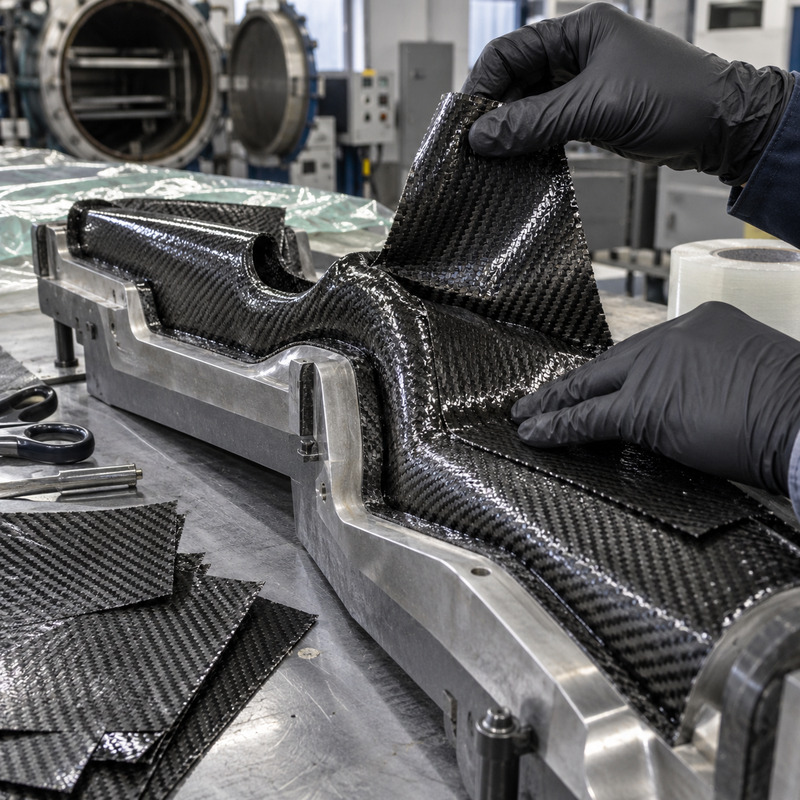
The process begins with cutting the layers according to the shapes, dimensions, and orientations defined by the project. The individual sheets are then placed in the mold following a precise lamination sequence.
The process generally includes:
- controlled defrosting of the material still sealed;
- cutting of the necessary shapes;
- laying the layers in the mold;
- intermediate compaction to limit air and creases;
- application of auxiliary materials and vacuum bag;
- air extraction and tightness check;
- thermal treatment in oven, press or autoclave;
- cooling, demoulding and finishing;
- dimensional and qualitative control of the component.
During curing, the resin temporarily becomes more fluid, adheres to the fibers, and fills any remaining spaces. It then polymerizes, transforming the overlapping layers into a rigid and durable structure.
Processing in the autoclave
The autoclave is a device capable of simultaneously applying controlled temperature and pressure. The component, already enclosed in a vacuum bag, is subjected to the cycle established for the fiber-resin system used.
The vacuum helps to extract air and volatile products, while the external pressure compresses the laminate against the mold. This allows for:
- high compaction of the layers;
- low presence of internal voids;
- good thickness uniformity;
- well-reproduced surfaces;
- high production repeatability;
- excellent mechanical properties.
However, an autoclave is not mandatory for every prepreg. There are out-of-autoclave systems designed to cure in an oven using only vacuum, as well as materials intended for press molding.
Why prepreg offers high performance
In a composite, the fibers bear most of the loads, while the matrix holds them in place and transfers the stresses from one filament to the next. An excessive amount of resin increases weight and fragility without providing a proportional increase in strength. An insufficient amount, however, can leave fibers improperly impregnated.
Prepreg allows for industrial control of the fiber-to-resin ratio , reducing the variations typical of manual impregnation. The result can be a lighter, more uniform, and repeatable laminate.
However, performance depends on the entire process: quality of raw materials, fiber orientation, curing temperature, pressure, absence of contamination and correct storage of the semi-finished product.
Use in gun stocks
One of the most interesting uses in the hunting field concerns carbon composite stocks . A prepreg structure can offer high rigidity with a significantly lower weight than many traditional solutions.
The layers can be oriented to resist bending, torsion, and localized stresses. However, the areas intended for action, recoil lugs, screws, and belt attachments require specific design, often with inserts, reinforcements, or structural cores.
A good prepreg stock can offer:
- reduction of the overall weight of the weapon;
- high structural rigidity;
- stability in the face of humidity and environmental variations;
- possibility of distributing the material only where necessary;
- good dimensional repeatability;
- wide freedom in designing shapes.
Lightness must be considered in relation to recoil. Reducing the mass of the gun, with the same cartridge and configuration, can increase felt recoil. The design must therefore find a balance between weight, ergonomics, rigidity, and shooting comfort.
Prepreg in carbon coated rods
Some rifle barrels use a metal core with a structural carbon fiber coating . In certain constructions, this coating may be formed from pre-impregnated tapes or sheets, wound in a pattern established by the design.
The goal may be to increase the stiffness-to-weight ratio, modify the vibrational behavior of the barrel, and reduce mass compared to a heavy-profile all-metal barrel.
The result doesn't depend solely on the presence of carbon. The following are also crucial:
- geometry and material of the metal core;
- type of fiber and resin;
- orientation and tension of the layers;
- adhesion between metal and composite;
- polymerization cycle;
- the system's ability to handle different heat and expansion.
Not all rods commercially defined as “carbon” are therefore made with the same technology or guarantee the same behavior.
Other uses in the hunting sector
Composites produced with prepregs can also be used for:
- rods and supports for optics;
- lightweight tripods and bipods;
- grips and forends;
- components of bows and sports equipment;
- protective panels and shells;
- shooting and transport accessories;
- structural parts of knives and tools;
- reinforcements for footwear and technical equipment.
In each application, the suitability of prepreg depends on the expected loads, the geometry of the part and the balance between performance, weight and cost.
Prepreg and hand lamination: the differences
In manual lamination, dry fabric is impregnated with resin during component construction. The method is relatively accessible and doesn't necessarily require refrigerated storage of the materials, but uniformity depends greatly on the operator's experience.
With prepreg, however, the resin is already distributed by the manufacturer in controlled quantities. This reduces the risk of areas that are too rich or too poor in matrix and allows for greater repeatability.
| Feature | prepreg | Manual lamination |
|---|---|---|
| Resin dosage | Industrially controlled | It depends on the manual application |
| Food container | Often refrigerated or frozen | Generally simpler |
| Equipment | Oven, press or autoclave according to the system | It can be more essential |
| Repeatability | High if the process is controlled | More operator dependent |
| Cost | Generally superior | Normally lower |
| Laminate quality | Potentially very high | Variable according to process and experience |
Prepreg, infusion and RTM
Prepreg should not be confused with vacuum infusion or resin transfer molding . In these processes, the fibers are placed into the mold while still dry and the resin is then added.
In prepreg, however, the fiber and matrix are already combined before installation. Each technology has specific advantages, and the choice depends on the number of pieces, their dimensions, the required performance, and the available production investment.
Main advantages of prepreg
- Controlled resin content: allows you to limit unnecessary weight and variations between components.
- High structural quality: Correct processing can produce compact laminates with few internal defects.
- Precise fiber orientation: allows the structure to be adapted to the main directions of the loads.
- Repeatability: makes the production of components belonging to the same series more uniform.
- Processing cleaning: The resin does not need to be dosed and applied freely during installation.
- Weight reduction: The material can only be placed in structurally necessary areas.
- Excellent stiffness-to-weight ratio: especially when carbon fiber is used.
- Possibility of hybrid structures: allows you to combine different fibers, cores and inserts.
Limits and critical issues
- High cost: the semi-finished product and the necessary equipment are more expensive than less advanced processes.
- Controlled storage: Many prepregs require a carefully managed cold chain.
- Limited duration: the material has a useful life established by the manufacturer.
- Rigorous process: temperature, pressure, vacuum and times must comply with the expected cycle.
- Skilled labor: Cutting, laying and compacting require experience.
- Risk of hidden defects: Voids, creases, delaminations or contamination may not be visible on the surface.
- Complex repairs: A damaged structural component cannot always be easily repaired.
- Recycling difficulty: Thermoset composites cannot be simply remelted like many thermoplastics.
Defects that can compromise the component
Even a high-quality material can produce a defective part if improperly stored and processed. Common problems include:
- voids and air bubbles inside the laminate;
- delaminations between the layers;
- creases or misalignment of the fibers;
- areas excessively rich or poor in resin;
- contamination caused by dust, grease or moisture;
- incomplete or uneven care;
- damage caused during cutting, drilling or finishing;
- insufficient adhesion between composite and metal inserts.
In the most important components, non-destructive tests, such as ultrasound or thermography, can be used to identify internal discontinuities that cannot be detected by simple external observation.
Aesthetic appearance and structural quality
The visible carbon fiber texture on the surface alone doesn't determine the quality of a component. A piece may display a perfectly regular pattern but contain defects in the internal layers. Conversely, a structurally sound laminate may be painted and still have no visible fibers.
In some products, the woven outer layer is chosen primarily for aesthetic reasons, while the strength is entrusted to the unidirectional layers underneath. It is therefore important to distinguish between decorative carbon and a load-bearing composite structure.
How to evaluate a product made of prepreg
Consumers can rarely directly verify the production process, but they can evaluate the completeness of the information provided by the manufacturer. It's helpful to check:
- type of fiber used;
- structural or merely aesthetic function of the composite;
- declared molding technology;
- presence of cores, inserts or reinforcements;
- actual weight of the component;
- warranty against defects and delaminations;
- assembly, maintenance and inspection instructions;
- any mechanical tests or quality checks.
The mere term "carbon prepreg" doesn't automatically guarantee superior performance. The result depends on the design and quality of the entire process.
Maintenance of prepreg components
Once cured, a prepreg component does not require low-temperature storage. However, it must be protected from impacts, crushing, temperatures exceeding the design limits, and chemicals incompatible with the matrix.
È consigliabile:
- clean the component with non-aggressive products;
- avoid unauthorized modifications or punctures;
- respect the prescribed tightening torques;
- inspect areas affected by violent impacts;
- check for cracks, bulges or detachments;
- Contact the manufacturer if you suspect delamination.
Internal damage may be more extensive than what appears on the surface alone. Any anomalies in the structural components of a firearm must be assessed by qualified personnel before continuing use.
Frequently Asked Questions about Prepreg
Is prepreg always made of carbon?
No. It can use carbon, glass, aramid, or hybrid fiber reinforcements. The term describes the pre-impregnation of the fibers, not their composition.
Should prepreg always be processed in an autoclave?
No. Many systems require an autoclave, but there are prepregs designed for vacuum oven curing or press molding.
Why is it kept in the freezer?
The low temperature slows down the reaction of the thermosetting resin and extends the period during which the material can be worked.
Is a prepreg component stronger than a metal one?
Not in an absolute sense. A composite can offer an excellent strength-to-stiffness-to-weight ratio, but the comparison depends on the type of load, the geometry, and the quality of the design.
Is carbon prepreg impact resistant?
It can be designed to withstand significant impacts, but some carbon structures are sensitive to concentrated impacts and out-of-plane stresses. Adding aramid fibers or other reinforcements can improve toughness.
Is a prepreg stock waterproof?
Properly cured composite doesn't absorb or react to moisture like wood. Holes, inserts, joints, cores, and finishes must still be adequately protected.
Does the carbon fiber design indicate its quality?
No. The regularity of the weave is primarily a visual element. The structural quality depends on the internal layers, their arrangement, and the absence of defects.
Conclusions
Prepreg is one of the most advanced semi-finished products for the construction of composite components. The resin, already dosed and distributed over the fibers , allows for lightweight, rigid, and repeatable structures, especially when the material is processed using carefully controlled cycles.
In the world of firearms and hunting, it is mainly used in carbon stocks, coated barrels, lightweight accessories, and structural components . Its advantages, however, come with high costs, the need for refrigerated storage before processing, and production processes that require specific expertise and equipment.
Final quality depends not only on the use of prepreg, but on the entire design: fiber selection, ply orientation, fiber-to-resin ratio, cure cycle, and defect control. When these elements are managed correctly, prepreg allows for the creation of components with an excellent balance of weight, stiffness, strength, and stability.