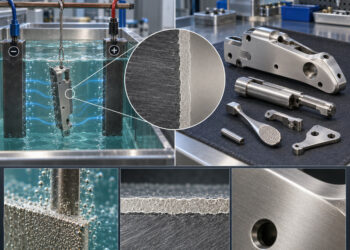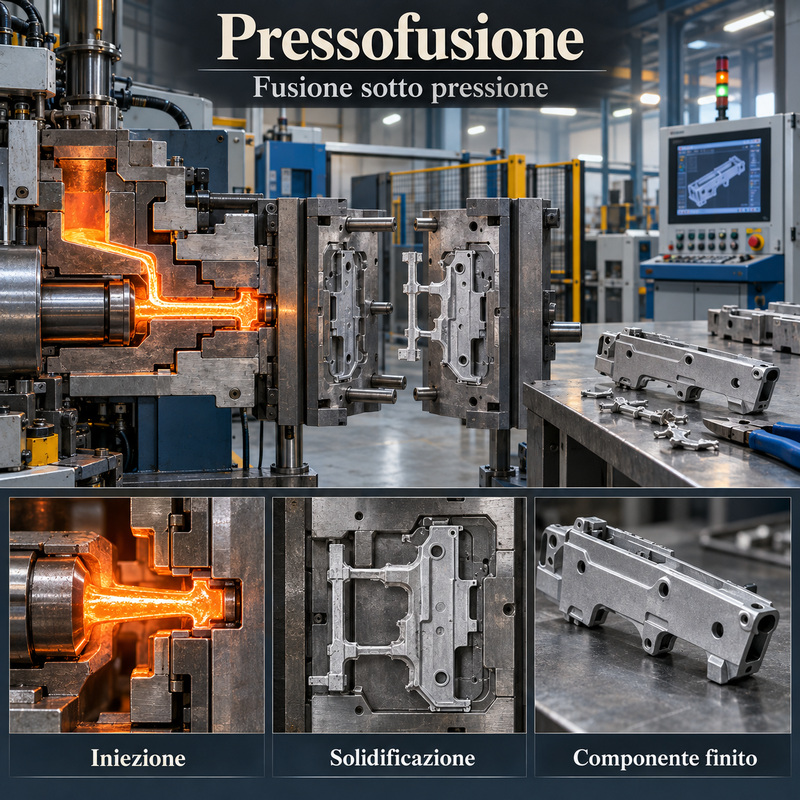
Die casting is a manufacturing process in which molten metal is injected at high pressure into a metal mold. After solidification, the mold is opened and the component is extracted with a shape very close to its final form.
The technology allows for the rapid production of large quantities of parts with complex geometries, relatively thin walls, and good dimensional uniformity . In the firearms industry, it is used primarily for components not directly subjected to the maximum firing pressures, such as receivers, accessories, levers, metal grips, and secondary parts.
How it works
The metal is brought to a liquid state and introduced into an injection chamber. A piston rapidly pushes it into the mold, where it fills cavities, ribs, and details.
Pressure is maintained during solidification to compensate for material shrinkage and improve component definition. The cycle generally includes:
- mold preparation and lubrication;
- closing of the two halves;
- molten metal dosage;
- high speed and pressure injection;
- solidification and cooling;
- mold opening;
- component ejection;
- blanking, deburring and finishing.
The metal mold
The mold, also called a matrix, is generally composed of two parts made of heat- and wear-resistant steels. Inside it, a cavity is created that reproduces the shape of the component.
It may include slides, pins, and moving cores to create holes, undercuts, and complex geometries. The design must also include feed channels, vents, ejection points, and cooling circuits.
Pressure and speed
The metal must fill the mold before solidifying. For this reason, it is injected at high speed and pressure, allowing for the reproduction of fine ribs, lettering, and surface details.
Incorrect parameters can trap air, cause incomplete filling, or create areas of different densities.
Hot chamber die casting
In hot-chamber machines , the injection system is immersed directly in the molten metal. The material is rapidly transferred into the mold, reducing cycle time.
The process is primarily used for alloys with relatively low melting temperatures, such as zinc. It is not suitable for metals that could damage or dissolve the immersed injection system.
Cold chamber die casting
In cold chamber machines , the metal is melted in a separate system and transferred to the injection chamber for each cycle. A piston then pushes it into the mold.
This system is mainly used for aluminum, magnesium alloys and other materials that require higher temperatures or are not compatible with the hot chamber.
Aluminum alloys
Die-cast aluminum allows for lightweight, corrosion-resistant components with good rigidity. It is used in numerous mechanical sectors and can be used in weaponry components not directly subjected to high pressures.
The properties depend on the specific alloy, the design, and the casting quality. A die-cast component does not automatically possess the same characteristics as a solid or forged one.
Zinc alloys
Zinc alloys, often referred to by trade names belonging to the Zamak family, exhibit excellent ability to fill details and produce smooth surfaces.
They are suitable for controls, levers, accessories and secondary components, but have different weight, resistance and thermal behaviour than aluminium and steel.
Magnesium alloys
Magnesium allows for the production of particularly lightweight components. However, it requires specific equipment and procedures due to its reactivity in the molten state.
The choice must take into account mechanical resistance, corrosion, protective finishes and environmental conditions expected during use.
Filling the mold
The path followed by the metal is determined by the channels and entry points. The flow must reach every area without generating excessive turbulence or entraining large quantities of air.
Digital simulation allows you to predict material movement, solidification, and potential defects before final mold construction.
Cooling and solidification
The mold rapidly removes heat from the metal, which solidifies in seconds. Internal circuits regulate the temperature and maintain a stable production cycle.
Uneven cooling can cause shrinkage, stress, warping, and differences in the component structure.
Component ejection
After solidification, the mold opens and a series of ejectors pushes the piece out. The placement of the pins must be carefully chosen to avoid deformations and marks on important surfaces.
The component is extracted together with the sprues, attachments and thin excess material which will need to be removed.
Cutting and deburring
After extraction, channels, sprues, and burrs are removed. Processing can be performed using blanking dies, CNC tools, brushes, or tumbling.
The finish must preserve dimensions, edges, and functional surfaces. The duct connection areas may require additional work.
Subsequent work
Die casting allows for shapes close to the final ones, but some surfaces still require milling, boring, threading, or grinding.
The following are mainly processed:
- pin and bearing seats;
- calibrated holes;
- threads;
- sliding guides;
- mating plans;
- surfaces subject to tight tolerances.
Surface finishes
Die-cast components can be sandblasted, ground, polished, painted, or subjected to conversion treatments. The choice depends on the alloy used.
Aluminum can be anodized or coated with protective coatings, while zinc alloys can be painted, nickel-plated, or chrome-plated after proper preparation.
Use in weapons
Die casting can be used to make:
- air gun carcasses or replicas;
- parts of optical accessories and instruments;
- levers and controls;
- metal bridges and handles;
- magazine bases and parts;
- supports and protective shells;
- aesthetic or secondary components;
- parts not directly subject to chamber pressure.
Structural components
The suitability of die casting for a structural part depends on the material, geometry, manufacturing quality, and expected stresses. It's incorrect to consider all die-cast components weak, nor to automatically equate them with forged components.
For parts that directly experience the pressure of the shot, specific calculations, tests, and certifications are required. The choice of process is up to the designer and manufacturer.
Gas porosity
Rapidly filling the mold can trap air or gas inside the metal, forming small cavities called porosity.
The defect can reduce strength, adhesion, and surface quality. It may also become visible during subsequent mechanical processing.
Shrinkage porosity
During solidification, the metal decreases in volume. If one area is not fed properly, an internal cavity can form due to shrinkage.
The position of the channels, the pressure maintained and the thermal control of the mould help to limit the phenomenon.
Incomplete filling
If the metal solidifies before filling the entire cavity, the part will have missing parts, undefined edges, or incomplete walls. The defect may be related to temperature, speed, pressure, or channel size.
An incomplete component is normally discarded and the process must be corrected.
Cold joints
When two partially solidified metal faces meet without fusing properly, a cold joint is formed . The surface may show a line, but the defect may also extend into the interior.
This discontinuity reduces local resistance and must be distinguished from a simple aesthetic sign.
Cracks and deformations
Thermal stresses, premature extraction, and unfavorable geometries can cause cracks or deformations. Very different wall thicknesses cause non-uniform cooling rates.
Correct fittings, balanced thicknesses and adequate draft angles improve the quality of the component.
Quality controls
Die-cast components can be subjected to:
- visual and dimensional control;
- industrial radiography;
- computed tomography;
- penetrating liquids;
- hardness tests;
- metallographic analysis;
- tensile and fatigue tests;
- tightness checks.
The type of verification depends on the function and the level of security required.
Die casting and micro casting
In microcasting, metal is poured into a ceramic mold obtained from a wax model. The process also allows for the processing of high-performance steels and alloys.
Die casting, on the other hand, uses permanent metal molds and high-pressure injection. It's generally faster and more cost-effective for large quantities of non-ferrous alloy components.
Die casting and forging
Forging deforms solid metal through pressure or impact, orienting its structure. It can produce components with excellent mechanical properties.
Die casting offers greater geometric freedom and requires less material removal, but can present porosity and a structure less favorable to more severe stresses.
Die casting and CNC machining
CNC machining removes material from a solid block and allows for very tight tolerances. However, it produces chips and requires longer machining times for complex geometries.
Die casting is more cost-effective for large-scale production, after the initial cost of the mold has been covered. The two technologies are often combined.
Main benefits
- high production speed;
- good dimensional repeatability;
- ability to create complex shapes;
- relatively thin walls;
- good surface quality;
- reduction of subsequent processing;
- integration of ribs, seats and details;
- low unit cost in large series.
Process Limits
- high initial cost of the mold;
- reduced convenience for small quantities;
- possible formation of porosity;
- limitations in the choice of alloys;
- difficulty in modifying the design after the mold has been built;
- mechanical properties dependent on the quality of the process;
- need for subsequent processing on precision surfaces.
A technology for large series
Die casting allows for the rapid production of complex and uniform components, reducing machining and material waste. Its main advantages are realized when the number of parts justifies the creation of a dedicated mold.
In the weapons sector it is used where repeatability, lightness and productivity are more important than the performance required of the most stressed parts.