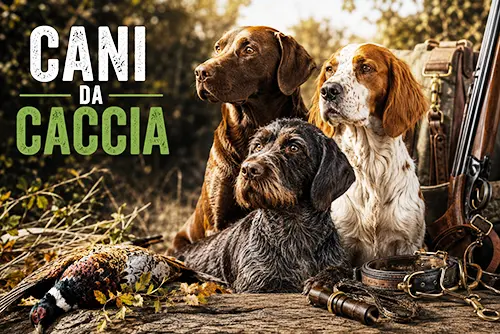
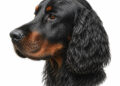
The Pudelpointer is one of the most interesting multipurpose hunting dogs developed by German dog breeding. Born from the genetic cross between the Pointer and the Poodle , it was selected with a very specific goal: to create a dog capable of retaining the Pointer's large nose, broad search, and confident point, while adding hardiness, a predisposition for retrieving, the ability to work in water, and greater versatility in challenging environments.
The result is not a simple cross between two breeds, but a population stabilized through very rigorous functional selection. The modern Pudelpointer is a continental, wire-haired pointing dog , powerful yet athletic, capable of working on plains, in woods, and in wetlands and capable of tackling different phases of hunting: searching, pointing, retrieving downed game, and working in water.
Its identity is deeply rooted in the German concept of the all-purpose Jagdhund . The dog must not excel in just one specialty. It must possess sufficient range of motion to work effectively on feathered game, sufficient connection with its handler to be manageable in the woods, a natural and reliable point, great willingness to retrieve, and the hardiness necessary to enter water or traverse dense vegetation.
The rough, dense coat, the robust Pointer build, the prominent beard, and the attentive expression give the breed an immediately functional appearance. The temperament is also selected based on the work: the Pudelpointer must be balanced, controllable, confident, and endowed with a strong passion for hunting , without fear of game or gunshots.

Pudelpointer: breed data sheet
| Official name | poodle pointer |
| country of origin | Germany |
| FCI Code | 216 |
| FCI Group | Group 7 – Pointing Dogs |
| Section | 1.1 – Continental Pointing Dogs, Bracco Type |
| Test of work | Yes |
| Use | Versatile hunting dog for work in the fields, woods and water |
| Genetic origin | Pointer and Poodle |
| Male height | 60-68 cm at the withers |
| Female height | 55-63 cm at the withers |
| Construction | Pointer type: robust, athletic and muscular |
| cloak | Hard, rough, dense, close-fitting, with dense undercoat |
| Approximate length of hair at the withers | Approximately 4-6 cm |
| Allowed colors | Brown, dead leaf and black |
| White marks | Small markings tolerated |
| Temperament | Balanced, controlled, confident and with a strong hunting instinct |
| Main skills | Search, point, retrieve, work in the woods and in the water |
Origin and history of the Pudelpointer
The birth of the Pudelpointer dates back to Germany in the second half of the nineteenth century, in a period in which German hunting dog breeding was developing a precise model of hunting dog: not a specialist limited to a single function, but a multipurpose auxiliary capable of working before and after the shot.
Tradition attributes a key role to Sigismund Freiherr von Zedlitz und Neukirch , also known by his hunting pseudonym Hegewald. The goal was to create a dog capable of combining the English Pointer's exceptional qualities for field work with the hunting characteristics still present in working poodles at the time.
The Pointer offered above all a very fine nose, a quick and spacious search, and a natural point . The Poodle, on the other hand, contributed qualities such as willingness to retrieve, a strong relationship with water, intelligence, hardiness, and a greater ability to adapt to different hunting situations.
The Poodle was used primarily during the breed's founding phase. Subsequent selection continued within the resulting genetic pool, without resorting to other pointing dogs. The result was progressively established through strong selective pressure on performance.
This element is particularly important: the Pudelpointer was not born to create an intermediate appearance between the Pointer and the Poodle, but to conserve and combine certain functional qualities.
A sturdy Pointer coated with wire hair
The standard describes the ideal type as a Pointer with a robust build and a rough, not excessively long coat. This definition allows us to immediately understand the morphological logic of the breed.
The Pudelpointer must not have the light and dry appearance of the English Pointer for large hunting purposes, but must retain its athleticism, the power of the gallop and the orientation towards working on feathered game.
However, the greater substance also allows you to tackle woods, thick vegetation, damp terrain and prolonged activity in difficult climatic conditions.
The body is slightly longer than the height at the withers, with an indicative ratio of 10 to 9. The back is short, straight and muscular, the loin strong and the croup moderately sloping.
The chest is broad and deep, with well-developed but not barrel-shaped ribs, a solution that ensures good respiratory capacity without compromising athleticism and mobility.
Head: power and olfactory finesse
The head must be proportionate to the body and sex. The skull is relatively flat and only slightly rounded laterally, with well-defined superciliary arches.
The stop is pronounced and the muzzle must maintain a correct balance between length and width, without appearing either narrow or pointed.
The nose is well pigmented, in harmony with the coat color, and has wide nostrils. In a pointing dog, the quality of the olfactory system is naturally fundamental: the Pudelpointer must detect scents even from a distance and interpret them during a dynamic search.
The jaws are powerful and the dentition is complete, with 42 teeth and a scissor bite.
The head must therefore combine olfactory functionality, strength and correct gripping ability , which is also essential in the retrieving phase.
Eyes, expression and ears
The eyes are relatively large, set laterally, and generally dark amber in color . The expression should be lively, attentive, and intelligent.
The eyelids are well-fitting and protected by fur, a useful element when working among vegetation and undergrowth.
The ears are medium-sized, set high, close to the head, and not fleshy. They are covered with hair and have rounded tips.
Overall, the Pudelpointer's head should convey the impression of an alert but balanced dog , ready to spring into action immediately without showing nervousness.
The rough coat: real protection, not ornamental
One of the distinctive traits of the breed is the hard, rough, close-fitting and very dense coat , accompanied by a dense undercoat.
At the withers, the topcoat measures approximately 4-6 centimeters. It should therefore not be as short as that of a Kurzhaar, but not so long as to retain excessive water, mud, and plant matter.
The hardness of the coat protects the skin from brambles, reeds, branches and abrasions, while the undercoat contributes to thermal protection during work in water and in cold seasons.
The head features a prominent beard and distinctive eyebrow and forehead coverage. The presence of a beard is so typical of the breed that its absence constitutes a serious fault compared to the normal type.
The belly must also be well protected by thick fur, because it is one of the most exposed areas when the dog crosses low vegetation and rough terrain.
Brown, dead leaf and black
The permitted colors are brown, dead leaf, and black . The coloration must be substantially uniform, and only small white markings are permitted.
The so-called dead leaf color represents a shade particularly consistent with the hunting origins of the breed and integrates very well with woods, dry vegetation and autumnal terrain.
Color naturally remains secondary to structure, health, temperament and quality of work.
Character: balance before excitement
The Pudelpointer must possess a calm, controlled and balanced temperament , combined however with an evident hunting instinct.
This is a very important distinction. A versatile dog must be extremely motivated when working, but cannot be nervous, unstable, or uncontrollable.
He must accept the shot without fear, demonstrate confidence in the game and face water, vegetation and different environments without hesitation.
At the same time, he must maintain good leadership ability, because the German all-purpose dog's work requires a constant alternation between initiative and collaboration.
The search on the plains: the most evident legacy of the Pointer
The influence of the Pointer is clearly evident in the pursuit of feathered game . The Pointer must have a nose capable of reacting at a distance and a search pattern that is sufficiently broad and dynamic to effectively explore the terrain.
However, it should not be judged by the same extreme parameters as the English Pointer selected exclusively for the great hunt.
Its function is different: it must maintain speed and breadth without losing connection, adaptability and the ability to subsequently move on to other tasks.
In open fields it can therefore develop a relatively spacious action, regulated by the conditions of the terrain, the vegetation and the density of the game.
High nose and interpretation of the emanation
The job of a good pointing dog isn't simply to track scent particles on the ground. The Pudelpointer must be able to use the wind and the scent carried in the air.
A correctly set search allows the dog to intercept the scent from a distance and progressively change direction and speed.
When it senses the presence of game, its action becomes more focused. The ability to distinguish a recent and useful scent from an old one is one of the qualities that emerge with experience and selection.
The Pointer's refined nose is a central component of this functional heritage.
The arrest: safety without haste
The Pudelpointer must have a natural, solid, and reliable point . When it identifies the presence of game with sufficient precision, it must stop the action and hold its position.
The stop allows the hunter to approach and organize the action correctly.
A dog that continues to advance excessively can cause premature flight; one that stops emanations that are too weak or old can instead produce numerous empty stops.
Quality comes from the balance between prudence, experience, olfactory power and certainty in evaluating the emanation.
Guided and approach to game
After pointing, it may be necessary to gradually advance toward game moving on the ground. The dog must then demonstrate controlled guidance , maintaining scent contact without rushing the action.
This situation is especially common with Pheasants and other birds capable of stalking before taking flight.
The Pudelpointer must be able to adapt its pace to the behavior of the prey, continuing to provide the hunter with information through posture and movement.
Pheasant: an ideal game bird for evaluating versatility
The Pheasant is one of the game species in which the Pudelpointer can most clearly demonstrate its completeness.
Before shooting, the hunter must search for and locate the scent, stop and, if necessary, guide an animal that is trying to escape on foot.
After the kill, the work changes completely. The dog must mark the fall and retrieve the game.
If the Pheasant is wounded and runs into the vegetation, the Pudelpointer must use smell and perseverance to complete the recovery.
Within a few minutes , search, point, control and retrieve are required – exactly the qualities for which the breed was developed.
Grey Partridge, Partridge and plain game
Partridges, grey partridges and other feathered game from open environments allow you to enhance the quality of the hunt.
The dog must cover ground without proceeding unnecessarily close to the handler and use the wind to intercept distant emanations.
Speed must be accompanied by method. A seemingly spectacular hunt that fails to systematically explore the terrain offers no real hunting advantage.
The Pudelpointer must show a wide but rational action , automatically adapting the distance to the conditions.
Woodcock and work in the forest
The forest represents one of the environments in which the Pudelpointer's greater versatility becomes particularly evident.
The search must inevitably be narrower than on the plains. Trees, vegetation, slopes, and limited visibility require a much closer connection with the hunter.
When hunting woodcock, the dog must use a refined nose and, above all, learn to interpret difficult emanations, often disturbed by humidity, irregular winds and the game's movements.
The hard coat also provides good protection against brambles and dense vegetation.
A subject capable of switching from a wide search on the plains to a more intimate search in the woods truly demonstrates that environmental adaptability which represents one of the strong points of the breed.
Water work: the other great soul of the Pudelpointer
The Pudelpointer was also bred to work effectively in water . This clearly distinguishes it from a pointing dog designed almost exclusively for dry terrain.
The dog must enter decisively, swim correctly and maintain motivation even when the retrieval requires a certain distance.
The rough and thick double coat offers important protection against cold and humidity.
Aquatic ability should not be interpreted simply as a willingness to bathe: a true hunting dog must be able to work in the water with the same concentration shown on the ground.
Anatidae and water retrieve
When hunting Anatidae , the Pudelpointer can make full use of its multipurpose qualities.
After the shot, he must observe the fall and reach the game by crossing open water or marsh vegetation.
An injured duck can swim away, dive, or reach a reed bed. The dog must therefore combine sight, smell, perseverance, and swimming ability.
The function is similar to that of a Retriever, but the Pudelpointer adds this skill to those typical of the pointing dog.
Report: a function that must not be ancillary
In the German concept of a multipurpose dog, retrieving is not a secondary exercise. After killing, the dog must be able to correctly reach and retrieve the game.
The grip must be secure enough to not lose the game during transport, but not so strong as to damage it.
The dog must return directly to the handler and deliver without turning the retrieval into possessive behavior.
This predisposition constitutes one of the functional contributions traditionally associated with the Poodle's heritage used in the formation of the breed.
Recovery of the wounded wild animal
The true value of a well-rounded hunting dog often emerges after a less-than-perfect shot. A wounded pheasant can quickly flee into the undergrowth, and a duck can reach a seemingly inaccessible area.
The Pudelpointer must use his nose, perseverance and method to reconstruct the move and complete the recovery.
The function also has an important ethical value: reducing the number of wounded animals that are not recovered is one of the main responsibilities of the hunting assistant.
Work in the forest beyond the fence
In the tradition of the German All-Purpose Dog, the forest is not just a place to search for woodcock. The dog must be able to adapt to different activities and maintain alertness even when the environment reduces visual contact with the handler.
A particularly fine balance between autonomy and connectivity is therefore required.
A dog that is too dependent will not explore the terrain sufficiently; an overly independent dog may become difficult to control.
A dog capable of changing style according to the terrain
One of the most interesting qualities of the Pudelpointer is the ability to modulate the search.
In a large, open plain, it can extend further and exploit wind and speed. In the woods, it must automatically reduce its width and distance. In a wetland, it must contend with vegetation, mud, and water.
Versatility, therefore, doesn't just mean knowing many different exercises. Above all, it means possessing a mental and physical structure capable of adapting behavior to the context.
Puppy training
Curiosity, initiative, and a passion for hunting must be nurtured in young Pudelpointers . A puppy that is overly controlled in the early stages can lose some of the confidence needed to search independently.
At the same time, recall, connection, sitting and the ability to interrupt the action must be developed.
Initial experiences with game should be positive and simple. The natural point should be valued without immediately turning it into an overly rigid exercise.
The puppy must gradually learn that collaboration with the handler does not limit hunting, but allows him to continue it.
The first introduction to water
Even in a breed predisposed to water, it's important to avoid abrupt approaches. The youngster should initially find shallow, safe water at a favorable temperature.
A dumbbell or the presence of an experienced dog can spontaneously facilitate entry.
Physically throwing the puppy into the water is counterproductive and can create a problem that genetically would never have existed.
The distance is increased only when the youngster demonstrates confidence and natural swimming.
Stationary training
Pointing should initially be observed and valued as a natural behavior. The dog must learn to trust the emanation and stop without being constantly restrained by artificial interventions.
Subsequently, stability and correct behaviour during take-off and shooting are built.
Training pressure should increase gradually. The goal isn't to achieve perfect posture early on, but to develop a dog who understands what he's doing and maintains enthusiasm and confidence.
The shot and character stability
The standard places great importance on the absence of fear of the gunshot and of game . A versatile hunting dog must face the shot without showing fear or loss of balance.
Genetic predisposition is fundamental, but the introduction to shooting must also be conducted correctly.
The young person should not be suddenly exposed to close-range detonations without having previously associated them with positive and hunting-motivating situations.
A problem created through mismanagement can be much more difficult to correct than it would have been to prevent.
Pick up and delivery
The retrieve must be constructed in such a way that the dog considers it natural to return to the handler with the object or game.
With puppies, it is useful to start with short sessions and keep motivation high.
Next, waiting, sending, correct collection and delivery are introduced.
The work must become progressively more reliable even in the presence of water, vegetation and different types of game.
The Pudelpointer compared to the Pointer
The relationship with the Pointer is central to the history of the breed, but the two dogs should not be evaluated by the same parameters.
| Feature | poodle pointer | English Pointer |
|---|---|---|
| Setting | polyvalent | Specialist of the great search |
| cloak | Rough with undercoat | Short and smooth |
| Search | Spacious but adaptable | Generally very large and fast |
| Ferme | Very important | Central quality of the breed |
| Water | Strong predisposition | It does not represent the main specialization |
| I'm reporting | An integral part of the work | Secondary to the search and stop function |
| The Forest | Good adaptability | Possible, but not primary origin of selection |
The Pudelpointer therefore retains a significant part of the Pointer's heritage, but places it within a much broader hunting structure.
Pudelpointer and Drahthaar
The most natural comparison in the German panorama is with the German Drahthaar . Both are wire-haired pointing dogs oriented towards versatility, but they have different genetic origins and selective traditions.
The Pudelpointer essentially arose from a cross between the Pointer and the Poodle, and selection has continued to develop within that heritage. The Drahthaar, on the other hand, derives from a more complex pedigree involving different strains of German wirehaired pointers.
In the Pudelpointer, a certain pointerian imprint can emerge in a particularly evident way in the search and in the quality of the nose , while the Drahthaar represents perhaps the most widespread expression of the multipurpose German dog.
There is no point in establishing a general superiority: the quality of the individual subject, the selection and the type of hunting remain decisive.
Pudelpointer and Kurzhaar
Compared to the German Shorthaired Pointer , the Pudelpointer offers above all greater protection of the coat against cold, water and vegetation.
The Kurzhaar features a much shorter canopy and an extremely clean, athletic silhouette; the Pudelpointer sacrifices some of this essentiality to achieve a true protective barrier.
Both breeds can be highly versatile and used from plains to water.
Pudelpointer and Griffon Korthals
The Korthals Wirehaired Griffon shares with the Pudelpointer the idea of a continental pointing dog protected by a rough coat and capable of working in different environments.
The Korthals generally tends to express a more collected and methodical search, while in the Pudelpointer the influence of the Pointer can emerge more through a more dynamic and spacious search.
However, both represent excellent examples of how European dog breeding has developed dogs capable of combining pointiness, rusticity and versatility.
Hunting qualities of the Pudelpointer
- Excellent nose and ability to perceive the emanation from a distance.
- Broad and dynamic search without necessarily losing the connection.
- Natural and safe stop.
- Great adaptability between plain, forest and water.
- Strong predisposition to retrieving.
- Good aquatics and protection from the cold.
- Rough and thick coat suitable for difficult vegetation.
- Balanced temperament associated with a strong hunting passion.
- Good physical endurance.
- Ability to work before and after the shot.
- Versatility on feathered game and in recoveries.
Aspects to consider before choosing a Pudelpointer
The Pudelpointer is a highly selected working hunting dog and should not be chosen solely for aesthetics or rarity.
It requires activity, use of the nose, and constant contact with the handler . A subject from truly functional lines can possess high levels of energy and hunting passion.
The relative rarity of the breed can also make it important to carefully evaluate the breeding and the breeders.
For the hunter, it is preferable to look for subjects in which aptitude, character, health and results in working trials are documented.
A selection based exclusively on morphology would risk losing the very thing that makes the Pudelpointer interesting: the ability to carry out numerous hunting tasks while maintaining good overall balance.
Health and selection
The breed's breeding tradition places particular importance on functional health . Problems such as hip dysplasia and epilepsy are carefully considered during selection.
This approach is particularly appropriate for a dog destined for intense work. A large nose and excellent hunting instincts become useless if the dog's physical structure doesn't allow it to withstand years of activity.
The choice of puppy should therefore always consider health checks, character and functional qualities of the breeders together with the morphology.
Daily life and relationship with family
Outside of hunting, the Pudelpointer can be a well-balanced dog with strong family ties, especially when given sufficient exercise and mental stimulation.
However, it shouldn't be considered a sedentary dog. Its genetic makeup is that of a companion dog selected to cover ground, constantly use its nose, enter water, and solve problems.
Olfactory activities, retrieving and long outings therefore represent fundamental tools even during periods in which it is not used for hunting.
A physically trained but mentally under-stimulated dog may remain dissatisfied; in the Pudelpointer, body and cognitive abilities must be used simultaneously.
Coat care after hunting
The rough coat requires relatively little maintenance but should be checked after every busy day.
Beards, legs, armpits, belly, ears and interdigital spaces can retain seeds, thorns, small branches and other plant material.
The hard texture should not be altered through excessive shearing which makes the covering softer and less protective.
After working in the water, it is also advisable to check the ears and skin and allow the dog to dry properly.
The Pudelpointer in the Hunting Encyclopedia
The Pudelpointer represents one of the most interesting and successful experiments in European hunting dog breeding. The goal was not simply to cross two very different dogs, but to identify complementary qualities in each and transform them into a new stable breed.
The main qualities sought in the Pointer were nose, speed, range of motion, and firmness . In the Working Poodle, the aim was to retain a predisposition for retrieving, aquatic ability, intelligence, hardiness, and versatility. Subsequent selection was intended to eliminate individuals in which these characteristics did not find a satisfactory balance.
This balance is the key to understanding the modern breed. A Pudelpointer who possessed only a great search but refused water would be incomplete. Likewise, a dog with an exceptional retrieving instinct but lacking a good nose and a sure point would be incomplete.
In fact, versatility requires a particularly complex level of selection because it requires simultaneously maintaining characteristics that, in other breeds, are developed separately.
The English Pointer can be trained to specialize in long-distance hunting. A Retriever can be bred almost exclusively for marking, memory, and retrieving. The Pudelpointer, on the other hand, must retain a sufficient amount of both qualities and add the ability to work in the woods and in water.
Its morphology perfectly reflects this philosophy. Its body resembles a sturdy Pointer, but its coat completely changes its potential uses. The rough coat, thick undercoat, and beard protect the dog in brambles, humid areas, and weather conditions that would more challenge a smooth-haired dog.
Versatility is clearly evident even during a single day's hunting. On the plains, the dog can use the wind and its large nose to search for pheasants or partridges. Entering the woods, it shortens the distance and adjusts its pace. When faced with a wetland, it must demonstrate its ability to swim and, after the shot, transform from a pointing dog to a retrieving assistant.
This ability to change function without losing balance probably represents the true value of the Pudelpointer.
Comparison with the Drahthaar, Kurzhaar, and Korthals also allows us to understand the rich European tradition of continental pointing dogs. The breeds often share the goal of versatility, but achieve the same result through different genetic heritages and styles.
In the Pudelpointer, the clarity of the original idea remains particularly fascinating: the speed and large nose of the Pointer combined with the aquatic qualities and versatility of the Working Poodle.
For this reason, the breed should be evaluated primarily on the ground. A perfect coat and a beautiful structure are only valuable if accompanied by balance, passion, a good nose, a good point, retrieving ability, and a willingness to work in the water.
German breeding has traditionally placed great importance on health and character stability, because a versatile dog must first and foremost be a reliable helper and physically capable of sustaining years of activity.
The Pudelpointer is therefore one of the most complete continental pointing dogs: an auxiliary in which the heritage of the Pointer and that of the Poodle have been transformed through rigorous selection in search, pointing, retrieving, aquatic and rusticity, creating a dog capable of accompanying the hunter from the plains to the woods and to the water without losing its identity as an authentic working dog.