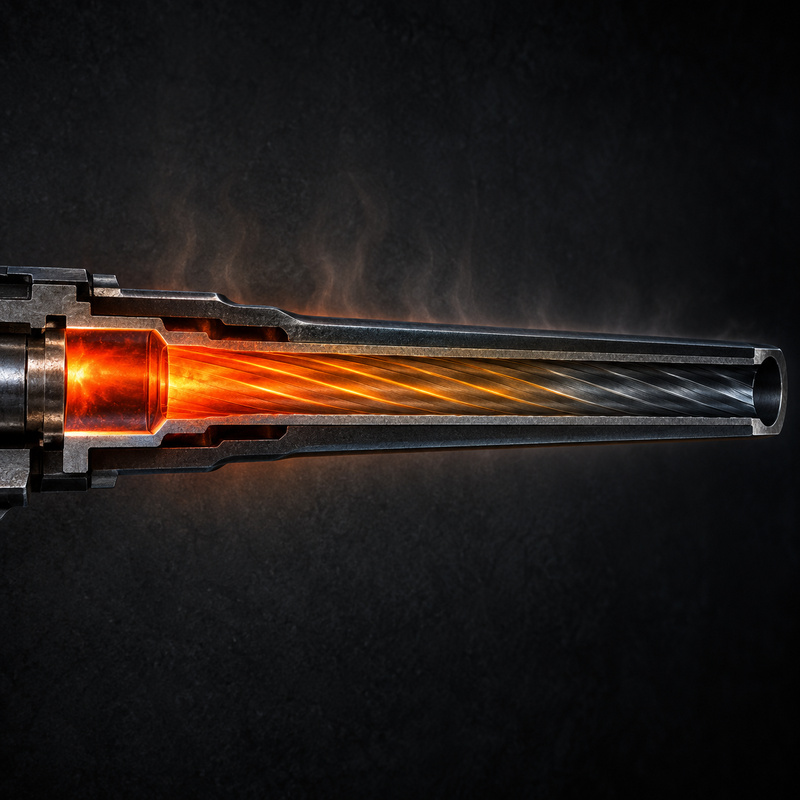
Bore heating is a natural consequence of firing. Part of the energy produced by the combustion of the powder is converted into the motion of the projectile or shot, while another part is absorbed by the bore in the form of heat.
Temperature increases especially during close-range bursts of fire. This phenomenon affects all firearms, but is particularly important for high-velocity rifles, semi-automatic weapons, and disciplines that require prolonged series of fire.
A hot barrel isn't necessarily damaged or unusable. However, excessive heating can temporarily affect accuracy, accelerate erosion of the initial rifling line, and subject the gun to more intense thermal stress.
How heat is generated during firing
When the primer ignites the powder, high-temperature, high-pressure gases form inside the cartridge chamber. These gases propel the bullet down the barrel, simultaneously transferring heat to the metal surfaces.
Heating comes mainly from:
- dust combustion and temperature of the propellant gases;
- contact of hot gases with chamber, connecting cone and barrel core;
- friction between bullet and rifling;
- mantle deformation during the commitment of the lines;
- high pressures developed in the initial stretch;
- close repetition of shots, which does not allow the metal to cool.
The greatest concentration of thermal energy generally occurs in the area immediately in front of the cartridge chamber, where pressure and temperature reach their highest values.
The temperature distribution along the barrel
The barrel heats unevenly. The chamber, the rifling cone, and the beginning of the rifling receive a particularly high amount of heat. As you move toward the muzzle, the gas pressure and temperature progressively decrease.
The rear part of the barrel therefore tends to reach higher temperatures than the area near the muzzle, even if the heat is gradually distributed through the metal by conduction.
The geometry of the barrel, the external diameter, the presence of fluting and the contact with the receiver and stock influence the way in which heat is accumulated and subsequently dispersed.
The role of rate of fire
Rate of fire is one of the most important factors. After each shot, the barrel slowly releases heat into the air and other parts of the gun. If the next shot is fired before enough heat has dissipated, the temperature continues to rise.
The phenomenon is cumulative: a rapid series can heat the barrel much more than the same number of shots spread over a prolonged interval.
The temperature reached therefore depends not only on the total number of shots, but above all on the time elapsed between one shot and the next.
Barrel profile and mass
The outer profile determines the amount of steel available to absorb heat. A heavier barrel has greater thermal mass and generally requires more shots to reach high temperatures. Once hot, however, it may take longer to cool completely.
A thin barrel heats up more quickly because it has less mass, but it can also dissipate heat more quickly when exposed to air and is not enclosed in a stock.
Lightweight barrels are an advantageous choice for hunting guns intended to be carried for long periods, while heavy profiles are often preferred in disciplines that involve more frequent shooting sequences.
Fluted barrels and heat dissipation
Longitudinal grooves, commonly referred to as fluting , increase the external surface area of the barrel and can improve heat exchange with the air. They also reduce weight compared to a cylindrical barrel of the same maximum diameter.
However, a fluted barrel should not be considered equivalent, in terms of mass and thermal behavior, to a solid heavy barrel. The heating and cooling rate depends on the interaction between residual mass, exposed surface area, flute depth, and environmental conditions.
Thermal expansion of steel
As the temperature increases, steel expands. The dimensional changes are very small, but they can be significant in a high-precision system.
Warming can temporarily change:
- diameter and length of the barrel;
- distribution of internal stresses;
- vibration frequency;
- relationship between barrel, receiver and stock;
- point of impact on the target;
- behavior of the devices applied to the muzzle.
A properly constructed barrel tends to expand evenly. Any residual stress or pressure exerted by the stock, however, can cause less predictable movements.
Heating and harmonics of the reed
During firing, the barrel vibrates in extremely rapid and complex motions, commonly referred to as barrel harmonics . The projectile leaves the muzzle while the tube is in a specific phase of these oscillations.
Heating changes the elasticity, dimensions, and stress state of the barrel. Consequently, it can slightly alter the way it vibrates, causing a shift in the point of impact or an increase in dispersion.
This behavior varies from gun to gun. Some barrels maintain regular groupings even when hot, while others exhibit a progressive opening of the pattern after a few close shots.
Moving the point of impact
During a series of shots, the shots may progressively shift from the point of impact obtained with the cold barrel. This phenomenon can manifest itself as a vertical, horizontal, or diagonal shift.
Possible causes include:
- non-perfectly uniform expansion of the barrel;
- residual stresses in the metal;
- contact of the barrel with the stock;
- variation of harmonics;
- heating of the frame and optic mounts;
- change in the internal conditions of the soul;
- thermal mirage in front of the telescope.
It's important to distinguish between repeatable shot patterning when the barrel is hot and irregular dispersion. In the former case, the weapon can maintain good accuracy while producing a group in a different location; in the latter, the shots tend to drift apart.
The cold-barrel shot
In hunting, the first shot fired with a cold barrel is particularly important , as it is often the one actually used. The point of impact of the first shot may be slightly different from that of subsequent shots fired with a warm barrel.
A hunting gun should therefore also be checked under the conditions in which it will actually be used, checking the position of the first shot after it has completely cooled down.
It is also necessary to distinguish between:
- cold and clean barrel;
- slightly contaminated cold barrel from previous shots;
- hot rod after a close series.
These conditions can produce impact points that are not perfectly coincident.
Thermal mirage
A very hot barrel heats the air immediately above it. Air currents of different temperatures alter the refraction of light and can create an unstable image when viewed through the telescope.
This effect, called bore mirage , can make the target appear to wobble, distort, or slightly shift. The shooter may therefore make aiming errors even if the mechanical accuracy of the weapon has not changed.
In precision disciplines, special anti-mirage bands can be used, mounted above the barrel without interfering with its vibrations.
Effects on projectile velocity
Barrel heating can be accompanied by variations in velocity, but there is no identical behavior for all gun-ammunition combinations.
Cartridge and propellant temperature can affect pressure and velocity more significantly than tube temperature alone. Friction, deposits, and bore condition can also contribute to differences between shots.
Ammunition left in a very hot chamber for a long time can heat up significantly. For this reason, data obtained during extended series testing must be interpreted while also considering the temperature of the cartridges.
Throat warming and erosion
Heat is one of the main causes of throat erosion , the section located in front of the cartridge chamber and at the beginning of the rifling. In this area, the gases still have very high temperatures and pressures.
Repeated heating and cooling cycles can produce microcracks, surface alterations, and progressive rounding of the rifling edges. Firing numerous rounds with an already very hot barrel generally accelerates this process.
Overheating is therefore not only a temporary accuracy problem, but can contribute to a reduction in the useful life of the barrel.
Caliber, charge and temperature
Cartridges that burn large amounts of powder relative to the barrel diameter transfer significant thermal energy to the initial stroke. High-performance calibers and those with high case capacity can therefore heat and erode the barrel more rapidly.
The heat produced by each shot depends on:
- mass and composition of the propellant;
- operating pressure;
- burning time;
- core diameter;
- weight and resistance of the projectile;
- efficiency with which energy is transformed into speed.
Two rounds of the same caliber can produce different heating if they use different propellants, pressures, or projectiles.
Heating in semi-automatic weapons
Semi-automatic weapons allow for rapid firing of multiple shots. The barrel can therefore accumulate heat quickly, especially during prolonged bursts of fire.
Some of the heat is also transmitted to the chamber, receiver, forend, and operating system components. In gas-operated weapons, the gas block is also exposed to hot gases and combustion residues.
The mechanical possibility of maintaining a high rate of fire does not mean that this is always compatible with maintaining the accuracy and durability of the barrel.
Heating in smooth pipes
Even smoothbore shotgun barrels heat up during firing. In clay pigeon shooting, where numerous rounds are fired, the temperature can become clearly noticeable.
In side-by-side and over-and-under shotguns, the barrels are joined together using ribs and welds. Thermal expansion can temporarily affect the overall performance, especially when one barrel is used more frequently than the other.
In smoothbore semi-automatics, the temperature rise depends on the firing rate, the weight of the loads, and the operating system. The forend can also heat up due to conduction and gas action.
Cane materials and treatments
Steel characteristics and surface treatments influence wear resistance, corrosion, and thermal behavior. Internally chrome-plated, nitrided, or specially formulated steel barrels can offer greater resistance under certain operating conditions.
These treatments, however, do not prevent the barrel from heating up. They can improve the resistance of the surfaces, but the amount of heat absorbed depends primarily on the energy generated, the mass of the barrel, and the rate of fire.
Carbon fiber coated rods
Some modern rods use a metal core covered with carbon fiber composite materials. The goal is to achieve high rigidity while limiting overall weight.
Thermal behavior depends on the structure of the coating, the resin, the orientation of the fibers, and the way the composite transfers heat from the core to the outside. Therefore, not all carbon-coated rods have the same characteristics.
The presence of the composite does not make the rod immune to overheating and the manufacturer's instructions must always be followed.
Influence of environmental conditions
Heat loss also varies depending on the environment. Outside temperature, wind, sun exposure, and ventilation all affect the rate at which the barrel cools.
A breeze promotes heat exchange, while a warm, windless day slows cooling. Even a reed left in the sun can start at a temperature significantly higher than ambient.
In rainy or extremely cold conditions, cooling may be more rapid, but sudden temperature changes should not be artificially induced.
How to promote barrel cooling
The simplest and safest method is to stop firing and let the weapon cool naturally under safe conditions.
During a shooting session you can:
- reduce the frequency of strokes;
- alternate short sets and adequate breaks;
- keep the action open when permitted and safe;
- place the unloaded weapon in a position that promotes ventilation;
- avoid leaving cartridges in the hot chamber;
- protect the weapon from direct exposure to sunlight;
- follow the manufacturer's limits and instructions.
It's not recommended to suddenly cool a very hot barrel with water, snow, ice, or coolants. A rapid temperature change can create unwanted stresses, promote corrosion, or damage finishes and other components.
How to evaluate the temperature
Simply touching the rod with your hand isn't a reliable system and can pose a risk of burns. A rod can reach high temperatures even when its external appearance shows no change.
For technical checks, infrared thermometers, contact sensors, or suitable thermochromic strips can be used. The surface temperature doesn't necessarily coincide with the throat temperature, but it allows for more repeatable comparisons between different firing series.
When to stop shooting
There is no universal maximum temperature applicable to every firearm. The limit depends on the construction, material, barrel profile, ammunition, and manufacturer's specifications.
However, it is prudent to stop the series when:
- the barrel has become excessively hot;
- an evident thermal mirage appears;
- the point of impact begins to move;
- dispersion increases abnormally;
- dipstick or other parts become difficult to handle;
- you notice unusual odors, smoke, or behavior;
- The manufacturer provides specific pauses between series.
Heating the barrel and hunting use
In normal hunting, the number of consecutive shots is often limited, and overheating tends to be less of a concern than in target shooting. However, the point of impact with a cold barrel, the stability of the zeroing, and the behavior of the gun after any close-range shots remain important.
For a hunting rifle, it is therefore more useful to know the position of the first shot and of the few subsequent shots than to evaluate long series fired with a very hot barrel.
A balance between precision, weight and durability
Barrel heating depends on the balance between the energy absorbed with each shot and the energy dissipated into the environment. Rate of fire, caliber, profile, material, and external conditions determine the rate at which the temperature increases.
Properly managing your pauses allows you to maintain more consistent shooting conditions, limit point-of-impact shifts, and slow throat erosion. Allowing the barrel the necessary time to cool is one of the simplest precautions for maintaining the accuracy, reliability, and durability of your firearm.