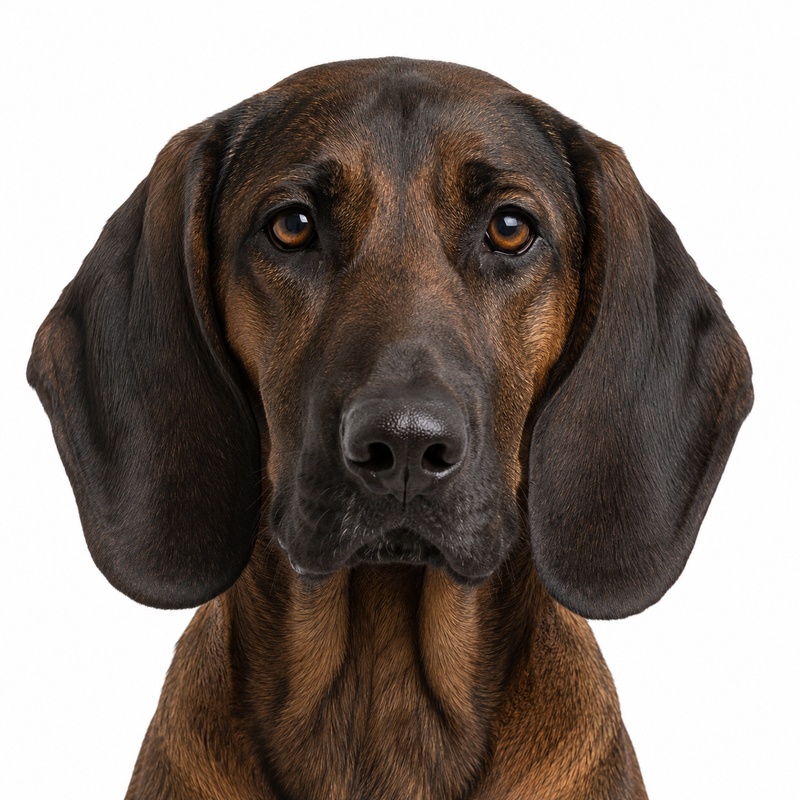
The Hanoverian Hound (Hannoverscher Schweißhund) is one of the oldest and most specialized European dogs for searching for wounded game by scent . It is a German breed built around an extremely precise function: to calmly, concentratedly, and persistently follow a difficult scent, even many hours after the wound, until reaching the animal and allowing it to be recovered.
It is therefore not a hound primarily intended for tracking healthy game. Its true identity is that of a tracking dog , used primarily on ungulates such as red deer, roe deer, fallow deer, and wild boar. The work requires great olfactory ability, composure, endurance, and above all an extraordinary ability to distinguish the correct scent from the numerous odors present on the ground.
The FCI standard explicitly defines it as a highly specialized dog for retrieving wounded game and requires it to possess the hunting skills necessary to tackle even the most difficult searches. For centuries, the breed's selection has therefore been oriented primarily towards performance in the field.
The Hanoverian Hound is a medium-sized, sturdy, muscular dog, relatively short-limbed. This build is no accident: a dog that works for hours with its nose close to the ground should not have excessively long limbs. Its deep chest, powerful muscles, and economical stride allow it to sustain long searches without losing accuracy.
Temperament is equally functional. The standard describes a calm, confident dog, sensitive with its handler and reserved with strangers , endowed with great concentration while working and strong loyalty to the hunter who leads it.

Hanoverian Hound: breed data sheet
| Italian name | Hanoverian Hound |
| Official name | Hanoverian Hound |
| English name | Hanoverian Scent Hound |
| country of origin | Germany |
| FCI Code | 213 |
| FCI Group | Group 6 – Scenthounds and related breeds |
| Section | 2 – Dogs for blood tracking |
| Test of work | Yes |
| Use | Search for the wounded wild animal on a blood trail |
| Male height | 50-55 cm at the withers |
| Female height | 48-53 cm at the withers |
| Male weight | 30-40 kg |
| Female weight | 25-35 kg |
| cloak | Short, thick, rough or relatively hard |
| Colour | From light deer red to dark red, more or less brindle, with or without mask |
| Temperament | Calm, confident, focused, sensitive and reserved |
| Main attitude | Traces of blood on wounded ungulates |
Origin and history of the Hanoverian Hound
The history of the Hanoverian Schweißhund is very ancient and can be traced back to the so-called Leithunde , or hunting dogs, used as early as the Early Middle Ages to track large game. The FCI standard recalls how these dogs, belonging to the ancient Germanic Bracken group, played an important role in the hunting practices of the Germanic peoples as early as 500 AD.
With the introduction of firearms, big game hunting changed radically. The challenge was no longer simply to locate and approach the animal, but also to find the wounded game after the shot . The old limpie had exactly the right qualities: a great nose, methodical slowness, the ability to work on a leash, and intense concentration on the trail.
From this function, the German-blooded hunting dog gradually developed. A fundamental role in the modern definition of the breed was played by the Jägerhof of Hanover , the hunting administration of the Kingdom of Hanover, which developed and maintained consolidated methods of selecting and training dogs.
Since 1894, the breed has been managed by the Verein Hirschmann e.V. , a specialized association that has maintained a strong selection oriented towards working performance. The FCI standard emphasizes that since then, breeding has continued to be conducted with particular attention to hunting ability and that these dogs are primarily used as specialists in the search for wounded large game.
A dog built to work with its nose close to the ground
The Hanoverian Hound's appearance is closely linked to its function. It is a medium-sized dog, very robust, well-proportioned, and strongly muscled. The standard emphasizes that the fore and hind limbs must allow for prolonged work without fatigue, and considers excessively long limbs undesirable, precisely because they would make working with the nose low on the trail more difficult.
The body is noticeably longer than it is tall, with an indicative length to height ratio of approximately 1,4:1 . This also promotes stability, slow progression and great balance when searching.
The chest is deep and roomy, allowing for ample breathing capacity. During a demanding search, the dog can work for many hours, navigating woods, slopes, and difficult terrain without losing concentration.
The overall impression should therefore not be that of a light and very fast hound, but of a resistant and methodical specialist.
Head and expression
The head is broad, strong, and very distinctive. The slightly wrinkled forehead and dark eyes give the breed the typical serious, focused expression , expressly recalled by the FCI standard.
The skull is broad and slightly rounded, while the stop is generally well pronounced, especially in males.
The nose is broad, predominantly black, and has very open nostrils. The muzzle is strong, deep, and broad, with a robust jaw.
The lips are broad and pendulous, a characteristic that contributes to the typical appearance of the German tracking dog.
The dentition is complete, with 42 teeth, and the standard allows a scissor or pincer bite.
Ears, neck and chest
The ears are of medium length, set high and wide, hanging close to the head and rounded at the tip.
The neck is long, strong, and gradually widens toward the chest. A certain amount of skin in the throat area is permissible and may form a slight dewlap.
The chest is deep and roomy rather than excessively wide, a solution particularly consistent with a dog intended for resistant and continuous work.
The thoracic system must allow for effective breathing even during long and demanding searches.
Arts and movement
The limbs should be strong and muscular, but not excessively long. The forelegs are straight and set well under the body, while the hindquarters are strong and correctly angulated.
The feet are compact, with well-knit toes, strong nails and large, resistant pads.
The standard specifies that the Hanoverian Hound must be capable of using all gaits, but in working the walk and canter are particularly important.
Speed, however, is not the primary objective. A tracking dog must be able to proceed slowly enough to analyze every emanation without passing the point where the trail changes direction.
Coat and color
The coat is short, dense, and relatively harsh . It may be slightly longer and harsher on the back of the thighs and on the tail.
The base color is one of the most typical characteristics of the breed. It can range from light deer red to dark red and feature more or less intense brindling, sometimes producing subjects with an almost black appearance.
A dark mask may or may not be present.
A small white spot on the chest is tolerated, but does not naturally represent the typical color.
The dark and inconspicuous shade is perfectly consistent with a dog that works in the woods and hunts big game.
Personality: calm, focused and very strong bond with the handler
The standard describes the Hanoverian Hound as a dog with a calm and confident temperament , at the same time sensitive towards its handler and selective with strangers. :contentReference[oaicite:14]{index=14}
This reserve shouldn't be interpreted as shyness. The right person is stable, observant, and self-confident.
The key characteristic is the ability to concentrate. While working, the dog must ignore most distractions and maintain focus on the assigned trail.
The bond with the handler is particularly deep because the search is often carried out in close collaboration, with the dog connected via the long tracking strap.
The standard also emphasizes a strong loyalty to the hunter who leads it.
The meaning of “Schweißhund”
The German term Schweißhund doesn't simply mean "hound." In German hunting parlance, Schweiß refers to the blood of wounded game.
The Schweißhund is therefore literally a blood-tracking dog , but its work does not consist of following only visible blood.
A difficult trail may, in fact, show very little blood or even no visible signs for long stretches. The dog must then use the entirety of the animal's emanations: body odor, secretions, footprints, trampled vegetation, and tiny traces impossible for humans to perceive.
It is precisely this ability that allows a true tracking dog to continue when the hunter no longer has any visible indications.
The search for wounded game: the true function of the breed
The Hanoverian Hound is primarily used after a wounded ungulate. Work begins at the site where the animal was injured or where the first signs were detected.
The dog must carefully analyze the spot and locate the correct trail . In a forest frequented by many animals, this can be extremely difficult.
Once the trail is set, the dog proceeds calmly and with great concentration. The handler follows, maintaining a long tracking leash, avoiding unnecessary interference.
The search can last a few minutes or many hours and can extend for miles.
A truly experienced subject must be able to continue even when the track crosses forest roads, waterways or areas traveled by other ungulates.
The cold trail
One of the points that distinguishes a great tracking dog from a simple dog with a good nose is the ability to work on a track that is many hours old.
As time passes, the emanations change, they are dispersed by the wind, altered by the rain and superimposed on those of other animals.
The dog must then proceed methodically and distinguish increasingly weaker information.
The Hanoverian Hound was selected precisely for this type of difficulty.
A search conducted the day after the injury can be much more challenging than one started a few minutes later, but in some situations waiting is necessary to avoid further challenging a still mobile animal.
The importance of the Anschuss: the point of the blow
In the Central European tradition, research begins with a careful analysis of the Anschuss , that is, the point at which the game is believed to have received the blow.
Blood, hair, bone fragments, organic material, footprints, or marks on vegetation may be present here.
A dog's behavior can provide important information, but interpretation must be entrusted to an experienced handler.
Leaving without having correctly identified the starting point can lead the dog to follow a different animal and compromise the entire search.
The work of the duo is therefore born from the integration between human reading of signs and the dog's olfactory capacity.
The track belt
The Hanoverian Hound traditionally works attached to the handler by a long strap.
The leash isn't just for restraining the dog. It's a true communication tool.
The conductor must learn to perceive variations in tension, changes in direction, hesitations and accelerations.
Excessive traction can disrupt the scent work, while leaving the strap completely uncontrolled can create problems among vegetation and obstacles.
Correct management therefore requires experience and great sensitivity.
Concentration on the correct track
One of the most difficult problems in the research is the intersection with the tracks of other healthy animals.
A wounded deer may cross an area that other deer have passed through just a few hours later. The more recent track may be more obvious to the dog by smell, but it's not the one the dog should follow.
The Hanoverian Hound must possess a strong ability to stay on the track , that is, to continue working on the assigned animal without being diverted.
This quality comes from genetic predisposition, experience and training.
The work on the Deer
The red deer represents one of the species most closely associated with the Hanoverian Hound tradition.
A large, wounded deer can travel considerable distances and traverse complex terrain.
The size of the animal, the type of wound and its behaviour after the blow can determine very different traces.
The dog must maintain concentration even when the search becomes long.
The physical robustness of the Hanoverian Schweißhund is particularly useful in this context.
Search for the wounded wild boar
The wild boar represents a particularly delicate situation because an injured animal can be extremely dangerous.
The initial phase is generally approached on a leash, with great caution and carefully evaluating the dog's behavior.
When game is close, the Hound may show obvious changes in behavior: increased tension, increased emanation and a different working pace.
The search must not be improvised. The handler must be well-versed in the breed's reactions and always prioritize the safety of the dog and others.
Hannover's determination becomes precious, but it must be accompanied by discipline and control.
Roe deer and other ungulates
The Hanoverian Hound can of course also be used in the search for roe deer, fallow deer, mouflon and other ungulates.
The difficulty doesn't necessarily depend on the animal's size. A roe deer hit in a non-immediately lethal manner can leave an extremely poor trail and travel a considerable distance.
The dog must maintain accuracy even when visible signs become almost non-existent.
Versatility on ungulates comes from the ability to work not on a particular species, but on the individual emanation of the wounded game.
When the wild animal is still alive: from attack to recovery
A search can end with the animal being found already dead, but it can also lead to a still-living wild animal.
In these situations, the dog must change its behavior and move from methodical search to managing a dynamic situation.
The handler must assess whether it is possible to approach and complete the recovery quickly while respecting the rules and safety.
An effective tracking dog must not simply catch up to the animal: it must allow the handler to conclude the search in an orderly and responsible manner.
Puppy training
Training the Hanoverian Hound must begin by developing rapport, recall, and environmental confidence . A puppy destined for tracking must learn to move calmly in the woods, cross different surfaces, and maintain attentiveness toward the handler.
The first artificial trails should be short and simple. The goal isn't to immediately test the dog, but to help him understand the principle of the work.
The length, age of the track, changes in direction and presence of distractions are progressively increased.
Rushing is one of the most common mistakes. A young dog exposed to overly difficult tracks too early can learn to work superficially or lose confidence.
Artificial tracks and blood training
Artificial trails are used to build method and concentration. They can be prepared with controlled quantities of blood and other odorous elements.
Over time, the amount of visible material is progressively reduced.
The real goal is not to teach the dog to “follow the blood”, but to maintain a precise olfactory line.
A track that's too packed can push a young person to work quickly and sloppily. Proper progression, however, should reward slowness, precision, and the ability to self-correct.
The right speed is the one that allows you not to make mistakes
In the Hanoverian Hound, speed is not a virtue in itself.
A dog moving too quickly may overshoot a turnoff, lose the trail, and begin working on different emanations.
The expert subject instead learns to maintain a pace compatible with the difficulty.
When the emanation is strong, it can proceed more quickly; when it becomes weak, it slows down and analyzes the terrain.
The fundamental quality is therefore sustainable precision , not spectacular gait.
The role of the conductor
The Hanoverian Hound doesn't work alone. The quality of the search depends greatly on the handler.
The latter must be able to read the terrain, interpret signs, know the behavior of wild animals and above all trust the dog when human information runs out.
One of the most common mistakes is correcting the dog just because it takes a different direction than the hunter imagined.
If the subject is experienced and truly on the trail, his nose has information that humans cannot access.
Proper management is therefore a constant balance between control and trust.
Hanoverian Hound and Bavarian Hound
The comparison with the Bavarian Mountain Hound (Bayerischer Gebirgsschweißhund) is inevitable, because both breeds belong to the great German bloodhound specialists.
The Bavarian Hound was developed from the Hanoverian Hound, crossed with lighter mountain hounds to produce a dog better suited to difficult Alpine terrain. The ENCI (Italian National Dog Association) notes that the Hanoverian Hound was too heavy for some mountainous terrain, and that its crossbreeding with lighter dogs gradually gave rise to the Bayerischer Gebirgsschweißhund. :contentReference[oaicite:16]{index=16}
| Feature | Hanoverian Hound | Bavarian Hound |
|---|---|---|
| Structure | More robust and heavier | Lighter and more agile |
| Ideal terrain | Woods, plains, collinand mixed soils | Mountain and very rough terrain |
| Weight | Greater | Lower |
| Functional origin | Ancient German blood trail specialist | Derived from the Hanoverian for mountain work |
| Style | Powerful, methodical and very resistant | More agile and lighter |
It's not a question of establishing which is better, but of understanding which structure is best suited to the area and the type of work.
Hunting merits of the Hanoverian Hound
- Exceptional specialization on the blood trail.
- Great ability to concentrate even during very long searches.
- Excellent physical resistance.
- Strong fidelity to the track and ability to ignore distractions.
- Good ability to work on cold tracks.
- Calm and confident temperament.
- Strong bond with the host.
- Robust structure suitable for large game and long retrieves.
- Great reliability on wounded ungulates.
Things to consider before choosing a Hanoverian Hound
The Hanoverian Hound is a highly specialized breed and should not be chosen simply for its appearance.
It requires real work, training, and a handler interested in the scent . Its concentration and olfactory heritage find full expression especially through use consistent with the original selection.
The robust structure may be less suitable than the Bavarian in extremely steep mountainous terrain.
Their strong reserve also makes proper socialization important in the first few months.
Those looking for a general companion dog or a fast hound for hunting in packs should look at different types.
Daily life and relationship with family
Outside of work, the Hanoverian Hound can display a surprisingly calm demeanor. It's not normally a frenetic dog and tends to develop very strong relationships with those it cares about.
With strangers he can be reserved and selective , a characteristic foreseen by the same standard.
However, he needs regular exercise and, above all, olfactory stimulation. A simple walk doesn't fully utilize his mental abilities.
Artificial trails, search exercises and field work are particularly appropriate activities.
After-work care and management
The short coat requires relatively little maintenance, but after a long search it is important to carefully check the feet, pads, ears, eyes and skin.
Thorns, brambles, foxtails and small debris can create problems, especially when the dog is walking through thick vegetation.
Bearings should be checked after long rides on stony or hard ground.
It is also essential to ensure proper hydration and recovery after particularly prolonged searches.
The Hanoverian Hound in the Hunting Encyclopedia
The Hanoverian Hound is one of the clearest examples of how hunting selection can transform a dog into an almost absolute specialist . It is not born to outrun the game, nor to find healthy animals before the hunter: its task begins precisely when the hunt seems to have ended badly.
A stricken ungulate can disappear into the woods without leaving a visible trace. A few meters of blood can become a single drop, then nothing. From that moment on, the person gradually loses the ability to interpret what happened.
This is where the Hanoverian Schweißhund comes in. The dog doesn't simply search for visible blood: it searches for the animal . It uses a set of olfactory information that remains completely invisible to the handler and connects it along a trail that can be hours old.
The very structure of the breed speaks to this work. The body is long and robust, the limbs are not excessively high, and the chest is deep. Everything is built to allow the dog to walk with its nose close to the ground and maintain concentration for long periods. The FCI standard, in fact, considers excessively long limbs atypical precisely because they hinder this type of work.
Temperament also plays a role. A nervous, overly impulsive, or easily distracted dog would have great difficulty on an old trail traversed by dozens of animals. The Hanoverian Hound, on the other hand, must be calm, confident, and deeply focused.
The relationship with the handler is different from that found with many other hunting dogs. The long harness creates a continuous physical connection, and the hunter must learn to read the dog almost as well as the dog reads the scent. A slowdown, a sudden acceleration, or a change in head position can provide valuable information.
The real challenge comes when a trail is crossed by another ungulate. The new trail may be much more intense, but the dog must ignore it and continue on the assigned one. This loyalty to the trail is one of the most important qualities of a truly good Schweißhund.
The breed also played a fundamental historical role in the formation of the Bavarian Hound. When the sturdy Hanoverian proved too heavy for some difficult mountain terrain, it was used as the basis for developing a lighter and more agile dog, today known as the Bayerischer Gebirgsschweißhund. :contentReference[oaicite:19]{index=19}
For the ungulate hunter, however, the most important function remains ethical as well as technical. A flawed shot can result in a wounded animal that would otherwise be unrecovered. Having a properly trained tracking dog dramatically increases the chances of finding it and completing the hunt responsibly.
For this reason, the Hanoverian Schweißhund should never be judged simply by its beauty, color, or elegance. Its true quality is measured on the ground, often many hours after the shot, when the visible trail has disappeared and only the dog's nose, experience, and concentration can indicate where the game actually passed.
The Hanoverian Hound is therefore the great bloodstalk specialist: an ancient, robust and methodical dog in which centuries of selection have transformed its sense of smell, calmness and perseverance into one of the most refined tools for the responsible recovery of wounded big game.