The Tyrolean Hound , known internationally as the Tiroler Bracke , is a hound originally from the Austrian Alps, bred to work with great endurance and autonomy in mountainous terrain. Part of the Central European hound tradition, it is distinguished by its keen sense of smell, its distinctive call when chasing, its ability to follow difficult tracks, and its remarkable adaptability to wooded and rugged terrain.
Its traditional use primarily includes hunting hares and foxes , along with the search and recovery of wounded ungulates, a particularly important task in Alpine hunting culture. It is a medium-sized dog, solid but not heavy, with a short, thick coat, built to face long working days in environments where slopes, snow, rocks, and vegetation require physical endurance and great surefootedness.
The Tyrolean Hound should not be confused with a pointing dog or a scenthound specialized exclusively for tracking blood. Its identity is that of a tracking hound, also capable of searching for wounded game . This dual purpose makes it particularly interesting for understanding the hunting tradition of the Alpine regions, in which the dog must combine passion, scenting ability, independence, and reliability.

Tyrolean Hound: technical data sheet
| Italian name | Tyrolean Hound |
| Original name | Tyrolean Bracke |
| country of origin | Austria |
| FCI Standards | 68 |
| FCI Group | 6 – Hounds and bloodhounds |
| Section | 1.2 – Medium-sized hounds |
| Test of work | Expected |
| Use | Scent hound for hunting hares and foxes; searching for wounded ungulates |
| Male height | 44–50 cm at the withers |
| Female height | 42–48 cm at the withers |
| Construction | Medium, robust, muscular and functional |
| cloak | Short, thick, with undercoat |
| Colors | Red and black and tan, with small white markings permitted. |
| Temperament | Balanced, passionate, persevering and autonomous |
| Main skills | Followed, tracked, search for the wounded game |
| Ideal environment | Mountain, forest, collinand rough terrain |
Origins and history of the Tyrolean Hound
The Tyrolean Hound belongs to the Bracken tradition , the Central European hounds used for centuries for scent-based hunting. Its origins can be traced back to ancient Alpine hounds, developed in an area where hunting required dogs capable of working independently, keeping a trail even in difficult conditions, and signaling their position by voice.
Historical evidence links the presence of these dogs to the hunting tradition of Tyrol, already important in the Middle Ages. Emperor Maximilian I of Habsburg , who lived between the 15th and 16th centuries, is also remembered for his interest in hunting in the Alpine regions and for the use of hounds in these territories.
Modern selection of the breed took shape in the second half of the 19th century. Around 1860, a more systematic breeding of Tyrolean Hounds began, while the first standard was defined in 1896. Official recognition in Austria dates back to 1908.
Originally, there were different types, also related to size and coloring. Subsequent selection helped standardize the breed and consolidate its functional characteristics. The modern Tyrolean Hound still retains the structure and temperament of a dog developed primarily for work, rather than for aesthetic needs.
Morphology: A hound built for the mountains
The Tiroler Bracke has a solid, harmonious, and slightly elongated build . Its medium size represents a particularly effective compromise between strength, endurance, and agility: the dog must have enough substance to cope with difficult weather conditions, but must not be so heavy as to compromise mobility on slopes.
The body is muscular, with a straight and strong back, a deep chest, and well-developed ribs. The loins must ensure good transmission of power, while the croup is sufficiently long and muscular. The underline has a moderate rise towards the belly, without the excessive tuck-up typical of some very fast breeds.
This structure allows the dog to maintain a steady pace for extended periods. In tracking work, speed isn't the only thing that matters: the ability to maintain a consistent performance even after hours of searching , overcoming uneven ground and changes in elevation, is crucial.
Head, nose and ears
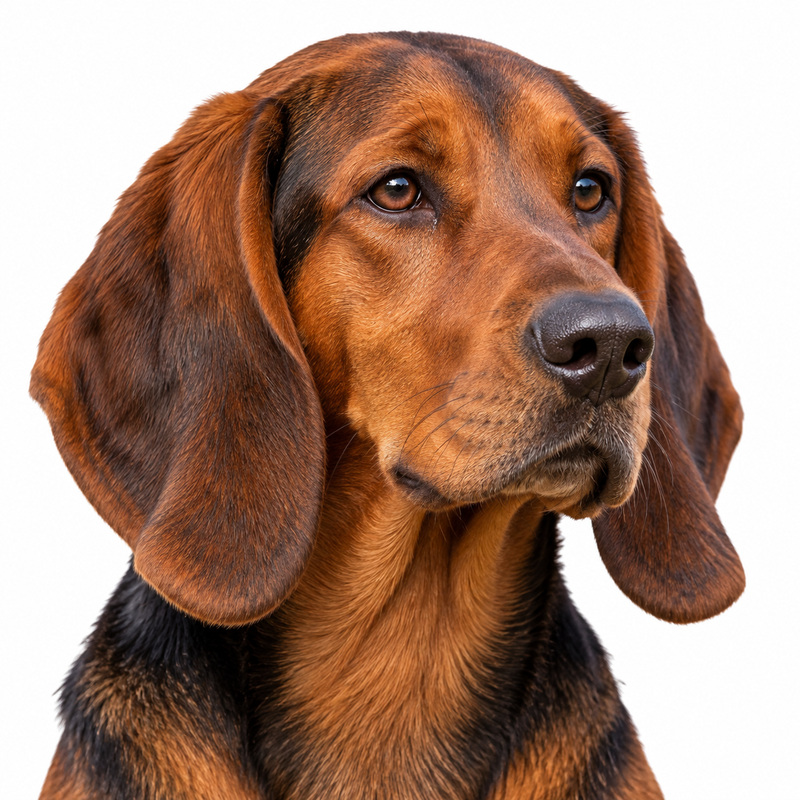
The head is proportionate to the body, with a moderately broad skull and a sufficiently developed muzzle. The stop is evident but not excessively marked. The nose is black and has well-open nostrils, while the jaws are robust and the dentition must be correct.
The eyes are dark brown, with an intelligent and attentive expression. The ears are large, set high, pendant, and rounded at the tips. They should fit properly on the head without appearing disproportionate.
Limbs, feet and movement
The legs are strong, lean, and correctly angulated. The hindquarters develop effective propulsion, while the forequarters must ensure stability even on descents and during sudden changes in direction.
The feet are compact, with tightly packed toes and tough pads . This characteristic is particularly important in Alpine terrain, where the dog encounters rocks, roots, gravel, frozen ground, and uneven surfaces. The gait must be smooth, regular, and functional, with good economy of effort.
Coat and colors
The Tyrolean Hound's coat is short, dense, and has an undercoat . The coat should protect the dog from cold, rain, and vegetation without becoming excessively long or cumbersome. This characteristic directly reflects the environment in which the breed was developed.
The standard allows two main colors:
- Red: in various shades from deer red to the most intense red, with possible nuances and small white markings in the permitted areas.
- Black and tan: black coat with well-defined markings, generally red or tawny in tone, distributed according to the characteristic type of the breed.
Small white markings are permitted, particularly on the chest and other areas specified in the standard. However, color should not be considered an indicator of hunting ability: what distinguishes a good Tyrolean Hound remains the combination of health, build, nose, voice, and perseverance.
Character and temperament
The Tyrolean Hound is a passionate, intelligent, balanced dog with remarkable independence . While hunting, it displays a strong motivation to follow the trail and can maintain concentration even when the game crosses difficult terrain or temporarily interrupts its scent.
Independence is a necessary quality for its work. A mountain hound can wander out of sight of its handler and must be able to make decisions without constant direction. This autonomy, however, requires careful training to prevent it from becoming difficult to recall or manage.
In daily relationships, the Tiroler Bracke can be affectionate and stable, especially when living in an environment that offers exercise, olfactory activity, and a constant relationship with its owner. However, it is not a dog suited to a purely sedentary lifestyle: its hound nature leads it to constantly seek out olfactory stimuli and opportunities for exploration.
The sequel: the fundamental work of the Tiroler Bracke
The Tyrolean Hound's main specialization is tracking the scent left by game . Unlike the pointing dog, which primarily seeks to locate the animal through its scent and freeze in its presence, the Hound uses its sense of smell to reconstruct the animal's path and track moving game.
The work involves several phases. The dog must locate a useful trail, recognize its direction, follow it through any changes in the terrain, and maintain olfactory contact during the chase. When the trail is interrupted, it must be able to conduct a methodical search to find it again.
One of the dog's distinguishing features is its bark during tracking . A properly selected hound uses its bark to signal the progress of the action, allowing the hunter to interpret the location and progress of the hunt even from a distance. The bark must be linked to actual olfactory activity and not simply to excitement.
Search for the past and matching
The initial phase requires attention and the ability to distinguish fresh tracks from less significant ones. The Tyrolean Hound must identify the game's path and follow it methodically, avoiding wasting energy on disjointed scents.
The work becomes particularly complex when the trail crosses scree slopes, streams, forest roads, or areas frequented by other animals. In these situations, experience, concentration, and the ability to independently resolve difficulties come to the fore.
Chase and voice
When the game is set in motion, the dog must maintain a constant pursuit, using its voice to signal the action. The speed must be compatible with the ability to correctly follow the scent: a dog that is too hasty can frequently lose scent contact, while an excessively slow dog may be less effective at maintaining pressure on the game.
The Tyrolean Hound must therefore express passion, perseverance and precision , qualities more important than speed alone.
The hare hunt
The hare is traditionally one of the most important game for the Tyrolean Hound. Hunting it requires a highly developed sense of smell and, above all, a remarkable ability to interpret complex scents, as the hare uses sudden changes in direction, returns, and movements to elude pursuit.
The dog must initially locate the animal's trail and reconstruct its path. As it approaches, it may encounter overlapping tracks and areas where the scent is weak or disturbed. Once the scent has been located, tracking becomes more dynamic and requires continuity, voice, and the ability to resolve lost scents.
In the territories collinThe difficulty increases further in the mountains and fields. The terrain can be dry, rocky, covered in leaves, or characterized by dense vegetation. A good Tiroler Bracke must be able to adapt his work to these conditions, without easily abandoning a difficult trail.
The quality of the hound is therefore measured in its ability to reconstruct the hare's path with precision and perseverance , not simply in the speed with which it crosses the territory.
Fox hunting
The fox is another traditional game animal of the breed. Its behavior requires a hound capable of keeping track through woods, slopes, and uneven vegetation, adapting to often rapid movements and sudden changes in direction.
The Tyrolean Hound must possess sufficient determination to track elusive game, but also the poise to avoid turning its hunting passion into a chaotic pursuit. The dog's voice allows the handler to follow the action, while the ability to recover a lost trail is crucial.
When working with foxes , courage, endurance, autonomy, and a precise sense of smell are key . The methods of use must, of course, comply with the hunting regulations in force in the area concerned.
The Tyrolean Hound and the search for wounded ungulates
In addition to traditional tracking, the Tiroler Bracke has a recognized aptitude for tracking wounded ungulates . This function is particularly important in Alpine regions, where retrieving a wounded animal can require long journeys through forests, slopes, and rough terrain.
The dog must learn to follow a single scent with concentration, distinguishing it from the numerous emanations present in the environment. Unlike tracking a hare, when searching for the injured animal, the goal is not to develop a rapid pursuit, but to precisely reconstruct the animal's path, avoiding losing the useful scent.
This work can be done on a long tracking leash , following the techniques established in retrieval dog training. Controlled guidance allows for methodical handling and limits the risk of unnecessarily disturbing other animals.
It is important to distinguish this aptitude from the specialization of dogs belonging to the FCI section of bloodhounds, such as the Bavarian Mountain Hound and the Hanoverian Hound. The Tyrolean Hound remains classified among the medium-sized hounds , although it can also be effectively trained to search for wounded game.
Work on roe deer and other ungulates
In Alpine hunting, roe deer play an important role in the search and recovery of wounded animals. The Tyrolean Hound can use its scent to track a wounded animal, even when it is passing through dense vegetation or very uneven terrain.
The ability to maintain focus on a single scent is particularly important in areas frequented by numerous ungulates. The dog must learn not to abandon the useful path to follow fresher scents that are unrelated to the task.
The same predisposition can be leveraged when searching for other ungulates, according to the training received and applicable regulations. Handling injured animals, especially when they may be dangerous, requires trained handlers, appropriate procedures, and particular attention to the dog's safety.
Working in the mountains: resistance and adaptability
The Alpine terrain represents the environment that best explains the morphology and temperament of the Tyrolean Hound. The dog must cope with slopes, scree, steep woods, snow, humidity, and climatic variations , while maintaining its ability to orient itself and sense of smell.
In these environments, speed alone is not enough. Tracking requires endurance, balanced movement, and the ability to manage effort. A dog that moves too quickly can quickly tire or lose the trail in more complex passages.
The thick coat offers useful protection against cold temperatures, while the muscular build and compact feet contribute to safety on rough terrain. The medium size is an advantage because it allows it to combine strength and agility without excessive body weight.
The good Tyrolean Hound must therefore be considered an endurance athlete specialized in olfactory work , capable of facing challenging environments without losing method and concentration.
Training of the Tyrolean Hound
Training must respect the nature of the hunting dog. The young Tiroler Bracke has a strong predisposition to following scents and requires controlled opportunities to develop this ability. At the same time, a good relationship with the handler, recall, and independent management must be developed.
The puppy's first experiences
During the first few months, it's important to encourage socialization and exposure to different environments. The puppy should gradually encounter woods, meadows, uneven terrain, and different surfaces, always in safe conditions.
The first olfactory activities can be simple and brief, enhancing the ability to search for and follow a scent without introducing excessive difficulty. The goal is to develop curiosity, confidence, and motivation.
Track education
Preparing for a follow-through requires a gradual approach. The young person must learn to follow a useful trail, maintain concentration, and not abandon the task at the first sign of difficulty. The complexity can increase progressively through changes in terrain, the aging of the trail, and the presence of distractions.
Recovering injured ungulates requires specific training, distinct from standard tracking. The dog must learn to work methodically, often on a long leash, maintaining focus on a single trail.
Recall and connection
One of the most delicate aspects concerns recall. The Tyrolean Hound can concentrate intensely on a scent and become unresponsive to external stimuli. For this reason, it's essential to develop a strong recall before the dog develops significant hunting autonomy.
Management should be based on progressive exercises, consistent reinforcement, and controlled situations. The use of location systems can contribute to safety, but it is not a substitute for the handler's education and training.
Tyrolean Hound and other hound breeds
Comparison with other European hounds allows us to better understand the characteristics of the breed and its place in hunting dog breeding.
| Razza | Origin | Distinguishing features |
|---|---|---|
| Tyrolean Hound | Austria | Followed by hare and fox, alpine resistance and aptitude for recovery |
| Austrian Black and Tan Hound | Austria | Medium-sized hound, known for working on difficult tracks |
| Italian Hound | Italy | Great tradition in hare following, with characteristic voice and style |
| Bavarian Mountain Hound | Germany | Specialist in the search for injured ungulates |
| Hanoverian Hound | Germany | Blood track specialist, heavier in build |
| Westphalian Dachsbracke | Germany | Low-limbed hound, suited to tracking game in difficult environments |
The Tyrolean Hound's main distinctive feature is its combination of traditional tracking and mountain working ability . Compared to hounds specialized in retrieving wounded ungulates, it retains a more pronounced identity as a game-tracking dog, while compared to other hare hounds, its selection is strongly influenced by the needs of the Alpine region.
Dog health, nutrition and care
The Tyrolean Hound is a hardy and generally hardy breed, but working in the mountains requires adequate physical preparation. Before the hunting season, it's a good idea to gradually increase the duration and intensity of your outings, avoiding subjecting an untrained dog to long days on challenging terrain.
Your diet should be proportionate to your workload, age, and physical condition. During the busiest days, proper hydration , adequate breaks, and temperature control are essential, even in cold weather.
The short coat requires relatively simple maintenance, but the paws, pads, ears, and skin should be checked after every outing. In woods and meadows, it's important to check for ticks, thorns, foxtails, and small injuries. Working on rocks can also cause abrasions to the pads, while snow and ice can cause irritation between the toes.
When choosing a puppy, it is advisable to evaluate the health of the breeders, their temperament and working qualities, favouring breeders that maintain a truly functional selection.
Family life and daily management
Outside of hunting, the Tyrolean Hound can be a well-balanced and affectionate dog, but it still has a strong need for exercise and olfactory stimulation. Simply offering ample outdoor space isn't enough: the dog needs to explore, use its nose, and maintain an active relationship with its owner.
Living with other animals requires proper socialization, especially considering their natural predisposition to chasing. Recalling and safe handling are particularly important even during non-hunting walks, because an interesting trail can quickly trigger chasing behavior.
The ideal owner is an active person, aware of the needs of a hound and willing to dedicate time to training and scent work. The breed is particularly suitable for those who appreciate a dog capable of working independently without losing a stable relationship with its handler.
The Tyrolean Hound in the Hunting Encyclopedia
The Tyrolean Hound represents one of the most distinctive expressions of Alpine hunting dog breeding. Its history, physical structure, and temperament reveal a dog bred to tackle challenging terrain and perform a job in which its sense of smell, voice, and perseverance are essential qualities.
When hunting hare and fox, the Tiroler Bracke demonstrates its identity as a tracking hound, capable of reconstructing complex paths and maintaining contact with the game. When searching for wounded ungulates, it can leverage its same olfactory qualities through more controlled and methodical work, contributing to the responsible recovery of game.
The mountains have profoundly shaped this breed. Its medium size, thick coat, solid musculature, and ability to manage exertion are functional adaptations to an environment where endurance and surefootedness are often more important than sheer speed.
Its value lies not only in the ability to follow a trail, but also in the autonomy with which it faces difficulties, in the continuity of its work and in the ability to communicate the progress of the trail through its voice.
The Tyrolean Hound is therefore a true mountain hunting specialist: a rustic, hardy hound with a great passion for hunting, capable of combining the tradition of tracking hares and foxes with the important aptitude for searching for wounded game, preserving the qualities that have made Alpine hounds valuable auxiliary dogs for generations of hunters.