The Viking sword is one of the most iconic weapons of early medieval Europe. With its straight, double-edged blade, short guard, and characteristic massive pommel, it accompanied the raids, trade, and conquests of the Scandinavian peoples between the late 8th and 11th centuries.
There was, however, no single, rigidly standardized model. Viking Age swords featured different types of pommel, guard, decoration, and blade construction. Some were simple and functional; others had hilts covered in silver, copper, bronze, or other precious materials.
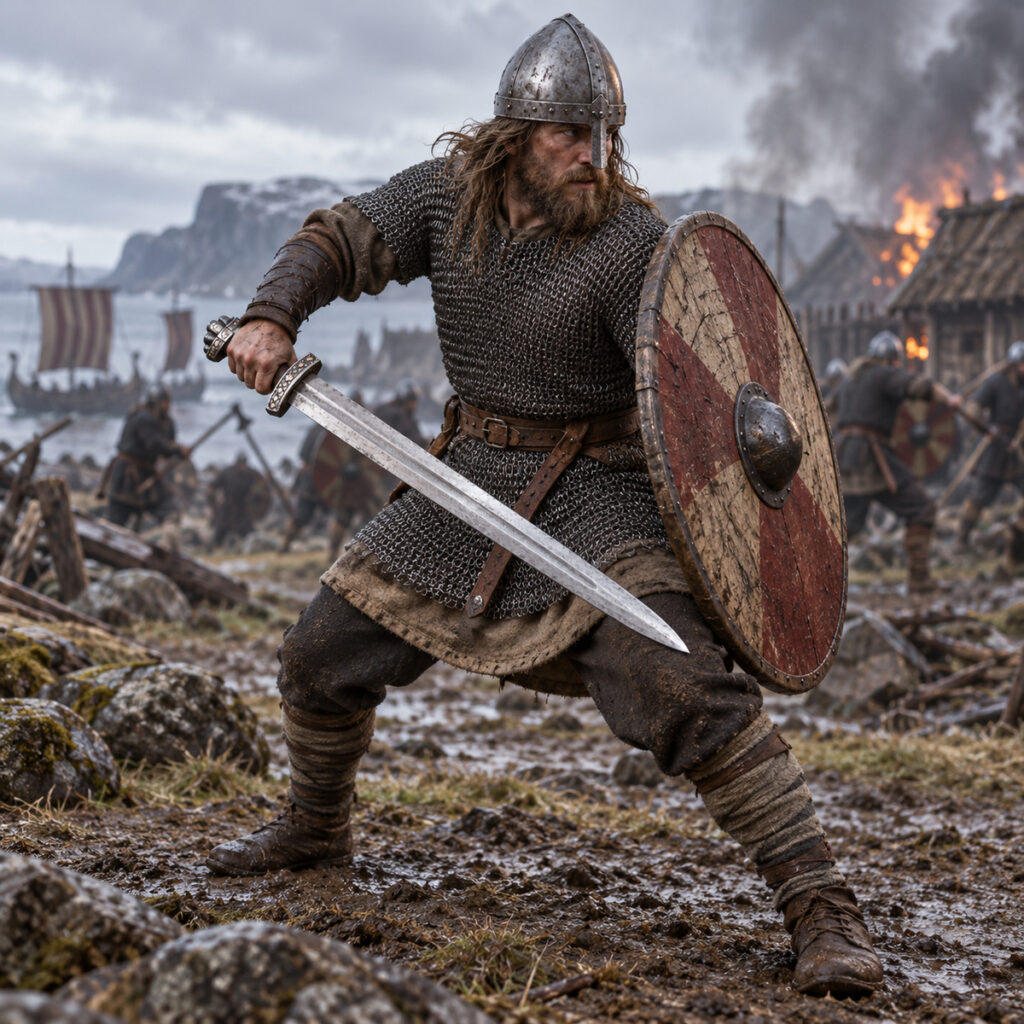
The sword was generally used with one hand, while the other supported the round shield . Its effectiveness derived from the balance between cutting power, maneuverability, and the ability to strike with a thrust. It was also an expensive object, often linked to the owner's prestige, wealth, and identity.
Is it correct to call it a Viking sword?
The term "Viking sword" is useful for the swords common in Scandinavia and the areas reached by the Norse during the Viking Age. From a historical and archaeological perspective, however, these weapons belonged to a broader European tradition.
Many blades were produced in the regions of the Carolingian Empire, particularly in the Rhineland area, and reached Scandinavia through trade, diplomatic gifts, mercenary service, booty, and other channels of circulation.
For this reason, scholars also use expressions such as:
- Viking Age sword;
- Carolingian sword;
- early medieval sword;
- Nordic sword, when shape and origin allow it;
- Viking-type sword, for specimens found outside Scandinavia.
The definition therefore does not indicate a weapon invented exclusively by the Vikings, but a family of European swords also adopted and developed by the Scandinavian populations.
The Origins of the Viking Sword
The Viking Age sword descends from weapons used in Europe during the Migration Period, which were in turn influenced by Roman and Late Antique longswords such as the spatha.
Between the 5th and 8th centuries, Germanic swords developed broad, double-edged blades, short guards, and pommels composed of various elements. The hilts could be richly decorated, and the blades were made by welding together iron and steel rods.
At the beginning of the Viking Age, this structure evolved further. Blades often became more regular, while pommels and guards took on shapes that today allow archaeologists to chronologically classify the weapons.
During the 11th century, the Viking sword gradually transformed into the medieval one-handed sword . The guard and blade lengthened, the point became more pronounced, and the pommel adopted new geometries.
What the Viking sword looked like
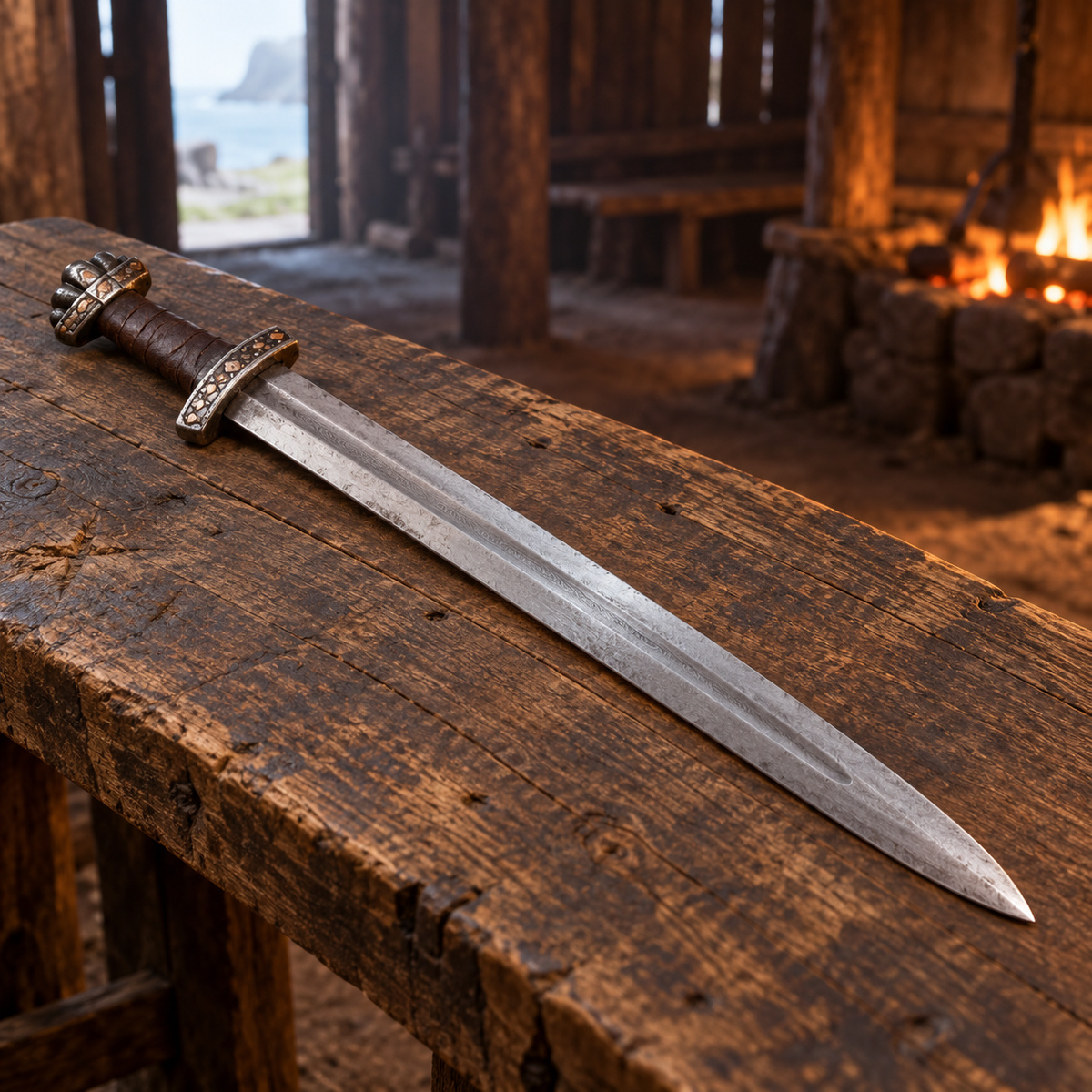
The Viking sword typically had a straight, double-edged blade, relatively wide and featuring a central fuller. The hilt was short, designed for one hand, and ended in a pommel intended to stabilize the grip and contribute to balance.
Its main parts were:
- lama, straight and sharp on both edges;
- tip, generally rounded or moderately pointed depending on the period and model;
- shell, large longitudinal depression obtained in the blade;
- lower guard, short and relatively thick;
- ergonomic, formed by the tang covered with organic material;
- upper guard, present in numerous configurations;
- knob, simple or divided into multiple lobes;
- sheath, built mainly with wood, leather and organic interior trim.
Dimensions and weight
Measurements varied, but a typical Viking Age sword might have a blade approximately 70 to 85 centimeters long . The overall length was often between about 85 and 100 centimeters.
Their weight could vary between approximately 1 and 1,5 kilograms , with some specimens being lighter or heavier. They were therefore not enormous, slow-moving felling blades, as they are sometimes depicted in films.
A well-crafted sword had to combine:
- sufficient mass to produce an effective blow;
- elasticity to absorb stress;
- cutting edges hard enough to retain their sharpness;
- balance suitable for rapid changes of direction;
- a stable grip behind the short guard.
The double-edged blade
The blade was usually sharpened on both sides. This feature allowed one to strike alternately with one edge or the other without having to completely rotate the wrist.
The earliest blades tended to have nearly parallel edges and a relatively rounded tip. They were particularly suited for striking at limbs, heads, and other less protected parts of the body.
As time passed, some blades showed a more pronounced taper and a more defined point, anticipating the characteristics of later medieval swords.
The Viking sword could therefore also strike with its thrust. To say that it was completely incapable of piercing is incorrect, even though the thrust was one of its primary functions.
The shell is not a "blood drainer"
The longitudinal depression in the center of the blade is called the fuller . In popular culture , it is often mistakenly referred to as the “blood channel.”
Its purpose was not to facilitate blood flow or prevent the sword from becoming stuck in the body. The fuller allowed for efficient distribution of the material, resulting in a relatively wide but not excessively heavy blade.
The structure can be compared, with some differences, to that of a beam: the metal is concentrated in the areas that contribute most to resistance, while the central part is lightened.
The shell could also accommodate:
- registrations;
- geometric symbols;
- workshop signs;
- inlays in iron or different metals;
- decorations intended to identify the blade.
The short grip
The grip of the Viking sword was generally rather short compared to that of many modern reproductions. The hand occupied almost the entire space between the guard and the pommel.
This configuration helped maintain a stable grip. The pommel could contact the side of the hand, limiting slippage during the blow.
The metal tang was covered with grips or organic materials, probably wood, bone, horn, leather, or cordage. Because these materials decay easily in the soil, many archaeological swords retain only the metal core of the hilt.
A short grip didn't necessarily prevent good wrist mobility. The shape of the pommel, the thickness of the handle, and the fighter's technique all influenced freedom of movement.
The guard
The lower guard was much shorter than the crosspiece of later medieval swords. Its primary function was to prevent the hand from slipping on the blade and to offer limited protection against an opponent's blow.
The short length doesn't mean that Viking blacksmiths didn't understand the usefulness of the guard. The combat system relied heavily on the shield , which was the warrior's primary defense.
Repeatedly parrying heavy blows directly with the sword's edge could damage both weapons. The fighter therefore used body movement, shield, distance control, and blade deflection.
The knob
The pommel is one of the most useful elements for classifying Viking Age swords. It could take many different shapes:
- triangular;
- semicircular;
- trilobate;
- pot-bellied;
- “tea hat”;
- composed of a base and a separate upper part;
- decorated with plaques, threads and metal inlays.
The pommel contributed to balance, but it wasn't simply a counterweight designed to offset the blade's mass. A sword needed to retain a certain presence in the hand to make effective cuts.
In high-end examples, the knob could be covered with silver, copper, bronze or different alloys, creating visible and precious geometric patterns.
Jan Petersen's classification
In 1919, Norwegian archaeologist Jan Petersen published a classification of Viking Age swords based primarily on the shape of the hilt. His system identifies numerous lettered types, from type A to type Æ, with further variations.
The Petersen typology does not primarily classify the blade, but notes:
- shape of the lower guard;
- upper guard structure;
- knob profile;
- number and arrangement of lobes;
- grip decorations;
- relationships between the different components.
This method allows us to compare finds from different territories and to reconstruct the diffusion of styles, workshops, and cultural influences.
Not every sword can be attributed with certainty to a single type, as there are intermediate forms, ancient restorations and combinations of components of different origins.
How the blade was built
Producing a good sword required considerable experience. The blacksmith had to work with a non-uniform material, obtained by reducing the ore in furnaces that produced a spongy mass of iron commonly called bloom.
The metal was repeatedly heated and hammered to remove slag, weld pores, and obtain usable bars. Iron and steel could have different carbon content and therefore different mechanical properties.
The blacksmith was trying to combine:
- a strong and relatively elastic core;
- harder cutting edges;
- a structure capable of absorbing shocks;
- a sufficiently thin and easy to handle blade;
- a tip and two symmetrical threads.
Package welding
Many early medieval blades were constructed using a technique called pattern welding . Iron and steel rods with different characteristics were welded, twisted, and joined together again.
The twisting of the bars produced wavy, herringbone, or snake-like patterns along the surface of the blade. These designs were not simply created by carving the metal, but derived from the internal structure of the welded materials.
Cutting edges with a higher carbon content could be applied to the sides of the core. The result depended on the quality of the raw materials and the blacksmith's ability to control temperatures and welding.
During the Viking Age, packet welding wasn't the only solution. With the availability of more homogeneous steels, some workshops produced blades with simpler, more compact structures. The absence of a damask pattern, therefore, doesn't necessarily mean a sword is of lower quality.
Damascus steel and packet welding are not the same thing
Viking blades with wavy patterns are often generically referred to as "Damascus." However, it's important to distinguish European packet welding from the crucible steels associated with Asian metalworking traditions.
In bundle welding, the pattern is created by joining and deforming different metal bars. In crucible steels, the material is produced through a different metallurgical process, and the pattern may derive from its internal structure.
Both techniques can generate decorated surfaces, but they should not be considered identical.
The ULFBERHT Swords
Among the most famous swords from the Viking Age are those bearing the inscription +VLFBERHT+ or its variants. Numerous examples have been found, dating mainly between the 9th and 11th centuries, across a vast area of Europe.
Ulfberht is a name of Frankish origin. The inscription likely originated in one or more workshops in the Rhineland area and over time became a sort of recognizable trademark. The long duration of production makes it unlikely that all the blades were made by a single blacksmith.
There are different spellings, including:
- +VLFBERH+T;
- +VLFBERHT+;
- incomplete or altered variants;
- inscriptions with inverted letters;
- imitations probably created to exploit the reputation of the name.
The presence of the inscription does not guarantee that all the swords were made of the same steel or using the same process. Analyses have shown significant metallurgical differences between the specimens.
The myth of ULFBERHT steel “from the future”
Some ULFBERHT swords feature particularly pure steel or a higher carbon content than many contemporary European swords. This characteristic has given rise to the legend of a material impossible to produce during the Middle Ages.
In reality, the Viking Age world was crisscrossed by vast trade networks that linked Scandinavia, Western Europe, Russia, the Black Sea, the Middle East, and Central Asia. Crucible steels or quality raw materials could reach European workshops via these routes.
Not all ULFBERHTs were made of crucible steel, however. Some had welded cores, hardened cutting edges, or steels with very different characteristics. The name identified a production or commercial tradition, not a single, mysterious "superalloy."
Frankish blades and Scandinavian handles
A sword found in a Norwegian grave wasn't necessarily entirely made in Scandinavia. High-quality blades from continental Europe could be imported and later fitted with guards and pommels crafted to local taste.
The sword could therefore bring together:
- blade produced in a free zone;
- grip built or modified in Scandinavia;
- decorations added by a local craftsman;
- sheath made near the place of use;
- materials from different commercial networks.
This combination makes the Viking sword a testament to the great mobility of goods, men and technologies during the Early Middle Ages.
The scabbard
The sword was kept in a scabbard, usually made of thin wooden slats. The inside could be lined with wool, fabric, or animal hair, materials capable of holding the weapon and protecting the metal.
The outer covering could be made of leather or fabric. Metal tips, straps, and suspension systems reinforced the structure and allowed the sword to be carried on a belt or shoulder strap.
The scabbard had to:
- protect the two sharp edges;
- prevent the blade from injuring the owner;
- reduce contact with water and dirt;
- keep the sword stable during movement;
- allow for rapid extraction.
Because wood, leather, and fabrics decay easily, complete scabbards are much rarer than blades and metal hilt components.
How it was carried
The sword was normally carried at the hip, suspended by a belt or strap. The position could be slightly inclined to facilitate drawing.
The weapon's length allowed it to be drawn with one hand. The warrior could hold the shield with his left arm and draw the sword with his right.
Not all fighters were necessarily right-handed, and not all suspension systems were identical. Reconstructions must take into account information from artifacts, images, and funerary contexts.
Sword and round shield
The Viking sword was designed to be used in conjunction with a round shield . This was made primarily of wood and had a metal boss in the center to protect the hand.
The shield was not just a passive barrier. It could be used for:
- intercept and deflect a shot;
- control the opponent's weapon or shield;
- cover the progress;
- hide the preparation of the attack;
- create an opening in the enemy's defense;
- to hit or push at close range.
After deflecting or blocking the threat with the shield, the warrior could respond with a direct blow to the head, neck, arms or legs.
How the Viking warrior fought
No surviving Viking fencing manuals exist. Techniques must be reconstructed through weapon characteristics, wounds observed on human remains, artistic representations, literary accounts, and practical experimentation.
The sword could be used with:
- vertical slashes;
- diagonal shots;
- horizontal cuts;
- lunges against the defense's openings;
- quick wire changes;
- blows delivered beyond or around the shield;
- close-quarters actions with pommel and guard.
The relatively broad point of many blades did not favor the penetration of mail as well as that of later, more tapered medieval swords. However, it could effectively strike the face, neck, abdomen, and other unprotected areas.
Could the sword cut through chain mail?
A good-quality chainmail suit offered considerable protection against blows. A sword could damage some of the links, especially with a particularly favorable blow, but it didn't automatically pierce the mail like it would fabric.
Even without penetrating, a powerful blow could cause:
- bruises;
- fractures;
- joint trauma;
- damage in areas not protected by padding;
- momentary loss of control of the weapon;
- fall or disorientation.
The warrior looked above all for openings in his equipment: face, neck, armpits, hands, legs, and exposed areas between the helmet, shield, and body armor.
How widespread was the sword?
The sword required a considerable amount of good-quality metal and many hours of skilled work. For this reason, it was usually more expensive than a spear or an axe.
Not every Viking owned a sword. Many fighters primarily used:
- spears;
- axes;
- arches;
- large knives;
- weapons made from everyday tools.
The sword was particularly associated with professional warriors, leaders, members of the elite, and men capable of acquiring a valuable weapon. However, swords of varying quality and cost existed.
The sword as a symbol of prestige
Beyond its military function, the sword communicated the owner's social standing. A hilt decorated with silver, copper, or bronze was immediately visible when the weapon was carried at the hip.
The sword could be:
- transmitted within the family;
- given by a chief to a faithful warrior;
- offered as a reward for service;
- acquired through trade;
- conquered as booty;
- placed in the tomb together with the owner;
- identified with a proper name.
Receiving a sword from a ruler or chief also created a political bond. The weapon physically represented the honor received and the warrior's obligations of loyalty.
Swords with a proper name
In Norse literature, swords often have names that express their character, origin, or legendary powers. Among the most famous are:
- Gram, the sword of the hero Sigurd;
- Tyrfing, cursed blade destined to cause tragedies;
- Skofnung, associated with the Danish king Hrólfr Kraki;
- Hrotti, conquered by Sigurd in the dragon's hoard;
- Legbiter, a name traditionally associated with a blade capable of striking the legs.
These weapons belong to literary tradition and cannot be considered archaeological finds identified with certainty. However, they demonstrate how the sword could be perceived as an object endowed with memory and identity.
Swords in the tombs
Numerous swords have been found among grave goods. The weapon could have been placed next to the deceased, placed on top of the body, or combined with shields, spears, axes, horses, and personal items.
In some cases the blade was intentionally:
- folded;
- broken;
- heated and deformed;
- rendered unusable before burial.
The gesture is often interpreted as a form of "ritual killing" of the weapon, intended to accompany the owner into the world of the dead. It could also prevent the recovery and reuse of a precious object.
Not every deformed sword necessarily had the same meaning. Interpretations depend on the archaeological context and the community's funerary practices.
The swords placed in the rivers
Some Viking Age swords have been recovered from rivers, lakes, swamps, and other wetlands. In some cases, they may have been lost during crossings, battles, or travels.
The quantity and arrangement of some finds, however, suggest that at least some of the weapons may have been deposited intentionally . The placing of objects in water had a long tradition in Northern Europe.
Establishing whether a single sword was lost or sacrificed often remains difficult, especially when precise information on the location and conditions of its discovery is lacking.
The differences with other weapons of the time
| Arma | Features | Main use | Difference from the Viking sword |
|---|---|---|---|
| Viking spear | Iron tip mounted on a long rod | Thrust, throw and formation fighting | It offered greater range and was less expensive; the sword was more agile at short range. |
| Danish axe | Large blade mounted on a long handle, often wielded with both hands | Powerful slashes and formation combat | More powerful and longer, but normally prevented the simultaneous use of the shield |
| One-handed axe | Compact weapon with a relatively light blade | Slashes, hooks and close combat | Less expensive and with a short cutting edge, the sword offered two edges and greater continuity in cutting. |
| seax | Large Germanic single-edge knife | Everyday use and close combat | Shorter and featuring a single edge, the sword provided greater range. |
| Late Antique Spatha | Straight double-edged sword of Roman tradition | Infantry and cavalry | It constitutes one of the main ancestors of the Viking sword |
| Frankish sword | Double-edged straight blade produced in Carolingian Europe | One-handed shield fighting | It often belonged to the same family; numerous blades used in Scandinavia were of Frankish production. |
| Steppe Saber | Curved single-edge blade | Slashes from the cavalry | It favored cutting in motion; the Viking sword was straight and double-edged. |
| bow | Arrow throwing weapon | Ranged Combat and Hunting | It struck before contact; the sword operated mostly at close range. |
| Medieval cross sword | More tapered blade, elongated guard and pronounced point | Cut and thrust | It represents the next evolution of the Viking Age sword. |
Viking sword and medieval sword
The Viking sword didn't suddenly disappear at the end of the 11th century. Its characteristics gradually evolved until it gave rise to the classic medieval one-handed sword.
The main transformations concerned:
- progressively longer guard;
- simplified or redesigned knob;
- more tapered blade;
- more effective tip in the lunge;
- slightly longer handle;
- progressive diffusion of new shell geometries.
The medieval knight's sword therefore did not represent a complete break, but the evolution of a tradition already consolidated during the Viking and Carolingian ages.
Could the Viking sword break?
Like any weapon, even a good-quality sword could bend, chip, or break. The risk increased in the presence of:
- defects in welding;
- slag trapped in the metal;
- incorrect heat treatment;
- corrosion;
- violent impacts against stone or metal;
- repeated blows wire against wire;
- previous deformations not repaired properly.
A blade that was too hard could be brittle, while one that was too soft could warp and lose its edge. The blacksmith's job was to find a balance between hardness and toughness.
How it was maintained
Iron required constant maintenance, especially in Scandinavia's humid climate and during sea voyages. Salt water, sweat, and condensation could quickly cause corrosion.
The owner had to:
- dry the blade after use;
- remove dirt and debris;
- apply protective greases or oils;
- check the condition of the handle;
- keep the sheath dry;
- straighten any deformations;
- carefully sharpen the two cutting edges.
A neglected sword could deteriorate rapidly, regardless of its original quality.
Anecdotes and curiosities about the Viking sword
The sword could be worth more than the rest of the equipment
A high-quality blade, especially if imported and finished with a decorated hilt, represented a considerable investment. It could be passed down for generations and gain value through the histories of its owners.
Not all decorated swords were Scandinavian
A blade could have been produced in the Rhine region, traded as far as Norway, and completed with a Nordic pommel. The place of discovery therefore does not necessarily coincide with the place of production.
There were imitations of the ULFBERHT
Incorrect or altered spellings demonstrate that the inscription was copied. As with modern brands, a prestigious name could be used to enhance the perceived value of a blade.
The swords weren't as heavy as in the movies
A combat sword needed to be maneuverable. An excessively heavy weapon would tire the warrior and slow down his defense. Its effectiveness depended on speed and control, not just mass.
The knob was not only used for balancing
In addition to helping distribute the weight, the pommel secured the hand, closed the grip structure, and provided a decorative surface. At close range, it could also be used for striking.
A sword could have multiple lives
Damaged or ancient blades could be repaired, shortened, sharpened, and mounted on new handles. A single artifact can therefore include components made in different periods or places.
Famous quotes related to the Viking sword
“Never walk away from your weapons”
In the Hávamál , a collection of poetic teachings attributed to the voice of Odin, the prudent man is advised never to abandon his weapons when traveling or in the fields. It is unknown when the sudden need to defend oneself might arise.
The passage does not exclusively mention the sword, but expresses the value of preparation in a society where travel could involve unforeseeable dangers.
“Cattle die, relatives die”
Another famous verse from the Hávamál reminds us that men and riches are destined to disappear, while the fame gained can survive. The sword, especially when passed down or placed in a prestigious tomb, became one of the tools through which the warrior built this reputation.
The maxim does not directly describe a weapon, but it helps to understand the importance placed on honor and memory.
The phrases spoken by the swords of the sagas
In sagas and heroic tales, some swords seem to possess a will of their own. They can bring victory, exact vengeance, or condemn their owner.
These episodes belong to literature and do not describe actual magical weapons. However, they testify to the strong symbolic connection between the blade, the warrior's destiny, and the family's memory.
Myths to dispel
- The Viking sword was not invented exclusively in Scandinavia: it belonged to a European tradition and many blades were of Frankish production.
- It wasn't a huge, heavy weapon.: it had to be handled quickly with one hand.
- It was not always used with two hands: the grip was designed for one hand, leaving the other free for the shield.
- It was not possessed by every Viking: spears and axes were generally cheaper and more widespread.
- The shell was not used to make the blood flow: it lightened the blade while maintaining a strong structure.
- It was not only used for cutting: the tip also allowed for thrusting actions.
- It did not easily pass through any chain mail.: Quality guards could stop or limit slashes.
- Not all blades were welded in packs: there were different construction techniques.
- Not all ULFBERHTs were the same: materials and metallurgical qualities varied considerably.
- The ULFBERHTs were not weapons from the future: quality steels circulated through extensive trade networks.
- Vikings did not normally fight with horned helmets: There is no evidence of the warlike use of such headdresses in the Viking Age.
- A rich decoration did not automatically make the blade better: mechanical quality and ornamental value must be evaluated separately.
Why the Viking Sword Was Effective
The Viking Age sword combined seemingly simple but extremely functional features: two cutting edges, a broad blade lightened by the fuller, a stable grip and a weight compatible with the contemporary use of a shield.
It lacked the reach of a spear or the concentrated power of a great axe. However, it offered considerable versatility at close range and allowed for chaining blows from different directions.
True effectiveness depended on the integration between:
- spade;
- shield;
- body movement;
- distance control;
- training;
- ability to fight alongside comrades.
More than a miracle weapon, it was a tool carefully adapted to the needs of the early medieval warrior.
The historical value of the Viking sword
Every Viking Age sword tells a story that goes beyond combat. The steel's composition can reveal the metallurgical skills of the workshop; the hilt demonstrates artistic tastes and cultural connections; inscriptions document names and trade networks; the location of the find helps reconstruct voyages, wars, and rituals.
A Frankish blade with a Scandinavian hilt, found in Ireland or along an Eastern European river, testifies to a world far more connected than the phrase “Dark Middle Ages” might suggest.
The sword was simultaneously a weapon, a luxury good, a political reward, a family heirloom and a ritual object.
The Legacy of the Viking Sword
Between the 10th and 11th centuries, the proportions of the sword began to change. The guards became longer, the pommels changed shape, and the blades developed tips more suited to thrusting.
From this evolution came the classic medieval cross-blade used by European knights. Many fundamental elements, however, remained unchanged: the straight, double-edged blade, one-handed grip, transverse guard, and pommel.
The Viking sword thus occupies a central position in the history of European weapons. It links the spatha of the late antique world to the knightly swords of the Middle Ages and testifies to the transition between different warrior societies.
Its modern fame derives from the exploits of Scandinavian navigators, but its true value lies in the complex union of European metallurgical technology, international trade, Nordic art and warrior culture.