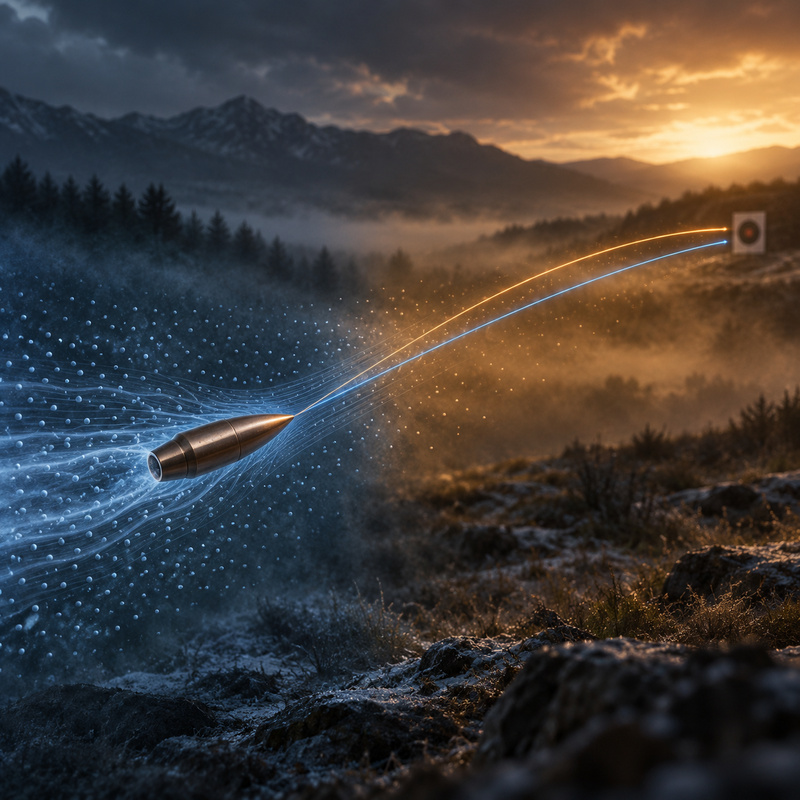
Air temperature is one of the environmental parameters that influence external ballistics. Varying atmospheric density alters the aerodynamic resistance encountered by the projectile, its velocity loss, its flight time, and therefore its drop and sensitivity to wind. Temperature can also affect internal ballistics, as the thermal conditions of the cartridge and the firearm can affect powder combustion and muzzle velocity. Its effects are often limited to short ranges, but become progressively more significant at long ranges and when the firearm is used in conditions significantly different from those of zeroing.
WHAT IS AIR TEMPERATURE?
Air temperature indicates the level of thermal agitation of the molecules that make up the atmosphere. When air heats up, the molecules tend to move faster and, at the same pressure, spread out over a larger space. The air thus becomes less dense.
As the temperature drops, molecules move more slowly and the air tends to become denser. The projectile must therefore pass through a greater amount of atmospheric matter along its path.
However, temperature is not the only factor that determines air density. Its effect must be considered together with atmospheric pressure, altitude, and relative humidity.
WHY TEMPERATURE AFFECTS THE BULLET
During flight, the projectile encounters a force directed against its motion: aerodynamic drag . The intensity of this force depends on the velocity, the shape of the projectile, its ballistic coefficient, and the characteristics of the air it passes through.
Generally speaking, aerodynamic drag increases as air density increases. A projectile flying in a cold, dense atmosphere therefore loses velocity more rapidly than the same projectile launched in warm, less dense air.
Temperature doesn't directly cause the projectile to "rise" or "fall." Instead, it changes the amount of energy lost during flight and, consequently, the time during which gravity can act on the trajectory.
BEHAVIOR IN HOT AIR
In warm air, atmospheric density is generally lower. The projectile encounters less resistance, maintains its velocity better, and takes slightly less time to reach its target.
The reduction in flight time limits the effects of gravity and wind. Compared to the conditions in which the weapon was zeroed, the point of impact may therefore be slightly higher and less laterally offset.
Hot air does not automatically result in a high impact. The actual result depends on the zeroing temperature, distance, muzzle velocity, ballistic coefficient, and other atmospheric parameters.
BEHAVIOR IN COLD AIR
Cold air is generally denser and produces greater aerodynamic drag. The projectile loses velocity more rapidly, increases its flight time, and is subjected to gravity for a longer period of time.
Compared to zeroing at higher temperatures, the point of impact may be slightly lower. The increased flight time also makes the bullet more susceptible to crosswinds.
The phenomenon becomes more evident with bullets characterized by a low ballistic coefficient, with relatively low initial velocities and at longer distances.
AIR TEMPERATURE AND DENSITY
To understand the effects of temperature, it's necessary to distinguish the value read on the thermometer from the actual air density . Two days with the same temperature can, in fact, present different ballistic conditions if the atmospheric pressure, humidity, or altitude changes.
In the mountains, for example, the pressure is typically lower and the air is less dense. A cold day at altitude can therefore have a lower atmospheric density than a warmer day near sea level.
For this reason, the most advanced ballistic calculators do not only use temperature, but simultaneously process all the main atmospheric data.
THE DENSITY ALTITUDE
The concept of density altitude allows us to summarize the combined effects of temperature, pressure, and humidity into a single value. It doesn't necessarily coincide with the geographic altitude of a location, but it describes the aerodynamic behavior of the atmosphere.
A high density altitude indicates relatively thin air. Under these conditions, the projectile maintains its velocity better and has a flatter trajectory. A low density altitude, on the other hand, corresponds to a denser atmosphere, capable of producing greater deceleration.
This parameter is particularly useful when comparing data collected in different locations or times of the year.
THE ROLE OF HUMIDITY
Contrary to what you might think, humid air is slightly less dense than dry air at the same temperature and pressure. Water vapor molecules have a lower molecular mass than the nitrogen and oxygen molecules they partially replace.
The effect of humidity on trajectory is generally smaller than that of temperature and pressure, but can be considered in calculations intended for longer shots.
A hot, humid day can therefore produce a less dense atmosphere than a cold, dry day, with measurable consequences for the conservation of velocity.
AIR TEMPERATURE AND CARTRIDGE TEMPERATURE
The ambient temperature and the ammunition temperature are not necessarily the same. A cartridge left in the sun, inside a vehicle, or near a heat source can reach temperatures much higher than the outside temperature.
Likewise, ammunition carried outdoors for a long time on a winter's day can cool significantly. It is therefore the actual temperature of the cartridge, and particularly of the powder contained within, that influences combustion.
The distinction is important because the air temperature affects mainly the external ballistics, while the cartridge temperature can modify the initial phase of the shot.
EFFECTS ON DUST COMBUSTION
Propellant powders can be sensitive to temperature changes. Under hotter conditions, combustion can become more vigorous, resulting in increased pressure and initial velocity. At very low temperatures, however, performance may be reduced.
The extent of the phenomenon depends on the chemical composition of the powder, the type of cartridge, the quantity of propellant, the primer and the characteristics of the weapon.
Modern powders defined as thermally stable are designed to minimize velocity variations between hot and cold conditions. Thermal stability, however, does not mean complete insensitivity to temperature.
BARREL TEMPERATURE
The temperature of the barrel can also contribute to the variation in the gun's behavior. A cold barrel may produce a slightly different point of impact than the same barrel after a series of shots.
During repeated firing, the metal heats up and expands. This can change, albeit slightly, the vibrational conditions of the barrel, the contact with the forend or stock, and the way the bullet is guided by the rifling.
This effect should not be confused with that of atmospheric temperature. However, in real shooting, the two phenomena can occur simultaneously.
EFFECTS ON INITIAL SPEED
Muzzle velocity is one of the fundamental parameters for calculating the trajectory. Even a seemingly modest change can alter the flight time and fall at longer distances.
If the temperature of the ammunition increases the initial velocity, the bullet will reach the target slightly faster. If the velocity decreases, the trajectory will tend to become more curved.
Actual differences cannot be determined based on temperature alone, because each combination of powder, case, primer, bullet, and gun exhibits specific behavior.
TEMPERATURE AND SPEED OF SOUND
Temperature also affects the speed of sound . In warm air, sound travels faster, while in cold air its speed slows.
This means that the same projectile, at the same speed, can have a different Mach number depending on its temperature. The Mach number expresses the ratio between the projectile's speed and the local speed of sound.
This phenomenon becomes particularly important as the projectile slows down and approaches the transonic region. Temperature can alter the point on the trajectory where the transition from supersonic to transonic occurs.
THE TRANSONIC REGIME
During the transition from supersonic to subsonic flight, the projectile passes through a zone where the airflow changes rapidly. During this phase, aerodynamic drag and stability conditions can vary.
A different atmospheric temperature can advance or delay entry into this region, because it modifies both the loss of velocity and the local speed of sound.
For normal hunting applications at moderate ranges this aspect is often secondary, but it takes on greater importance in long-range ballistics.
PROJECTILE TEMPERATURE AND STABILITY
Gyroscopic stability depends mainly on the rotational speed imparted by the rifling, the shape of the bullet, its mass and the density of the air.
In a warm, less dense atmosphere, the projectile generally encounters less destabilizing action. In cold, denser air, however, the aerodynamic stress increases.
For ammunition properly matched to the twist rate, normal seasonal variations should not compromise stability. However, the effects may become more noticeable when using particularly long bullets or when the stabilization margin is already limited.
TEMPERATURE AND FLIGHT TIME
Time of flight represents the period during which the projectile is exposed to the action of gravity and atmospheric agents.
In cold, dense air, the increased deceleration extends the time it takes to reach the target. Gravity can then act for longer, increasing the fall. The wind also has more time to cause lateral deflection.
In warm, less dense air, the opposite occurs: speed is conserved more effectively and flight time tends to decrease.
EFFECTS ON WIND DRIFT
Temperature does not directly change wind direction, but it can change the amount of drift through air density and flight time.
In denser air, the bullet slows down more and remains exposed to crosswinds longer. In less dense air, however, it maintains a higher velocity and reaches the target sooner.
The actual wind can also vary along the trajectory due to uneven heating of the ground, vegetation, shaded areas and differences in altitude.
THERMAL GRADIENTS AND MIRAGE
The ground, heated by the sun, transfers heat to the layers of air closer to the surface. Temperature differences between atmospheric layers can cause changes in the refractive index and produce the phenomenon commonly called a mirage.
The target may appear to wobble, distort, or slightly shift from its actual position. Mirage doesn't alter the bullet's trajectory to the same extent as it alters the target's optical perception, but it can make it more difficult to correctly acquire the aiming point.
Observing the movement of the mirage can also provide indications of the direction and apparent intensity of the wind along part of its trajectory.
THE IMPORTANCE OF DISTANCE
At short ranges, the projectile takes a short time to reach the target and retains a high proportion of its initial velocity. Temperature-related differences are therefore generally small.
As distance increases, deceleration variations accumulate. Differences in residual velocity, flight time, sink rate, and wind drift increase.
There is no universal distance beyond which temperature becomes a determining factor. The result depends on the caliber, the projectile, the ballistic coefficient, the muzzle velocity, and the amplitude of the thermal change.
EFFECTS ON THE RESET
Zeroing connects the line of sight to the bullet's trajectory under certain conditions. If temperature, pressure, and muzzle velocity change significantly, the point of impact can also change.
A gun zeroed on a hot summer day may exhibit slightly different behavior in the dead of winter. This change may be due to the increased air density, the different temperature of the cartridges, and the behavior of the cold barrel.
For this reason, a zeroing performed under conditions very different from those of use should be verified before use in the field.
A cliché to be cleared up
It's common to say that "in hot weather, the pulse rises" and "in cold weather, the pulse falls." This simplification only describes one possible consequence, but doesn't accurately explain the phenomenon.
Temperature does not exert a direct vertical force on the projectile. The shift in the point of impact is primarily due to changes in atmospheric density, different velocity loss, and any changes in initial velocity.
Furthermore, pressure, altitude, and humidity can reinforce or offset the effects of temperature. Actual behavior must therefore be evaluated by considering the entire set of atmospheric conditions.
HOW TO EVALUATE THE EFFECT OF TEMPERATURE
For a reliable assessment, it's necessary to know the temperature at the location and time of the shot. The measured value must be combined with other atmospheric data and the ammunition's characteristics.
The main elements to consider are:
- air temperature;
- approximate temperature of the cartridges;
- atmospheric pressure;
- relative humidity;
- altitude;
- real initial velocity;
- ballistic coefficient of the projectile;
- target distance;
- wind direction and speed.
Ballistic calculators use this data to estimate the trajectory. The result, however, remains a prediction and must be compared with the actual behavior of the weapon and ammunition.
DID YOU KNOW THAT?
- Warm air is generally less dense than cold air.
- Humid air is slightly less dense than dry air at the same temperature and pressure.
- Temperature also changes the speed of sound and therefore the Mach number of the projectile.
- The cartridge may be significantly warmer or colder than its surroundings.
- Not all propellant powders have the same thermal sensitivity.
- Increased air resistance also indirectly increases the effects of wind.
- Barrel temperature can affect the point of impact regardless of atmospheric temperature.
- Mirage is produced by thermal differences between air layers and can alter the optical perception of the target.
FOR THE HUNTER
In normal close-range hunting, the effect of atmospheric temperature is generally less important than errors in range estimation, support, or wind judgment.
However, the phenomenon becomes more relevant when hunting in the mountains, on longer shots and when there is a large difference between the zeroing conditions and those encountered on the ground.
It's advisable to avoid leaving ammunition exposed to direct sunlight, on a vehicle's dashboard, or near heat sources. Likewise, it's important to consider that cartridges left in the cold for many hours may exhibit different behavior than those tested in warmer conditions.
Zeroing should be performed with the same ammunition intended for use and, when possible, under environmental conditions similar to those expected. Recording the temperature, distance, and point of impact helps you better understand the actual behavior of your weapon-ammunition combination.
IN SUMMARY
Air temperature changes atmospheric density and therefore the resistance encountered by the projectile. With warm, less dense air, velocity is generally maintained longer; with cold, denser air, deceleration, flight time, and fall are increased.
Temperature can also influence powder combustion, initial velocity, speed of sound, transition into the transonic regime, and, indirectly, wind drift.
It should therefore not be considered as an isolated fact, but as part of the set of atmospheric and thermal conditions that accompany the shot.