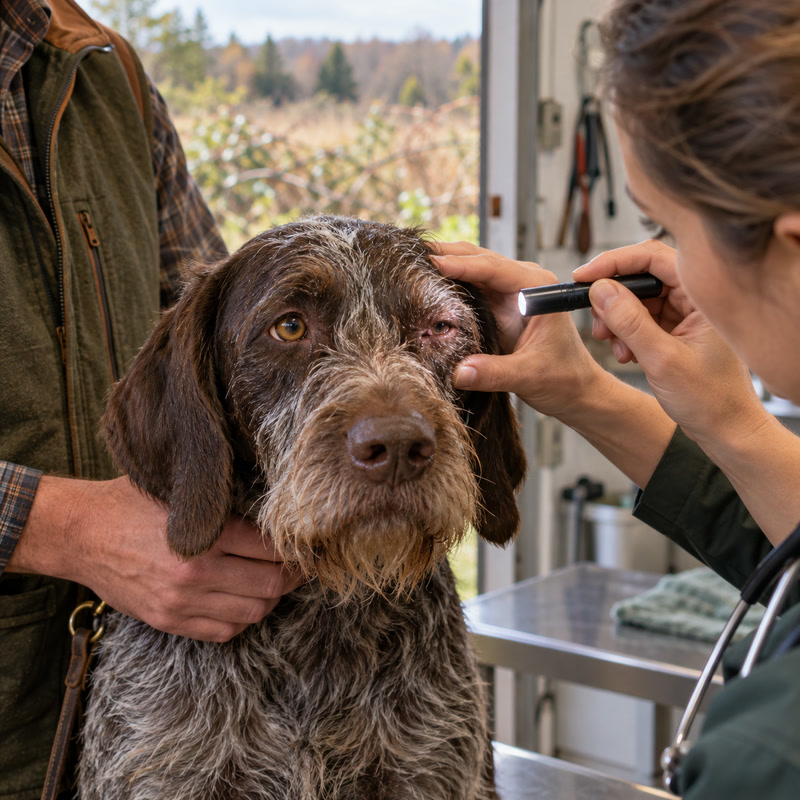
Eye trauma while hunting represents a particularly delicate veterinary emergency. Brambles, branches, thorns, seeds, plant fragments, soil, bites, and accidental impacts can damage the eyelids, cornea, or internal structures of the eye.
Even an initially subtle injury can rapidly worsen and impair vision. If a dog shows pain, keeps his eye closed, or has a visible injury after a hunting trip, you should immediately stop the activity and contact your veterinarian.
Why are eyes exposed during hunting?
The hunting dog quickly moves through environments with dense vegetation, brushwood, brambles, and broken branches. While searching, it can walk with its head down and slip into passages where its muzzle and eyes are directly exposed.
The risk increases in the presence of:
- woods with particularly dense undergrowth;
- hedges, brambles and thorny shrubs;
- stubble and dry vegetation;
- broken or sharp branches;
- dusty or sandy soils;
- clashes with wild animals;
- falls, impacts and difficult crossings;
- presence of pellets, shrapnel or other projectiles.
Breeds with more prominent eyes may be more vulnerable, but any dog used for hunting can suffer an eye injury.
Main types of eye trauma
The severity of the trauma depends on the force of the impact, the nature of the object, and the depth of the injury. The most common forms include corneal abrasions, eyelid injuries, foreign bodies, and penetrating trauma.
Corneal abrasions and ulcers
The cornea is the clear surface covering the front of the eye. It can be scratched by leaves, twigs, thorns, sand, or other plant material.
A superficial abrasion can develop into a corneal ulcer . This lesion is generally very painful and can quickly deepen, especially if contaminated with bacteria or if the dog continues to rub itself.
Foreign bodies
Seeds, bark fragments, thorns and small plant residues can get stuck:
- on the surface of the cornea;
- under the third eyelid;
- in the conjunctival sac;
- in the thickness of the cornea;
- inside the eyeball.
A fragment hidden behind the third eyelid can continue to rub the cornea with every eye movement, maintaining pain and inflammation.
Eyelid wounds
Branches, barbed wire, bites, and sharp objects can lacerate the eyelids. Wounds near the eyelid margin require precise reconstruction, as uneven healing could prevent the eye from closing properly or cause permanent chafing on the cornea.
Perforating trauma
A thorn, branch, or splinter can completely pass through the cornea or sclera and penetrate the eyeball. These injuries can cause fluid leakage, hemorrhage, iris prolapse, lens damage, deep infections, and retinal detachment.
A perforation is an absolute emergency and may require immediate surgery.
Contusive trauma
Striking a branch, falling, being kicked, or being struck by an animal can damage the eye even without causing an obvious external wound. The consequences may include:
- bleeding inside the eye;
- inflammation of the iris and ciliary body;
- lens dislocation;
- retinal detachment;
- increased or decreased intraocular pressure;
- optic nerve damage;
- partial or complete loss of vision.
Bites and scratches
Contact with a wild boar, another dog, or a wild animal can cause wounds around the eye. Even small punctures caused by teeth can hide deep injuries, skull fractures, or bacterial contamination.
Injuries from pellets or shrapnel
Wounds caused by pellets, metal fragments, or shrapnel require immediate veterinary evaluation. Damage can involve not only the eye, but also the orbit, skull, and other organs.
The visible entry point does not allow us to determine the path followed by the bullet. The dog must therefore be assessed as a whole, even when it appears alert and only has a small wound near the eye.
Symptoms of eye trauma
Eye pain may appear immediately or become noticeable over the next few hours. The main signs include:
- closed or half-closed eye;
- frequent blinking;
- profuse tearing;
- redness of the conjunctiva;
- swelling of the eyelids;
- rubbing the muzzle with the paws or against the ground;
- sensitivity to light;
- presence of secretions;
- cloudy, bluish or whitish cornea;
- traces of blood in or around the eye;
- pupils of different sizes;
- irregular pupil shape;
- raised third eyelid;
- visible foreign body;
- difficulty orienting oneself or bumping into obstacles.
The dog may also become restless, refuse head contact, or react aggressively due to pain. Even a normally docile animal must be handled with caution.
Signs of particular gravity
You should immediately reach a veterinary facility when you observe any of the following signs:
- object lodged in the eye or socket;
- deep wound or visible perforation;
- leakage of tissue or fluid from the bulb;
- deformed, displaced or apparently larger eye;
- bleeding inside the eye;
- irregular or immobile pupil;
- sudden loss of vision;
- very severe pain;
- trauma caused by pellets, splinters or bites;
- injury associated with disorientation, loss of balance, or shock.
Don't wait until the next day to see if your dog improves. Some corneal and intraocular lesions can worsen within a few hours.
How to intervene at the scene of the accident
The first goal is to prevent the dog from causing further harm. It's best to stop the activity, take him to a safe area, and keep him calm.
While waiting for transport to the vet it is advisable to:
- prevent the dog from rubbing itself with its paws or against the ground;
- apply an Elizabethan collar, if available and tolerated;
- keep him on a leash and limit his movements;
- protect it from bright light, dust and wind;
- contact the veterinary facility in advance;
- carry it without applying pressure to the head or eye.
If the dog is agitated or in pain, be aware of the risk of bites. A muzzle should not be applied if the animal is having difficulty breathing, vomiting, or has significant facial injuries.
When is it possible to rinse the eye?
A gentle rinse may be helpful only when dust, fine sand, or an irritant has entered the eye and there are no embedded objects, deep wounds, or signs of perforation.
In these cases, you can use a generous amount of sterile saline solution, allowing it to flow without touching the cornea with the container's spout. After rinsing, the dog should still be examined if pain, redness, or difficulty opening the eye persists.
In case of contact with chemicals, irrigation must begin immediately and continue while arranging transport, also following the veterinarian's telephone instructions.
What not to do
Seemingly simple maneuvers can aggravate an injury or cause loss of ocular contents. You should not:
- attempt to remove thorns or objects that have penetrated the eye;
- push or reposition the eyeball;
- apply pressure to the eye;
- apply compression bandages;
- use tweezers or cotton swabs on the cornea;
- force the eyelids open;
- use human eye drops or home remedies;
- apply antibiotic ointments without a prescription;
- administer painkillers intended for people;
- resume hunting because the dog seems temporarily improved.
Eye drops containing corticosteroids can seriously worsen a corneal ulcer and should not be used without ruling out corneal injury.
Even the anesthetic eye drops used during the veterinary visit are not intended for repeated home use, because they can delay healing and damage the ocular tissue.
Object stuck in eye
If a branch, thorn, or other foreign body protrudes from the eye, it should not be removed. The object could temporarily limit the bleeding, and its removal could cause further damage.
It must be prevented from moving during transport, without pressing on the bulb or manipulating the fragment. Stabilizing particularly long or unstable objects should be discussed with your veterinarian over the phone.
How is trauma diagnosed?
The veterinarian first assesses the dog's general condition, especially if the trauma was caused by a fall, a bite, or a bullet. He or she then examines the eyelids, conjunctiva, cornea, and internal structures of the eye.
Investigations may include:
- assessment of visual capacity and ocular reflexes;
- slit lamp and ophthalmoscope examination;
- fluorescein test to highlight ulcers and perforations;
- measurement of tear production;
- monitoring of intraocular pressure, when a rupture of the bulb is not suspected;
- examination under the third eyelid;
- ocular ultrasound;
- X-rays or CT scans of the orbit and skull.
In very painful dogs, sedation or general anesthesia may be necessary to perform the examination safely and remove any foreign bodies.
Treatment
Treatment depends on the type and depth of the injury. Superficial abrasions can be treated with specific ocular medications, painkillers, and an Elizabethan collar, accompanied by close monitoring.
Deep ulcers, lacerations and perforations may instead require:
- removal of the foreign body under sedation or anesthesia;
- suturing of the cornea or eyelid;
- grafts or surgical techniques to protect the cornea;
- local or systemic antimicrobial drugs;
- anti-inflammatory and pain-relieving therapy;
- treatment of increased eye pressure;
- hospitalization and specialist monitoring.
When the eye is severely damaged, blind, and painful, it may need to be removed. This decision is made to eliminate pain and prevent further complications, after evaluating all recovery options.
Check-ups during healing
Eye injuries should be re-examined according to the schedule established by your veterinarian. Relief of pain does not guarantee complete healing of the cornea.
During convalescence it is important to:
- administer medications at the prescribed intervals;
- do not stop therapy on your own;
- always keep the Elizabethan collar;
- avoid running, hunting and thick vegetation;
- report any worsening immediately;
- show up for check-ups even if the eye appears normal.
Prognosis
The prognosis depends on the location, depth, and extent of the injury, as well as the speed of surgery. Superficial abrasions treated promptly can heal without permanent consequences.
The prognosis becomes more conservative in the presence of perforation, internal infection, lens injury, hemorrhage, retinal detachment, or optic nerve damage. Even when vision cannot be restored, prompt treatment remains essential to manage pain and maintain the dog's well-being.
Prevention while hunting
Not all accidents can be avoided, but careful management of the dog and the terrain can reduce their frequency.
È consigliabile:
- check the type of vegetation present before leaving;
- avoid, when possible, impenetrable brambles and areas with many broken branches;
- recall the dog in particularly dangerous passages;
- evaluate canine eye protection that is suitable for the activity and correctly adjusted;
- gradually accustom the dog to any protective glasses;
- bring sterile saline solution and an Elizabethan collar in your first aid kit;
- know in advance the veterinary facilities present in the hunting area;
- inspect eyes and eyelids after every outing.
Protective eyewear must fit properly, provide adequate vision, and not cause chafing. They don't offer complete protection and aren't a substitute for monitoring your dog and its surroundings.
Checking the dog at the end of the hunt
After each outing, it's a good idea to check both eyes in a well-lit place. The following should be checked:
- symmetry of the pupils;
- ability to keep both eyelids open;
- presence of tearing or secretions;
- any redness;
- corneal transparency;
- sores or swelling around the eyelids;
- dog behavior when moving.
If your dog squints, tears, or avoids light, don't automatically attribute the problem to dust. A small corneal scratch can be very painful and requires prompt treatment.
In short (Italian only)
Eye trauma while hunting can be caused by brambles, branches, foreign bodies, bites, impacts, pellets, and splinters. A blocked eye, watery eyes, redness, corneal clouding, blood, or pupil changes require prompt veterinary evaluation.
Do not remove any objects that have penetrated the eye, apply pressure, or use nonprescription eye drops. Protecting the dog from rubbing, immediately stopping activity, and seeking veterinary care are the most important measures to limit damage and increase the chances of saving the eye and vision.