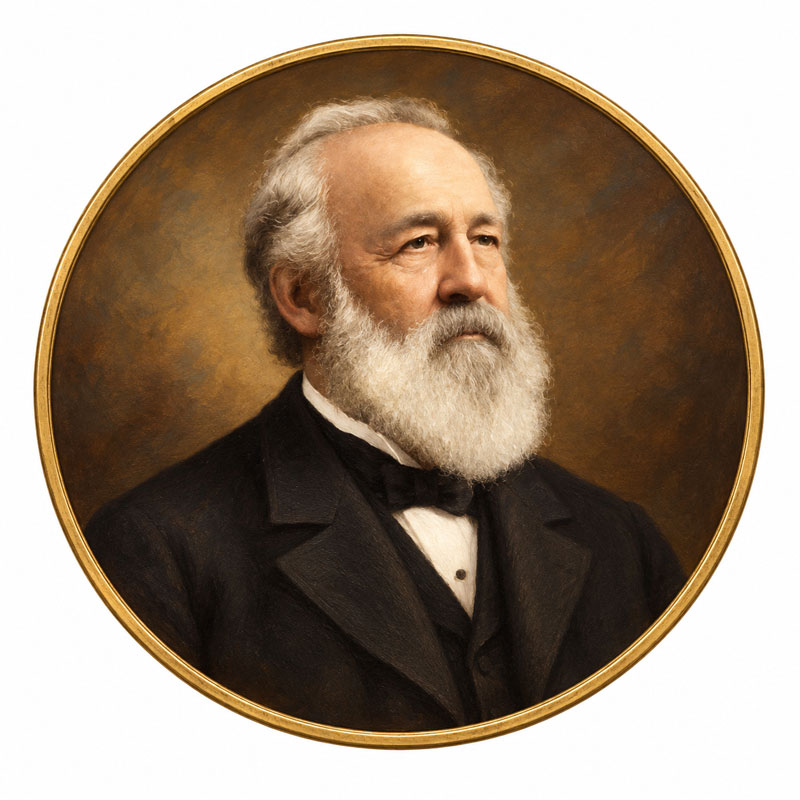
Daniel Baird Wesson is one of the key figures in the history of the American revolver and, more generally, in the evolution of metallic cartridge weapons during the second half of the nineteenth century.
His name is inseparable from that of Horace Smith , with whom he began a collaboration in 1852 that was destined to produce some of the most important innovations in the American arms industry.
But to consider Wesson simply one of the two founders of Smith & Wesson would be reductive.
His career spans over half a century of technical transformations: from the first repeating weapons fed with self-contained ammunition to rimfire revolvers, from large centerfire revolvers to extraction systems, up to double-action weapons and the famous .38 Military & Police introduced at the end of the century.
Wesson was a gunsmith, designer, inventor, and entrepreneur. Above all, he possessed the ability to observe an innovation and immediately grasp its future possibilities.
Daniel Baird Wesson: biographical information
| Full name | Daniel Baird Wesson |
|---|---|
| Birth | 18 May 1825 |
| Place of birth | Worcester, Massachusetts, United States |
| Death | August 4, 1906 |
| Activities | Gunsmith, designer, inventor and entrepreneur |
| Historical member | Horace Smith |
| First partnership with Smith | 1852 |
| Industrial headquarters | Springfield, Massachusetts |
| Fundamental innovations | Repeating weapons, metallic cartridge revolvers, extraction systems and development of centerfire revolvers |
| Symbolic weapons | Smith & Wesson Model 1, Model 3, Safety Hammerless, .38 Military & Police |
| Son and collaborator | Joseph Wesson |
| Heredity | Transformation of the metallic cartridge revolver into a mature, reliable, and industrially produced system |
Daniel Wesson's Education
Daniel Baird Wesson was born in 1825 in Massachusetts , in an area of the United States where an extraordinary concentration of mechanical and gunsmithing skills was developing during the first half of the nineteenth century.
From a young age he came into contact with the world of weapons construction and gained practical experience in mechanical processing.
This aspect is fundamental to understanding his figure.
Wesson didn't come to the industry as a mere financier. He was a man directly interested in the mechanics of the gun and its ammunition.
Throughout his career he would continue to personally intervene in the development of technical solutions and patents.
The meeting with Horace Smith
The decisive moment comes with the meeting with Horace Smith.
The two shared a particular interest in one of the most important problems of the time: building a weapon capable of repeated firing using self-contained, easily loaded ammunition.
In 1852 Smith and Wesson formed a partnership.
In this first phase, their interest is not yet focused on the revolver that will make the brand famous.
They are trying to develop a repeating weapon.
The problem wasn't just the gun: it was the ammunition.
One of the elements that most characterizes Wesson's technical thinking is the awareness that the evolution of firearms could not be separated from that of ammunition.
Building a mechanism capable of rapidly repeating the firing cycle made little sense if the shooter had to continue to handle the powder, projectile and primer separately.
The real revolution would come when all these elements were brought together into a single unit.
Smith and Wesson worked precisely in this direction.
From Rocket Ball to Volcanic
Their research followed the path begun by previous experiments on self-contained munitions.
The so-called Rocket Ball used a hollow projectile inside which the propellant charge was placed.
The solution allowed a repeating weapon to be fed much more quickly than traditional muzzle-loading systems.
Wesson contributed to the development of this concept together with Smith.
The result would flow into the weapon known as Volcanic.
The Volcanic: A more advanced idea of its ammunition
The Volcanic had extremely modern features.
A tubular magazine allowed more ammunition to be stored in the gun, and a lever controlled the cycle needed to feed the next round.
The main limitation was not so much the mechanical concept as the ammunition.
The amount of propellant that could be contained in the projectile cavity was limited and, consequently, the ballistic performance was also modest.
That experience, however, taught Daniel Wesson something fundamental: the repeating weapon needed a true metallic cartridge.
A new direction: the revolver
After the first industrial experience, Smith and Wesson turned their attention towards a different possibility.
The revolver was already an established reality, but the weapons of the time were mainly percussion.
The drum chambers had to be loaded with the various ammunition elements and prepared before firing.
The ability to feed a complete cartridge directly from the rear of the cylinder would have radically changed the system.
Rollin White and the cylinder pierced through and through
A decisive step was represented by the patent of Rollin White relating to the cylinder with through chambers.
The solution allowed a metal cartridge to be introduced directly from the rear of the chamber.
Daniel Wesson immediately understood the importance of that configuration.
Smith & Wesson obtained the rights to exploit it commercially and was able to develop a revolver designed specifically to use metallic cartridges.
It was a fundamental technical and industrial decision.
1857: The Smith & Wesson Model 1
In 1857 , the Smith & Wesson Model 1 was introduced , initially referred to as the “Seven Shooter.”
It was a small seven-shot revolver chambered for the .22 rimfire cartridge.
Its size may make it appear modest compared to the large revolvers that would come later, but its historical importance is enormous.
The Model 1 demonstrated concretely that a revolver could be designed from the ground up around a self-contained metal cartridge.
For the shooter this meant a vastly simpler loading procedure than with the percussion revolver.
Wesson and the development of the metallic cartridge
Daniel Wesson did not consider the cartridge a simple accessory purchased to be inserted into the gun.
It was an integral part of the project.
His work on ammunition continued alongside his work on weapons, and he contributed to the refinement of the first American metallic cartridges.
This is one of the most important aspects of understanding Wesson as a gunsmith.
The gun and cartridge are designed as elements of a single system.
Pressures, chamber dimensions, primer, extraction and case geometry must be compatible with each other.
The Smith & Wesson patent of 1860
On April 17, 1860, Horace Smith and Daniel B. Wesson were granted a patent for improvements in the construction and loading of metallic cartridges.
It is a concrete testimony to the attention that both devoted to ammunition.
For Wesson, this research would remain central to his subsequent developments.
From small rimfires to the most powerful revolvers
The success of the Model 1 proved the principle sound, but Wesson understood that the future could not be limited to small rimfire revolvers.
It was necessary to increase size and performance.
The range then began to evolve towards larger weapons and more powerful cartridges.
It is in this passage that Daniel Wesson's ability to not consider a successful product as a point of arrival particularly emerges.
Each solution became the basis for the next.
The American Civil War
The outbreak of the Civil War in 1861 greatly increased the demand for weapons.
Metallic cartridge revolvers offered obvious advantages in terms of ease of loading and practicality.
The war thus helped to make technologies familiar that just a few years earlier had still been considered innovative.
For Smith & Wesson it was also a phase of strong production growth.
1870: The Model 3 American
One of the key milestones in Daniel Wesson's career came in 1870 with the Smith & Wesson Model 3 American.
This time it's no longer a small rimfire revolver.
The Model 3 is a large, centerfire , metallic cartridge revolver.
With it, the technology developed through previous experiences definitively enters the sector of large-caliber handguns.
The top-break system
One of the defining elements of the Model 3 was its top-break architecture.
By unlocking the upper part, the barrel and cylinder could swing away from the frame.
The movement allowed the chambers to be accessed and the extraction system to be activated at the same time.
For Wesson, the problem was not just making loading quick.
It was also necessary to quickly dispose of spent shells.
Wesson and the extraction problem
It is precisely in the study of extraction that Daniel Wesson's technical approach emerges again.
A metal cartridge in fact introduces a problem that did not exist in the same way in previous percussion weapons: after the shot, the case remains in the chamber.
It must therefore be removed quickly and safely.
Wesson worked directly on mechanisms intended to improve this phase and developed patented solutions for revolvers and extractors.
The practical speed of a gun now depended not only on how quickly it could fire, but also on how quickly it could be emptied and reloaded.
Model 3 and the international dimension
The Model 3 also opened up a much broader international dimension for Smith & Wesson.
Several variants were developed to meet different military and commercial needs.
For Daniel Wesson, this meant dealing with specifications, ammunition, and demands from different markets.
The company was no longer just an American manufacturer of innovative revolvers.
It was now a manufacturer with an international presence.
1873: Horace Smith retires
In 1873 a fundamental transition occurred in Daniel Wesson's life.
Horace Smith sells his interest in the company to Wesson and retires from the business.
The collaboration between the two men had produced extraordinary results, but from that moment on the responsibility for the enterprise fell directly on Daniel Wesson.
The brand retains both surnames.
The leadership, instead, passes to Wesson.
Daniel Wesson to lead the company
This stage is fundamental to distinguish Wesson's biography from that of Horace Smith.
Smith's story as a direct protagonist of the enterprise ends in 1873.
Daniel Wesson's continued for over thirty years.
During this period Wesson had to deal with the evolution of centerfire cartridges, the spread of double action, new frame architectures, different extraction systems and increasingly advanced competition.
It is therefore above all in its ability to continue to innovate after its initial success that its industrial personality emerges.
From single action to double action
The revolver continued to evolve.
Double action allowed the hammer to be cocked and the cylinder to rotate by pressing the trigger, making for a more immediate shot.
The growing demand for this type of operation pushed the company to develop a range of self-cocking revolvers.
For Wesson it represented a further step towards a faster and more intuitive handgun to use.
Daniel Wesson and his son Joseph
As the years went by, his son Joseph Wesson also entered the technical history of the company.
The relationship between father and son becomes particularly interesting because it shows the transformation of Smith & Wesson from a partnership between two inventors to a true industrial and technical dynasty.
Daniel is not just passing on a business to his son.
He involves him in weapons development.
The Safety Hammerless
In the early 1880s, Daniel Wesson and his son Joseph began work on a new type of revolver that would lack the traditional external hammer.
The result came to market in 1887 with the Safety Hammerless.
The hammer was enclosed within the frame, reducing the risk of external elements interfering with the mechanism during drawing or use of the weapon.
But the most recognizable feature was another.
The dorsal safety
The Safety Hammerless utilized an automatic shoulder safety integrated into the grip.
To allow the shot to be fired, the shooter had to hold the weapon correctly by compressing the safety lever.
The solution once again demonstrates Wesson's attention not only to mechanical operation, but also to the interaction between weapon and user.
The revolver had to be quick to use, but at the same time offer a level of safety adequate for its intended purpose.
1899: The .38 Military & Police
At the turn of the century, Daniel Wesson witnessed another milestone in the company's history.
In 1899 the .38 Military & Police was introduced.
The new revolver adopted a solid frame and a laterally breaking cylinder, thus abandoning the top-break architecture that had characterized many of the previous models.
It was a configuration destined to become one of the classic shapes of the modern revolver.
From top-break to swinging drum
This passage perfectly describes the technical philosophy that accompanied Wesson throughout his life.
A solution should not be retained just because it was successful.
When new needs required a different architecture, you had to be willing to change.
The solid frame offered a structure suitable for the new generations of cartridges, while the laterally swinging cylinder allowed quick access to the chambers.
The revolver thus entered the twentieth century with a completely different configuration compared to the small Model 1 of 1857.
Forty-two years of evolution
Comparing the 1857 Model 1 with the 1899 Military & Police provides insight into the extraordinary breadth of Daniel Wesson's career.
The first was a small rimfire revolver with a break-action frame.
The second now belonged to the modern generation of centerfire revolvers with a solid frame and a laterally opening cylinder.
Forty-two years passed between the two armies.
Daniel Wesson is present in both eras.
A designer who thought in systems
The true distinctive element of Daniel Wesson emerges when looking at all these innovations together.
Wesson didn't just work on the revolver.
He worked on the weapon-ammunition system.
A new cartridge required adequate chambers.
The case required an extraction system.
A more powerful cartridge might require a different chassis.
A new intended use could make an internal dog or a different safety device convenient.
Each element had consequences on the others.
From the gunsmith's bench to large-scale industry
Daniel Wesson's professional life also coincides with the transformation of the American gun industry.
When it first began its activity, most weapons still used percussion systems.
By the time he died in 1906, the centerfire metallic cartridge was fully established and industrial production had reached vastly superior levels of precision and standardization.
Wesson didn't just witness this change.
He was one of the men who directly contributed to making it happen.
Daniel Baird Wesson's Milestones
| Year | Event | Meaning |
|---|---|---|
| 1825 | Birth of Daniel Baird Wesson | One of the protagonists of the modern American revolver industry is born |
| 1852 | Partnership with Horace Smith | Collaboration begins on repeating weapons and self-contained ammunition |
| 1850s | Development of Volcanic | Smith and Wesson Experiment with Repeating Weapon and Integrated Ammunition |
| 1857 | Smith & Wesson Model 1 | The practical metal cartridge revolver becomes a commercial reality |
| 1860 | Patent relating to cartridges | Confirms Wesson's direct interest in the development of the ammunition |
| 1870 | Model 3 American | The house enters the era of the large centerfire revolvers |
| 1873 | Horace Smith's Retirement | Daniel Wesson acquires partner's stake and continues to lead the company |
| 1880 years | Development of double-action revolvers | Production follows the evolution towards more immediate shooting systems |
| 1887 | Safety Hammerless | Daniel and Joseph Wesson introduce a double-action revolver with a hammer and grip safety |
| 1899 | .38 Military & Police | The company enters the era of the modern solid-frame revolver with a break-action cylinder |
| 1906 | Death of Daniel Baird Wesson | A career spanning more than half a century of evolution of metallic cartridge weapons comes to an end |
Horace Smith and Daniel Wesson: two complementary figures
The biographies of the two founders should be read together, but not confused.
Horace Smith was instrumental in the pioneering phase that led from the first repeating weapons to the Volcanic and then to the birth of the Smith & Wesson revolver.
Daniel Wesson goes through the same phase, but stays with the company much longer.
After Smith retired in 1873, he continued to develop the product and accompanied the company through the transition from rimfires to large centerfires, from single to double action, and from top-break to solid frame with a break-action cylinder.
It is precisely this long technical continuity that makes his biography different from that of his partner.
Daniel Wesson and the pursuit of practicality
Looking at the weapons developed during his career, a recurring principle emerges: reducing the operations required by the shooter.
Self-contained ammunition eliminates separate loading of components.
The extraction system accelerates the removal of spent cases.
Double action reduces the number of operations required before firing.
The Safety Hammerless protects the hammer mechanism and introduces an automatic safety.
The swing-out cylinder makes access, extraction and reloading easier.
These are not isolated innovations.
They all follow the same direction: to make the revolver simpler, faster and more practical to use.
The Death of Daniel Baird Wesson
Daniel Baird Wesson died on August 4, 1906.
The world of arms he was leaving was radically different from the one he had begun working in.
When he was young, the percussion system was still the norm.
By the end of its life, the centerfire metallic cartridge revolver had reached a modern, mature configuration.
Few gunsmiths of the nineteenth century had the opportunity to directly participate in such a broad evolutionary arc.
The True Genius of Daniel Baird Wesson
Daniel Wesson should not be remembered only because his surname forms the second half of one of the most famous gun brands in the world.
Its importance is technical.
He understood that the future was in self-contained munitions.
He understood the possibilities of the rear-loaded cylinder.
He contributed to the development of the metallic cartridge.
He worked on extraction systems.
He brought the revolver to more powerful calibers.
The development of double action followed.
He participated with his son in the design of new security solutions.
And he continued to innovate even after achieving industrial success.
Why Daniel Baird Wesson is one of the great gunsmiths in history
The greatness of Daniel Baird Wesson emerges above all when comparing the beginning and the end of his career.
At the beginning we find a young gunsmith busy solving the difficult problem of building a repeating weapon powered by a self-contained ammunition.
Finally, we find an industry capable of producing modern centerfire revolvers, equipped with vastly more advanced mechanisms, extraction systems, and safety solutions.
Between these two extremes lies much of the technical history of the nineteenth-century American revolver.
And Daniel Wesson was one of the protagonists.
His most important contribution was therefore not a single weapon, but having accompanied the revolver throughout its entire evolution: from the nascent metallic cartridge to the modern configuration with which it would enter the 20th century.