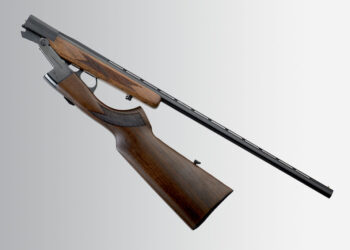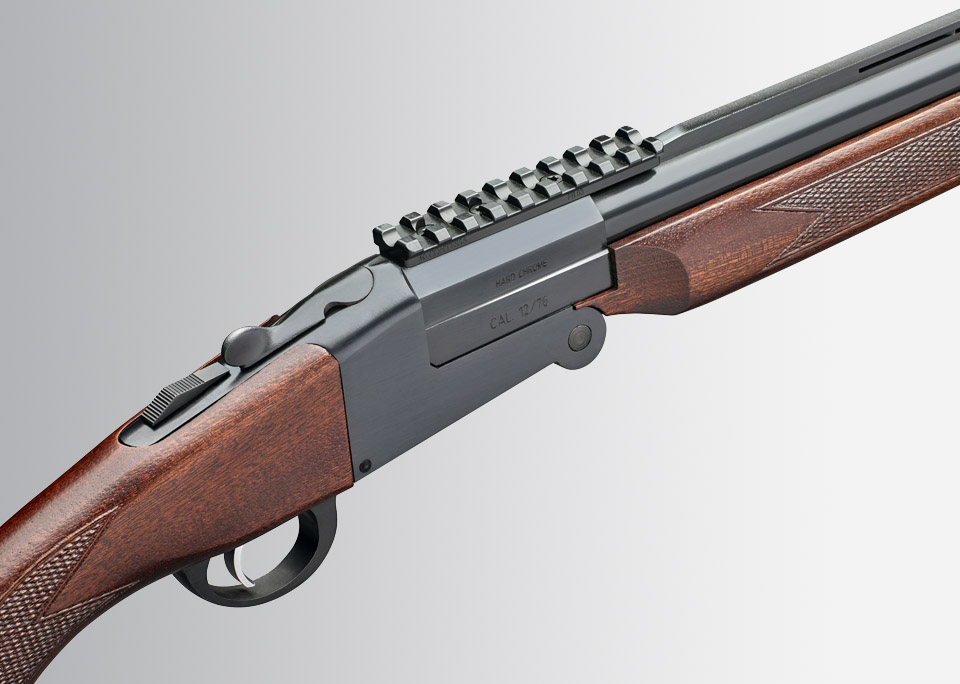
The EFFEBI BETA Stinger It represents a particular interpretation of one of the simplest and longest-lived architectures in the world of hunting weapons: the break-action single-barrel shotgun. EFFEBI officially presented the Stinger at EOS Show 2024 as a new single-barrel gun, ideally placing it in the Brescia-based company's long experience in the production of folding rifles.
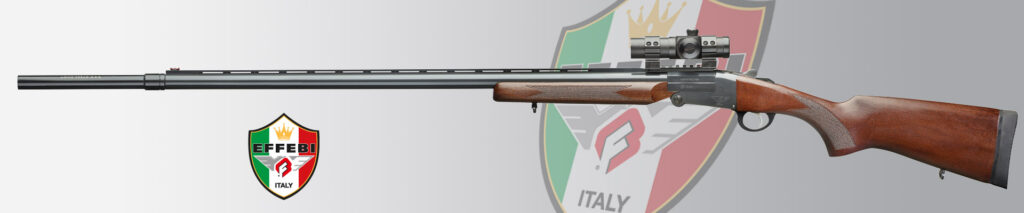
The starting concept is deliberately simple: a single barrel, simple action, and a gun that prioritizes practicality, reliability, and ease of transport. With the Stinger, however, this philosophy is reinterpreted with a more modern approach than the traditional single-barrel shotgun with a wooden stock and forend.
It is precisely this contrast that makes the project interesting: a basic mechanics inserted in a weapon with a contemporary image , designed for those who appreciate the simplicity of the single barrel but want something less traditional in appearance and ergonomics.
EFFEBI: a long experience in folding single-barrel rods
The Stinger did not arise in isolation. EFFEBI has long had a very comprehensive range of folding single-barrel spearguns. The BETA family includes different configurations, from the traditional BETA to the BETA Deluxe, from the BETA Key to the special BETA 110 with extension, up to the BETA 810.
Production EFFEBI is entirely linked to the Brescia arms district. The company, founded by Franco Beretta After his experience at Breda, over the years he has developed a production that includes hunting and shooting weapons, components, barrels, chokes, sights and numerous accessories.
This expertise in components is crucial to understanding even seemingly simple products like the Stinger. Behind a basic single-barrel shotgun lies a complex process involving the barrel, receiver, opening system, extraction system, and the coupling of the various parts.

The single-barrel: simplicity stripped to the essentials
Conceptually, few guns are as simple as a break-action single-barrel shotgun . The gun has a single chamber and a single barrel; after firing, it is opened, the spent case is removed, and a new round is inserted.
This architecture eliminates much of the complexity typical of semi-automatic and repeating weapons. There are no magazines to feed or systems to automatically transfer a second round to the chamber.
The main advantage is a simple mechanic to understand and control. The limitation is equally obvious: only one shot is immediately available.
It is therefore a type of weapon that requires a precise philosophy of use and which continues to have admirers precisely because it reduces the rifle to its fundamental functions.
Stinger: the attempt to overcome the image of the traditional single-barrel
For decades, the single-barrel shotgun has been almost automatically associated with an inexpensive shotgun, with a simple action and wooden stock. The traditional BETA family of EFFEBI largely follows this approach: the company's price list indicates for various models a smooth black action, beech wood and manual extraction.
The Stinger, on the other hand, was created with the aim of giving the concept a more contemporary image. The fundamental logic of the weapon doesn't change, but the way it is interpreted does.
This is an interesting operation because it demonstrates that even an extremely simple architecture can be rethought without necessarily adding mechanical complexity.
Foldability remains one of the strong points
One of the characteristic elements of the single-barrel family EFFEBI is the possibility of fold the weaponThe action allows the barrel group to be rotated relative to the stock, significantly reducing the overall size when the shotgun is not in use.
This feature distinguishes a folding single-barrel gun from many other long guns. Its compactness when folded makes it easier to carry in a case and easier to store.
However, foldability and lightness should not be confused: they are different characteristics. The former mainly concerns the size of the weapon when fully opened; the latter depends on the materials and the actual dimensions of the components.
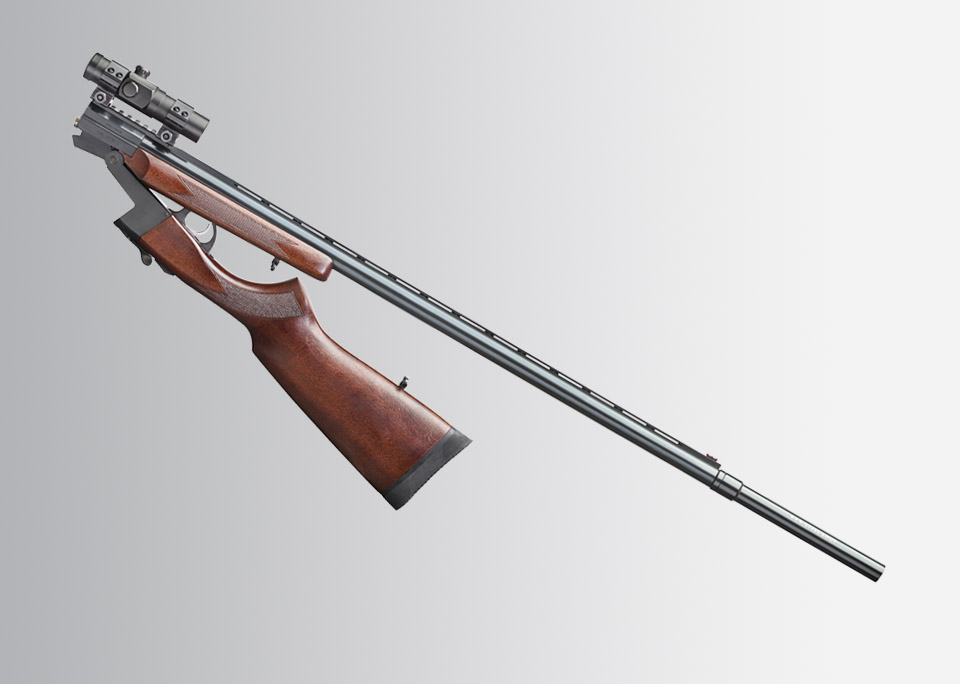
A single rod also means a different balance
The presence of a single barrel inevitably produces a different weight distribution compared to side-by-side and over-and-under shotguns. There's no weight for the second barrel, and the front end can therefore be relatively slim.
The dynamic behavior naturally depends on the length and specific profile of the rod, but in general a single rod can offer a feeling of great immediacy.
This is especially an advantage when the rifle is used in situations where compactness and speed of movement are considered more important than the ability to immediately fire a second shot.
The value of mechanical simplicity
One of the most interesting aspects of theEFFEBI Stinger is what you deliberately does not ownThere is no semi-automatic cycle, there is no loader and there is no need to synchronize numerous organs during feeding.
This reduces the number of mechanical variables and makes checking the gun's status very intuitive. When the rifle is opened, the chamber is immediately visible.
For many users, this simplicity is an integral part of the single-rod's appeal.
The relationship with the family EFFEBI BETA
To better understand the Stinger it is useful to compare it conceptually with the other single-barrel guns of the family EFFEBI.
The traditional BETA represents the most essential configuration: folding single barrel, manual ejector, smooth black action, beech wood and 71 cm barrel without rib.
The BETA Deluxe maintains the same general setup but adds the ventilated rib.
The BETA Key introduces top-key opening, while the BETA 110 in .410 caliber adds the special 40 cm extension to the 71 cm barrel.
The BETA 810 instead follows a different philosophy with an 81 cm barrel.
The Stinger must therefore be read as a further evolution of the concept: not simply another barrel length, but a more contemporary reinterpretation of the single barrel. EFFEBI.
A weapon that favors the first shot
Using a single-barrel shotgun means accepting a very simple rule: after the first shot, there is no second cartridge immediately available.
This necessarily influences the way the rifle is used. The shooter must place greater importance on building the first shot and choosing the right moment.
It is therefore not an architecture designed to compete with a semi-automatic in terms of number of rounds. Its value lies precisely in the opposite philosophy: reducing the weapon to the essentials and entrusting everything to a single available round.
Stinger and wandering fighter
A compact single-barrel shotgun can find its place in stalking hunts , especially when the user prefers simple and easily transportable equipment.
The reduced complexity and the absence of a second tube or power supply system can help keep the overall dimensions down, while the ability to fold the weapon is an advantage in transport.
However, the choice must be made with awareness: in some forms of hunting, the immediate availability of a second shot can be crucial. The Stinger is therefore aimed primarily at those who consider a single-barrel shotgun a specific choice and not simply a cost-effective alternative.
The single-barrel as a specialist weapon
It's interesting to note how in recent years the single-barrel shotgun has been progressively re-evaluated as a specialized weapon. Its simple construction allows for highly specialized configurations without having to adapt complex feeding systems.
EFFEBI itself has demonstrated this philosophy through models such as the BETA 110, BETA 810 and its own folding rifles.
The Stinger ideally continues this path, trying to transform a historical concept into a product with a more contemporary personality.
Ergonomics: especially important on a light and simple weapon
When the gun features extremely basic mechanics, ergonomics takes on an even more prominent role. The grip, stock, and forend become the primary points through which the shooter perceives the rifle.
The position of the strong hand should allow for natural control of the trigger, while the front hand should be able to guide the barrel without introducing unnecessary tension.
A well-balanced single-barrel gun can be very quick to pick up, but a low mass also makes any sudden movements more noticeable. The best technique, therefore, is to guide the gun smoothly.
Maintenance: one of the advantages of the single-barrel
Routine maintenance of the Stinger inevitably benefits from the simplicity of its architecture. Once the rifle is opened, the chamber and barrel are easily accessible for routine cleaning.
Even the action area can be inspected without having to intervene on complex feeding systems or bolt groups.
This doesn't mean that a single-barrel shotgun doesn't require maintenance. The locking surfaces must be kept clean and properly lubricated, while the barrel itself must be treated according to the conditions in which it was used.
EFFEBI BETA Stinger: technical data sheet
| Feature | EFFEBI BETA Stinger |
|---|---|
| Producer | EFFEBI Srl di F. Beretta |
| Production | Concesio, Brescia – Italy |
| Model | Stinger |
| Introduction | EOS Show 2024 |
| Typology | Single barrel |
| Architecture | Tilting / folding |
| Number of rods | 1 |
| Number of shots immediately available | 1 |
| Constructive philosophy | Modern, essential and compact single-barrel |
| gauges | To be verified on the specific marketed version |
| Barrel length | To be verified on the specific configuration |
| Choking | Dependent on configuration |
| Weight | Not clearly stated in the documentation EFFEBI publicly available consulted |
| Destination | Hunting use and uses in which simplicity and compactness are privileged |
Note: EFFEBI officially presented the Stinger at the EOS Show 2024 as a new single-barrel rifle. Some dimensional data for the model are not reported in the public documentation. EFFEBI currently indexed; for this reason the values of the other BETA models have not been attributed to the Stinger.
EFFEBI BETA Stinger and BETA 110: Two Different Philosophies
The comparison with the BETA 110 is particularly interesting. The BETA 110 focuses entirely on an immediately recognizable technical feature: a 71 cm barrel and a 40 cm extension , for an extremely high overall development.
The Stinger, on the other hand, follows a different philosophy. Its appeal stems from a modern and compact reinterpretation of the single-barrel shotgun, while the BETA 110 is a project strongly characterized by the possibility of modifying the length of the barrel system.
So they are not two versions of the same concept, but two very different ways of developing the simplicity of the single-barrel.
A product consistent with the philosophy EFFEBI
The Stinger is also a good example of the particular position occupied by EFFEBI in the Italian firearms scene. The company doesn't just produce complete weapons, but also manufactures and sells a large number of components: smoothbore and rifled barrels, chokes, ribs, sights, stocks, forends, and other parts for sporting weapons.
This knowledge of components allows the Brescia-based company to experiment with sometimes unusual configurations, while maintaining a production that is declared 100% Made in Italy.
Conclusions: EFFEBI Stinger, the single-barrel gun changes its image
The EFFEBI BETA Stinger It starts from a concept that's almost impossible to simplify further: a barrel, a cartridge, and a break-action action. Yet this very simplicity is its main characteristic.
EFFEBI chose not to transform the single-barrel shotgun into something it isn't. The Stinger retains the philosophy of a simple, folding gun, while trying to give it a more contemporary identity than the classic BETA models with beech stocks.
The result is interesting above all for the hunter who considers the single-barrel not simply an economical shotgun, but a voluntary choice based on simplicity, compactness and immediate operation.
Within the family EFFEBI, the traditional BETA represents essentiality, the BETA Deluxe adds a more complete configuration, the BETA 110 takes the concept of length to the extreme through the extension, while the Stinger seeks to bring the single-barrel into the present through a more modern setting.
And this is probably the best way to interpret it: not to reinvent the single-barrel shotgun, but to demonstrate that even one of the simplest architectures in the history of hunting weapons can still be developed and reinterpreted.