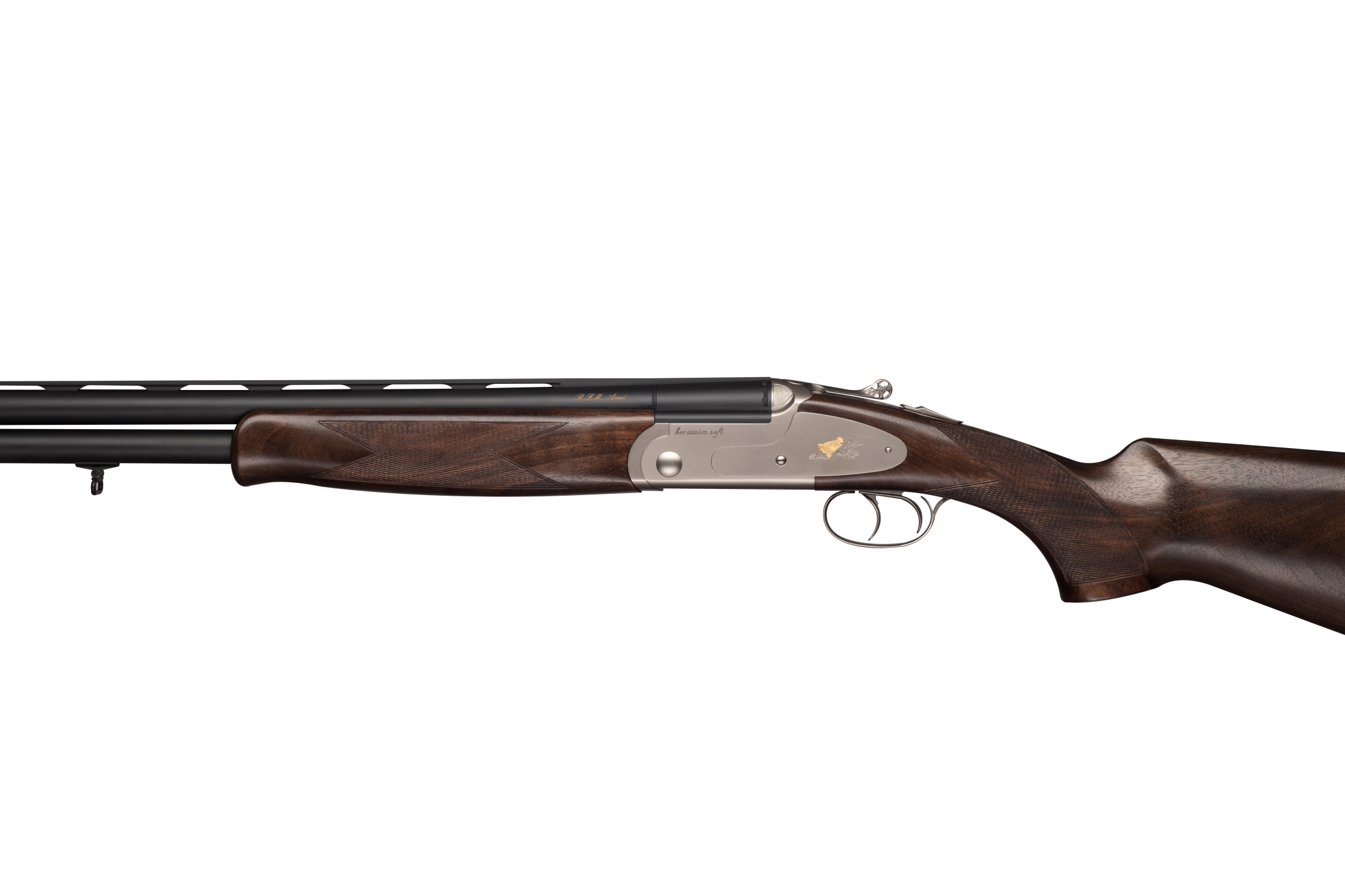
Woodcock hunting imposes very different demands than many other forms of hunting. Shooting is often done at close range, time can be very limited, and vegetation limits both the view and the gun's freedom of movement. It is precisely in these conditions that the RFM SK Bécassier Soft and the RFM Bécassier S Soft take on meaning , specialized over-and-under shotguns developed by the Sarezzo-based company for hunters who primarily frequent woods and dense environments.
These aren't just ordinary over-and-unders with shortened barrels. The entire project revolves around three specific needs: keeping weight low, making it easier to shoulder, and achieving patterns suitable for close-range shots.
The word "Soft" perfectly describes this setup. The Bécassier must be pleasant to carry for long hours behind the dog and immediate to use when, after miles of walking, the woodcock gives you only a few moments to complete the shot.


A specialist rifle, not a shortened “all-purpose”
The key concept for understanding the Bécassier family is specialization . A standard over-and-under hunting shotgun must find a balance between close-up and long-distance shots, open environments and woodland, stability and speed. A Bécassier can afford to sacrifice some of this versatility because it was designed for a much more specific purpose.
In thickets, a very long barrel and a high degree of forward momentum can become disadvantages. Likewise, a choke designed to maintain a concentrated pattern at long range isn't necessarily the ideal solution when game is engaged at just a few meters.
RFM has therefore built these models by privileging the characteristics that are truly useful in the forest, consciously accepting a less generalist vocation.
SK Bécassier Soft: the compact over-and-under of the family
The RFM SK Bécassier Soft is an over-and-under shotgun with an extremely compact configuration. The model is also available in 20 gauge , a particularly coherent solution with the goal of reducing weight and size without entering the even more specialized territory of smaller gauges.
The overlapping barrel arrangement keeps the front section of the gun narrow and allows for a short, easily controllable assembly. The desired feel is not that of a sporting shotgun that continues its movement thanks to inertia, but of a gun capable of reacting rapidly to the hunter's movements.
This makes a significant difference when shooting between logs, branches, and undergrowth, where the woodcock's trajectory can change direction in a fraction of a second.
Bécassier S Soft: greater aesthetic characterization
The Bécassier S Soft develops the same specialized concept, introducing a more refined presentation. The letter S identifies a configuration in which aesthetics take on greater importance, making the shotgun attractive to those seeking a gun dedicated to woodcock hunting without sacrificing a superior level of finish.
It is therefore useful not to interpret the SK and S as two completely unrelated projects: they belong to the same Bécassier philosophy, while they change configuration and trim level.
The Ergal 55 frame reduces weight at the most important point
One of the fundamental technical solutions of the Bécassier Soft is the Ergal 55 receiver . The use of this light alloy allows for a significant reduction in mass compared to an equivalent structure made entirely of steel.

The advantage isn't just the number on the scale. Removing weight from the central area changes the feel of the entire gun and allows for an extremely agile over-and-under without having to overwork the other components.
On a rifle intended to be carried for many hours and used for a relatively limited number of shots during the day, this choice seems particularly rational.
Gardonese closure with low gusset
The mechanism uses a Gardonese closure with a low lug that acts on the lugs , a solution widely tested in the production of Brescia over-and-under shotguns.
The Bécassier doesn't require the oversized mechanics required for a target rifle designed to fire tens of thousands of rounds a year. The goal is to achieve a reliable structure while keeping weight and size under control.
61-centimeter barrels: the measurement that defines the Bécassier
The 61 cm barrels are one of the most distinctive elements of the project. Compared to traditional 71 or 76 cm barrels, they significantly reduce the overall length of the over-and-under and make it easier to move through the undergrowth.
The advantage is especially noticeable when shouldering the weapon. The lower forward inertia allows for rapid acceleration and direction correction with small movements of the arms and torso.
This characteristic, however, requires proper technique: a very fast rifle can also be more sensitive to movement errors. The goal shouldn't be to "snatch" the shot, but to exploit agility to quickly reach the trajectory while still maintaining proper fluidity.

Tri-alloy steel for the barrel group
The barrels are made of tri-alloy steel . In the 28-gauge Bécassier Soft, the 61 cm group weighed in at around 900 grams , making a significant contribution to the overall lightness of the gun.
The construction therefore seeks to obtain a sufficiently light front end to guarantee the required speed without turning the rifle into an object without control during movement.
Blunt chokes: patterns designed for short range
A particularly interesting feature of the Bécassier Soft is the very open chokes, similar to a Skeet/Skeet configuration in models specifically intended for close-range shooting.
The goal is diametrically opposed to that of a Full choke. In the woods, maintaining a very high concentration at long range is not important: it is more useful to quickly obtain a wide and sufficiently uniform pattern , capable of increasing the effective surface area when the game starts close.
RFM still allows you to customize chokes. This option is important because not all woodcock hunters hunt in the same environment: an extremely closed forest may require a different setup than an area where shooting opportunities arise even beyond the first vegetation layer.
20 gauge: a natural choice for the woods
The 20 gauge is probably one of the most balanced interpretations of the SK Bécassier Soft concept. It allows for a reduction in size and weight while maintaining a pellet count that still offers good flexibility when choosing cartridges.
For the hunter who wants a specialized rifle but doesn't want to drop to .28 or .410, it represents a very interesting solution. It also allows for the use of moderate loads, particularly consistent with a lightweight gun and shots taken primarily at close range.
28-gauge: the Bécassier becomes even more specialized
The 28-gauge Bécassier Soft takes the concept of lightweight to a new level. In a documented configuration, the shotgun weighs approximately 2,14 kg : an extremely low value for a hunting over-and-under.
This lightness is especially noticeable after a few hours in the woods. The difference compared to a three-kilogram rifle may seem modest on paper, but it becomes noticeable after a long day spent on difficult terrain.
The 28, however, requires careful management of distances. It would be pointless to exploit such a specialized weapon and then try to compensate for its small caliber with excessive loads.
A grouping verified at 12 and 18 meters
A configuration of the 28 gauge Bécassier Soft with Skeet/Skeet chokes was tested at distances of 12 and 18 meters using a 17 gram cartridge with number 11 shot. The results showed a wide distribution, consistent with the intended purpose of the shotgun.
The distances chosen are significant: instead of checking the behavior at the classic medium-long shooting distances, the test was set precisely in the operating range for which the Bécassier was created.
Selective single trigger or double trigger
RFM allows you to configure the shotgun with a selective single trigger or double trigger . The single trigger allows you to maintain the same finger position and pre-select the barrel order.
The double trigger, on the other hand, offers an interesting advantage when two different chokes are chosen: the hunter can instantly decide which barrel to use simply by choosing one of the two triggers.
In a hunt characterized by extremely rapid decisions, both solutions have their own logic; the choice should depend above all on the automatic mechanisms already acquired by the owner.
Automatic or manual extractors
Ejection can also be configured to suit the hunter's preferences. Automatic ejectors eject spent cases when the gun is opened, allowing for very quick reloading; manual ejectors allow for retrieval of spent cases directly from the chambers.
On a Bécassier intended to fire relatively few cartridges during a hunting day, the choice depends mainly on personal habits.
6mm rib and high visibility sight
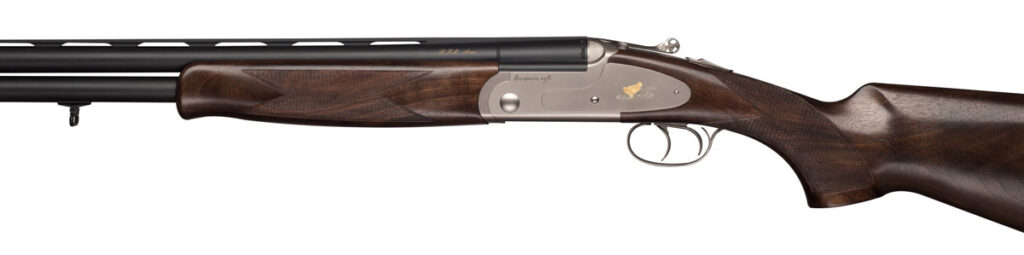
The Bécassier Soft configuration uses a narrow, ventilated, and anti-glare top rib, around 6 mm thick . Its narrow width is consistent with the proportions of the shotgun and keeps the visual reference unobtrusive.
The front sight can be made of high-visibility fiber optics , with different colors available. When hunting, often in conditions where light is filtered by vegetation, an easily visible front dot can help instinctively acquire the gun's line, while keeping your attention focused on the game while shooting.
Walnut stock and open grip
The stock is made of walnut , with the option of choosing a higher grade than the standard configuration. One documented solution uses a 2,5-grade wood, a relatively open pistol grip, and fine-pitch manual checkering.
The loose grip is particularly suited to a rifle of this type because it leaves the wrist a certain amount of freedom during rapid changes in line of fire.
The goose-beak forend completes a slim configuration and maintains a good grip without visually weighing down the front end.
The rubber butt pad has a concrete function
A solid rubber buttpad of about 15 mm may seem like a marginal detail, but on a rifle weighing just over two kilograms it takes on an important function.
For the same cartridge, the reduction in the gun's mass increases the perceived recoil. The Bécassier is not designed for heavy loads, and the presence of an elastic element on the butt helps make cartridges more comfortable for its intended purpose.
SK Bécassier Soft and Bécassier S Soft: who are they for?
These RFMs make sense especially for the specialist woodcock hunter . The hunter who wants to buy a single over-and-under shotgun to use on waterfowl, wood pigeons, pheasants, and woodcocks might find a more generalist model more rational.
Those who spend most of the season in the woods chasing their dog can really take advantage of the project's features: small size, low weight and the ability to build shot patterns around the typical distances of this type of hunting.
SK or S Soft: which one to choose?
The choice must start from the desired trim level. The SK Bécassier Soft very directly expresses the concept of a specialized over-and-under, prioritizing functionality and lightness above all.
The Bécassier S Soft is aimed at those who wish to retain the hunting characteristics of the project while adding greater attention to finishes and aesthetic presentation.
The fundamental difference, therefore, doesn't concern the game they're intended for: both share the same philosophy. It's primarily the trim level that determines the choice between the two versions.
RFM Bécassier Soft: reference technical data sheet
| Feature | RFM Bécassier Soft |
|---|---|
| Producer | R.F.M. Armi |
| Headquarters | Sarezzo, Brescia – Italy |
| Typology | Specialist over-and-under hunting shotgun |
| Main destination | Woodcock hunting / hunting in the forest |
| Versions | SK Bécassier Soft / Bécassier S Soft |
| Documented calibers | 20 and 28; availability to be verified according to current configuration |
| Documented 28 gauge chambering | 70 mm |
| Weighing machine | Ergal 55 in the documented Soft configurations |
| Closure | Gardonese with low gusset on crampons |
| Cane | Tri-alloy steel |
| Reference barrel length | 61 cm |
| Documented specialist bottlenecks | Fixed Skeet / Skeet with trumpet |
| Alternative bottlenecks | Configurable on request |
| Extraction | Automatic or manual |
| Shoot | Selective single trigger or double trigger |
| Bindella | Approximately 6mm, ventilated and anti-reflective |
| Viewfinder | High visibility fiber optics |
| Safety | With cursor on the rocker switch |
| Stocking | Walnut; customizable grade and configuration |
| Documented grip | Open gun |
| Documented dipstick | Goose beak |
| Recoil pad | Solid rubber, approximately 15 mm in the documented configuration |
| Documented 28 gauge barrel weight | About 0,9 kg |
| 28 gauge overall weight documented | About 2,14 kg |
| Production | Made in Italy |
Technical note: RFM manufactures highly customizable firearms. The data shown describes the documented Bécassier Soft configurations and should not be interpreted as mandatory for every model. Caliber, chokes, trigger, ejection, wood, and finish may vary depending on the order and the evolution of the range.
Conclusions: a true forest specialist
The RFM SK Bécassier Soft and the Bécassier S Soft belong to an increasingly less common category of rifles: that of weapons deliberately designed to perform a specific task very well rather than adapting discreetly to any use.
It's precisely this specialization that determines its value. The woodcock hunter can choose a compact over-under, configure its patterns based on the distances at which he normally shoots, and adapt various details to his own preferences.
The level of specialization changes between 20 and 28 gauge; between SK and S, the desired level of equipment changes above all. The destination, however, remains crystal clear: the woods, the dog, and that sudden shot in which just a few moments separate the woodcock from its point and its flight.