The construction of reeds in the past required great manual skill, a lot of work and a constant search for materials.
The hunting rifle barrel is the fundamental part of any firearm. Today, as in the past, depending on the material it's made of, its bore for various calibers, and its shape, it can bring either great satisfaction or bitter disappointment. Today, barrels are mostly produced using industrial processes and highly advanced steels, but once upon a time, this wasn't the case at all.
The first hunting rifle barrels were the so-called "twisted" ones , creations that required a decidedly lengthy manufacturing process and a team of specialized craftsmen to achieve a satisfactory result. Patience and great skill were therefore required. The complex process involved a long, conical-shaped iron rod, which 1800th-century craftsmen called a mandrel. After preliminary heating, small metal rods measuring a few millimeters on each side were spirally wound around it. The material for the rods was the result of a metallic union between iron, bronze, steel, silver, nickel, and sometimes even gold, which were joined together through heating and hammering.
Once the spiral winding was completed, achieved with great hammerwork, before proceeding to the next steps, the gunners would perform a real bench test on the barrel, in their own way. This consisted of closing the tube at the mouth with a wooden plug wrapped in rags for an effective seal, while at the other end, after filling the barrel with water, a plug made of a particularly hard wood (dogwood was almost always used) was inserted.
Then the dowel was struck with a mallet, effectively creating considerable pressure inside the tube. Thus, if the tube was not properly welded at all its joints, fractures would be visible, and the cane would be considered defective and not sent for further processing. The canes (at the time, single-barreled or double-barreled) were then joined with all the parts intended to form the lugs and cross and prepared for the welding operations. The tubes were first tied together with all the various parts: ribs, lugs, tenons. Then, everything was covered with a unique mixture of clay and horse manure. The mixture was left to dry very slowly.
It was then placed in a furnace until it reached 800 degrees, the melting point of the brass solder. The melting of the brass, and therefore the reaching of 800 degrees, was indicated by the color of the flame, which turned greenish.
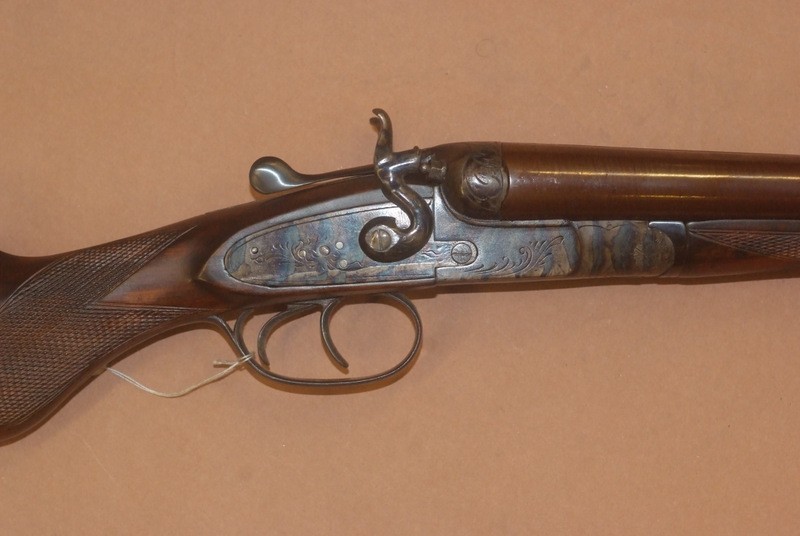
After welding and when the metal had fully returned to room temperature, the barrels were checked and straightened as needed. The tool used to do this is still seen today in almost all gun manufacturing companies and essentially consists of a wheel and two housings that hold the barrel. The gunner, using the shadow system, would sight the barrel, identify the points where straightening was needed, and perform the adjustments by turning the wheel. The entire operation was done manually—or rather, by hand and eye—and required considerable experience.
We then moved on to the internal calibration of the barrel, carried out with a machine called a “banchina”, equipped with a mandrel with a transverse hole, a cutter and a feed carriage.
As the work progressed, the cutters were changed by hand, turning the machine back and forth until the desired caliber was achieved. The work was then polished with lead and oil, always using the same working method.
Generally, barrels were designed to have a minimum length of 80 cm, and as is evident from the process, they did not have the current end choke, but rather the entire barrel was a single continuous section, wider at the breech and narrower at the muzzle. At the time, the standard chamber length was 75 mm for 10-gauge, 65 mm for 12-, 16-, and 20-gauge rounds, then progressively shorter from 60 to 65 mm for the smaller calibers.
After these actual structuring activities of the canes, we moved on to milling the lugs and tenons using a "violin drill" placed on the belly.
The barrels were then passed on to other workers for external stretching to eliminate all the accumulated burrs. The work was practically finished with a burnishing, before moving on to the harpooning phase and subsequent joining to the wooden parts (stock and forend).
In Italy, specifically in the Bergamo and Brescia areas, twisted barrels were produced until the early 900s.
__________________________________