
Towards a business model: the turning point for wildlife and hunting companies in the 2026 Budget Law.
An interesting article has recently been published in the Journal of Applied Ecology (Podgórski et al. , 2025*), which offers an in-depth analysis of the behavioural effects of selective hunting and drive hunts on wild boar populations, also highlighting possible management implications.
The research was based on satellite telemetry data from 21 European populations of the species, spanning nine countries, for a total of 289 monitored individuals. The researchers specifically examined the effect of the two traditional hunting methods on wild boar social contacts, both within and between groups, also taking into account factors that may influence contact, such as habitat productivity, population density, predation, seasonality, sex, and spatial proximity between groups.
Selective hunting, which notoriously involves the targeted killing of individual animals, has not shown significant effects on social contact within wild boar groups. This hunting method therefore appears to have less impact on the social structure of groups, as it can be targeted at specific target individuals , such as adult males, which have been shown to be the main culprits in intergroup contact.
The social structure of wild boars is based on matrilineal groups, whose nucleus is composed of related females who maintain long-lasting relationships and have little contact between different groups. Young males remain in family groups until dispersal (around 10 months of age).
Considering the main challenges currently underpinning management strategies for this ungulate, not only in Italy (control/prevention of ASF and mitigation of agricultural damage), positive effects are also highlighted for driven hunting. Indeed, during the months of driven hunting, contact rates between individuals within groups are significantly reduced, from 0,45 in non-hunting months to 0,22 in hunting months. Meanwhile, contact rates between different groups are not affected by hunting methods and maintain similar contact rates between individuals across all months.
Although hunting causes a reduction in social cohesion within groups, the effect is only temporary and intra-group contact returns to normal levels within a short time. In summary, the impact of hunting on wild boar social structure is limited to the individual groups involved and limited in time. The authors write that contrary to what was expected, their results do not support the previous hypothesis, by Iacolina et al. (2009), according to which individuals from different groups can reorganize or form random associations in response to hunting disturbance.
Given that interactions between groups play a particularly important role in pathogen transmission (particularly directly transmitted infectious diseases), the conclusion of this research, based on objective data, does not support a disruptive role of driven hunting in facilitating the spread of directly transmissible diseases. The authors hypothesize that escape movements triggered by driven hunting may represent a risk factor for transmission in neighboring areas, but this hypothesis is not supported by any conclusive data. However, overlapping home ranges of groups were the strongest predictor of intergroup contact rates compared to hunting, as is natural, even compared to density, habitat suitability, and resource distribution.
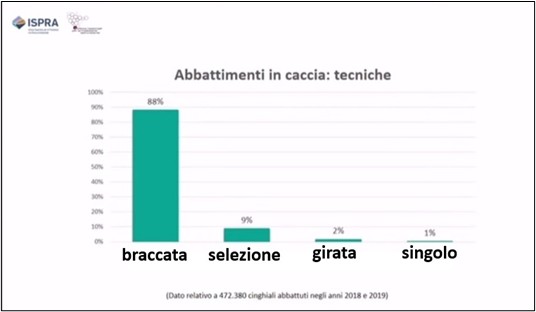
The authors believe that the reduction in group cohesion during collective hunts could affect individual survival with respect to predation, resource utilization, and food efficiency. This is a very important point for a species currently subject to "depopulation" measures. In other words, driven hunting appears to produce additional effects that go beyond the numerical impact on groups (unlike selective hunting), potentially contributing to limiting the increase in wild boar populations. It should be noted, however, that according to ISPRA data, driven hunting accounts for 88% of direct culls in Italy (calculated on 472.380 wild boars killed in 2018 and 2019).
The authors, with a view to sustainable population management (therefore regardless of depopulation or containment needs), suggest that careful management of collective hunting areas, avoiding multiple interventions in the same hunting areas during the season and therefore targeting different groups each time, could mitigate the "negative" effects of driven hunting, improving the survival of the remaining individuals.
Adult males, however, play a crucial role in maintaining intergroup connectivity, facilitating interactions between different groups and maintaining natural gene flow. This male behavior, especially during the mating season, could play a specific role in disease transmission. Consequently, to contain the spread of disease in certain areas, it may be useful to focus selective hunting on male removal.
Overall, therefore, selective hunting is evaluated positively for its low impact on social cohesion and the possibility of targeted population management. At the same time, driven hunting, while having a temporary impact on group cohesion, can be used strategically to reduce wild boar density.
Based on this work, it emerges that both methods of wild boar hunting are useful tools for managing the species' populations, even if they require careful planning to maximize the benefits for the purpose of containing the significant problems associated with the exceptional spread of this ungulate throughout Europe.
Taken from Federcaccia.org