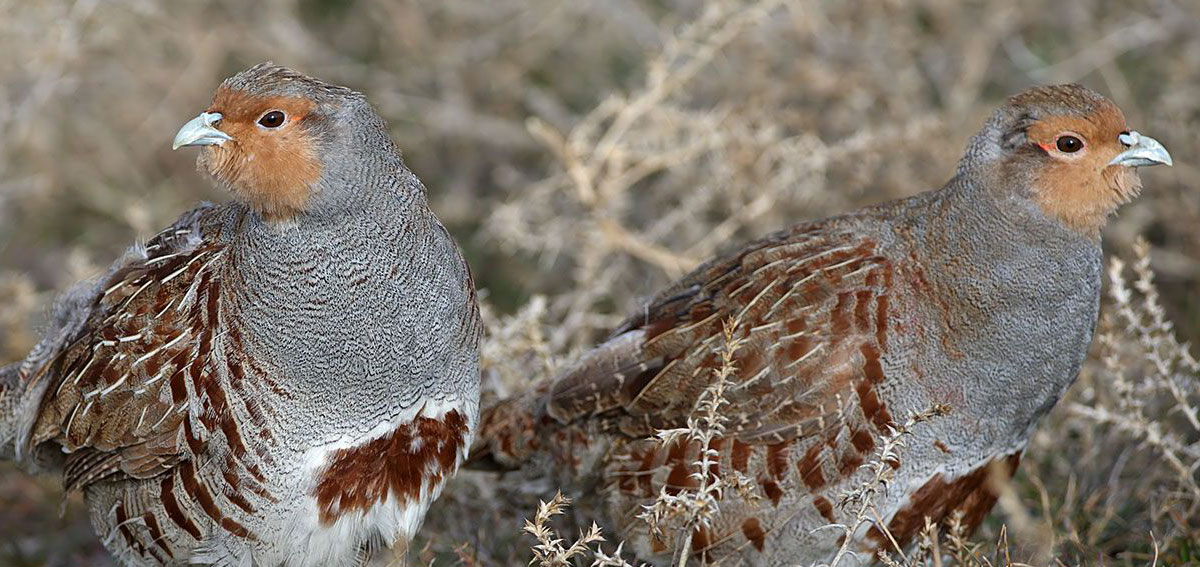

ONCFS – (Office National de la Chasse e de la Faune Savage) – The gray partridge or partridge
Management proposals
Setting targets by habitat type
The gray partridge, or grey partridge , prefers large, open cultivated plains, likely reflecting its original steppe habitat. It is much less abundant or absent in more wooded or closed, wet, and grassy environments. The set of objectives must therefore be realistic and match the environment's potential. It makes no sense to try to establish grey partridges everywhere, defying their ecological needs.
Population Management
Harvest management through hunting has been progressively developed over the last twenty years. Today, harvests are limited by French administrative measures (most commonly, with bracelets and/or a limited number of hunting days) in more than a third of municipalities.
Releases can be carried out to consolidate a natural population. Releasing young birds in the summer seems to yield the best results. However, some examples have shown that without a thorough diagnosis that highlights excessive hunting pressure, or without significantly addressing potential habitat degradation (biotope and/or predation), there is a significant risk of failure, even when operating on a large scale and releasing large numbers of birds.
These operations, which involve significant human and financial resources and can discredit their promoters if unsuccessful, must therefore be particularly carefully considered. Approximately 17% of municipalities conduct fires, especially in areas where grey partridges are still highly sought after by hunters, but where wild populations cannot meet demand under hunting pressure, it is still beneficial to supplement populations.
This is the case in the regions bordering the Paris Basin to the west and south and the Île de France. Shooting has never been encouraged by the CNERA PFSP, whose research and study policy has always been oriented towards managing (or reconstituting) wild populations. This is the case, if we take hunters' satisfaction as our political vision.
However, it is worth remembering the disadvantages of such a practice for the conservation of wild birds.
Consequences on management.
Experience shows that it is very difficult to manage natural populations into which farmed birds are introduced annually, except when it is possible to save them upon request (the hunting plan applies only to natural birds, meaning it is easy to identify farmed birds and stop hunting as soon as the hunting plan is reached ). Furthermore, the large number of released partridges available for hunting causes hunters to gradually lose interest in managing wild populations and environments. This can lead to the near extinction of wild partridges, even in areas where they could be maintained in significant numbers. Conserving wild populations in this context therefore presupposes the obligation for hunters to implement environmental management and actively participate in population monitoring.
Genetic consequences.
It has not been possible to generally estimate the level of “ genetic pollution ” caused by releases intended to strengthen populations because, if it exists, it probably depends on a large number of factors including the origin of the birds, the size and nature of the residual natural population, the success of the release… and can only be judged fragmentarily.
Health consequences.
In the event of a mass release, parasitic, bacterial, or viral contamination of wild populations is a concern. However, such occurrences have rarely been observed.
Behavioral consequences
The arrival of large numbers of individuals within a population triggers reactions among partridges already present in the wild. When adults adopt the young released in the summer, the effect is beneficial, but when the presence of newcomers causes aggression and fighting behavior, the consequences are likely less favorable, if not simply reducing the birds' vigilance for predators.
Consequences on predation.
Partridges , which are often relatively easy to catch for a few days to a few weeks, attract predators, who then tend to specialize in these birds and continue to pursue them even when they are more difficult to catch (wild birds or well-acclimated, raised birds). Furthermore, the increased food resources represented by these game species can have a favorable effect on the development and proliferation of predatory species.
We might consider releasing red-legged partridges to preserve the grey partridge, while also meeting significant hunting pressure. It's unclear whether this objective can be achieved in this way; releasing red-legged partridges could have the same adverse effects on management, predation, and health as releasing partridges themselves.
It's not always possible to distinguish between the two species at the time of shooting, which can lead to hunting plans being overridden or even shooting during a prohibited period when legal hunting seasons are not the same. The advantages are obviously the complete absence of genetic contamination and the immediate recognition of breeding birds in the hunting register.
Territory management
Habitat management aims to create annual cover crops or permanent cover crops (cover belts, shrubs) judiciously distributed throughout the area. The goal is to divide the large plot, diversify crops, and provide additional cover in terms of phenology and wildlife interest (refuge, feeding, or breeding areas). Strips of 3% of the UAA are usually recommended because they can be adapted to the width of agricultural machinery and do not pose a significant inconvenience to field work. However, it appears that this habitat development method, when too scattered, increases the risk of predation in winter, when the plains are bare, concentrating prey and predators near these shelters.
Changes in agricultural practices aim to limit losses among adults, breeders, and juveniles by reducing risks associated with agricultural machinery, promoting feeding areas for juveniles, and creating favorable habitat characteristics for the partridge. The main actions proposed include managing field edges and grassy path edges (avoiding irrigation, harvesting, or mowing too early, or using high cuts), using pesticides that are non-toxic to wildlife, and implementing simplified agricultural techniques that have positive effects on soil fauna, weed flora, and insects (the impact on wildlife remains to be studied).
It has been shown that linking is likely to improve the reproductive success of partridges. On the other hand, territories with a high density of partridges are often seeded more or less intensively throughout the year.
Predator control through trapping, digging, and/or hunting aims to limit the mortality of grey partridge populations. Sometimes the results are contradictory, and this likely depends on the complexity of the predator community, its abundance and primary prey, trapping pressure, and other limiting factors of the predator.
X30 DOG TRACE