
A well-documented and rigorous volume retraces the activities of the Siena Provincial Hunting Committee from 1949 to 1979, offering valuable evidence of the social, environmental, and administrative transformations of the post-war period.
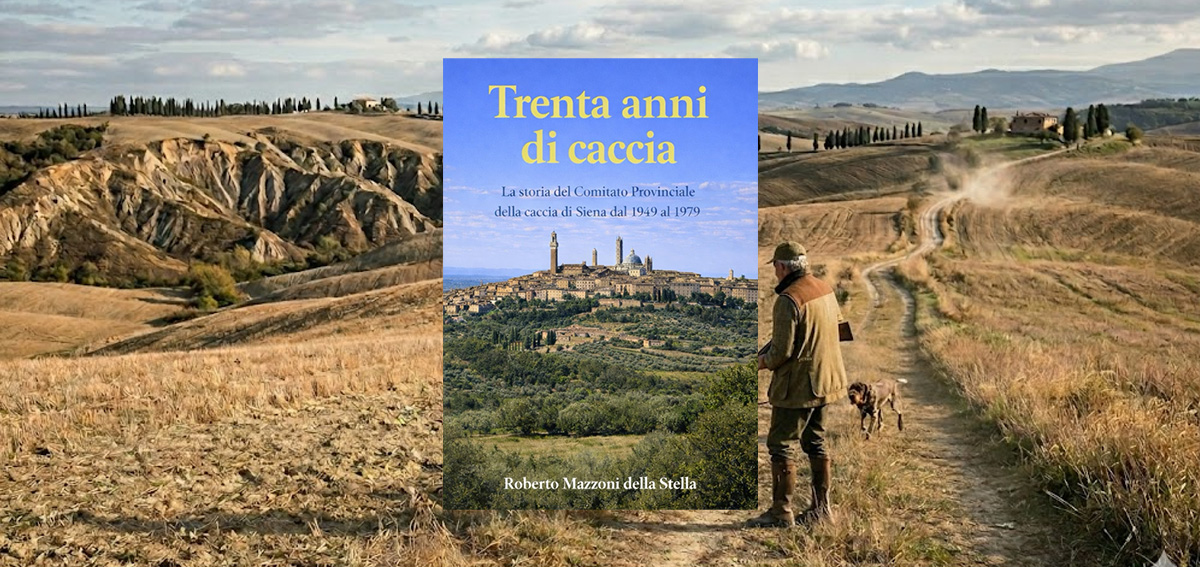
Understanding the evolution of wildlife and hunting management also means understanding the history of the institutions that accompanied the profound changes in Italy during the twentieth century. This is the context for "Thirty Years of Hunting," a book by Roberto Mazzoni della Stella that rigorously and accurately reconstructs the activities of the Siena Provincial Hunting Committee in the thirty-year period between 1949 and 1979.
 This work represents much more than a simple administrative chronicle. Through careful research based on official documents, archival documents, and firsthand accounts, the author paints a picture of an era characterized by profound economic, social, and cultural transformations. The period analyzed coincides with post-war reconstruction, the economic boom, and the launch of major reforms that redefined the relationship between people, the environment, and land management.
The Provincial Hunting Committee emerges from the book's pages as a privileged observatory for understanding the changes that have affected the hunting world. Administrative decisions, wildlife management policies, and organizational choices reveal a constantly evolving reality, confronted with new environmental protection needs and a growing focus on the conservation of natural resources.
Particular emphasis is placed on the activities carried out in repopulation and trapping areas and in private hunting reserves, essential tools for wildlife management in an area that still represents one of the most significant models at the national level. The volume also explores the relationship between institutions, hunters, and the agricultural world, highlighting the clash of different yet closely related interests in the protection and enhancement of rural heritage.
One of the most interesting aspects of Mazzoni della Stella's work is his ability to document the transition from a traditional understanding of hunting to a more modern vision, grounded in scientific and sustainable wildlife management. This highlights debates, critical issues, and new sensitivities that have helped shape the current wildlife management model.
The clear and flowing style makes it accessible even to those without specialized knowledge, without sacrificing the rigor of historical reconstruction. The result is a detailed portrait of the province of Siena and its surrounding area, offering readers a useful tool for understanding the evolution of hunting and environmental management in the post-World War II period.
"Thirty Years of Hunting" is aimed at hunters, managers of restocking and capture areas, wildlife and hunting company licensees, scholars, and local history enthusiasts. This volume is a valuable resource for anyone wishing to delve deeper into a significant chapter in the management of wildlife and hunting in one of Italy's most iconic and best-preserved provinces.
At a time when environmental sustainability and proper wildlife management are at the center of public debate, Roberto Mazzoni della Stella's book offers an important contribution to understanding the historical roots of modern hunting policies and the role the hunting world has played in protecting and managing the land.