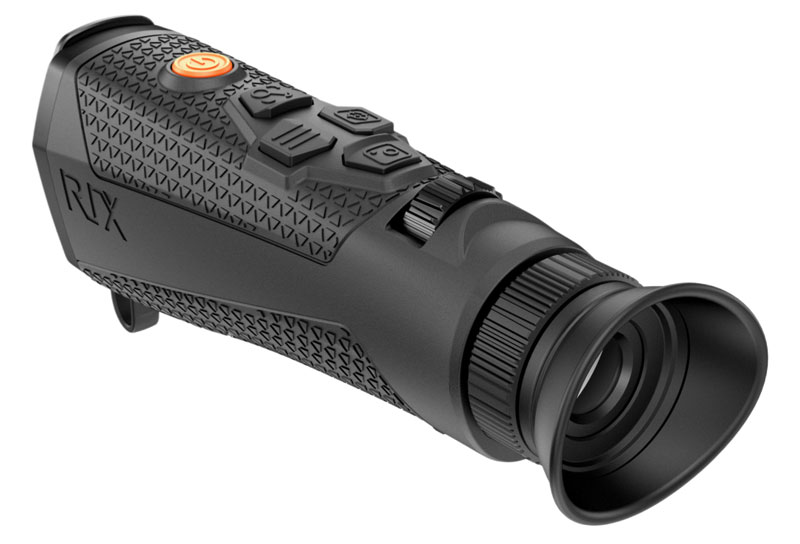
The RIX TITAN T3 and TITAN T6 are two thermal imaging monoculars that share much of the same technology but address different needs. The T3 uses a 384x288 pixel sensor paired with a 25mm lens, while the T6 increases to 640x480 pixels with a 35mm lens. Both models feature remarkable thermal sensitivity, a built-in laser rangefinder, electronic image stabilization, and a Full HD OLED display.
The philosophy behind the TITAN series is particularly interesting because RIX didn't just create a visor capable of detecting a heat source. It built a true observation and measurement instrument , in which thermal imaging, range, and ballistic information can be integrated within the same device.
The choice between T3 and T6 therefore does not depend on the accessory functions, which are substantially common, but above all on the level of detail required and the distances at which you plan to observe.
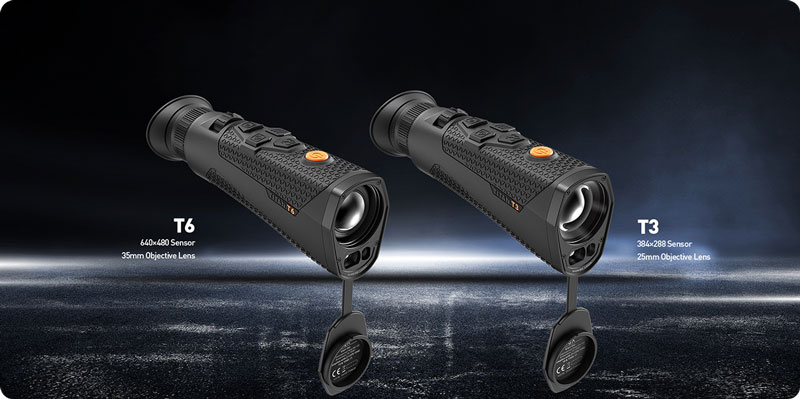
TITAN T3: 384×288 pixels and 25 mm F0.9 lens
The RIX TITAN T3 uses an uncooled VOx thermal sensor with a resolution of 384×288 pixels , a pixel pitch of 12 μm and a refresh rate of 50 Hz.
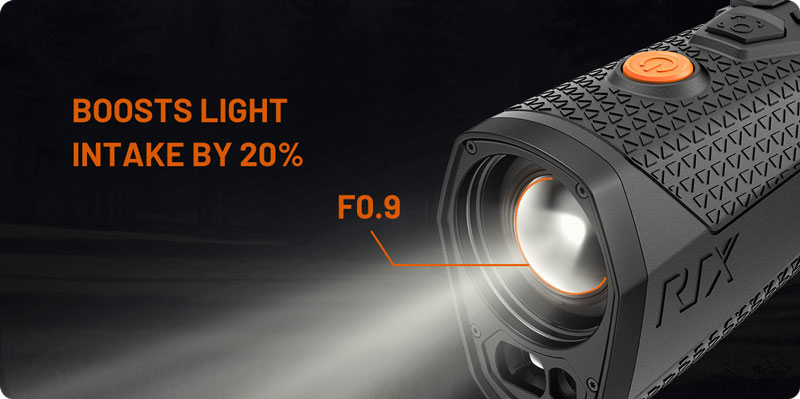
The sensor is paired with a 25mm F0.9 lens . The F0.9 aperture is an important element because it allows a high amount of infrared radiation to be conveyed onto the sensor, contributing to image quality especially when the ambient thermal contrast is low.
The basic magnification is 2,6× , while the digital zoom can be adjusted from 1× to 4×. The field of view reaches 10,5° × 7,9° , equivalent to approximately 18,4 × 13,8 meters at 100 meters.
It is therefore a balanced configuration for hunting game in woods, clearings and mixed terrain, where it is important to maintain a good field of vision without giving up the possibility of examining a thermal source more closely.
TITAN T6: The leap to a 640x480 sensor
The RIX TITAN T6 represents the top level of the series and the main difference is immediately noticeable in the sensor.
The resolution in fact rises to 640×480 pixels , maintaining a pixel pitch of 12 μm, NETD of less than 20 mK and a frequency of 50 Hz.
The increased pixel count offers an advantage that becomes particularly noticeable when the heat source is distant or occupies a small portion of the image. The T6 has more information to represent the animal's silhouette, contours, and details.
It doesn’t simply mean “seeing further”: above all, it means having more detail at the same distance and maintaining superior quality when using digital zoom.
35mm F0.9: The T6 looks further
The T6's 640×480 sensor is paired with a 35mm F0.9 lens.
The base magnification is 2,2× and the field of view reaches 12,5° × 9,4°, equivalent to approximately 21,9 × 16,5 meters at 100 meters.
It is interesting to note how RIX has managed to combine the longer focal length with a still wide field of view thanks to the 640 sensor. This makes the T6 particularly versatile: it can be used to quickly scan the territory, but at the same time has the resolution necessary to move on to a more detailed observation.
The declared detection distance reaches approximately 1.818 meters , compared to approximately 1.299 meters for the T3 . This is of course the thermal detection distance and should not be confused with the distance at which it is possible to identify an animal with certainty.
NETD below 20 mK: the figure that matters when thermal contrast decreases
Both TITANs claim NETD thermal sensitivity <20 mK.
The NETD expresses, in simple terms, the sensor's ability to distinguish very small temperature differences. The lower the value, the greater the theoretical ability to thermally separate elements with very similar temperatures.
This feature becomes particularly important in the presence of fog, humidity, light rain or wet vegetation and, more generally, when the ground, vegetation and animals have relatively similar temperatures.
A sensitive sensor does more than simply increase the brightness of the image: above all, it allows it to preserve nuances and separation between elements that a less sensitive system might represent as more thermally uniform surfaces.
1920×1080 OLED display: identical on T3 and T6
One of the most interesting aspects is that RIX has not penalized the T3 on the display. In fact, both use a 1920×1080 pixel OLED.
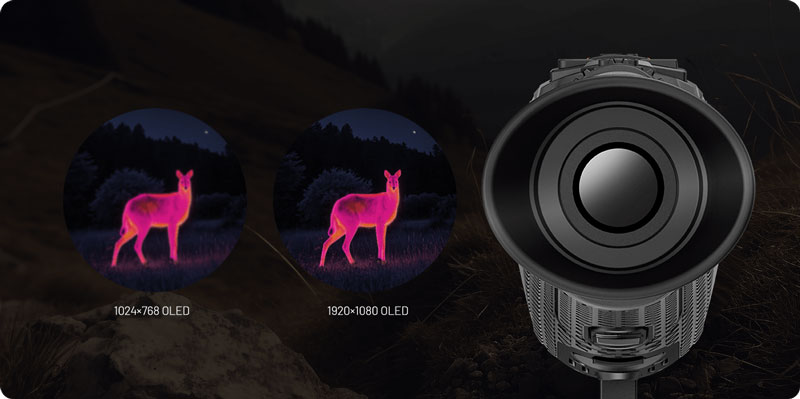
The Full HD display offers significantly more viewing area than the traditional 1024×768 panels used on many thermal devices.
Of course, the display can't capture details the sensor hasn't captured. This is why the T6's 640x480 resolution advantage remains clear. However, a high-resolution display allows for better representation of the available information and makes prolonged observation more pleasant.
The diopter adjustment between -5 and +5 diopters also allows the eyepiece to be adapted to the user's visual needs.
EIS: Electronic Image Stabilization
One of the most interesting technologies of the TITAN series is the EIS – Electronic Image Stabilization.
Built-in motion sensors detect device shake and algorithms kick in to electronically stabilize the image.
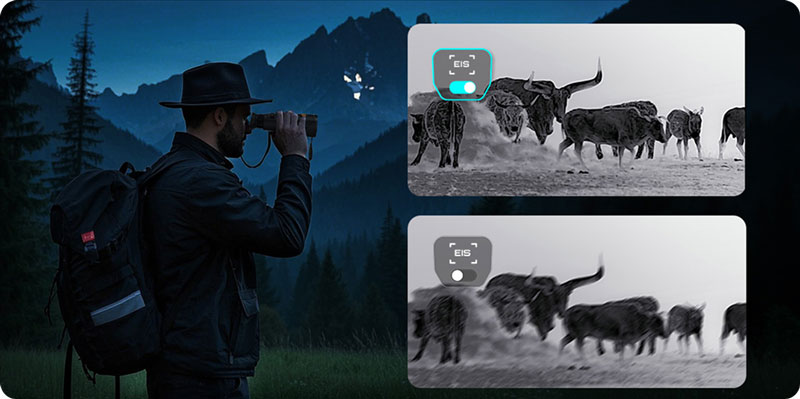
The advantage is clear when observing freehand. As digital magnification increases, even small hand movements become highly visible; reducing these oscillations makes it easier to keep a thermal source in the center of the field and analyze its details.
The EIS is particularly interesting on the T6, where the higher resolution encourages you to use the magnification for distant observations.
RET: Digital zoom tries to preserve detail
RIX combines stabilization with RET technology , developed to improve image rendering during digital enlargement.
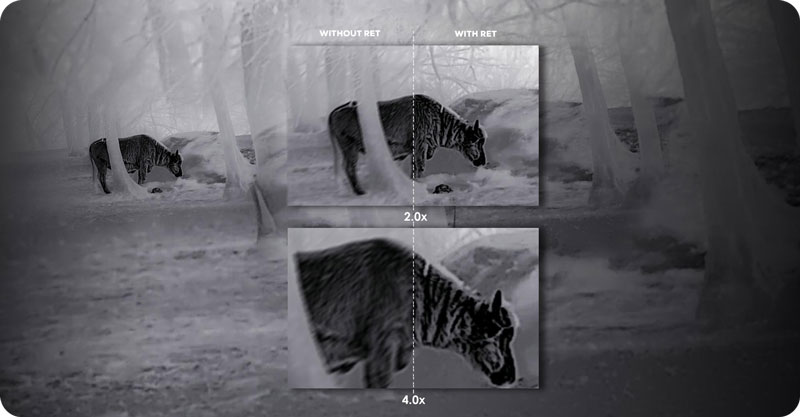
One of the traditional limitations of digital zoom in thermal imaging is the progressive loss of definition: by enlarging a portion of the frame, the individual pixels become increasingly evident.
RET uses processing algorithms to reconstruct and enhance the available details, trying to maintain a more readable image when zooming.
Of course, it doesn't replace the sensor's physical resolution, and that's precisely why the T6 retains a substantial advantage. With the same processing power, starting at 640x480 means having much more information available than 384x288.
Integrated laser rangefinder up to 1.200 meters
The T3 and T6 integrate an LRF laser rangefinder capable, according to RIX, of measuring distances up to 1.200 meters , with a declared accuracy of ±1 meter.
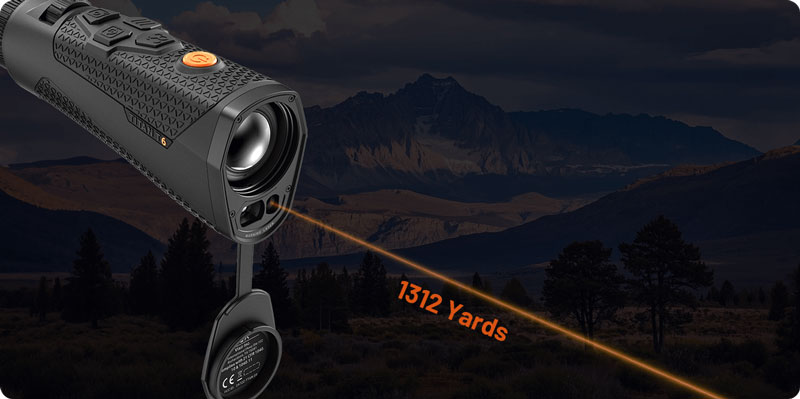
Integrating the rangefinder inside the monocular avoids having to constantly switch between thermal imaging and a separate device.
When observing an animal, it is thus possible to immediately obtain an estimate of the distance while keeping the scene inside the viewfinder.
This is a particularly useful function for nighttime observation, because in the dark the perception of distances becomes much less intuitive than in normal daytime conditions.
Integrated ballistic calculator
The TITAN series also introduces a ballistic calculator associated with the rangefinder.
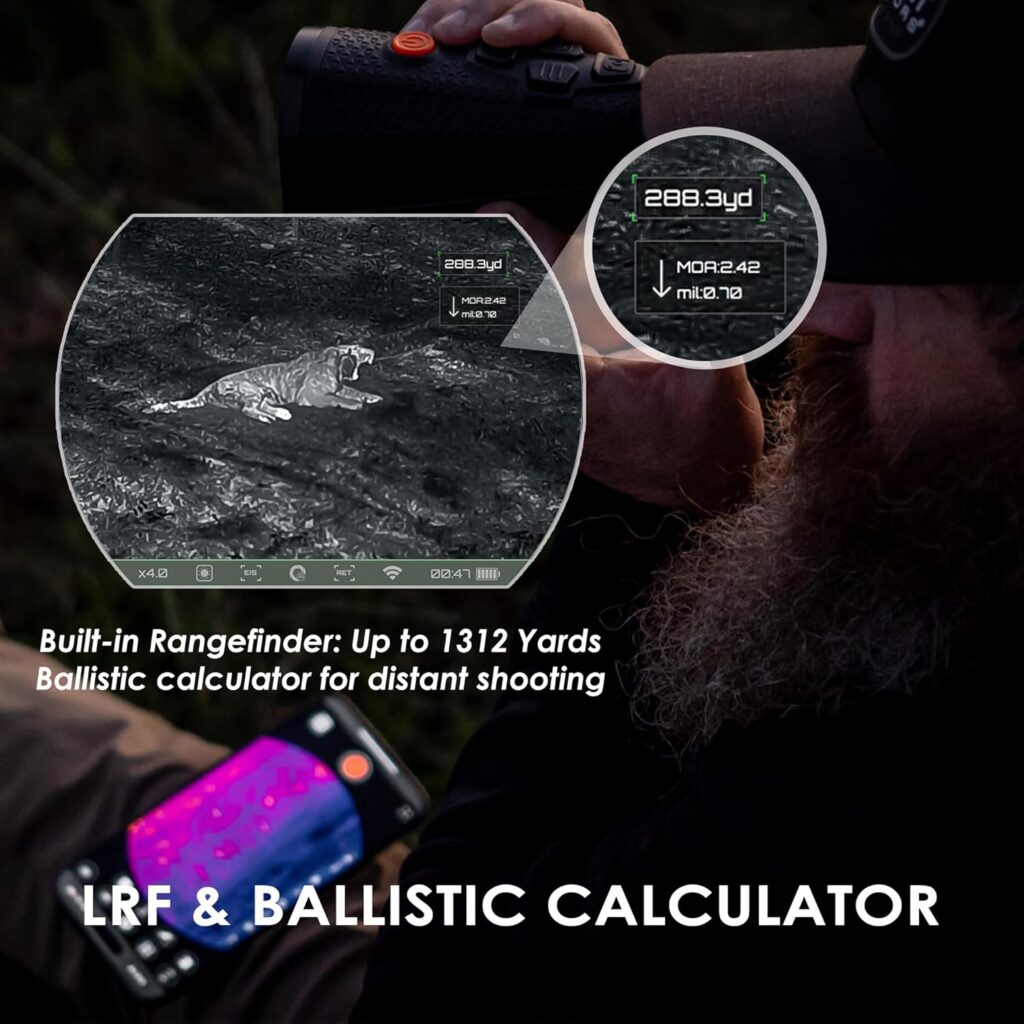
The RIX+ app allows you to set the parameters required for the ballistic profile. Once the distance has been measured with the rangefinder, the system can calculate the corresponding correction and display it along with the measurement information.
The TITAN remains an observation monocular and not a riflescope: the value of the function therefore lies in the possibility of providing the hunter or shooter with additional information without having to use a second electronic device.
RIX also specifies that the calculation can also be used with optics from other manufacturers, as long as the relative correction values in MOA or MIL are known.
One-handed controls
RIX has paid particular attention to the ergonomics of the TITAN. The body is narrow and elongated and the main controls are arranged so that they can be reached while holding the gun.
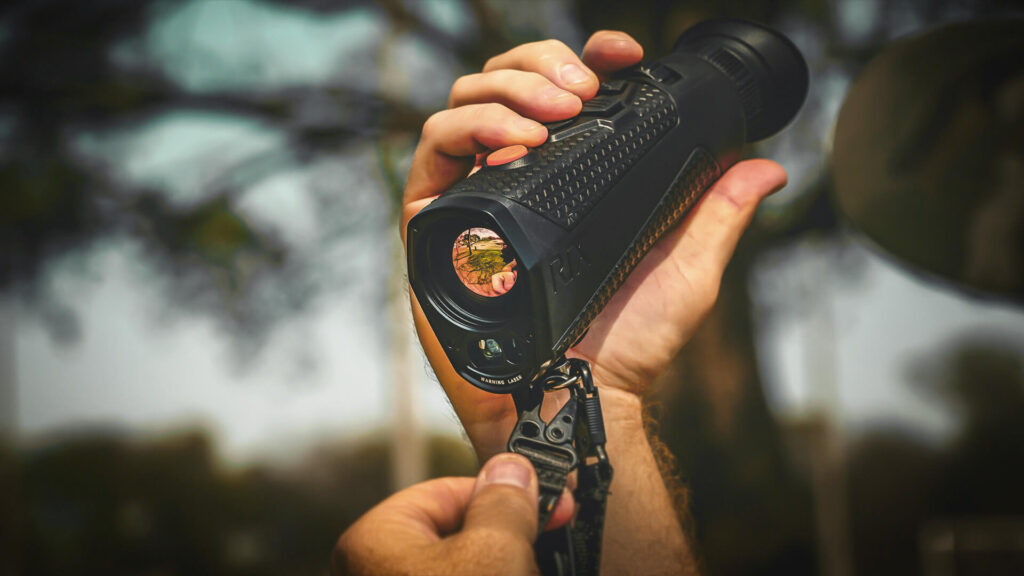
The focus is also designed for one-handed operation . This is a much more important feature in the field than it might seem from a simple spec sheet.
While hunting for game, the other hand can remain free for support, use of binoculars or other equipment.
The T3 and T6 also use virtually the same body: both measure approximately 203 × 52 × 74 mm.
Only two grams separate T3 and T6
One of the most surprising data emerges when comparing the weights. The TITAN T3 weighs approximately 427 grams , while the T6 reaches approximately 429 grams.
The difference is therefore practically irrelevant.
This means that the move to the T6's 640x480 sensor and 35mm lens doesn't really mean a sacrifice in portability. This is important because increased optical performance typically comes with increased size and weight.
In this case, the choice between the two models can be made almost exclusively based on the required performance and budget, without having to consider a significant difference in weight.
Photo and video recording and 32 GB memory
Both TITANs allow you to record photos and videos directly to the 32 GB internal memory.
The T3 records photos and videos up to 1024×720 pixels , while the T6 reaches 1536×1080 pixels.
The formats used are MP4 for videos and JPG for images.
The function allows you to document observations, subsequently check the animals' behavior and preserve the most interesting sequences without using external recorders.
Wi-Fi and RIX+ app
Wi-Fi connectivity allows you to connect the device to the RIX+ application available for compatible smartphones.
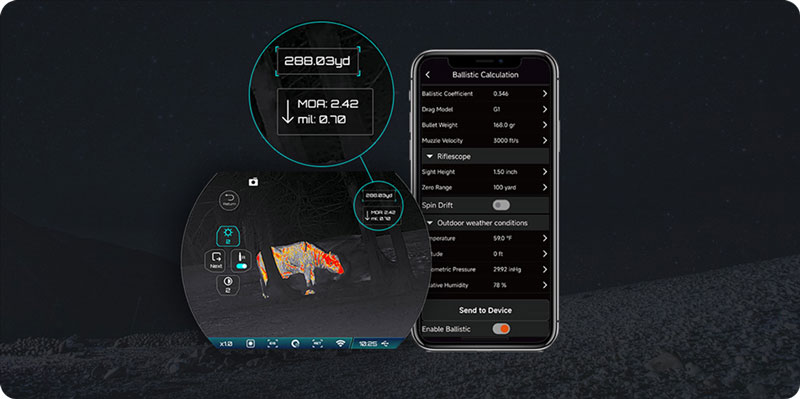
The app can be used to view the video stream, manage content and updates, and configure functions related to the ballistic calculator.
The connection between monocular and smartphone therefore expands the possibilities of the device without making the phone indispensable during normal observation.
Replaceable 18650 battery
The TITAN series uses a 18650 battery , a particularly interesting solution for a device intended for long outdoor sessions.
The stated battery life is approximately 5 hours at 25°C . The battery is replaceable, allowing you to carry a spare instead of having to wait for the entire device to recharge.
External power is also available via USB Type-C 5V.
The intelligent standby function uses motion sensors and the position of the device: when the TITAN is not in use, it can reduce power consumption and quickly reactivate the display when it is picked up again.
IP67 and use from -20 to +50 °C
The declared protection is IP67 , an important feature for a monocular intended for hunting use.
Rain, snow, dust and humidity are part of the normal conditions in which a thermal imager can be used, especially during prolonged observations.
RIX also claims an operating range of -20 to +50°C , wide enough to cover most climatic conditions typically encountered in Europe.
RIX TITAN T3: when it's the most rational choice
The TITAN T3 is probably the most interesting model for those who want to enter the TITAN platform without incurring the cost of the 640 sensor.
It is not a version impoverished in terms of features: it maintains NETD <20 mK, OLED 1920×1080, 1.200 meter rangefinder, EIS, ballistic calculator, 32 GB memory, Wi-Fi and replaceable battery.
The compromise essentially concerns sensor resolution and lens. The 384x288 with 25mm F0.9 remains particularly valid for observation at medium to short distances and in areas where a usable field of view and good thermal sensitivity are more important than extreme detail analysis.
For woods, mixed areas and general hunting observation, the T3 therefore represents a very balanced configuration.
RIX TITAN T6: When 640x480 Really Makes a Difference
The TITAN T6 becomes the most interesting choice when distances increase and the need to recognize details increases.
The 640×480 sensor has almost three times the number of pixels of a 384×288 sensor. When combined with the 35mm F0.9 lens , it can retain significantly more information.
The advantage is especially evident when observing distant animals, reading silhouettes partially hidden by vegetation, and when using digital zoom.
Considering that the dimensions and weight remain practically identical to the T3, the real element that separates the two models becomes mainly the level of thermal performance you want to achieve.
RIX TITAN T3 vs. T6 Comparison
| Feature | RIX TITAN T3 | RIX TITAN T6 |
|---|---|---|
| Sensor | 384 × 288 | 640 × 480 |
| Sensor type | Uncooled VOx | |
| Pixel pitch | 12 μm | |
| NETD file | <20mK | |
| Frame rate | 50 Hz | |
| Target | 25 mm F0.9 | 35 mm F0.9 |
| Basic magnification | 2,6 × | 2,2 × |
| Digital zoom | 1–4× | |
| Field of view | 10,5 ° × 7,9 ° | 12,5 ° × 9,4 ° |
| Field at 100 m | 18,4 × 13,8m | 21,9 × 16,5m |
| Declared detection distance | 1.299 m | 1.818 m |
| Display | OLED 1920×1080 | |
| Laser rangefinder | up to 1.200 m | |
| Declared rangefinder accuracy | ±1 m | |
| Stabilisation phase | EIS electronics | |
| Ballistics calculator | Yes | |
| Conference proceedings | 32 GB | |
| Registration | 1024 × 720 | 1536 × 1080 |
| Wi-Fi / RIX+ | Yes | |
| Battery | 18650 replaceable | |
| Autonomy declared | about 5 hours at 25°C | |
| Protection | IP67K | |
| Operating temperature | -20 / +50 ° C | |
| Dimensions: | 203 × 52 × 74 mm | |
| Weight | 427 gr | 429 gr |
T3 or T6: the choice depends mainly on how much detail is needed
Comparing the RIX TITAN T3 and TITAN T6 is particularly simple because RIX has chosen not to reserve the most advanced features exclusively for the larger model. Both have a rangefinder, ballistic calculator, EIS, Full HD display, NETD less than 20 mK, recording and connectivity.
The T3 therefore focuses on the performance-to-investment ratio: the 384x288 sensor and the 25mm F0.9 lens offer a complete configuration suitable for a wide variety of hunting observations.
The T6 , on the other hand, invests almost all of its advantage in image quality. The 640x480 sensor and 35mm F0.9 lens significantly increase the amount of detail available and bring the stated detection range from around 1.300 meters to over 1.800 meters.
Perhaps the most significant feature is that to achieve this increase you don't have to accept a much larger or heavier device: there is just 2 grams of difference between the two . This is why the T3 is the most rational choice when distances remain short, while the T6 is the preferred one when recognition, detail and long-distance observation become priorities.
RIX OPTICS It is a brand distributed in Italy by SAPIO