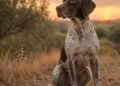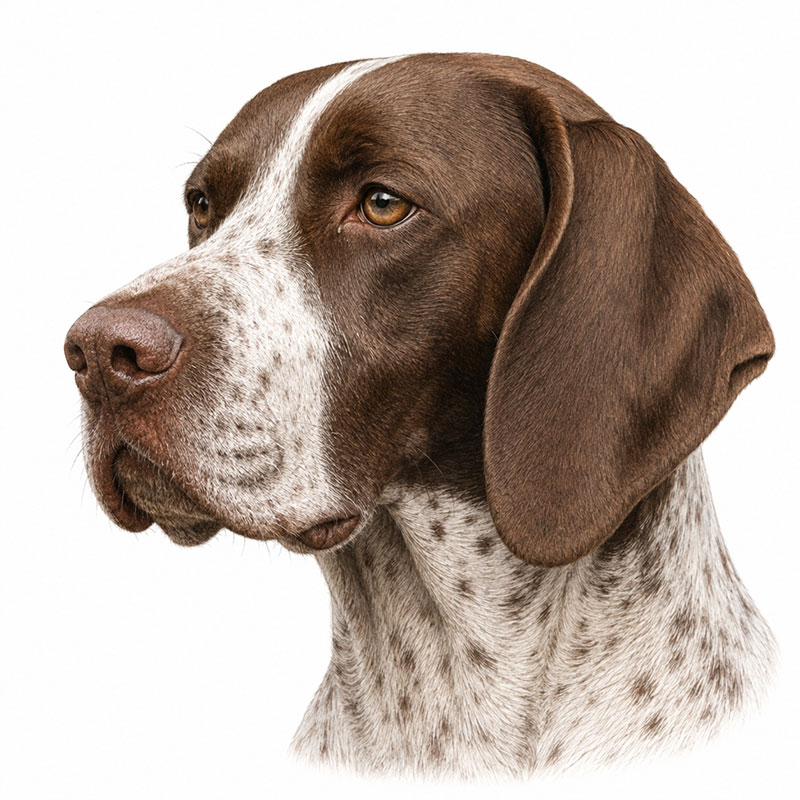
The French Pointer , known internationally as the Braque Français , is one of the great representatives of the French tradition of continental pointing dogs . Elegant without being overbearing, gifted with an excellent sense of smell, a natural pointer, and a strong connection with the hunter, it is a companion built especially for practical hunting, capable of combining initiative, balance, and versatility.
When talking about the French Pointer, however, it is necessary to immediately make a fundamental distinction. There are in fact two varieties recognized by the FCI : the Braque Français type Gascogne , larger, more powerful and traditional in construction, and the Braque Français type Pyrénées , smaller, lighter, faster and more dynamic.
The two varieties share a common hunting identity and many functional characteristics, but they present differences significant enough to influence the hunter's choice. Both, however, remain the expression of a precise philosophy: finding game methodically, stopping it correctly, and working in collaboration with the handler.
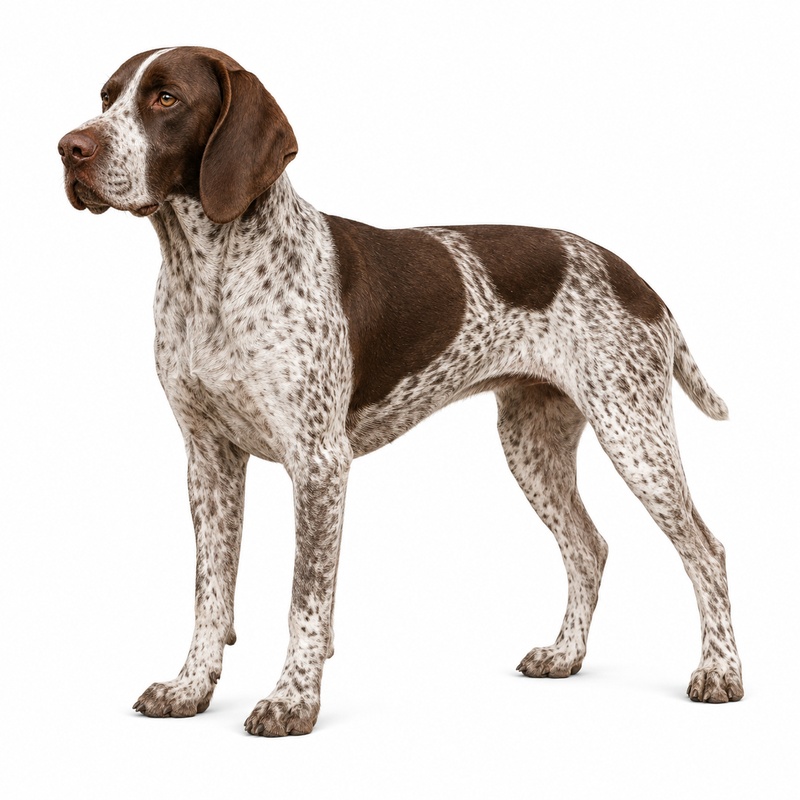
French Pointer: identity card
| Name | Braque Français – French Pointer |
| country of origin | France |
| Hunting category | Continental Pointing Dog |
| Variety | Type Gascogne and Type Pyrénées |
| FCI Classification | Group 7 – Pointing Dogs |
| Section | Continental Pointing Dogs – Pointer Type |
| FCI Gascogne Standard | N. 133 |
| Standard FCI Pyrénées | N. 134 |
| Test of work | Expected |
| Size | Medium in the Pyrénées, medium-large in the Gascony |
| Hair | Short; more robust in the Gascogne, finer in the Pyrénées |
| Characteristic colors | Brown; brown and white; brown and white heavily mottled |
| Temperament | Docile, balanced, sensitive and collaborative |
| Main attitude | Search, point and work on feathered game |
French Pointer, Gascony, and Pyrenees: The Main Differences
| Feature | Gascogne | Pyrenees |
|---|---|---|
| Size | Greater | More contained |
| Construction | Powerful and substantial | Lighter and drier |
| Movement | Wide and regular | Faster and more dynamic |
| Overall impression | Classic and important pointer | Agile and athletic pointer |
| Search | Methodical and sustained | Lively and dynamic |
| Maneuverability | Very good | Excellent |
| Adaptability | Very high | Very high |
The distinction should not be interpreted as a division between a better and a worse French Pointer. Rather, it is two different interpretations of the same hunting heritage.
The Gascogne retains more of the image of the large traditional continental pointer, while the Pyrénées responds to a more compact, agile and dynamic concept.
The main hunting skills of the French Pointer
| Smell | ★ ★ ★ ★ ★ |
| Ferme | ★ ★ ★ ★ ★ |
| Search | ★ ★ ★ ★ ★ |
| connection | ★ ★ ★ ★ ★ |
| Trainability | ★ ★ ★ ★ ★ |
| I'm reporting | ★★★★ ☆ |
| Resistance | ★★★★ ☆ |
| Adaptation to terrain | ★ ★ ★ ★ ★ |
| Work in the forest | ★★★★ ☆ |
| Swift | ★★★★ ☆ |
| Hunting versatility | ★ ★ ★ ★ ★ |
The ratings are indicative and describe the characteristics generally associated with the breed. An individual dog's performance depends on pedigree, selection, experience, athletic preparation, and training.
The French Pointer in a few words: balance and hunting practicality
One of the most interesting characteristics of the French Pointer is its overall balance . It is not a breed built around a single exaggerated quality.
Smell, speed, search, point, connection and adaptability coexist in a dog designed to be above all effective during a real hunting day.
The Braque Français must possess sufficient initiative to explore the terrain independently, but without losing contact with the hunter. It must be swift when the environment allows and more methodical when vegetation and game require greater precision.
It is precisely this ability to adapt that represents one of the breed's greatest strengths.
Origins and history of the French Pointer
The French Pointer belongs to the ancient European family of continental pointing dogs and is generally considered one of the breeds that best preserve the traditional type of pointers developed in Western Europe.
France has an extremely rich tradition of pointing dogs. Over the centuries, different regions have developed dog populations adapted to the environmental characteristics and local hunting practices.
The Braque Français developed mainly in the southwestern regions of the country, where it was used as a versatile pointing dog for hunting feathered game.
From this population the two types known today as Gascogne and Pyrénées would have gradually been defined.
Why are there two types of French Pointer?
The distinction between the two varieties is one of the most interesting aspects of the history of the breed.
The Gascogne type represents the largest and most structured version, close to the historical image of the great French pointer.
Over time, however, smaller, lighter and more dynamic subjects also developed, particularly appreciated for their agility and ease of movement.
This second typology was progressively consolidated in the Braque Français type Pyrénées.
The two populations still maintain many common characteristics today, but have distinct standards and their own morphological identity.
Braque Français type Gascogne
The French Pointer Gascogne type is the largest variety.
The construction is powerful without being heavy, with an overall impression of strength, nobility and solidity.
The Gascogne represents the traditional concept of the continental pointer very well: a dog capable of sustaining long days of hunting, equipped with an excellent nose and a methodical and effective action.
However, greater structure shouldn't translate into slowness. A properly selected individual should maintain dynamism, endurance, and the ability to effectively cover ground.
Dimensions of the French Gascogne Pointer
| Our boys | 58-69 cm at the withers |
| Our girls | 56-68 cm at the withers |
| Construction | Strong and powerful without excessive heaviness |
| Appearance | Noble and typically braccoid |
Braque Français type Pyrénées
The Pyrénées-type French Pointer retains many of the fundamental characteristics of the Gascogne but expresses them through a more compact, lean and light structure.
It is generally faster and more agile and offers remarkable ease of movement.
These characteristics make it particularly interesting for the hunter who wants a continental capable of combining point and connection with a lively and dynamic action.
The small size also makes it easier to handle and transport without making the dog fragile: the Pyrénées remains a true hunting dog, built to work.
Dimensions of the French Pyrenees Pointer
| Our boys | 47-58 cm at the withers |
| Our girls | 47-56 cm at the withers |
| Construction | Lighter and more compact than the Gascogne |
| Appearance | Athletic, lean and functional |
Which one to choose: Gascony or Pyrenees French Pointer?
The choice between Gascony and Pyrenees depends above all on the hunter's preferences and the type of territory frequented.
Those who appreciate a more structured, powerful dog, closer to the classic model of the large continental pointer, will find the Gascogne an extremely interesting companion.
Those who prefer greater compactness, speed and ease of handling can opt for the Pyrénées.
Much, however, depends on bloodlines and hunting selection . Differences between individual subjects can be significant, and when choosing a puppy for hunting, the qualities of the parents and ancestors must be a determining factor.
Morphology of the French Pointer
Both varieties have a typically braccoid structure , characterised by harmony, solidity and functionality.
The head is large and well-proportioned, with a gentle, intelligent expression. The nose is developed and the nostrils are well-opened, characteristics consistent with the importance placed on the sense of smell.
The ears are pendant and contribute to the typical expression of the breed.
The trunk must offer sufficient thoracic capacity and a muscular structure capable of sustaining prolonged activity.
In the Gascogne, the overall impression is more focused on power and substance; in the Pyrénées, however, the lines are leaner and lighter.
The coat of the French Pointer
The coat is short and functional for hunting activity.
In the Gascony the coat tends to be thicker and more abundant, while in the Pyrenees it is generally finer and shorter.
This difference further contributes to the different overall impression of the two varieties.
In both cases, managing the coat is relatively simple, although after each day of hunting it is still necessary to carefully check the skin, feet, ears and eyes.
The colors of the French Pointer
Color is one of the elements that make Braque Français immediately recognizable.
The coat may be brown, brown and white, or brown and white with a strong mottle.
The combination of brown and white can create different color distributions, while maintaining the typical identity of the breed.
The French Pointer Hunting: How It Works
The French Pointer must be practical when hunting, first of all.
The search is aimed at encountering game and must continually adapt to the terrain. In open environments, the dog can increase its range and speed, while in the woods and in more dense vegetation, it must spontaneously narrow its search.
The nose is used mainly by exploiting the emanations carried by the wind, but the dog must be able to interpret different olfactory conditions.
When it detects an interesting emanation, it progressively modifies its behavior until it locates and points the game.
The search for the French Pointer
The search represents one of the fundamental moments of the work.
A good Braque Français must explore the terrain in an orderly and profitable manner, avoiding both excessively limited action and an unnecessarily dispersive search.
The size must be in proportion to the environment and the game.
This characteristic makes the French Pointer particularly interesting for practical hunting, where the dog must face very different territories and conditions in the same season.
The French Pointer's sense of smell
The nose is one of the main strong points of the breed.
The French Pointer must be able to detect emanations from a distance and interpret them correctly until the game is located.
Olfactory quality isn't measured solely by the distance at which a scent is perceived. Equally important is the ability to distinguish, track, and resolve the scent.
Experience and knowledge of the wild gradually transform the young dog with a good nose into a truly effective helper.
The French Pointer's Pointing
The stop is naturally one of the fundamental characteristics of the Braque Français.
When the dog is certain of the game's presence, it stops moving and indicates its position to the hunter.
The point must be secure and functional. The aesthetics of the gesture are certainly appealing, but in practical hunting, what matters most is the dog's ability to correctly locate the game without unnecessarily forcing it.
The expert subject also learns to modulate distance and pressure depending on the species encountered.
The guide in the French Pointer
When the game tends to move on the ground, the French Pointer must be able to lead.
The dog moves forward trying to maintain olfactory contact without applying excessive pressure.
This phase requires balance and sensitivity. Stalking game birds like pheasants can test a dog's ability to continually adjust speed and distance.
The guide improves significantly with experience and is one of the elements through which a truly mature dog can be recognized.
Retrieving in the French Pointer
Retrieving completes the work of the pointing dog in practical hunting.
Many French Pointers have a good natural predisposition for retrieving shot game, a characteristic that can be consolidated through progressive training.
The dog must use its sense of smell and perseverance to locate the fallen item, even in vegetation, retrieve it, and deliver it correctly to the handler.
French Pointer and Partridge Hunting
Attitude: ★★★★★
The grey partridge allows you to enhance many of the classic qualities of the French Pointer: search, nose, ability to use the wind and point.
In open environments the dog can develop a broad and profitable action, while still maintaining the necessary connection with the hunter.
French Pointer and partridge hunting
Attitude: ★★★★★
Partridge hunting requires an athletic, resistant dog capable of tackling often challenging terrain.
The properly trained French Pointer can perform excellently thanks to the combination of resistance, olfactory qualities and adaptability.
French Pointer and pheasant hunting
Attitude: ★★★★★
The pheasant is a particularly interesting game bird for evaluating hunting intelligence and hunting ability.
When tending to stalk into the vegetation, the dog must maintain contact with the emanation without rushing the action.
Method, prudence and adaptability make the French Pointer particularly effective on this species.
French Pointer and quail hunting
Attitude: ★★★★★
The quail represents another species on which the Braque Français can express its sense of smell and precision in pointing very well.
Weather conditions and wind can significantly alter the quality of the emanation and require the dog to have the ability to interpret it.
The French Pointer in woodcock hunting
Attitude: ★★★★★
The French Pointer for woodcock can become an extremely effective auxiliary, especially when it comes from selected lines and acquires specific experience in the woods.
The woodcock requires olfactory ability, connection, adaptation of the search width and great experience in managing the emanation.
The dog must learn to interpret erratic wind, vegetation and the behavior of particularly unpredictable game.
The Pyrénées, thanks to its more compact and agile structure, can be particularly interesting in intricate territories, although a good Gascogne, correctly selected, can be equally effective.
The French Pointer in the mountains
Working in the mountains requires athletic preparation, endurance, and the ability to distribute energy correctly.
The French Pointer can adapt very well to these territories, especially when trained progressively.
The greater lightness of the Pyrénées can be an advantage on terrain characterised by significant differences in height, while the structure and base of the Gascogne can prove interesting during long working days.
Individual quality, however, remains more important than simply belonging to one variety or another.
The ideal terrain for the French Pointer
| Collina | ★ ★ ★ ★ ★ |
| Pianura | ★ ★ ★ ★ ★ |
| Agricultural land | ★ ★ ★ ★ ★ |
| The Forest | ★ ★ ★ ★ ★ |
| Mountain | ★★★★ ☆ |
| Dense vegetation | ★★★★ ☆ |
| Open lands | ★ ★ ★ ★ ★ |
The ability to work effectively in different environments is one of the major advantages of Braque Français.
It is not a breed rigidly tied to a single type of territory. Its main quality lies precisely in the ability to modify its search and behavior according to the environment.
What game with the French Pointer?
| Gray partridge | ★ ★ ★ ★ ★ |
| Partridge | ★ ★ ★ ★ ★ |
| Pheasant | ★ ★ ★ ★ ★ |
| Quail | ★ ★ ★ ★ ★ |
| Woodcock | ★ ★ ★ ★ ★ |
| Snipe | ★★★★ ☆ |
| Feathered game in general | ★ ★ ★ ★ ★ |
How to recognize a good French Pointer on the ground
A good Braque Français should not be judged solely by its speed or spectacular action.
It is necessary to observe all its qualities:
smell, search, connection, initiative, adaptability, pointing, guiding, retrieving, endurance and hunting intelligence.
The big dog must be able to interpret the terrain and spontaneously modify its behavior.
An open plain and a dense forest cannot be approached in the same way. The ability to understand it without constantly relying on the handler's commands is one of the most important qualities of a mature assistant.
Character of the French Pointer
The French Pointer's character is one of the reasons why the breed is appreciated even beyond its hunting abilities.
It is generally a balanced, docile dog and very attached to its owner.
The strong predisposition to collaboration facilitates training, but the sensitivity of the breed requires consistent and progressive methods.
Unnecessarily harsh training can undermine trust and spontaneity. The Braque Français, however, tends to perform at its best when a relationship based on trust, clarity, and collaboration develops between dog and handler.
French Pointer and family
The generally balanced character allows the French Pointer to integrate well into family life, provided that its needs are respected.
It remains an athletic hunting dog , requiring movement, activity and stimulation.
The possibility of living indoors does not therefore eliminate the need for daily exercise and outdoor experiences.
The subject used for hunting naturally finds the best expression of its physical and mental characteristics in hunting activity.
The relationship between the French Pointer and the hunter
The connection represents one of the most appreciated characteristics of the breed.
The Braque Français must have sufficient initiative to explore the terrain independently without forgetting the position and movement of the handler.
The ideal result is a dog that appears to work autonomously but, in reality, continuously constructs its action in relation to the presence of the hunter.
This balance between autonomy and collaboration is particularly important in practical hunting.
Training of the French Pointer
The training of the French Pointer must enhance the natural qualities of the breed without excessively limiting its initiative.
Socialization
The puppy must be gradually accustomed to different people, animals, environments and situations.
Recall
A reliable recall forms the basis for subsequently developing an independent but well-connected search.
First releases
During the first experiences on the ground, it is important to give the young dog enough freedom to develop curiosity, initiative and confidence.
Encounter with the wild game
Contact with wild animals is a crucial phase. The dog must learn through experience to recognize and interpret different emanations.
Ferme
The natural predisposition must be progressively consolidated without transforming the work into a purely mechanical exercise.
Guided
With experience, the dog learns to follow the stalking game while maintaining the correct balance between pressure and caution.
I'm reporting
Natural predisposition can be enhanced through simple and progressive exercises, always maintaining a positive relationship with the object and with the handler.
Shooting habits
The introduction to shooting should be gradual, avoiding sudden exposures that could create negative associations.
Athletic training for the French Pointer
Like all pointing dogs intended to work for many hours, the Braque Français requires correct athletic preparation.
Training must be progressive and aimed at developing endurance, muscle strength, and cardiovascular fitness.
Particular attention must also be paid to the feet, especially in subjects destined to work on stony and mountainous terrain.
Maintaining a healthy weight contributes to both your dog's performance and overall health.
Caring for the French Pointer after hunting
The short coat makes daily grooming relatively easy, but the dog should be carefully checked after every outing.
It is important to check the feet, pads, interdigital spaces, eyes, ears and skin.
Pendulous ears deserve special attention, especially after working in humid environments.
During the foxtail season, it is also advisable to carefully check the spaces between the toes, the ears and other areas where plant matter can penetrate.
Health and Management of the French Pointer
When choosing a puppy, it is advisable to turn to breeders who simultaneously select health, character, functional morphology and hunting qualities.
Morphological beauty should never be considered separately from function in a breed born and developed for work.
It is important to know the health checks carried out on the breeders and, when possible, evaluate the working qualities of the parents and offspring.
Is the French Pointer the right hunting dog for you?
| Smell | ★ ★ ★ ★ ★ |
| Ferme | ★ ★ ★ ★ ★ |
| Search | ★ ★ ★ ★ ★ |
| connection | ★ ★ ★ ★ ★ |
| Trainability | ★ ★ ★ ★ ★ |
| Flexibility | ★ ★ ★ ★ ★ |
| I'm reporting | ★★★★ ☆ |
| Resistance | ★★★★ ☆ |
| Swift | ★★★★ ☆ |
| Adaptability to terrain | ★ ★ ★ ★ ★ |
| Relationship with the host | ★ ★ ★ ★ ★ |
| Need for activity | ★ ★ ★ ★ ★ |
The French Pointer is particularly suitable for the hunter who wants a balanced, connected and versatile pointing dog , capable of tackling different game and territories.
The Pyrénées can be particularly interesting for those who prefer a more compact and dynamic dog, while the Gascogne offers greater structure and retains more of the traditional image of the large continental pointer.
In both cases, the quality of the selection must be more important than the simple choice of variety.
French Pointer: Strengths and Aspects to Consider
| Key features | Aspects to consider |
|---|---|
| Excellent sense of smell | Requires regular physical activity |
| Natural stop | Bloodline selection is important |
| Great connection | May be sensitive to harsh methods |
| High versatility | Requires athletic training |
| Good predisposition to retrieving | Ears require regular checks |
| Adaptability to terrain | Needs daily exercise |
| Collaborative nature | The most suitable variety must be chosen carefully |
| Great effectiveness in practical hunting | Individual qualities are highly dependent on selection |
French Pointer and Italian Pointer: What are the differences?
The comparison between the French Pointer and the Italian Pointer is particularly interesting because both breeds belong to the great European tradition of continental pointers.
The Italian Pointer has a highly codified style, in which the long and fast trot , the head carriage and the particular interpretation of the emanation represent characteristic elements.
The Braque Français generally has a freer action and, especially in the Pyrénées type, can express greater speed and dynamism.
Both have a great sense of smell, point, connection and adaptability, but they represent two different schools of continental hunting dog breeding.
French Pointer and Kurzhaar
Braque Français and Kurzhaar are two extremely interesting continentals for the hunter looking for versatility.
The Kurzhaar was developed within the German all-purpose hunting dog system and has extremely broad aptitudes beyond traditional pointing dog work.
The French Pointer, on the other hand, retains a strong identity linked to hunting feathered game , to the search, to pointing and to collaboration with the hunter.
The Pyrénées type may be closer to the Kurzhaar in terms of dynamism and lightness, while maintaining different morphological and stylistic characteristics.
French Pointer and Brittany Spaniel
The comparison between the Pyrenees Pointer and the Brittany Spaniel is particularly interesting for those who want a relatively compact dog.
The Breton is generally even more compact and belongs to the continental Spaniel typology, while the Pyrénées clearly maintains the structure and identity of the pointer.
Both can offer great dynamism, connection, firmness and adaptability.
The choice therefore depends not only on the size, but above all on the type of action and dog that the hunter prefers.
French Pointer and Pointer
The English Pointer represents a different philosophy than the Braque Français.
The Pointer is one of the greatest specialists in the long-distance pursuit, galloping and pointing of feathered game.
The French Pointer focuses more on the versatility of practical hunting, connection and adaptation to different environments.
It is therefore not a question of establishing which is best in absolute terms, but of understanding which type of work best meets the needs of the hunter and the territory frequented.
French Pointer and Woodcock: Which Type to Choose?
For the hunter specializing in woodcock hunting , the choice between Gascogne and Pyrénées deserves specific consideration.
The Pyrénées offers compact size, agility and speed which can be very interesting characteristics in dense forests and difficult terrain.
However, Gascogne can compensate for his greater structure through method, power and the ability to maintain a prolonged action.
In reality, for a woodcock specialist, it is often more important to identify truly selected genealogical lines on the game rather than choosing exclusively on the basis of the variety.
Similar breeds to the French Pointer to know
Anyone who appreciates the Braque Français should also look into other important continental pointing breeds.
Bracco Italiano – one of the oldest Italian pointing breeds, characterized by its typical trotting work.
Kurzhaar – athletic and highly versatile German continental.
Brittany Spaniel – compact, dynamic and particularly versatile French dog.
Auvergne Pointer – another important French pointing breed, characterised by its typical black and white coat.
Braque du Bourbonnais – an ancient French pointer of medium size, compact and closely linked to practical hunting.
Braque Saint-Germain – elegant French breed developed in the 19th century through the meeting of different pointing dog traditions.
Why choose a French Pointer for hunting
The French Pointer represents a particularly interesting choice for those looking for a pointing dog in which no characteristic is exaggerated to the detriment of the overall balance.
Smell, pointing, searching, connection, adaptability and hunting intelligence are the main elements of a breed developed to be above all effective on the ground.
The presence of the two varieties also allows you to choose between two different interpretations of the same genetic and hunting heritage: the Gascogne , larger, more powerful and closer to the classic pointer model, and the Pyrénées , more compact, agile and dynamic.
When it comes from a line truly selected for the job and is correctly trained, the Braque Français can successfully deal with grey partridges, partridges, pheasants, quails and woodcocks, adapting its behaviour to the plains, collina, forest and mountain.
And this is probably the characteristic that best sums up the French Pointer : not a dog built to amaze through a single extreme quality, but a complete, balanced and concrete assistant, capable of putting his qualities at the service of hunting and the hunter.