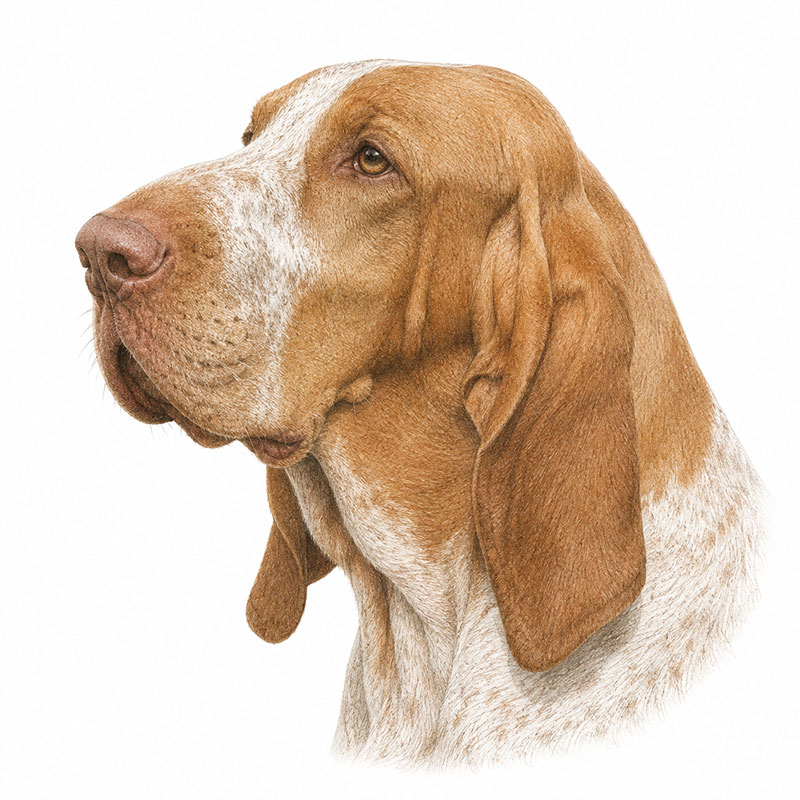
The Bracco Italiano is one of the oldest and most prestigious Italian pointing dog breeds and represents a historic asset to the national hunting dog scene. Powerful yet harmonious, with a keen sense of smell, a sure point, and a natural predisposition to retrieving, it possesses, above all, a deeply distinctive working style, in which the long, fast trot is one of the breed's defining characteristics.
The history of the Italian Pointer spans centuries of hunting evolution: from dogs used to locate birds for capture with nets to modern rifle hunting. Artistic evidence dating back to the Middle Ages documents the presence in Italy of dogs surprisingly similar to the current type.
On the ground, the Bracco Italiano shouldn't be considered simply a slower dog than the great British gallopers. Its hunting philosophy is different: method, scenting ability, connection, adaptation to the terrain, and interpretation of scent are the elements that define its effectiveness.

Italian Pointer: identity card
| Official name | Italian Pointer |
| country of origin | Italy |
| Hunting category | Pointing dog |
| FCI Classification | Group 7 – Pointing Dogs |
| Section | Continental Pointing Dogs – Pointer Type |
| FCI Standards | N. 202 |
| Test of work | Expected |
| Height at the withers | 55-67 cm |
| Weight | 25-40 kg, depending on size |
| Construction | Strong, harmonious and vigorous |
| Most characteristic color varieties | White-orange and roan-brown |
| Hair | Short, thick and shiny |
| Characteristic hunting gait | Long and fast trot |
| Temperament | Intelligent, docile, serious and collaborative |
| Main attitude | Search, point and retrieve game |
The main hunting skills of the Italian Pointer
| Ferme | ★ ★ ★ ★ ★ |
| Smell | ★ ★ ★ ★ ★ |
| Search | ★ ★ ★ ★ ★ |
| Ability to interpret the emanation | ★ ★ ★ ★ ★ |
| I'm reporting | ★ ★ ★ ★ ★ |
| Resistance | ★ ★ ★ ★ ★ |
| Connection with the conductor | ★ ★ ★ ★ ★ |
| Adaptation to terrain | ★ ★ ★ ★ ★ |
| Work in the forest | ★★★★ ☆ |
| Swift | ★★★★ ☆ |
| Hunting versatility | ★ ★ ★ ★ ★ |
The ratings are indicative and describe the characteristics generally associated with the breed. The qualities of an individual dog depend on genetics, bloodline, selection, experience, and training.
The Italian Pointer in a few words: smell, method and style
To truly understand the Italian Pointer at hunting, it is necessary to observe it without using British pointing dogs as an exclusive reference.
The Pointer has its own working philosophy. Its search must be effective and adapted to the terrain, while its action is dominated by the need to continually resolve the olfactory problems it encounters.
The dog works mainly with its head held high, questioning the wind and progressively modifying its behavior and speed when it perceives an interesting emanation.
The result is a style in which power, elegance, prudence and hunting practicality coexist in a way that is difficult to confuse with that of other breeds.
Origins and history of the Italian Pointer
The Italian Pointer is a breed of ancient Italian origin . Its history accompanies the evolution of bird hunting techniques over many centuries.
Before the advent of firearms, pointing dogs were used to locate game intended for capture through nets. As hunting techniques evolved, the Pointer gradually adapted to hunting with a rifle.
One of the most fascinating testimonies to the breed's antiquity comes from Italian art. 14th-century depictions document the presence of hunting dogs that can be traced back with surprising morphological and functional continuity to the Bracco Italiano.
Particularly significant is the representation attributed to the context of the Allegory of Good Government by Ambrogio Lorenzetti , created in the fourteenth century in the Palazzo Pubblico in Siena.
Other artistic and documentary testimonies confirm the presence and prestige of these dogs in the following centuries.
The Italian Pointer in the Renaissance courts
During the Renaissance, pointers were particularly appreciated by the Italian aristocracy and were bred at some of the most important courts of the peninsula.
The history of the breed is intertwined with great families such as the Medici, Gonzaga and Estensi , for whom hunting was not only a recreational activity, but an important component of aristocratic culture.
Italian pointers gradually acquired a reputation that transcended the peninsula's borders. Until the 18th century, specimens from Italy were also sent across the Alps and contributed to the canine landscape from which several continental pointing breeds would develop.
The Crisis of the Italian Pointer in the 19th Century
The history of the breed has not only been characterized by periods of great prestige.
During the 19th century, the Italian Pointer went through a particularly difficult period. Social and hunting changes, and the subsequent spread of more modern and dynamic foreign breeds, led to a progressive decline in popularity.
A portion of the population also became excessively heavy, losing some of the athletic characteristics necessary for a modern pointing dog.
The survival of the breed was possible thanks to the work of enthusiasts and breeders who preserved lines on which the subsequent recovery work would be built.
The rebirth of the Italian Pointer
During the twentieth century, important work began aimed at recovering a modern, athletic and functional Italian Pointer , without losing the historical characteristics of the breed.
A fundamental role was played by the Società Amatori Bracco Italiano – SABI , which has protected and promoted the breed since 1949.
Modern selection has progressively focused on vigorous, lean, dynamic subjects capable of competing on the ground while maintaining those characteristics of movement, psyche and style that make the Italian Pointer immediately recognizable.
An Italian Pointer was the first dog registered in the Stud Book
A historical detail testifies to the symbolic role occupied by the breed in Italian dog breeding.
When what would become the current national canine system was born in 1882, the first dog registered in the Italian Stud Book was precisely an Italian Pointer.
The subject was called Falco and was born in 1875.
This is a particularly significant detail: one of the oldest breeds in our hunting tradition also symbolically occupies first place in the official genealogy of modern Italian dog breeding.
Morphology of the Italian Pointer
The Italian Pointer is a dog with a strong and harmonious build , with a vigorous appearance that must not, however, become heavy.
The most functional subjects have lean limbs, evident musculature and well-defined lines.
The head is one of the most distinctive features of the breed. It is long, sculpted, and immediately recognizable, with divergent craniofacial axes and a distinctive facial conformation.
The long, hanging ears contribute to the Pointer's typical expression, while the large nose visually demonstrates the importance of the sense of smell in its hunting function.
Overall the dog should appear powerful without being heavy, elegant without being fragile.
White-orange and roan-brown: the colors of the Italian Pointer
Two color expressions are particularly associated with the image of the Italian Pointer: white-orange and roan-brown.
The coat can be white, white with orange or amber spots, white with brown spots or with different forms of mottling and roaning as foreseen by the standard.
In the brown roan, the combination of white and brown hairs creates one of the most characteristic and immediately recognizable coats in Italian dog breeding.
The coat is short, dense and shiny, finer and shorter on the head, ears and front parts of the limbs and feet.
The Italian Pointer Hunting: How It Works
The work of the Italian Pointer represents one of the most fascinating aspects of the breed because it follows a codified style that is deeply linked to its history.
The dog must proceed by continually trying to resolve the olfactory problem. He doesn't simply run to cover as much ground as possible: he interprets the wind, the environment, and possible scents.
The carriage is generally high and noble. When it senses an interesting scent, the action gradually changes and the dog tries to determine its origin and nature.
This ability to move from the search to the ascertainment phase and finally to the stop constitutes one of the most characteristic expressions of his style.
The trot of the Italian Pointer: the signature of the breed
If there is one characteristic capable of immediately identifying the Italian Pointer on the ground, it is probably its long and fast trot.
It is not simply a mode of locomotion, but an element closely linked to the psychology and hunting function of the breed.
During the search, the trot must be lively, productive and capable of allowing the dog to explore the terrain while simultaneously maintaining the concentration necessary for olfactory work.
The working standard allows for some galloping phases when certain objective situations justify them, but when the dog actually enters into the solution of the olfactory question, the characteristic gait remains the trot.
It is precisely this particular balance between speed and control that makes the work of a great Italian Pointer profoundly different from that of a Pointer or a Setter.
The Search for the Italian Pointer
The search for the Italian Pointer must be diligent, effective and above all suited to the terrain.
In open spaces it can develop through wide and well-distributed diagonals, allowing the dog to effectively explore the territory.
In the thick woods, however, the action must become more contained and meticulous.
This ability to spontaneously change the amplitude, speed and mode of search constitutes one of the great practical values of the breed.
A good Pointer does not apply a single scheme regardless of the environment: he reads the terrain and modifies his work.
The Italian Pointer's sense of smell
The olfactory abilities of the Italian Pointer represent one of the strengths historically associated with the breed.
While searching, the dog tends to hold its head high to question the wind and identify the emanations coming from the game.
When it detects an interesting scent, its behavior gradually changes. The dog slows down and tries to pinpoint its source.
The ability to distinguish a simple occasional emanation from one that truly leads to the wild represents one of the elements in which experience and natural quality merge.
The approach: one of the most fascinating moments
When the Pointer perceives an emanation that he finds interesting, he can begin an extremely characteristic approach phase.
The movement becomes progressively slower and more cautious. The final steps can be particularly measured, as the dog tries to reach the correct distance without exerting excessive pressure on the game.
It is at this stage that one of the most refined characteristics of the breed emerges: the ability to transform an athletic action into a controlled, plastic and almost feline movement.
The Italian Pointer's Stop
The Italian Pointer's stance must be an expression of the certainty achieved through the analysis of the emanation.
The dog gradually stops moving forward and assumes an alert, controlled and confident position.
A good point shouldn't be judged solely on aesthetics. What matters is the dog's precision in identifying the game and its ability to maintain control, allowing the hunter to approach.
In the large subject, search, approach and stop do not appear as separate moments, but as successive phases of the same olfactory reasoning.
The Guide of the Italian Pointer
When the game tends to move away, the ability to guide comes into play.
The Pointer must maintain contact with the scent and advance with caution, adapting his movement to the animal's behavior.
Tracking requires balance. A dog that's too hasty risks forcing the game; an overly cautious dog could lose contact.
Experience and knowledge of the different species allow the mature Pointer to gradually find the right balance.
The retrieve in the Italian Pointer
The predisposition to retrieving is deeply rooted in the breed's function. The official standard itself emphasizes that the Bracco Italiano is by nature an excellent retriever.
In practical hunting this means that the work does not necessarily end with the takeoff and the shot.
The dog must contribute to the recovery of the killed game, once again using its sense of smell and ability to cooperate.
A natural, safe and correct retrieve completes the image of the Pointer as a complete pointing aid.
The Italian Pointer in partridge hunting
Attitude: ★★★★★
The grey partridge is one of the species in which it is possible to fully appreciate the classic style of the Italian Pointer.
Open environments allow the dog to develop a wide and orderly search, work with its head held high and use the wind effectively.
The ability to detect the scent from a distance and gradually resolve it highlights the breed's great olfactory qualities.
The Italian Pointer in pheasant hunting
Attitude: ★★★★★
Pheasant hunting often requires a dog capable of interpreting a game animal inclined to stalk and use vegetation to escape the pressure of the assistant.
Method, caution in guiding and the ability to adapt the search make the Italian Pointer particularly interesting for this species.
The predisposition to retrieve also completes the work after the shot, especially when the game falls into the vegetation.
The Italian Pointer in quail hunting
Attitude: ★★★★★
The quail allows you to enhance your olfactory abilities and precision in localization.
The Pointer must correctly interpret emanations that can be influenced by temperature, wind and vegetation characteristics.
The methodical search and the natural predisposition to point allow the breed to effectively tackle this traditional hunt as well.
The Italian Pointer in woodcock hunting
Attitude: ★★★★☆
The Italian Pointer can be an extremely effective woodcock hunter when he has specific experience in the woods.
In this environment, the hunter must reduce the search range, maintain good communication, and learn to interpret complex emanations caused by vegetation, erratic winds, and game behavior.
The diligent and meticulous search that the Pointer can develop in the woods represents an important advantage.
As with all pointing breeds, the true woodcock specialist is born from the combination of genetics, natural qualities and experience accumulated with game.
The Italian Pointer in partridge hunting
Attitude: ★★★★☆
Partridge hunting requires endurance and the ability to work on often challenging terrain.
An athletically trained Pointer can also effectively tackle these environments, taking advantage of his qualities as a long-distance runner and his ability to maintain a profitable action for prolonged periods.
The ideal terrain for the Italian Pointer
| Pianura | ★ ★ ★ ★ ★ |
| Collina | ★ ★ ★ ★ ★ |
| Agricultural land | ★ ★ ★ ★ ★ |
| The Forest | ★★★★ ☆ |
| Mountain | ★★★★ ☆ |
| Dense vegetation | ★★★★ ☆ |
| Wetlands | ★★★★ ☆ |
One of the strong points of the Italian Pointer is the ability to adapt its work to the characteristics of the terrain.
In the great plains, it can increase its breadth and initiative. In the forest, it must become more meticulous. In collinae montagna must instead combine resistance, method and the ability to interpret the wind.
This adaptability helps explain why the breed has historically been considered an auxiliary capable of tackling different forms of feathered game hunting.
Is the Italian Pointer really a slow dog?
One of the most persistent clichés about the Italian Pointer concerns its alleged slowness.
This is a misleading interpretation.
The modern Pointer must possess a long, fast, and efficient trot . Just because its typical gait is not the exasperated gallop of a Pointer doesn't mean the dog has to be slow.
Modern breeding seeks athletic and dynamic subjects, capable of covering the ground effectively while maintaining typical movement.
The real comparison should therefore not be between a fast dog and a slow dog, but between two different hunting philosophies.
The Italian Pointer as a cross-country dog
Another interesting characteristic of the breed is the ability to maintain performance during prolonged activity.
The Pointer is often interpreted as a true long-distance hunter : a dog that must be able to work for long periods while maintaining concentration and efficiency.
The trot, when supported by correct construction and adequate athletic preparation, allows you to cover ground with a particularly favorable ratio between speed and energy expenditure.
This feature becomes important during long hunting days, when the ability to maintain continuity can be more useful than maximum speed expressed for short periods.
How to recognize a good Italian Pointer on the ground
A great Pointer should not be judged solely by the beauty of its pointing or the breadth of its search.
The entire work must be observed:
trot, head carriage, use of the wind, method, olfactory abilities, connection, approaching, pointing, driven, retrieving and adaptation to the terrain.
Quality emerges above all from the continuity between these different phases.
The large Italian Pointer gives the impression of not making useless movements: every change in direction or speed arises from the need to understand what its nose is perceiving.
Character of the Italian Pointer
The Italian Pointer is generally a serious, intelligent, docile dog with a great capacity for learning.
Collaboration with the hunter is an important component of his personality.
This doesn't mean, however, that it should lack initiative. In the field, it must have sufficient autonomy to interpret the environment and game, while maintaining a functional relationship with its handler.
His sensitivity suggests a consistent and progressive education, avoiding unnecessarily harsh systems that can undermine trust and collaboration.
The relationship between the Italian Pointer and the hunter
The connection is one of the historically important characteristics of the breed.
The Pointer was selected to hunt alongside humans and must therefore interpret the handler's direction and movements without requiring constant recall.
The ideal relationship combines autonomy and collaboration: the dog takes the initiative to solve the problems it encounters, but its work always remains integrated into the hunter's hunting action.
Training of the Italian Pointer
The training of the Italian Pointer must respect the character and natural characteristics of the breed.
Education and recall
The first goal must be to build a solid relationship with the young dog through socialization, recall, and proper daily management.
The first outings on the ground
The young Pointer must be given the opportunity to explore and develop his initiative. Excessively rigid interventions can compromise his confidence and natural desire to search.
The encounter with the game
Contact with wild animals is a fundamental part of training. It is through experience that the dog learns to distinguish different scents and interpret the behavior of different species.
Stops her
The natural predisposition must be progressively consolidated, privileging safety and correctness over an artificial construction of the position.
The Guide
With experience, the dog must learn to follow the moving game without applying excessive pressure.
The carryover
The breed's natural predisposition can be enhanced from a young age through progressive and positive exercises.
The habit of shooting
It should be introduced gradually and without forcing, preferably by associating the noise with positive hunting experiences.
Athletic training for the Italian Pointer
The powerful structure of the Pointer makes it particularly important to keep the dog in good physical condition.
Being overweight is an enemy of both hunting efficiency and general health.
Before the season, training must be progressive and aimed at developing cardiovascular endurance, muscle tone, trotting efficiency and foot strength.
A properly trained Pointer can sustain long days while maintaining constant and effective action.
Caring for the Italian Pointer after the hunt
The short coat makes it easier to handle, but the dog should still be carefully checked after each outing.
Particular attention must be paid to the ears, eyes, feet, pads, interdigital spaces and skin.
Large, floppy ears deserve regular checks, especially after working in humid or vegetated environments.
Any thorns, awns, abrasions or parasites collected during the activity must also be quickly identified.
Health and Management of the Italian Pointer
The choice of puppy should be made by favoring breeders who work seriously on health, character, functional morphology and hunting qualities.
It is advisable to find out about the health checks carried out on the breeders and the characteristics of the genealogical lines.
In dogs intended for hunting, maintaining a correct weight, progressive athletic training, adequate nutrition, anti-parasitic prevention and periodic veterinary checks are particularly important.
Is the Bracco Italiano the right hunting dog for you?
| Smell | ★ ★ ★ ★ ★ |
| Ferme | ★ ★ ★ ★ ★ |
| I'm reporting | ★ ★ ★ ★ ★ |
| Resistance | ★ ★ ★ ★ ★ |
| connection | ★ ★ ★ ★ ★ |
| Adaptability to terrain | ★ ★ ★ ★ ★ |
| Search method | ★ ★ ★ ★ ★ |
| Swift | ★★★★ ☆ |
| Trainability | ★ ★ ★ ★ ★ |
| Need for physical activity | ★ ★ ★ ★ ★ |
The Italian Pointer is particularly suitable for the hunter who appreciates a methodical, connected, resistant dog with a great sense of smell.
It is a breed to choose especially if you love observing and understanding the work of the auxiliary, because a good part of its charm comes precisely from the progressive interpretation of the emanation.
It requires activity, physical preparation and an owner willing to enhance its characteristics without trying to transform it into a copy of a dog belonging to another hunting school.
Italian Pointer: Strengths and Aspects to Consider
| Key features | Aspects to consider |
|---|---|
| Very great olfactory abilities | Requires adequate athletic preparation |
| Safe and typical stop | Weight must be carefully monitored |
| Effective and resistant trot | He should not be judged by the standards of a British galloper. |
| Great connection | Requires regular activity |
| Predisposition to carry | The quality of the selection is crucial |
| Adaptability to terrain | Ears require regular checks |
| Intelligence and trainability | An excessively harsh education can be counterproductive |
| Great historical and hunting heritage | It is important to preserve its typical style |
Italian Pointer and Italian Spinone: What are the differences?
The Italian Pointer and the Italian Spinone represent the two great historical Italian expressions of the continental pointing dog, but they possess different morphological and functional characteristics.
The Pointer has a short coat, an elegant and powerful build and a typical high-stepping trotting action.
The Spinone is characterized by its hard coat, a particular rusticity and a great ability to tackle difficult vegetation and terrain.
Both are strongly linked to the Italian hunting tradition and share qualities such as smell, method, point, connection and endurance , but they express them through different breed styles.
Italian Pointer and Kurzhaar
The comparison between the Italian Pointer and Kurzhaar brings together two different interpretations of the continental pointing dog.
The Kurzhaar is generally characterized by a faster and more athletic action, with an important vocation for versatility.
The Italian Pointer, on the other hand, maintains a style deeply characterised by the trot, the head carriage and the progressive interpretation of the emanation.
Both can be extremely effective aids, but the choice depends on the terrain, the game and above all the type of work the hunter wants to see in his dog.
Italian Pointer and Pointer: Trot versus Gallop?
The comparison between the Italian Pointer and the English Pointer is particularly interesting because it allows us to understand how different two great schools of pointing dogs can be.
The Pointer represents one of the highest expressions of speed, gallop and great hunting.
The Italian Pointer instead builds its action mainly through trot, method and olfactory interpretation.
However, reducing the comparison to which of the two is faster would be wrong. Both are the result of different selection philosophies, developed to achieve the same goal through different methods: effectively finding and stopping game.
Italian Pointer and Breton
Even the comparison between the Italian Pointer and the Brittany Spaniel highlights two different interpretations of the continental pointing dog.
The Breton is much more compact and generally has a lively, agile and dynamic action.
The Pointer is larger in size and build and develops a search that is strongly characterised by its trotting style.
Both can offer great connection, stopping and reporting, but through profoundly different working methods.
Similar breeds to the Italian Pointer to know
Anyone who appreciates the Italian Pointer should also learn more about other important pointing breeds.
Spinone Italiano – the other large Italian pointing breed, rustic, resistant and characterised by its hardy coat.
Kurzhaar – German short-haired continental, athletic and versatile.
Brittany Spaniel – compact, dynamic and particularly versatile French continental spaniel.
Hungarian Pointer or Vizsla – elegant continental pointing dog characterised by its typical golden coat.
English Pointer – great British galloper and international benchmark for speed, pursuit and style.
Why choose an Italian Pointer for hunting?
Choosing an Italian Pointer means choosing not just a hunting dog, but one of the oldest expressions of Italian canine and hunting culture.
Its value, however, should not be confined to history. The modern Pointer, when bred through truly functionally oriented selection, is an athletic, resilient dog capable of high-level hunting performance.
Smell, trot, method, connection, pointing, leading and retrieving are the components of a complex style that reaches its maximum expression when the dog is left to work according to its nature.
This is probably the most fascinating aspect of the Italian Pointer : having managed to cross centuries of hunting evolution while maintaining an immediately recognisable identity and, at the same time, still being a modern, effective and profoundly functional auxiliary today.