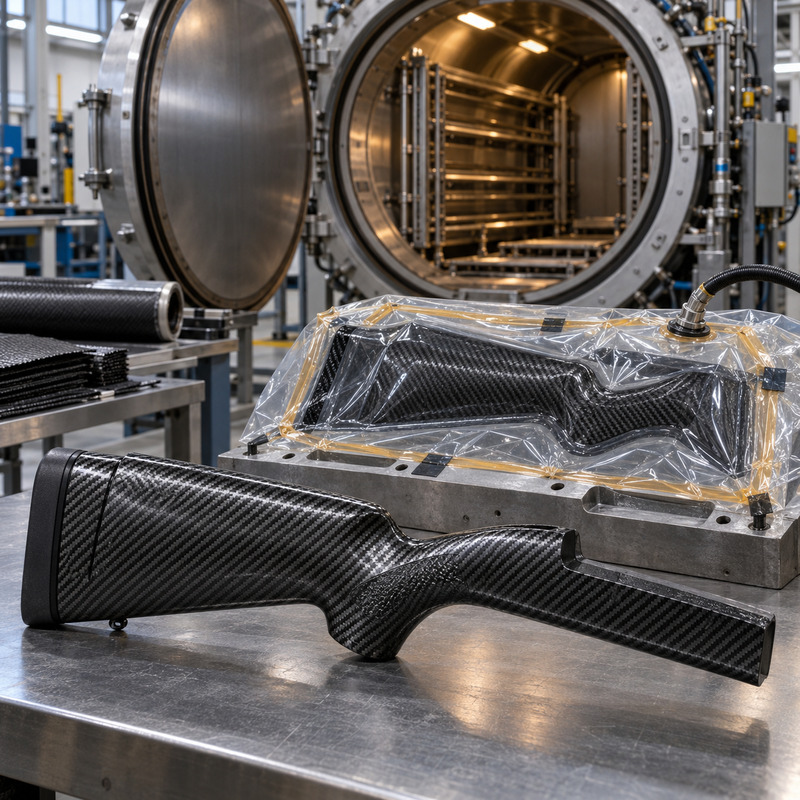
The term autoclaved carbon commonly refers to composite components made of carbon fibres and polymer resin, consolidated through a controlled cycle of temperature, vacuum and pressure inside an industrial autoclave.
The autoclave does not identify a specific carbon fiber, but rather the system used to transform the layers of composite material into a rigid and structurally efficient component. The process produces compact laminates with uniform resin distribution and very few internal voids.
In the gunmaking sector, this technology is used mainly to produce stocks, forends, coated chassis, composite-sleeved barrels and other lightweight components for hunting and target shooting rifles.
What is a carbon fiber composite material?
A component commonly called “carbon” is actually made up of two main elements:
- carbon fibers: they withstand most of the stresses and provide resistance and rigidity;
- polymer matrix: Generally a thermosetting resin, it holds the fibers in their intended position, transfers loads, and protects the reinforcement.
The final properties depend not only on the amount of fiber present. The type of fiber, the resin, the orientation of the layers, the consolidation pressure, the thermal cycle, and the quality of the processing are also crucial.
Carbon does not behave like a homogeneous metal. It is an anisotropic material : its strength and stiffness vary depending on the direction in which the fibers are arranged.
What is a composite autoclave?
The autoclave for composite materials is a large pressurized chamber equipped with systems to control temperature, pressure, and cycle time. It should not be confused with the common autoclave used for medical sterilization.
The component is inserted into the chamber inside a vacuum bag . During the cycle, the vacuum helps eliminate air and volatile products present between the layers, while the external pressure compresses the laminate against the mold. Simultaneously, heat brings the resin to the temperature necessary for its curing.
Temperature and pressure values are not universal. They depend on the fiber-resin system, the thickness of the laminate, and the prepreg manufacturer's instructions. Many materials are processed at temperatures between approximately 80 and 180°C , but different cycles exist.
The pre-impregnated material
Autoclave production often uses pre-impregnated fabrics or tapes , also called prepregs. In these materials, the resin is already distributed on the fibers by the manufacturer at a controlled rate.
Prepreg offers several advantages:
- more uniform fiber-to-resin ratio;
- less variability between one component and another;
- ability to precisely control the orientation of the fibers;
- reduction of excess resin;
- better laminate quality;
- smoother surface after polymerization.
Many prepregs must be stored at low temperatures to slow the resin's reactions. Before processing, they are gradually brought back to the conditions required by the production cycle.
How to make a carbon component in an autoclave
Laminate design
Before production, the sequence of layers, called lay-up , is defined . Each layer can have fibers oriented in a different direction to withstand tension, compression, torsion, and bending.
A properly designed component can combine longitudinal, transverse, and diagonal fibers. Simply increasing the number of layers doesn't guarantee the best result: position and orientation are as important as the overall thickness.
Mold preparation
The mold determines the shape, size, and surface quality of the component. It must be rigid, stable at the processing temperature, and treated with a release agent that allows the part to be removed after hardening.
Layer placement
The prepreg sheets are cut and placed into the mold following the designed sequence. During this phase, wrinkles, contamination, misaligned fibers, and air pockets must be avoided.
In complex geometries, intermediate vacuum compaction operations can be foreseen, useful for progressively adhering the layers to the mould.
Application of the vacuum bag
Auxiliary materials are placed on top of the laminate, chosen according to the production cycle:
- release tissue;
- separator film;
- draining or absorbent material;
- breathable fabric;
- temperature resistant bag;
- sealant to ensure the system is sealed.
A pump extracts air from the bag and maintains the vacuum during the required phases. Before placing the piece in the autoclave, the system is usually checked for leaks.
Autoclave cycle
The component undergoes a programmed heating, holding, and cooling sequence. The pressure exerted in the chamber compresses the laminate, while the vacuum continues to help eliminate trapped air.
During heating, the resin temporarily becomes more fluid, impregnates the fibers, and then polymerizes, forming a rigid structure. Heating rate, pressure, maximum temperature, and dwell time must be precisely controlled.
Cooling and finishing
After hardening, the component is cooled according to the specified cycle and removed from the mold. This is followed by trimming, drilling, milling of the seats, application of the inserts, and surface finishing.
The dust produced during carbon processing is fine, abrasive, and electrically conductive. Operations must therefore be performed with extraction, personal protective equipment, and appropriate equipment.
Why pressure and vacuum are important
Vacuum and pressure perform complementary functions. Vacuum eliminates much of the air contained in the bag and helps extract the gases produced during the cycle. The pressure of the autoclave compresses the layers, improving adhesion to the mold and reducing the volume of residual voids.
A well-established laminate generally has:
- low internal porosity;
- good adhesion between layers;
- uniform distribution of the resin;
- controlled thickness;
- smooth surface;
- more repeatable features.
However, the mere presence of an autoclave cycle does not automatically guarantee a quality component. An error in the design, fiber placement, or thermal cycle can compromise the result.
Unidirectional fibers and woven fabrics
Carbon fibers can be used in the form of unidirectional fabrics or tapes.
Unidirectional fibers
In unidirectional tapes, almost all the fibers are arranged in the same direction. This configuration allows for high stiffness and strength along the fiber axis, but requires the overlapping of differently oriented layers to withstand multidirectional loads.
Woven fabrics
The fabrics feature fibers woven in different patterns. They offer greater ease of conformance to curved surfaces and produce the characteristic aesthetic pattern associated with carbon.
However, the visible texture doesn't reveal the piece's complete structure. Beneath the aesthetic layer, there may be unidirectional fibers, localized reinforcements, lightweight cores, or metal inserts.
Carbon stocks in autoclave
Carbon fiber stocks reduce the rifle's weight while maintaining good rigidity. They are particularly popular for mountain hunting and for applications requiring long distances.
A composite stock can be constructed as a hollow structure, as a shell with internal reinforcements, or around a lightweight core. The contact areas with the action, screws, and buttplate require inserts and reinforcements designed to properly distribute loads.
The main advantages are:
- low weight;
- high rigidity;
- reduced sensitivity to humidity compared to wood;
- geometric stability;
- possibility of orienting the reinforcements in the most stressed areas;
- good resistance to atmospheric agents;
- wide freedom in designing shapes.
However, lightness can increase perceived recoil. The weapon's behavior also depends on the distribution of weight, the shape of the stock, and the type of buttplate used.
Carbon fiber coated rods
Some rifles use barrels composed of a steel core wrapped or lined with carbon fiber. The steel forms the chamber, bore, and rifling, while the composite material contributes to rigidity and weight management.
The term “carbon barrel” is therefore a simplification: the surfaces directly crossed by the projectile and subjected to gas pressure generally remain metallic.
Thermal behavior depends on the design. Carbon fiber can have high conductivity along its own direction, while the resin and laminate orientation influence heat diffusion. It's incorrect to say that all carbon-coated rods necessarily cool faster than steel-coated ones. Performance and heat distribution must be evaluated on a product-by-product basis.
Autoclaved carbon and printed carbon
Not all carbon-look components are created equal. You may encounter:
- autoclave cured prepreg laminates;
- laminates consolidated in the vacuum bag only;
- components produced by resin infusion;
- compression molded materials with short fibers;
- polymers filled with carbon particles or fibres;
- parts simply covered with an aesthetic fabric;
- surfaces decorated with a film that imitates the carbon texture.
These materials can have very different properties. A visible surface texture alone does not prove that the component is structural, made of continuous fiber, or autoclave-produced.
Carbon and fiberglass
Fiberglass is lower in cost, has good impact resistance, and does not conduct electricity. For the same configuration, carbon fiber generally allows for greater rigidity with less mass.
Hybrid structures can also be used in stocks, in which carbon and glass are combined to balance cost, stiffness, impact behavior and ease of production.
Carbon and aluminum
Carbon offers high specific rigidity and allows for the creation of very lightweight hollow shapes. Aluminum, on the other hand, is easier to machine, exhibits more predictable behavior, and allows threads and mechanical seats to be created directly in the material.
When carbon fiber and aluminum come into contact in the presence of moisture, galvanic corrosion can occur . For this reason, protective coatings, insulating layers, sealants, or inserts designed to electrically separate the materials are used.
Resistance to impact and damage
Carbon can be very strong along the directions intended by its design, but it is not indestructible. A concentrated impact can damage the matrix or separate the layers without producing noticeable deformation like that observed in metal.
The main possible defects include:
- delamination: separation between layers;
- matrix cracks: cracks in the resin;
- fiber breakage: loss of continuity of reinforcement;
- detachment of the inserts: failure between composite and metal part;
- porosity: presence of voids in the laminate;
- crushing of the soul: possible in hollow or sandwich structures.
Abnormal noises, softened areas, bulges, cracks, or changes in the sound produced by a light tap may indicate damage. A suspect structural component should be inspected by the manufacturer or a qualified technician.
Quality controls
The most critical components can be subjected to visual, dimensional, and non-destructive inspections. In the industrial field, methods such as ultrasound, thermography, and radiography are used to identify voids, delaminations, and internal inclusions.
Production quality also depends on the control of:
- prepreg storage temperature;
- time spent out of the freezer;
- cleaning of the layers;
- fiber orientation;
- vacuum bag sealing;
- actual temperature and pressure trend;
- correct polymerization of the resin.
Finishing and maintenance
The component can be left with a visible texture or painted. A clear finish protects the resin from UV exposure, while a full-coverage paint can improve camouflage and further protect the surface.
For maintenance, it's best to use soft cloths and detergents compatible with the finish. Avoid harsh solvents, abrasives, and intense heat sources.
After a major impact, it is advisable to carefully check the area, especially near screws, strap attachments, inserts, bedding and other points where stresses are concentrated.
Advantages of autoclave carbon
- high stiffness-to-weight ratio;
- possibility of orienting the fibres according to the loads;
- low porosity if the process is done correctly;
- good production repeatability;
- stability to humidity variations;
- possibility of creating hollow structures and complex geometries;
- weight reduction of stocks and components;
- high technical and aesthetic value.
Carbon limits in autoclave
- high cost of materials, molds and equipment;
- complex production process;
- need for specialized personnel;
- behavior strongly dependent on fiber orientation;
- possibility of internal damage that is not very visible;
- more difficult repairs than those of some traditional materials;
- need for inserts in threaded areas or areas subjected to concentrated loads;
- possible galvanic corrosion in contact with some metals;
- more complex to recycle than metal materials.
Final houghts
Autoclave carbon fiber is one of the most advanced technologies for producing lightweight, rigid weapon components. Its advantages stem not only from the fiber used, but from the entire process: laminate design, prepreg quality, layer orientation, vacuum application, and polymerization cycle control.
A flawless aesthetic texture alone isn't enough to assess the quality of a component. Actual performance depends primarily on the structure hidden beneath the surface. When properly designed and manufactured, carbon fiber composite can offer an excellent combination of light weight, stiffness, stability, and environmental resistance , particularly advantageous in hunting rifles intended for long-distance carry.