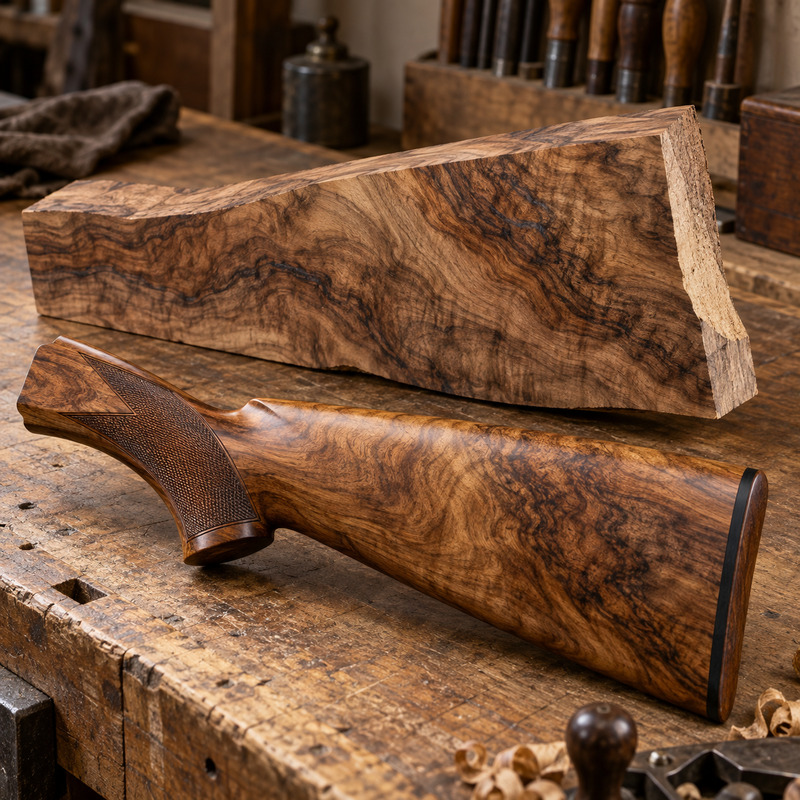
Turkish walnut is one of the most prized woods for making high-quality rifle and carbine stocks. Sought after for its combination of strength, elasticity, stability, and beautiful grain, it is traditionally used in European and international arquebusiers.
This term generally refers to the wood of Juglans regia, native to Turkey and neighboring regions. It is the same botanical species known as European walnut, Persian walnut, or English walnut. However, the wood's characteristics can vary significantly depending on the growing region, the age of the tree, the soil, the climate, and the part of the trunk from which the piece is obtained.
Botanical and geographical origin
Juglans regia is a species widespread from western and central Asia to southeastern Europe. Turkey is within its natural range and has long been one of the most important regions for the production of wood for stocks.
Trees grown slowly in dry, rocky, mountainous terrain can develop dense grain, deep colors, and very pronounced veining. However, not all Turkish production exhibits the same qualities: alongside exceptional pieces, there are common planks with straight grain and limited aesthetic value.
Geographical origin alone does not guarantee quality. A rough piece must be evaluated individually, considering:
- fiber orientation and continuity;
- density and compactness;
- degree of seasoning;
- absence of cracks and hidden defects;
- arrangement of the grain in the future handle;
- color and contrast of the design;
- useful dimensions of the piece.
Why Turkish walnut is suitable for stocks
A stock must withstand recoil, firing vibrations, environmental changes, and stresses concentrated at points of contact with the action. The wood must be sufficiently durable, but also workable with precision.
Turkish walnut has a particularly favorable set of properties:
- good mechanical resistance in relation to weight;
- elasticity useful in absorbing stresses;
- dimensional stability after proper seasoning;
- good workability manual and mechanical;
- ability to receive fine knurling and clean cuts;
- excellent response to oil finishes;
- great variety of colors and decorative figures.
Its density is not constant and can vary from tree to tree. In terms of magnitude, dried wood often lies around 0,50–0,65 g/cm³ . However, pieces intended for weapons are selected based on their actual characteristics and not just an average value for the species.
Color and grain
The heartwood of Turkish walnut can exhibit shades ranging from honey, golden brown, warm brown, and very dark brown. The most spectacular rough specimens may feature black streaks, red veins, copper highlights, and deep color variations.
The most sought-after aesthetic figures include:
- flamed grain: wavy design similar to tongues of flame;
- marbling: irregular alternation of light and dark areas;
- feather grain: symmetrical figure reminiscent of an open feather;
- wink: small knots or circular figures distributed in the wood;
- root: complex and lively design coming from the basal or root areas;
- mineral structure: thin dark lines running through the heartwood.
A striking grain pattern doesn't automatically equate to greater strength. When building a stock, beauty must be compatible with the correct orientation of the fibers, especially in the most stressed areas.
Importance of fiber direction
The most delicate part of a rifle stock is generally the grip neck , where the cross-section narrows and recoil stresses are concentrated. In this area, the fibers should follow the shape of the stock longitudinally and continue without interruption towards the receiver or action.
A grain that runs obliquely across the neck can create a weak point, even if the design appears highly decorative. For this reason, the rough piece must be examined on both sides, at the edges and the ends, trying to reconstruct the three-dimensional pattern of the grain.
Greater aesthetic freedom is possible in the rear blade. However, when it comes to the grip and the mechanical housings, structural continuity must take precedence over appearance.
Turkish walnut root
Burl features irregular grains and highly complex patterns, originating in growth areas near the roots or in specific outgrowths of the trunk. It is highly prized for its aesthetic value, but requires careful selection.
Highly twisted grain can offer an exceptional design, but it can also hide inclusions, small cavities, internal stresses, and discontinuities. A burl blank intended for a stock must therefore be sufficiently compact and have well-arranged grain in the neck area.
Not all high-quality Turkish walnut is burl, and not all burl is suitable for stock construction. The term should not be used as an automatic synonym for superior quality.
Cutting of rough materials
The trunk and the base of the tree are divided into stock roughs , also called roughs or blanks. The dimensions across the wood must take into account the future shape of the stock and the direction of the grain.
For a break-action shotgun, two elements are normally selected:
- the raw material intended for football;
- the piece intended for the forend.
In higher-quality sets, the two elements are chosen with a view to achieving good continuity in color and grain. A rifle with a one-piece stock requires a longer blank, capable of including the buttstock, grip, and fore-end.
The cut can be oriented to prioritize stability, strength, or aesthetic design. The best choice often represents a compromise between these three aspects.
Walnut seasoning
Freshly cut wood contains a high amount of moisture and cannot be processed immediately. It must undergo controlled seasoning , during which the water is gradually eliminated without causing warping or cracking.
Natural curing requires extensive time and suitable environmental conditions. The raw pieces are protected from sun and rain, separated by strips, and left in a ventilated area. The ends may be sealed to slow moisture loss and reduce the risk of cracking.
Artificial kiln drying allows for temperature, humidity, and air circulation to be controlled, but it must be performed with cycles suited to the thickness and characteristics of the wood. Drying too quickly can cause:
- superficial or internal cracks;
- deformations;
- residual stresses;
- collapse of wood cells;
- differences in humidity between the surface and the core of the piece.
Before final processing, the rough wood must reach a humidity level compatible with the environment in which it will be used. Even seasoned wood can continue to exchange moisture with the atmosphere, slightly altering its dimensions.
Commercial classification
Walnut blanks are often divided into grades indicated by terms such as standard, select, deluxe, exhibition, or by a variable number of stars. However, there is no universal classification system valid for all producers.
The commercial valuation generally takes into account:
- intensity and complexity of the grain;
- color contrast;
- presence of the figure on both sides;
- continuity of the fiber in the neck;
- absence of defects;
- size and thickness of the rough;
- rarity of the drawing.
Two blanks belonging to the same commercial class can have very different characteristics. The choice should therefore be made by observing the actual piece and verifying its suitability for the weapon model.
Stock processing
Turkish walnut can be worked with cutters, chisels, rasps, and abrasives. The quality of its grain allows for precise surfaces, harmonious joins, and distinct knurls.
The making of a stock usually includes:
- tracing the shape on the blank;
- initial profile cut;
- action or receiver casing;
- shaping of the handle and blade;
- creation of the expected folds and deviations;
- progressive smoothing;
- knurling of the grip areas;
- protective treatment and finishing.
The fit must ensure proper contact between the wood and metal parts. Uneven fit can concentrate recoil in small areas and encourage cracks.
Oil finish
The oil finish is particularly popular because it enhances the depth, color and movement of the grain without necessarily creating a thick, artificial film.
Preparation involves carefully sanding and sealing the pores. Thin layers of product are then applied, allowing each layer the necessary time to penetrate and harden. The process can be repeated several times until the desired level of protection and shine is achieved.
A well-executed finish helps limit moisture absorption, but it doesn't make the wood completely waterproof. Internal surfaces, action housings, and areas covered by the butt plate must also be protected.
Turkish walnut and other types of walnut
Turkish walnut and Circassian walnut
The terms Turkish walnut and Circassian walnut are sometimes used interchangeably in the arms trade. Both can refer to Juglans regia from the area between Anatolia, the Caucasus, and neighboring regions.
"Circassian" is often a commercial term reserved for particularly figured pieces, but it doesn't necessarily identify a distinct botanical species. It's therefore more useful to evaluate the individual rough stone than to rely solely on the name.
Turkish walnut and European walnut
Both generally belong to the Juglans regia species. The differences depend primarily on the growing environment and selection. The Turkish walnut is known for its contrasting and vibrant grain, while some European walnuts may have more uniform colors or different shapes.
Turkish walnut and American walnut
American black walnut , Juglans nigra, belongs to a different species. It often has a fairly uniform brown color, is easy to work, and is widely available. It is used for numerous industrial and artisanal stocks.
Turkish walnut can offer more complex shapes and superior aesthetic value, especially in high-quality rough cuts. However, the structural quality depends on the individual piece and the correct grain direction.
Defects to check
Before purchasing or working on a rough stone it is necessary to check for the possible presence of:
- cracks at the ends;
- internal or grain cracks;
- unstable knots;
- bark included;
- cavities and spongy areas;
- traces of wood-boring insects;
- fungal stains;
- cross-fiber in the future handle;
- deformations due to irregular seasoning.
Lightly wetting the surface with alcohol or water can temporarily make the grain more visible, but it does not allow you to evaluate stability, seasoning and internal defects on your own.
Stock maintenance
After use in the rain, the stock should be dried slowly at room temperature. It should not be placed near stoves, radiators, or other heat sources, as rapid drying can cause shrinkage and cracking.
È consigliabile:
- remove water, mud and plant residues;
- avoid aggressive solvents on the finish;
- periodically check the areas near the frame or action;
- restore the oil finish when it appears dry or worn;
- store the weapon in a dry but not excessively hot environment;
- avoid prolonged stay in damp cases.
Benefits of Turkish walnut
- excellent ratio between strength, elasticity and weight;
- great variety of colors and grains;
- good stability after correct seasoning;
- workability suitable for artisanal creations;
- possibility of obtaining precise knurling;
- excellent response to oil finishes;
- high aesthetic value in fine weapons.
Limits of the Turkish walnut
- high cost of the most figured rough products;
- non-uniform quality between pieces of the same origin;
- possible defects hidden in the more lively roots;
- need for long and careful seasoning;
- sensitivity to humidity changes;
- risk of breakage if the fibre is oriented incorrectly in the neck;
- non-standardized trade classifications.
Final houghts
Turkish walnut is one of the most prestigious materials in gunmaking tradition. Its grain can transform a stock into a unique piece, but beauty requires proper seasoning, continuous grain, and precise socketing.
The value of a stock doesn't depend solely on the amount of visible grain or its brand name. A good stock is born from a balance between structural quality, grain orientation, stability, and aesthetic value . It is this combination, along with the craftsman's skill, that makes Turkish walnut particularly suitable for the finest hunting guns.