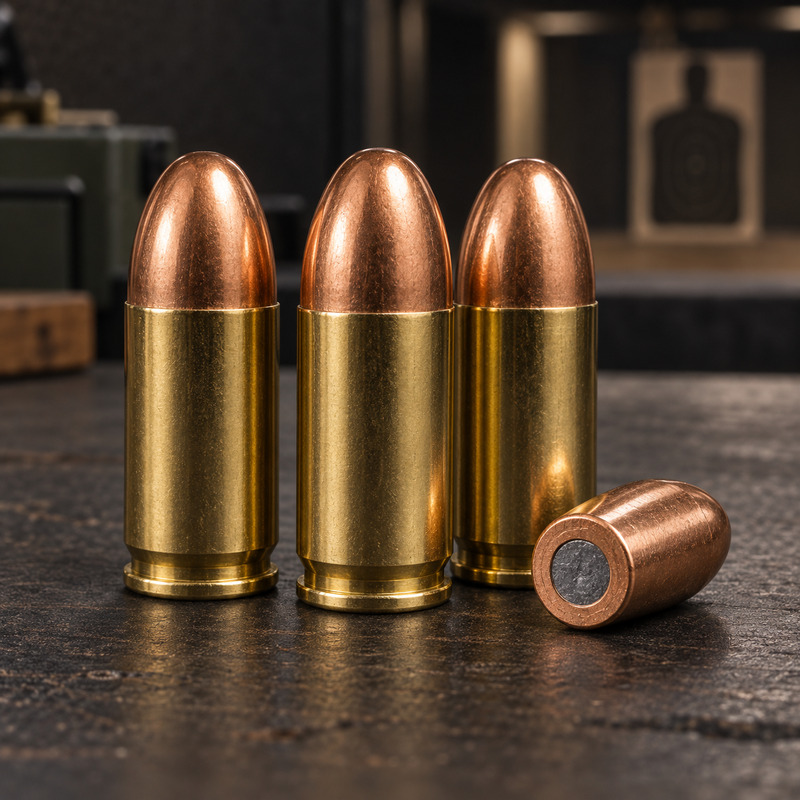
The acronym FMJ , which stands for Full Metal Jacket , identifies a bullet in which the front and lateral surfaces of the core are covered by a metal jacket . In Italian it is commonly referred to as a fully jacketed bullet or armored ball.
Although the term “full” may suggest total coverage, in traditional FMJs the jacket mainly envelops the nose cone and sides, while the base of the core may remain uncovered . When the base is also enclosed by the jacket, it is more properly called a TMJ, Total Metal Jacket , or completely encapsulated bullet.
How an FMJ bullet is constructed
An FMJ is generally composed of two main elements:
- un inner core, usually made of lead or lead alloy;
- a outer shirt harder, usually made of copper alloy.
The most commonly used material for the jacket is gilding metal , an alloy consisting primarily of copper with a smaller percentage of zinc. Jackets made of cupronickel or coated mild steel have also been used.
During production, the sleeve is obtained through successive drawing operations. The core is inserted inside the casing and the assembly is calibrated and shaped until the desired nose cone is obtained.
In traditional FMJ construction, the jacket is typically closed toward the nose. Consequently, the visible portion of the nose is completely coated, while the lead may remain exposed on the rear surface.
Why the FMJ Ball Was Developed
All-lead bullets have limitations when fired at the velocities typical of modern firearms. The relatively soft material can deform during feeding, leave deposits in the barrel, and fail to adequately withstand the stresses of pressure and rifling.
The metal jacket allows the ball to:
- tolerate higher speeds;
- take regular scratches;
- reduce lead deposits in the barrel;
- maintain its shape while feeding;
- resist the stresses of firing;
- ensure reliable operation in semi-automatic and automatic weapons.
Impact behavior
The FMJ bullet is not typically designed to produce controlled expansion. The closed jacket on the ogive hinders the core from opening and allows the bullet to retain much of its shape during penetration.
Compared to a Soft Point or Hollow Point hunting bullet, an FMJ therefore tends to:
- deform to a lesser extent;
- penetrate more deeply;
- produce a generally narrower connection;
- transfer a smaller portion of the energy into the first tissues crossed;
- present a higher risk of complete target penetration.
This doesn't mean that an FMJ always remains perfectly intact. Impact velocity, jacket thickness, bullet stability, and structures encountered can cause deformation, tipping, deflection, or fragmentation.
The acronym FMJ therefore describes the general construction of the bullet, but does not guarantee identical terminal behavior for all bullets.
FMJ Ball Shapes
FMJ bullets can be made with different profiles based on the caliber and intended use.
Round Nose
The Round Nose has a rounded ogive. It is widely used in pistol ammunition and in many historical military cartridges. The rounded shape generally favors consistent feeding.
Flat Nose
The Flat Nose has a flat front. It is mainly used in some pistol calibers and in cartridges intended for specific shooting disciplines.
Spitzer
The spitzer shape features a pointed, aerodynamic nose. It's typical of modern rifle ammunition and reduces air resistance compared to older, rounded bullets.
boat tail
In FMJ Boat Tails, the base of the bullet is tapered. This geometry improves aerodynamic efficiency and can increase the ballistic coefficient, especially at medium to long ranges.
The acronym FMJ-BT therefore indicates a fully jacketed bullet with a tapered base.
Main uses
FMJ ammunition is widely used in training and sport shooting . Its relatively simple construction generally allows for low costs and the production of large quantities of consistent, reliable ammunition.
The main areas of use include:
- training at the shooting range;
- recreational shooting;
- some sports disciplines;
- ordinary military ammunition;
- weapon function tests;
- loads where a particularly reliable power supply is required.
The smooth, lead-free surface on the ogive resists contact with feed ramps, magazines, and other firearm components well.
FMJ and hunting use
The FMJ bullet is generally not the right choice for normal ungulate hunting . Its limited deformation can result in poor energy transfer and a relatively narrow wound path, increasing the risk of injury and complete traversal of the game.
For hunting, bullets designed to expand in a controlled manner are normally preferred, such as:
- Soft Point;
- Hunting type Hollow Point;
- bonded;
- expansive monolithic;
- balls with a polymer tip and controlled structure.
The hunting use of FMJ ammunition may also be prohibited or limited by applicable regulations. Before using any ammunition, it is necessary to check national, regional, and specific regulations for the species being hunted.
Difference between FMJ and Soft Point
In FMJ, the shirt is closed at the front and may leave the base exposed. In Soft Point, the opposite is generally true: the shirt covers the sides and the base, leaving a portion of the core exposed at the tip.
The exposed lead of the Soft Point facilitates the initiation of deformation upon impact. The FMJ, on the other hand, tends to retain its profile more and penetrate without intentionally programmed expansion.
Difference between FMJ and Hollow Point
The Hollow Point bullet features a cavity in the front. In versions intended for hunting or defense, this cavity promotes the expansion of the bullet.
The FMJ, on the other hand, has a closed, jacketed ogive. It typically provides consistent feeding and high penetration, but does not produce the controlled expansion typical of hollow points designed for terminal use.
It should be remembered, however, that some competition balls have a small cavity resulting from the manufacturing process and are not designed to expand.
Difference between FMJ and TMJ
In traditional FMJ, the base of the core can remain exposed to the gases produced by the powder combustion. In TMJ (Total Metal Jacket), however, the core is completely enclosed by metal, including the rear surface.
Full coverage can reduce the vaporization and dispersion of lead particles generated by the base's exposure to incandescent gases. This feature is particularly valuable in closed ranges, where controlling airborne contaminants is important.
The TMJ designation can include different manufacturing techniques, including full jacketing or electrochemical coating deposition. It is therefore advisable to check the construction declared by the manufacturer.
FMJ and copper ball
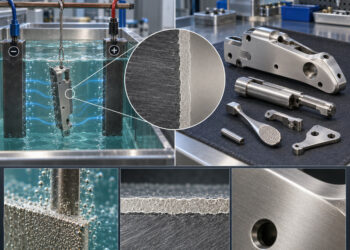
A copper-plated or plated bullet isn't necessarily a true FMJ. In traditional jacketed bullets, the coating is produced separately and then bonded to the core. In copper-plated bullets, however, a layer of copper is deposited directly on the surface of the core.
The electroplated coating may be thinner than a conventional jacket and may require specific speed and crimp limits specified by the manufacturer.
FMJ does not mean piercing
The FMJ bullet is sometimes mistakenly identified as an armor-piercing projectile. In reality, the acronym simply describes the presence of a metal jacket around the core.
A standard FMJ typically has a lead core. An armor-piercing bullet, on the other hand, uses materials, structures, and cores specifically designed to penetrate armor or resistant targets. The two classifications are not equivalent.
FMJ and precision
FMJ bullets can offer good accuracy, especially at ordinary distances, but the acronym does not automatically indicate a match-level construction.
In traditional FMJ bullets, the open base can be less uniform than the carefully formed base of some competition bullets. Because gases act on the base as it exits the barrel, any irregularities can affect the bullet's initial stability.
However, there are FMJs made to high production standards and capable of excellent performance. Accuracy depends on the uniformity of the jacket, the concentricity of the core, the geometry of the base, and compatibility with the weapon, chamber, and rifling.
Advantages of FMJ bullets
- generally reliable power supply;
- good resistance to deformation during handling;
- ability to reach high speeds;
- reduced contact of the lead with the barrel;
- normally low costs;
- wide availability of calibers and loads;
- good uniformity for training and recreational shooting.
FMJ Bullet Limitations
- absence of controlled terminal expansion;
- high chance of completely passing through the target;
- generally limited suitability for hunting ungulates;
- possible lead exposure at the base;
- accuracy not necessarily equivalent to that of a match ball;
- possible deposits of copper or other jacket material in the barrel.
Final houghts
FMJ – Full Metal Jacket is one of the most common constructions in modern ammunition. The metal jacket protects the core, allows for high velocities, and ensures reliable feeding, making these bullets particularly suitable for training, recreational shooting, and numerous military applications.
However, the limited expansion capacity represents a significant limitation in hunting use. The choice should not be based solely on weight and caliber, but also on the bullet's structure and the required terminal behavior.