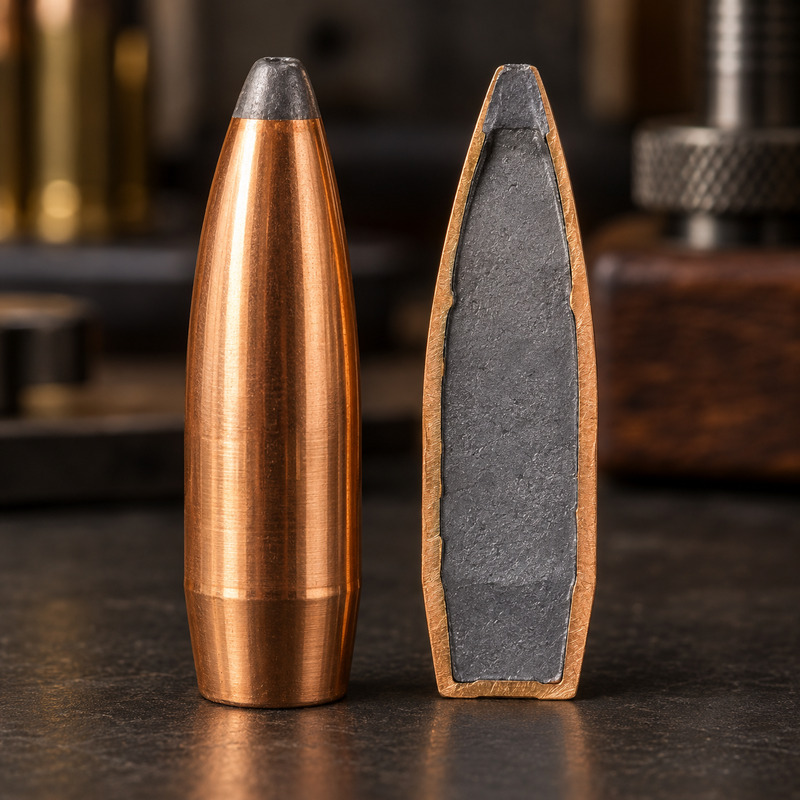
The jacket is the metal covering that completely or partially envelops the core of a bullet. This casing, called a jacket , separates the core from the barrel, protects the bullet during feeding, and affects its ballistic and terminal behavior.
The jacket should not be considered a simple protective covering. Its thickness, hardness, shape, and connection to the core determine the bullet's ability to withstand the stresses of firing, engage the rifling correctly, expand, and penetrate.
Why is the shirting used?
All-lead bullets are relatively soft. When propelled at high velocities, they can deform, leaving residue in the barrel, and not adequately withstand the pressure exerted by gases and rifling.
The metal shirt allows you to:
- protect the core during firing;
- limit lead deposits in the barrel;
- withstand higher speeds and pressures;
- promote a regular grip of the grooves;
- maintain the aerodynamic shape of the projectile;
- improve uniformity and accuracy;
- control expansion, fragmentation and penetration;
- protect the ball during feeding, transport and handling.
The materials used
The most common material is gilding metal , an alloy composed primarily of copper with a smaller percentage of zinc. This alloy offers a good balance of ductility, mechanical strength, and the ability to conform to rifling without causing excessive barrel wear.
Over time, other materials have also been used:
- almost pure copper;
- cupronickel;
- mild steel coated with copper or other alloys;
- copper and zinc alloys with different compositions.
Cupronickel was widely used in historical military ammunition, but it could produce stubborn deposits in the barrel. Clad steel jackets were used primarily to reduce copper consumption and production costs.
How the shirt is made
The traditional shirt is generally made from a metal disc. Through successive pressing and drawing operations , the disc is transformed into a small cup and then stretched until it reaches the desired shape and thickness.
The core, usually made of lead or a lead alloy, is inserted inside the jacket. The assembly is then calibrated and shaped using high-precision dies.
The main production phases include:
- metal disc blanking;
- cup formation;
- shirt drawing and lengthening;
- trimming to the intended length;
- insertion of the nucleus;
- formation of the ogive and the tip;
- final diameter calibration.
Even minimal variations in jacket thickness or concentricity can compromise the dynamic balance of the bullet and negatively impact accuracy.
Shirt with constant or differentiated thickness
The jacket can maintain a relatively uniform thickness or have a variable thickness . In many hunting bullets, it is thinner at the front and progressively thicker towards the base.
The thinner front portion facilitates expansion, while the stronger rear portion helps retain a portion of the core and ensure adequate penetration.
Some shirts also have:
- internal grooves that guide the opening;
- sectors of different thickness;
- rings or constrictions that hold the nucleus;
- internal partitions that separate the front section from the rear section;
- incisions on the tip to make the expansion more regular.
Total and partial lining
FMJ – Full Metal Jacket
In FMJ bullets , the jacket covers the ogive and the sides of the core, while the base can remain exposed. This configuration limits deformation and facilitates feeding in semi-automatic weapons.
FMJ bullets are primarily used in training, target shooting, and military ammunition. Since they are generally not designed to expand, their use in hunting may be prohibited or unsuitable depending on regulations and the game being hunted.
TMJ – Total Metal Jacket
TMJ bullets feature a jacket that also encloses the base of the core. This complete coating reduces the lead's exposure to incandescent gases and can reduce the dispersion of lead particles into the shooting environment.
Softpoints
In Soft Point bullets , the jacket leaves a portion of lead exposed at the tip. Upon impact, the exposed lead begins to deform and favors the jacket's opening.
The thickness of the cladding and the hardness of the core determine the speed and extent of expansion.
Hollow Point
Hollow Point bullets feature a cavity in the front. In hunting versions, the cavity promotes expansion, while in competition bullets it may be a result of the manufacturing process and is primarily intended to improve consistency and accuracy.
The presence of a hollow point does not therefore automatically guarantee that the bullet is designed to expand on game.
Bonded jacket
In conventional bullets, the core is inserted into the jacket, but the two components remain physically separable. During a violent impact, the lead can detach from the jacket, causing severe fragmentation and a reduction in residual mass.
In bonded balls , the core is joined to the jacket using chemical, thermal, electrochemical, or mechanical processes. The goal is to hold the two elements together during expansion.
A bonded ball generally offers:
- increased weight retention;
- less separation between core and jacket;
- deeper penetration;
- more controlled behavior on bones and resistant tissues;
- greater reliability at high impact velocities.
This construction is particularly appreciated when hunting robust game and in situations where it is necessary to cross important bony structures.
Jacketing and terminal behavior
The jacket controls how the bullet reacts on impact. A thin jacket tends to promote rapid expansion, while a thicker, stronger structure slows deformation and increases penetration.
The actual behavior depends on a combination of several elements:
- impact speed;
- thickness and hardness of the shirt;
- tip shape;
- presence of cavities or incisions;
- core hardness;
- possible welding between jacket and core;
- type of tissue or bone structure encountered.
The same ball can expand violently at a short distance, when the velocity is high, and deform much less at a greater distance. Therefore, it is important to respect the velocity range indicated by the manufacturer.
Shirting and precision
A uniform, concentric jacket keeps the bullet's center of gravity properly aligned with its geometric axis. Differences in thickness can create imbalances that, during rotation, cause dispersion on the target.
In precision shooting balls, the following are therefore checked with particular attention:
- uniformity of thickness;
- concentricity of the shirt;
- regularity of the base;
- shape of the ogive;
- core distribution;
- overall weight consistency.
The quality of the jacket is one of the factors that distinguishes an ordinary bullet from a bullet intended for high-precision shooting.
Jacketing and deposits in the barrel
During firing, the jacket is compressed against the walls of the barrel and is scored by the rifling. Friction can leave small deposits of copper or metal alloy, commonly referred to as fouling.
Excessive buildup can alter friction, increase pressure, and reduce accuracy. Deposit formation depends on the jacket material, the internal finish of the barrel, velocity, pressure, and number of rounds fired.
Cleaning must be performed with products and procedures compatible with the material and finish of the barrel.
Difference between jacketing, copper plating and monolithic ball
The jacketed ball has a separate core enclosed in a separately manufactured metal casing. In the copper-plated ball , however, a layer of copper is deposited directly on the core, generally through an electrochemical process.
The copper jacket is typically thinner than a traditional jacket and may have specific speed and crimp limitations.
The monolithic ball does not have a separate jacket: it is made entirely of copper or another metal alloy. Therefore, separation between the core and the jacket cannot occur, but its behavior depends on the tip geometry, the expansion cavities, and the material characteristics.
Final houghts
The bullet jacket is an essential component in modern ammunition design. It not only protects the core, but also determines accuracy, resistance to stress, interaction with the rifling, and impact behavior.
To correctly evaluate a bullet, it is therefore not enough to know its weight and caliber. It is also necessary to consider the material, thickness, and geometry of the jacket, its connection to the core, and the velocity range for which the projectile was designed.